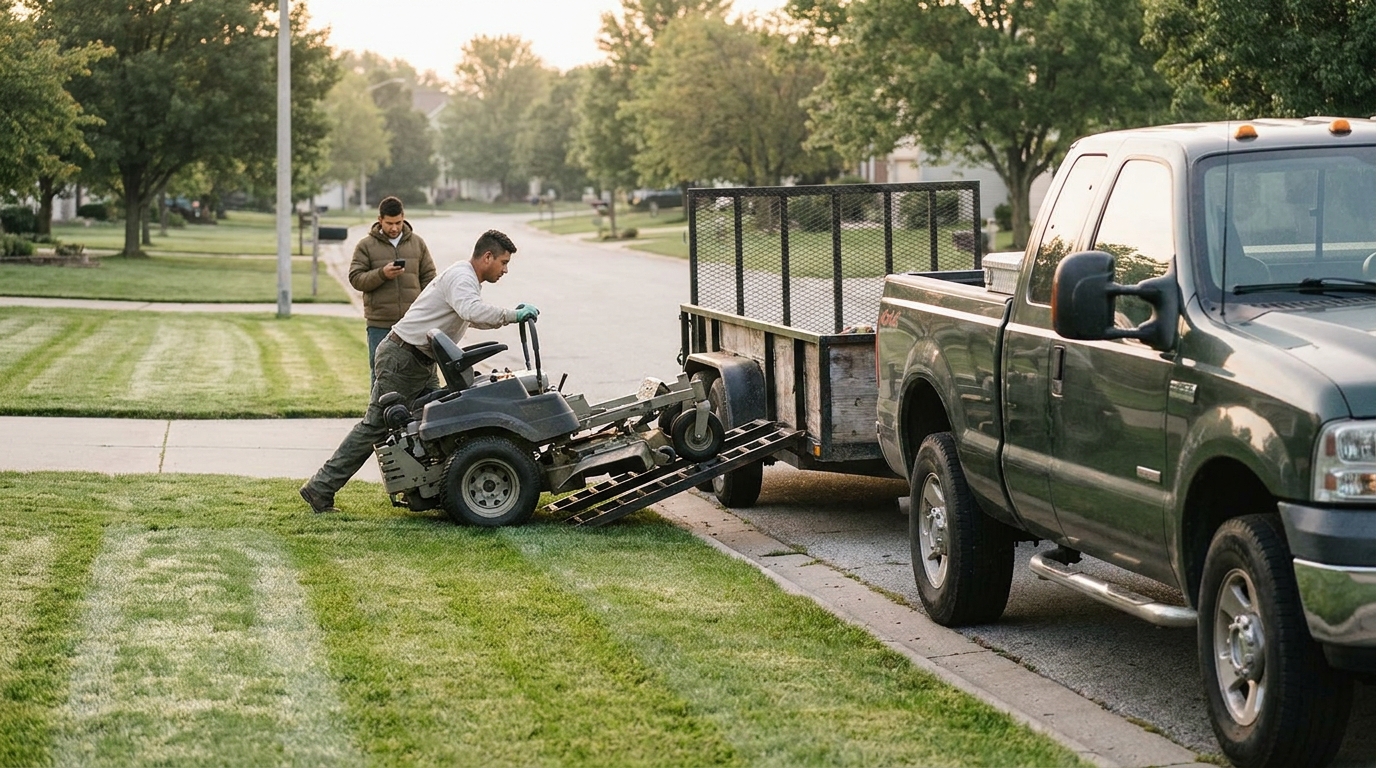
Every lawn care business equipment list on the internet answers a question you already know the answer to. Mower. Trimmer. Blower. Trailer. Gas cans. What none of them tell you is what that equipment costs to own — per season, per engine hour, per lawn — and that is the only version of the question that changes a decision.
So here is the arithmetic instead. Real prices read off a manufacturer's own site on August 14, 2026. The warranty hours that quietly decide which machine is actually the cheap one. Fuel at this week's published pump price. The tax treatment straight out of IRS Publication 946. And the payback, counted in cuts. Where a number is my assumption rather than a fact, I say so in the line where it appears.
One equipment line is about to stop being a preference and start being a rule, and the sticker price is not where the money is. Read on the same day from one manufacturer: the flagship gas backpack blower lists at $749.99, complete. The battery backpack from the same maker also lists at $749.99 - and that is the bare tool, with no way to turn it on until you add a $1,390.99 backpack battery. For 2.85 times the money you get 26 N of blowing force against 41 N, which is 36.6% less. The full conversion cost, priced per crew.
One item that does not belong on the trailer year-round is the blowout compressor. The trade guidance is 20-50 CFM at a regulated 50 psi (K-Rain, VMAC); the high-volume operators tow a 185 CFM diesel, and in 2026 that rents for about $165 a day, $550 a week or $1,612 for four weeks from the big rental houses. A three-week window is a rental, not a purchase, until the machine has a second job. Sizing the compressor and pricing the stop.
If the fall cleanup route is going to carry gutters, the list gains one ladder and one decision. The ladder is a 28-foot Type IA aluminum extension - Werner's D1528-2 is $501 at Home Depot and close to 60 lb - plus a stand-off bracket, a scoop and a bucket hook: under $700 to start. The decision is the ground-operated gutter vacuum, $3,079 for a SkyVac 85 Elite before the generator or $6,399 for the gas Interceptor, which takes the ladder out of a two-story job and saves about $35-$40 of labour on each one - so it needs 100 to 115 two-story jobs to pay back. Rent it the first fall. The gutter equipment list and the vacuum payback, worked.
What the ranking equipment lists say a mower costs
I read the guides currently ranking for this search and pulled every price on them. Here is what they publish for the one machine that dominates the budget.
| Source | Dated | Zero-turn / riding mower price |
|---|---|---|
| GorillaDesk equipment list | no date shown | $3,000, with a stated range of $1,000–$5,000 |
| Insurance Canopy checklist | updated Jan 14, 2026 | Zero-turn $3,000–$10,000; ride-on $1,200–$4,500 |
| Spyker equipment guide | Nov 19, 2018 | Riding mower $1,000–$5,000; push mower $200–$1,000 |
Now here is Exmark's own published price list, read the morning this article went up. Not a review, not an estimate — the manufacturer's cash price on its own product pages.
| Machine | Cash price | Advertised monthly |
|---|---|---|
| Radius E-Series | $6,699 | $135/mo |
| Radius S-Series (starting) | $7,199 | $145/mo |
| Radius S-Series, 60" deck, Kawasaki FR730 | $8,499 | $171/mo |
| Radius X-Series | $9,999 | $201/mo |
| Lazer Z E-Series | $11,299 | $212/mo |
| Lazer Z S-Series | $13,899 | $278/mo |
| Lazer Z X-Series | $16,699 | $333/mo |
| Lazer Z Diesel | $28,099 | $559/mo |
| Lazer Z V-Series | $40,499 | $804/mo |
Read those two tables against each other. The cheapest zero-turn this manufacturer sells costs $6,699 — which is $1,699 above the top of the range two of the three ranking guides publish. Their numbers are not wrong about machines that exist; they are describing the homeowner aisle and filing it under "business." And inside the one manufacturer's own commercial line there is a six-fold spread, $6,699 to $40,499, every unit of it sold as commercial equipment.
One smaller trap in the same table: the S-Series "starts" at $7,199, but the 60-inch deck with the Kawasaki FR730 — the configuration a route operator would actually buy — is $8,499. The starting price is a 48-inch machine. That is $1,300 of difference between the number in the ad and the number on the invoice.
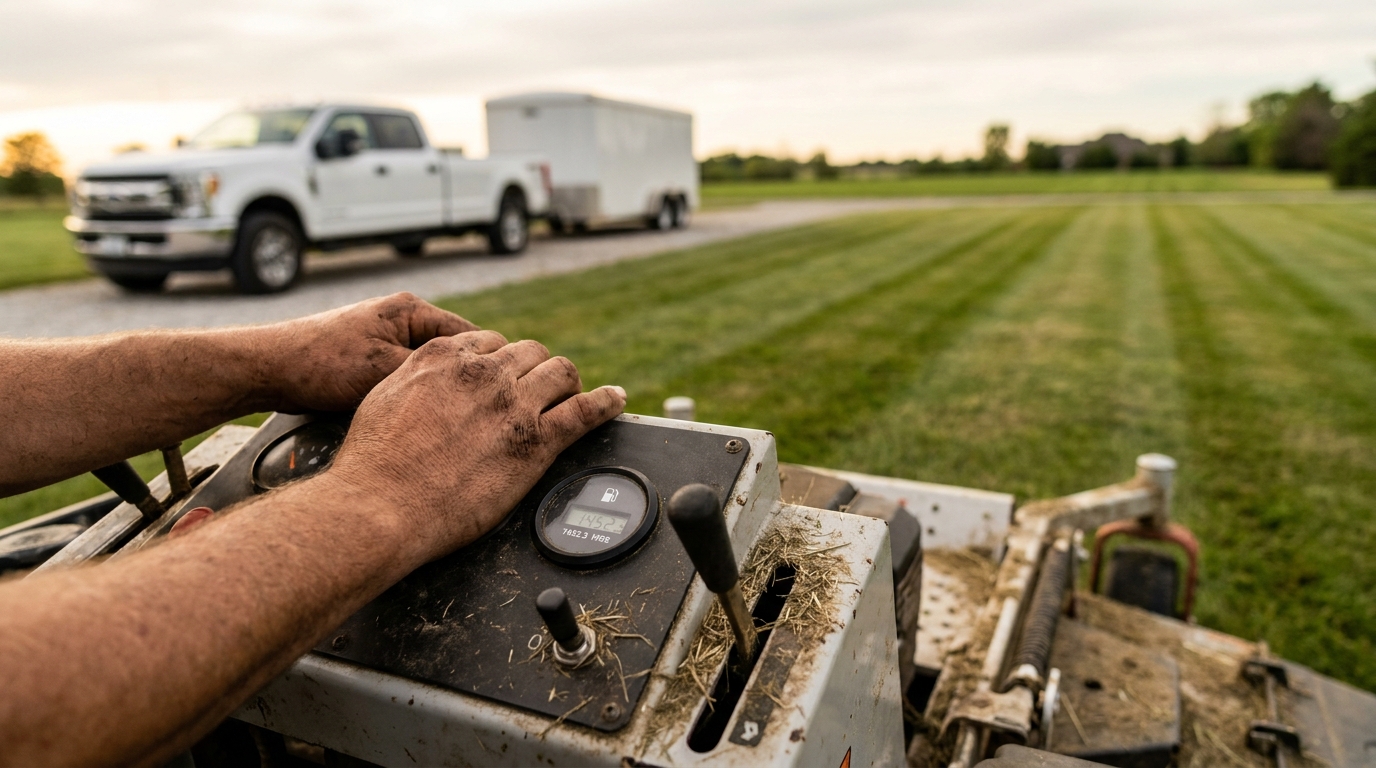
The number that decides which machine is cheap, and it is not the price
Commercial mower warranties are not written in years. They are written in years or hours, whichever comes first, and the hours are the part that binds. Exmark's own launch announcement for the redesigned Radius line (October 18, 2022) states the tiers plainly: 4 years or 500 hours on E-Series, 4 years or 750 hours on S-Series, 4 years or 1,000 hours on X-Series.
Worth flagging honestly, because it matters and nobody else will tell you: the live product page today for the 60-inch S-Series describes an "extended 4-year/500-hour commercial warranty" — 500 hours, not the 750 in the company's own press release. Warranty terms are model-year specific, and this is the proof that you cannot take the number from an article, including this one. Read the sheet for the exact machine, in the year you are buying it.
Now put your route through it. This site's standing example book is 60 weekly clients at $52 a cut across a 32-week season — 1,920 cuts and $99,840 of recurring mowing revenue. The variable is how long the mower's engine actually runs per stop, which is yours to measure, so here it is at three rates.
| Mower hours per stop | Engine hours per season | 500-hr warranty lasts | 750-hr | 1,000-hr |
|---|---|---|---|---|
| 0.20 (12 min) | 384 | 1.30 seasons | 1.95 | 2.60 |
| 0.25 (15 min) | 480 | 1.04 seasons | 1.56 | 2.08 |
| 0.35 (21 min) | 672 | 0.74 seasons | 1.12 | 1.49 |
At the middle rate, a 500-hour warranty expires almost exactly at the end of your first season. The "4 years" on the sticker is decoration for anyone running a real book. Push the route a little harder and the machine is out of warranty before the leaves turn.
Which produces the finding this whole article is built on. If the warranty hours are what you are actually buying, price them that way:
| Machine | Cash price | Warranty hours | Cost per warranted hour |
|---|---|---|---|
| Radius X-Series | $9,999 | 1,000 | $10.00 |
| Radius E-Series | $6,699 | 500 | $13.40 |
| Radius S-Series, 60" | $8,499 | 500 (per current model page) | $17.00 |
The cheapest machine has the most expensive hours. The X-Series costs $3,300 more than the E-Series and carries twice the warranted hours, so it is 25% cheaper on the only unit that matters to a business. That is not a sales argument for the expensive machine — it is an argument for buying hours instead of buying price tags, and for checking the hour limit before you check the sticker.
What the mower actually costs per lawn
Two honest numbers here, because they answer two different questions and conflating them is how people end up believing their equipment is free.
The first is cost per warranted hour, above: what an hour of manufacturer-backed coverage costs. The second is cost per hour of service life, which needs a service-life figure, and here I have to be careful. Exmark does not publish an expected engine life. The commonly cited operator figure for a well-maintained commercial air-cooled V-twin is roughly 2,500 hours, with a technician quoted in one discussion putting Kawasaki nearer 2,000 before major work and Kohler lower. That is operator lore, not a manufacturer specification, and I am flagging it as an assumption rather than laundering it into a fact. Substitute your own if you have real machines and real hour meters.
| Machine | Per cut, warranty basis | Per cut, 2,500-hour life | As % of a $52 cut |
|---|---|---|---|
| Radius E-Series | $3.35 | $0.67 | 1.3% |
| Radius S-Series 60" | $4.25 | $0.85 | 1.6% |
| Radius X-Series | $2.50 | $1.00 | 1.9% |
All at 0.25 engine hours per stop. And there is the answer nobody publishes: on a service-life basis the machine is well under two dollars a lawn, one to two percent of the ticket. The mower is not what makes a route unprofitable. Something else is.
Fuel costs more per lawn than the mower does
The EIA's weekly retail series for August 10, 2026 puts U.S. regular gasoline at $4.006 a gallon and on-highway diesel at $5.257, both including taxes. Consumption is machine and load specific and I am not going to invent a spec, so here is the band as your input:
| Burn rate | Fuel per engine hour | Fuel per cut (0.25 hr) |
|---|---|---|
| 1.50 gal/hr | $6.01 | $1.50 |
| 1.75 gal/hr | $7.01 | $1.75 |
| 2.00 gal/hr | $8.01 | $2.00 |
Against $0.85 of machine per cut on the S-Series, fuel runs roughly two to two and a half times the cost of the mower itself — and that is before the truck burns a drop getting there. Every equipment list on this search result prices the asset and ignores the consumable that outspends it inside a single season. On the standing book, 480 engine hours at $7.01 is $3,365 of mower fuel a year, which is a bigger line than most of the machines on the shopping list.
The obvious follow-up is the $28,099 diesel, and I am deliberately not going to resolve it for you. Diesel costs 31% more per gallon at this week's prices and diesel engines burn meaningfully fewer gallons per hour under load, and I do not have first-party consumption figures for either machine. Anyone who tells you which way that trade lands without those two numbers is guessing.
The financing page, and the number it does not print
Look again at that first price table. The manufacturer leads with the monthly payment — "$135.00/Mo" is presented as the starting price of a Radius E-Series — and the terms are given as 60 months including a $150 promo fee. What is not on the page, anywhere, is an APR. So here it is, derived from the two numbers the company does publish.
| Machine | Cash | 60 payments total | Premium over cash | Implied APR |
|---|---|---|---|---|
| Radius E-Series | $6,699 | $8,100 | +$1,401 (20.9%) | 7.7% |
| Radius S-Series 60" | $8,499 | $10,260 | +$1,761 (20.7%) | 7.7% |
| Radius X-Series | $9,999 | $12,060 | +$2,061 (20.6%) | 7.6% |
| Lazer Z E-Series | $11,299 | $12,720 | +$1,421 (12.6%) | 4.8% |
| Lazer Z S-Series | $13,899 | $16,680 | +$2,781 (20.0%) | 7.4% |
| Lazer Z X-Series | $16,699 | $19,980 | +$3,281 (19.6%) | 7.3% |
| Lazer Z Diesel | $28,099 | $33,540 | +$5,441 (19.4%) | 7.2% |
| Lazer Z V-Series | $40,499 | $48,240 | +$7,741 (19.1%) | 7.1% |
Two things fall out of that table that you cannot see on the site. First, financing costs about a fifth of the machine — a fact worth knowing before you sign, and not a scandal. Second, and stranger: the implied rate is not the same across the line. Seven of eight sit between 7.1% and 7.7%. The Lazer Z E-Series sits at 4.8%. A buyer comparing $201 a month against $212 a month would conclude the Lazer Z costs $11 more; in fact it is a $4,600 more expensive machine being offered on visibly cheaper money.
The honest counterweight, because this is where articles like this usually overreach. Spread that $1,761 of interest across the cuts it will do — 1,920 a season, 9,600 over the note — and it is 18 cents a lawn. Cash versus financing is a real decision about your cash position, and it is worth about a fifth of what the warranty-hours decision is worth. Do not spend a week on the 18 cents and five minutes on the hour limit.
One more thing that only shows up when you put the two halves together. A 60-month note on a machine with roughly 2,500 hours of life in it, run at 480 hours a season, reaches 2,400 hours in month 60. You finish paying for the mower at about the same moment you finish the mower. Run a heavier book than the standing 60 clients and the note outlives the machine.
The lines an equipment list never includes
Here is where the guides get vague, and where the money actually is. Two of them disagree with each other by five times on the same line item.
| Line | What the guides publish | Comment |
|---|---|---|
| Trailer | $1,000–$3,000 (Insurance Canopy) vs $5,000 (GorillaDesk) | A 5x disagreement between two pages on the same search result |
| Truck | $15,000–$60,000 (GorillaDesk) | The largest line on the list by far, published as a 4x range and analysed by nobody |
| Handhelds (trimmer, edger, blower, hedge trimmer) | $750–$1,300 combined | Insurance Canopy's 2026 ranges, summed |
| Insurance | not on any equipment list | ~$5,541 a year on this same book — see the insurance breakdown |
| Licensing | not on any equipment list | ~$450 first year in Florida — see the licensing guide |
| Software | $49/mo (GorillaDesk, quoting itself) | The only recurring line any of them price |
Add the equipment a route operator actually needs — the $8,499 mower, about $1,000 of handhelds, a $2,000 trailer — and you have $11,499 of kit against $99,840 of season revenue, or 11.5%. That ratio is the number to carry around. It is also why the truck line matters more than any of it: a $40,000 truck is nearly four times the entire mowing kit, and not one page on this search result treats it as a financial decision.
If you want the full picture of what the non-equipment side costs, the two big ones have their own worked breakdowns: what lawn care business insurance really costs and which licenses you actually need. Both are costed on this same 60-client book so the numbers stack.
The tax treatment, done properly
Every equipment article eventually says "you can write it off with Section 179." Most of them stop there, which is where the useful part starts.
Per IRS Publication 946, for tax years beginning in 2026 the maximum Section 179 deduction is $2,560,000, reduced dollar-for-dollar once you place more than $4,090,000 of qualifying property in service. For a lawn crew buying an $8,499 mower, those limits are irrelevant — and quoting them, as the internet loves to, tells you nothing.
The limit that actually binds is the business income limit. Publication 946 states the deduction "cannot exceed the taxable income for the tax year that is attributable to the active conduct of any trade or business." If your first year is a loss, Section 179 does not rescue it; the disallowed amount carries forward to the next tax year and is treated as Section 179 property placed in service then.
The special depreciation allowance — bonus depreciation — is a different tool, and Publication 946 does not put a taxable-income limit on it. It currently runs at 100% for qualified property acquired and placed in service after January 19, 2025. So the practical distinction the shopping lists never make: in a profitable year the two get you to a similar place; in a loss year Section 179 waits and bonus depreciation does not. Which is the right lever is a conversation with your accountant, not with a blog. The rest of the deduction landscape is in our landscaper tax deductions guide, and the bookkeeping that has to exist underneath it is in the bookkeeping walkthrough. None of this is tax advice.

Payback, counted in cuts
If the machine is going into a funding request rather than a purchase order, these prices are the largest sourced line in the financial section of a startup plan, alongside the truck that dwarfs it.
At $52 a cut and the 45% gross margin worked through in our profit margin breakdown, every cut contributes $23.40 toward fixed costs. So:
| Machine | Cuts to pay for itself | Weeks on a 60-client book |
|---|---|---|
| Radius E-Series, $6,699 | 287 | 4.8 |
| Radius S-Series 60", $8,499 | 364 | 6.1 |
| Radius X-Series, $9,999 | 428 | 7.1 |
Under two months of a full book pays for the most expensive machine on that list. Financed, the $171 payment is covered by 7.3 cuts a month — roughly two clients out of sixty. This is the same shape as the machine economics in the aeration pricing guide, where a $6,000 aerator pays for itself in 228 jobs: on a route with real density, equipment is rarely the constraint. The constraint is the route. A machine sized for 60 clients and pointed at 22 of them is the actual way operators go broke buying equipment, and no equipment list can warn you about it because the list does not know your book.
Which is the honest reason to read this next: filling the machine is a harder problem than choosing it. Ours are the customer acquisition playbook and the costed flyer campaign.
Two kits, and the threshold between them
GorillaDesk's own advice is that you can start with "a vehicle, mower, string trimmer, and two gas cans" — and at their prices that is a push mower at $350, a trimmer at $150, a blower at $150 and $50 of cans: $700 of equipment. That advice is correct, and it is correct for exactly as long as your hours stay low.
| Starter kit | Route kit | |
|---|---|---|
| Equipment | ~$700 | ~$11,499 |
| Realistic weekly clients | Under ~15 | 40–70 |
| Cost per cut, machine only | Pennies, but slow | $0.85 on service life |
| What actually fails first | Your hours | Nothing, if the route is full |
The crossover is not a feeling and it is not a revenue number. It is the mower's engine hours, which is the same variable the manufacturer prices its warranty in. A residential machine asked to do 480 hours a season is being asked to do roughly what a commercial machine's entire warranty covers — and it will tell you so, usually in July, usually on a Friday.
What Landscapey does and does not do here
Being straight about this, because a software company writing about equipment has an obvious incentive not to be.
| We do | We do not |
|---|---|
| Expense tracking with categories, so equipment purchases, fuel and repairs land somewhere | An asset register with purchase dates and serial numbers |
| Financials that show what a route actually earned against what it spent | Depreciation schedules or Section 179 elections |
| Job and route data, so you know how many stops a machine is doing | Engine-hour tracking or maintenance-interval reminders |
| QuickBooks sync, so the numbers reach your accountant unretyped | Dealer, financing or parts integrations of any kind |
If you want the fuel and repair lines separated from the mowing revenue they belong to, that is what the expenses and financials side is for, at $19.99 a month. If you want an equipment management system, buy an equipment management system.
Frequently asked questions
How much equipment do I need to start a lawn care business?
Less than the lists imply, at the beginning. A push mower, a string trimmer, a blower and a way to carry them is roughly $700 at the prices the ranking guides publish, and it is genuinely enough for a small number of weekly clients. The threshold to a commercial machine is engine hours, not pride: once your route is putting 400-plus hours a season through a mower, you are asking a residential machine to consume its entire life in under a year.
What does a commercial zero-turn mower cost in 2026?
On Exmark's own published pricing, $6,699 for the entry Radius E-Series up to $40,499 for the Lazer Z V-Series, with the 60-inch Radius S-Series that most route operators would actually buy at $8,499. Note that this is well above the $1,000–$5,000 ranges several popular equipment guides publish — those ranges describe residential machines.
Is it better to finance or pay cash for a mower?
Financing an $8,499 mower on the manufacturer's advertised 60-month terms costs $10,260, so $1,761 more than cash, an implied rate of about 7.7%. Spread across the 9,600 cuts that note covers on a 60-client book, that is 18 cents a lawn. It is a cash-flow decision, not a profitability one, and it matters far less than which warranty tier you buy.
How long does a commercial mower last?
Ask in engine hours, not years. The manufacturer will tell you what it expects: Exmark's Radius warranty tiers run 4 years or 500, 750 or 1,000 hours, whichever comes first. A 60-client route at 15 engine minutes per stop puts about 480 hours a season through a machine, so the entry tier's warranty is gone in roughly one season. Operators commonly report 2,000–2,500 hours of useful life on well-maintained commercial machines, but that is field experience rather than a published specification.
Can I write off lawn care equipment in the first year?
Usually, but the mechanism matters. Section 179's 2026 ceiling of $2,560,000 will never bind on a lawn crew; the business income limit will, because the deduction cannot exceed the taxable income from the active conduct of your business, and any excess carries forward. Bonus depreciation, currently 100% for property placed in service after January 19, 2025, does not carry that income limit. Talk to your accountant about which fits your year.
How much does equipment cost me per lawn?
Roughly $0.67 to $1.00 a cut for the mower on a 2,500-hour service life, or 1.3% to 1.9% of a $52 ticket. Fuel is the bigger line at $1.50 to $2.00 a cut. Both are dwarfed by labor, which is why the equipment decision is much less dangerous than it feels — and why a half-empty route is far more expensive than an over-specified mower.
Sources and limits
Machine prices, advertised monthly payments, financing terms and the current model-page warranty language are from Exmark's own website, read August 14, 2026. The Radius warranty tiers of 4 years or 500/750/1,000 hours are quoted from Exmark's press release of October 18, 2022, announcing the redesigned line; the live product page for the 60-inch S-Series today states 500 hours rather than 750, which is why the article says to read the sheet for your own model year rather than trusting any secondary source, this one included. Fuel prices are the U.S. Energy Information Administration's weekly retail series for August 10, 2026. Tax figures and the quoted limits are from IRS Publication 946.
Competitor equipment prices are quoted from the pages currently ranking for this search — GorillaDesk's lawn care equipment list, Insurance Canopy's checklist (updated January 14, 2026) and Spyker's guide (November 19, 2018) — and are reproduced as what they publish, not as verified market prices.
The 60-client book, the $52 cut, the 45% gross margin and the 32-week season are this site's standing example, not measurements of your business. The engine-hours-per-stop figure, the fuel burn rate and the 2,500-hour service life are stated assumptions, shown at multiple values with the arithmetic exposed so you can substitute your own. Implied APRs are derived from the manufacturer's published cash price and monthly payment over 60 months; the $150 promo fee is treated as included in the payment stream, and no APR is disclosed by the manufacturer. Nothing here is tax, legal or financial advice.
What I could not verify: fuel consumption for any specific machine, because no manufacturer publishes it in a form worth quoting; resale values, which vary too much by region to be useful; and current-model-year warranty terms beyond the one model page cited, which sit behind a model-selector form.
The reason this article is arithmetic instead of a shopping list is that the shopping list is the easy half. What decides whether the machine was a good idea is how many stops it does a week, and that is a number your own books should be telling you. Start a free trial and at least the route and the expenses will be written down in the same place. That test breaks down entirely for autonomous machines, which live on one lawn instead of riding the trailer — we ran the commercial robotic mower payback on first-party catalogue prices and found two units covering the same seven acres at $14,999.99 and $59,999.99.