The question "do I need a license to run a lawn care business" has a clean answer for the work most operators actually do, and a genuinely messy one the moment you add a service. The pages that rank for it are mostly written by companies selling insurance, software, or leads, and between them they give you almost no numbers you can act on.
This is the version with the numbers in it: what the four different things people call "a license" actually are, the dollar thresholds that decide whether you need one, the certification that sounds like it covers lawn spraying and explicitly does not, and what the whole compliance line costs against the other two bills every maintenance business pays. Every state figure below was read on the agency's own page on August 12, 2026, and the ones I could not verify first-hand are named as such rather than guessed.
The chemical credential deserves its own page, and now has one. The short version: in most states the general-use loophole is closed not by the applicator rule but by the business rule. Georgia's Pesticide Contractor License triggers on charging a fee to apply "any pesticide" and costs $55 a year; Florida's Chapter 482 covers treating turf for hire regardless of what is in the tank; Texas attaches a $100,000/$100,000 liability floor to the applicator business. Nine states' rules and fees, read from their own pages.
The short answer, and the four things people call "a license"
If you strictly mow, trim, edge and blow, you almost certainly do not need an occupational license anywhere in the United States. What you need is a business registration, which is a tax and identity formality, not a competency test. The licensing questions start when you install things or apply chemicals.
Almost all the confusion on this topic comes from four unrelated requirements sharing one word. They are issued by different bodies, cost different amounts, and are triggered by different things:
| What people call it | What it actually is | Who issues it | What triggers it |
|---|---|---|---|
| "Business license" | Local business tax receipt or registration | City or county | Operating a business at all |
| "LLC" | A business entity, not a license | Secretary of State | Your choice, for liability reasons |
| "Contractor license" | An occupational license with an exam | State contractor board | Construction-type work over a dollar threshold |
| "Spray license" | Pesticide applicator license or certification | State agriculture department | Applying pesticides for hire |
Only the last two are competency licenses in any meaningful sense, and only the last two can stop you from selling a service you have already sold. A mowing route needs the first. An LLC is a liability decision that belongs next to your insurance decisions, not your licensing ones.
What the ranking pages get wrong, and the one that gets it right
I read the first page of results for this query the way I would read a competitor's pricing page: looking for the specific claim a reader would act on. Here is what is there.
The regulator's own two documents disagree with each other. California's Contractors State License Board publishes a consumer-education sheet titled "Gardener or Landscaping Contractor - What's the Difference?" It is live on cslb.ca.gov today and it says, twice: "Any construction project that is $500 or more in combined labor and material costs requires a state-licensed contractor," and that an unlicensed person "cannot provide work that is going to cost $500 or more in combined labor and material costs."
CSLB's own industry bulletin #24-07, dated December 31, 2024, says something else: "Starting January 1, 2025, Assembly Bill 2622 (Carrillo, Chapter 240, Statutes of 2024) increases the minor work license exemption from $500 to $1,000." The threshold doubled more than eighteen months ago and the consumer sheet still prints the old number. I am not calling that dishonest, and the sheet is genuinely useful on everything else. But if you are a California operator trying to work out whether a $700 job puts you over the line, the agency's own publications will give you two different answers depending on which one you find.
A software vendor ranking in the top five describes a Florida certification as covering something it explicitly excludes. Aspire's Florida licensing article says a Commercial Landscape Maintenance Applicator License "is required for pest control and herbicide application," and puts the exam at "around $100." The Florida Department of Agriculture and Consumer Services page for that program says the exam fee is $150 per category, and describes the scope in terms that leave no room: the certification "allows commercial landscape maintenance personnel to make pesticide applications (using herbicides, insecticides and fungicides) to ornamental plants and plant beds only," and "does not allow landscape maintenance workers to make any kind of pesticide applications (including weed control and/or weed and feed products) to any turf areas."
That is not a rounding error on a fee. A Florida crew that reads the ranking article, gets the certificate, and then sprays broadleaf weeds in a client's lawn is doing something their credential specifically does not authorize. More on that below, because it is the single most consequential thing on this page.
A state government page ranks on page one and answers nothing. Missouri's Department of Natural Resources has a page titled "Permits Needed for Landscaping Businesses." It lists exactly one item: open burning. And it then says the department does not issue open burning permits, so you should contact your city or county. A landscaper in Missouri who finds this page learns nothing about licensing at all.
Credit where it is due. GreenPal's article, updated August 7, 2026, gives the clearest correct answer on the SERP for the mow-only case: "no state has made any additional licensing requirements for a lawn care company that strictly mows lawns," and it separates pesticide work and tree work out as the exceptions. It is a marketplace with an interest in getting operators started, and it is still the most accurate page in the top ten on the core question. What it does not give you is a single dollar figure or threshold beyond an estimate that registering an LLC "costs about $200 in most states."
That is the pattern across the whole first page: the specific numbers that decide anything are either absent, stale, or wrong. I also did not find a single published penalty figure on any page ranking for this query, and I am not going to invent one. If you want to know what unlicensed work costs in your state, that number lives in your state's statute, not in an article like this one.
The dollar thresholds are the whole game, and they are 30x apart
Where a contractor license is required at all, it is almost never required for "landscaping." It is required for landscaping above a number. Two states, both first-party, both read today:
| State | Threshold that triggers a contractor license | Measured how |
|---|---|---|
| California | $1,000 in combined labor and materials | Per contract, since January 1, 2025 |
| North Carolina | $30,000 in contract value | Per job site, "during any consecutive 12-month period" |
Same trade, same work, a 30x difference in where the line sits. There is no national answer to give you, and any page that offers one is describing one state and generalizing.
California's exemption also carries two conditions that matter more than the dollar figure, both quoted verbatim from CSLB's bulletin:
- "the work cannot require a permit, and the unlicensed person cannot employ anyone for the project"
- "if the minor work is subject to a permit requirement of any kind, or if the unlicensed person hires one or more workers to assist or perform the work, a license is required - even if the project is less than $1,000"
Read that second one twice, because it inverts what most people assume. A $300 job done by two people is outside the exemption. A $900 job done alone is inside it. The exemption is not really a dollar rule at all; it is a solo-operator rule with a dollar cap attached. The day you hire your first helper, every dollar of construction-type work you do in California needs a license, at any price.
There is a third condition about advertising that catches people with websites. CSLB: "Unlicensed individuals can now advertise for work up to $1,000 (from $500) provided they disclose in the advertisement that they are not licensed," and "the minor work exemption rule does not apply to people who advertise they are licensed or qualified to act as contractors." Your website is an advertisement.
The upsell is the licensing event, not the route
Here is the arithmetic nobody on that first page does, on the standing book I use throughout this blog: 60 maintenance clients at $52 a visit, 32 weeks a season. That is 1,920 visits and $99,840 of revenue.
CSLB's own sheet is explicit that routine maintenance is not the trigger: "Gardeners who routinely maintain yards (mowing, weeding, shrub trimming) generally are not required to hold a state license unless they install construction-related extras or perform repairs that exceed the [threshold]." So in California, none of that $99,840 requires a contractor license.
Now look at what is on CSLB's list of common landscaping projects that require a license. It is longer than most operators expect, and two entries on it are things a maintenance crew sells casually:
| On CSLB's license-required list | How a maintenance business ends up doing it |
|---|---|
| Plants and sod | "Can you redo the beds along the driveway?" |
| Irrigation systems | A zone repair that turns into a rebuild |
| Drainage systems | Fixing the wet corner that keeps rutting |
| Patios, walkways and retaining walls | A weekend hardscape add-on |
| Landscape lighting | A holiday or curb-appeal upsell |
| Artificial turf | The dog-run job |
| Tree trimming at 15 feet and above | The one tall limb over the garage |
So take that same book and add a single $1,200 bed renovation for one client: plants and sod, over the threshold. $99,840 of recurring work needs no license and one $1,200 job does. The job that creates the exposure is 83 times smaller than the business it sits on top of.
That is the frame I would keep. Your licensing risk does not scale with your route, your revenue, or your headcount. It scales with the add-ons, which are exactly the jobs that get sold verbally at the tailgate and never make it onto a written scope. If your service agreement covers recurring maintenance and your install work is a text message, the paperwork trail is inverted: the thin document covers the licensed work.
The honest counterweight: this cuts the other way too. An operator who reads CSLB's stale $500 sheet will believe a $700 install requires a C-27 when the current rule puts it inside the exemption, and may turn down work they could legally take. Over-compliance is cheaper than the alternative, but it is not free.
Chemicals: where the line actually is
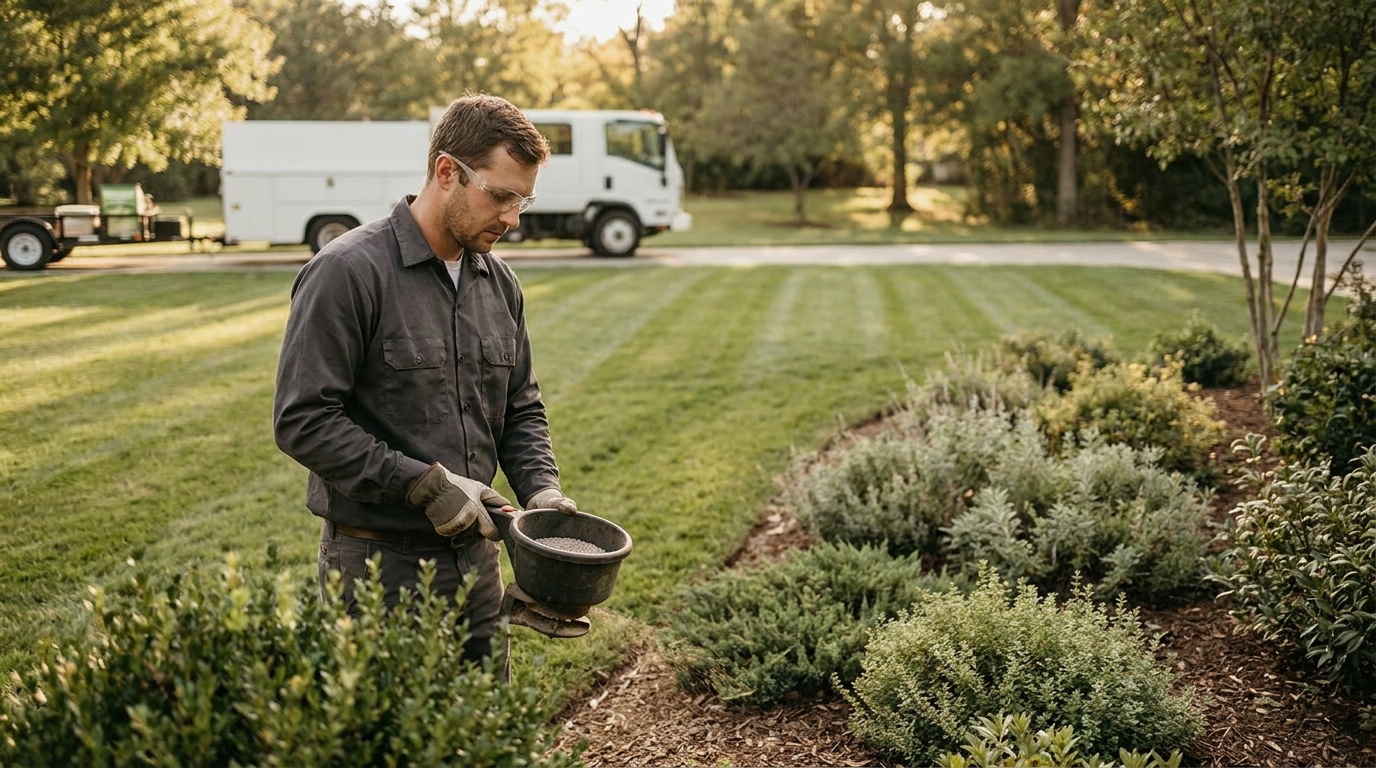
This is the part of licensing that is genuinely universal. GreenPal's page cites the Institute for Justice for the claim that all states license pesticide applicators, and nothing I read today contradicted it. If you apply pesticides on someone else's property for money, there is a credential involved everywhere.
What varies, and what almost nobody explains, is that the credential is scoped by surface and by material, not by job title. Florida is the clearest example because its own agency writes the boundary down.
| What you are spraying | What Florida requires | Cost (FDACS, read 2026-08-12) |
|---|---|---|
| Ornamental plants and plant beds | Limited Commercial Landscape Maintenance certification | Exam fee $150 per category |
| Any turf area, including weed and feed | Not covered by LCLM at all | Pest control business license, $300 per business location |
| Supervising employees who apply | Not covered by LCLM at all | A full-time Florida-certified operator in charge |
Read the second and third rows together, because the step between them is not a bigger exam. FDACS states that each pest control business location must "employ full-time a Florida-certified operator in charge of the pest control operations," and that the LCLM certification "does not allow or authorize the maintenance company or the certificate holder to supervise company employees under their certificate or operate a pest control business."
In Florida, the difference between spraying a flower bed and spraying the lawn is a staffing requirement. One is a $150 exam you take yourself. The other is a licensed business with a certified operator on the payroll full time. That is a hiring decision disguised as a licensing question, and it is why "we'll add weed control next spring" is a bigger commitment than it sounds at the tailgate.
Texas draws its line on the material rather than the surface. The Texas Department of Agriculture requires a commercial applicator license of anyone who "operates a business or is employed by a business that applies restricted-use or state-limited-use pesticides to the property of another person for hire or compensation." Category exams are $64 each, a failed retest is another $64, and licensees "are required to recertify every year by obtaining five continuing education credits." TDA does not publish the license fee itself on that page, and I am not repeating the figure I saw quoted elsewhere without a first-party source for it.
The practical difference between those two states is worth naming. Under a material-based rule you can sometimes stay outside licensing by using only general-use products; under a surface-based rule like Florida's, the lawn is the lawn regardless of what is in the tank. Check which kind of rule your state uses before you assume a product choice solves it.
What compliance costs, against the rest of the stack
Licensing has a reputation as the expensive, scary part of going legitimate. On the same 60-client book, it is the cheapest line in the compliance stack by an order of magnitude. Comparing first-year Florida figures against the numbers this blog has already worked out for insurance and for field service software:
| Line item | Annual cost | Per client | Per visit | Share of $99,840 |
|---|---|---|---|---|
| Licensing (FL: LCLM exam + pest control business license) | $450 | $7.50 | $0.23 | 0.45% |
| Software (Housecall Pro MAX, published rate) | $3,588 | $59.80 | $1.87 | 3.6% |
| Insurance (one truck, one employee, published medians) | $5,541 | $92.35 | $2.89 | 5.6% |
Insurance costs 12.3 times what licensing does, and nobody hesitates over insurance the way they hesitate over licensing. The hesitation is not about money. It is about not knowing which of the four requirements applies, which is a research problem, and research problems feel more expensive than they are.
The limits on that $450, stated plainly: it is a first-year, single-category, Florida-specific figure. It excludes your local business tax receipt, which is real but usually small; it excludes renewals and continuing education, which recur; it excludes travel and time to sit exams; and it assumes one category. In a state with a contractor license requirement you actually cross, the number is larger and includes bonding. Treat it as the floor, the same way the insurance medians are a floor.
One thing worth noting for your books: license fees, exam fees, and continuing education are ordinary business expenses. If you are already tracking them properly they land in the same place as your other deductible costs, and the certificate itself is frequently a prerequisite for the commercial work that pays best, in the same way a certificate of insurance is a bid requirement.

How to answer this for your own state in under an hour
Six steps, in the order that stops you paying for something you do not need:
- Write down every service you actually sell, including the ones you sell twice a year. Mowing, trimming, mulch, bed renovation, irrigation repair, tree work over 15 feet, fertilizer, weed control. The list is the input to everything else.
- Register the business locally. City or county business tax receipt, plus an EIN. This is paperwork, not a competency test, and it applies whether or not anything else does.
- Search your state contractor board for a dollar threshold, not for the word "landscaping." The question is not "does my state license landscapers," it is "at what contract value does my state require a license, and does my install work cross it."
- Go to your state agriculture department for anything you spray or spread. Read the scope of the certification, not the name of it. Florida's is the cautionary example: the one named for landscape maintenance excludes every turf application.
- Check the employee and advertising conditions attached to any exemption you plan to rely on. In California both of them void the exemption independently of price.
- Re-check annually. California's threshold doubled in 2025 and the agency's own consumer sheet still has not caught up. Fees and thresholds move; the page you read two years ago is not evidence.
What Landscapey does and does not do here
Landscapey is a CRM for landscaping businesses: clients, recurring jobs, scheduling, route optimization, invoicing with card payments, expenses and financials, plus a public profile page that takes quote requests. It is $19.99 a month, one plan, no per-seat fee and no setup fee.
None of that is a compliance tool, and I would rather say so than imply otherwise:
| What we do not do | What that means for you |
|---|---|
| No license or certificate storage | Your certificates live wherever you keep them today |
| No renewal or expiry tracking | Nothing here will warn you before a license lapses |
| No CEU tracking | Recertification credits are on you to log |
| No pesticide application records | Where your state requires application logs, that is a separate system |
| No multi-user crew accounts | One login today, so per-technician credential records are not modelled |
| No e-signature or document builder | Contracts and scopes are written elsewhere |
What it does do that is relevant: the add-on jobs that create licensing exposure are exactly the jobs that never get written down, and a CRM that records every one-off job against a client at least gives you a list of what you sold and where. That is a records benefit, not a compliance product. If you want the system of record for the work itself, the pricing is here and you can start a trial without talking to anyone.
Frequently asked questions
Do I need a license to mow lawns for money?
For mowing, trimming, edging and blowing alone, no state appears to require an occupational license. You will still need whatever business registration your city or county requires, and you should carry liability insurance regardless. The licensing questions begin when you install things or apply chemicals.
Is an LLC a license?
No. An LLC is a business entity that affects your liability and your taxes. It is filed with your Secretary of State and it does not authorize you to do any work you could not otherwise do. Several pages ranking for licensing queries blur these together, usually because they are selling formation services.
What is the dollar threshold for needing a contractor license?
It is entirely state-specific. California's minor work exemption is $1,000 in combined labor and materials as of January 1, 2025, and it disappears if a permit is required or if you employ anyone on the job. North Carolina's landscape contractor threshold is $30,000 in contract value at a job site over any consecutive 12-month period. Those two numbers are 30 times apart, which is why a national answer does not exist.
Does a landscape maintenance certification let me spray weeds in a lawn?
In Florida, no. The Limited Commercial Landscape Maintenance certification covers ornamental plants and plant beds only, and FDACS states it does not permit any pesticide application to turf areas, including weed and feed. Turf work puts you into pest control business licensing, which requires a licensed business location and a full-time certified operator in charge. Check the scope language in your own state rather than the name of the certificate.
How much does it cost to get licensed?
Less than most operators expect. Florida's limited certification exam is $150 per category and a pest control business license is $300; Texas charges $64 per category exam with the same fee for a retest. Against a 60-client book those figures are under half a percent of season revenue, roughly one twelfth of what insurance costs. The expensive part of compliance is insurance, not licensing.
What happens if I work without a license?
That depends on your state statute, and I am deliberately not putting a number on it. Not one page ranking for this query publishes a penalty figure, and an invented one would be worse than none. What is clear is that the exposure is not only regulatory: unlicensed work is commonly unenforceable in court, which means chasing an unpaid invoice on a job you were not licensed to perform can be harder than the licensing was in the first place.
Sources and limits
Every figure above was read on the issuing agency's own page on August 12, 2026: California CSLB industry bulletin #24-07 and the CSLB consumer-education sheet "Gardener or Landscaping Contractor - What's the Difference?"; the North Carolina Landscape Contractors' Licensing Board licensing page; the Florida Department of Agriculture and Consumer Services pest control licensing and certification page; and the Texas Department of Agriculture commercial and noncommercial applicator page. The competitor claims described are from the pages currently ranking for this query, read the same day.
The limits, stated rather than buried: four states are named here and forty-six are not. Fees and thresholds change, and this article will itself go stale, which is the exact failure it documents in someone else's publication. Local requirements sit underneath state ones and vary by city. This is not legal advice, and where this page and your state agency disagree, your state agency is right. Read the agency page, including after reading this one.