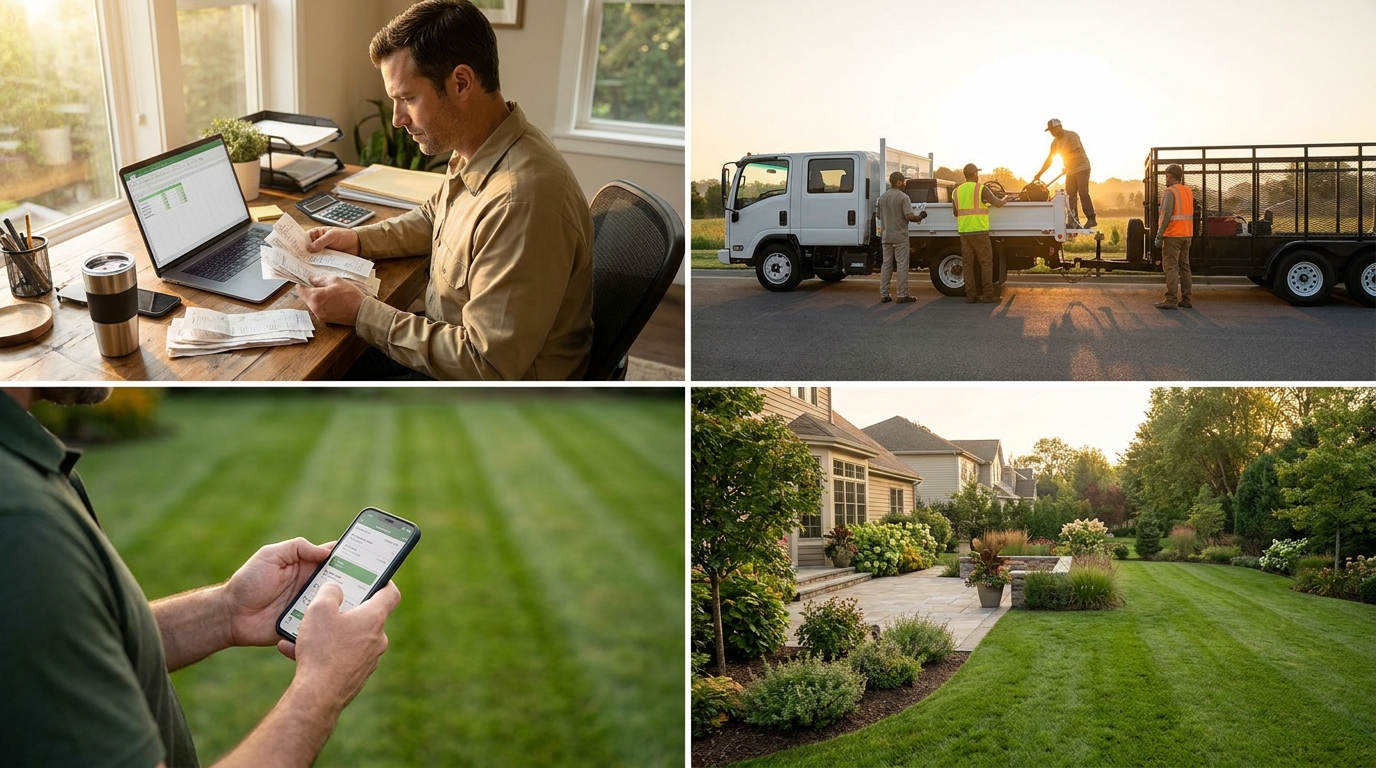
Most landscaping owners don't overpay their taxes because they're missing deductions. They overpay because they can't prove the deductions they're entitled to. The write-offs in this business are genuinely generous — a truck, a mower, the fuel to get between jobs, the insurance that lets you bid commercial work. What trips people up is the shoebox of faded receipts and the mileage they "kind of remember" driving. When you can't substantiate a deduction, you don't take it, and you hand the IRS money that was legally yours to keep.
This is a landscaper's guide to the deductions that matter, the worked numbers behind the big ones, the gray areas that draw audits, and — the part the generic "26 write-offs" listicles skip — exactly what records make each deduction hold up. Pair it with our bookkeeping guide for landscaping businesses and you'll have both halves: the books, and what to do with them at tax time.
This article is general information, not tax advice. Tax law changes every year and your situation is specific to you — confirm anything here with a CPA or enrolled agent before you file.
How deductions actually lower your bill
A deduction reduces your taxable income, not your tax bill dollar-for-dollar. If you're in a combined bracket where federal income tax plus self-employment tax lands you around 25–30 cents of tax on each additional dollar of profit, then a legitimate $1,000 deduction keeps roughly $250–$300 in your pocket. That's the lens to keep: every deduction you can defend is 25–30% of itself in real cash.
The IRS standard for almost everything below is that an expense must be ordinary and necessary for your trade — common in the landscaping business and helpful to running it. A zero-turn mower clears that bar instantly. A bass boat does not. Most of the gray areas later in this guide are really arguments about whether something is ordinary and necessary, or whether it's personal.
The big three: vehicle, equipment, and home office
For most landscaping businesses, three categories do the heavy lifting. Get these right and you've captured the majority of your deductible dollars.
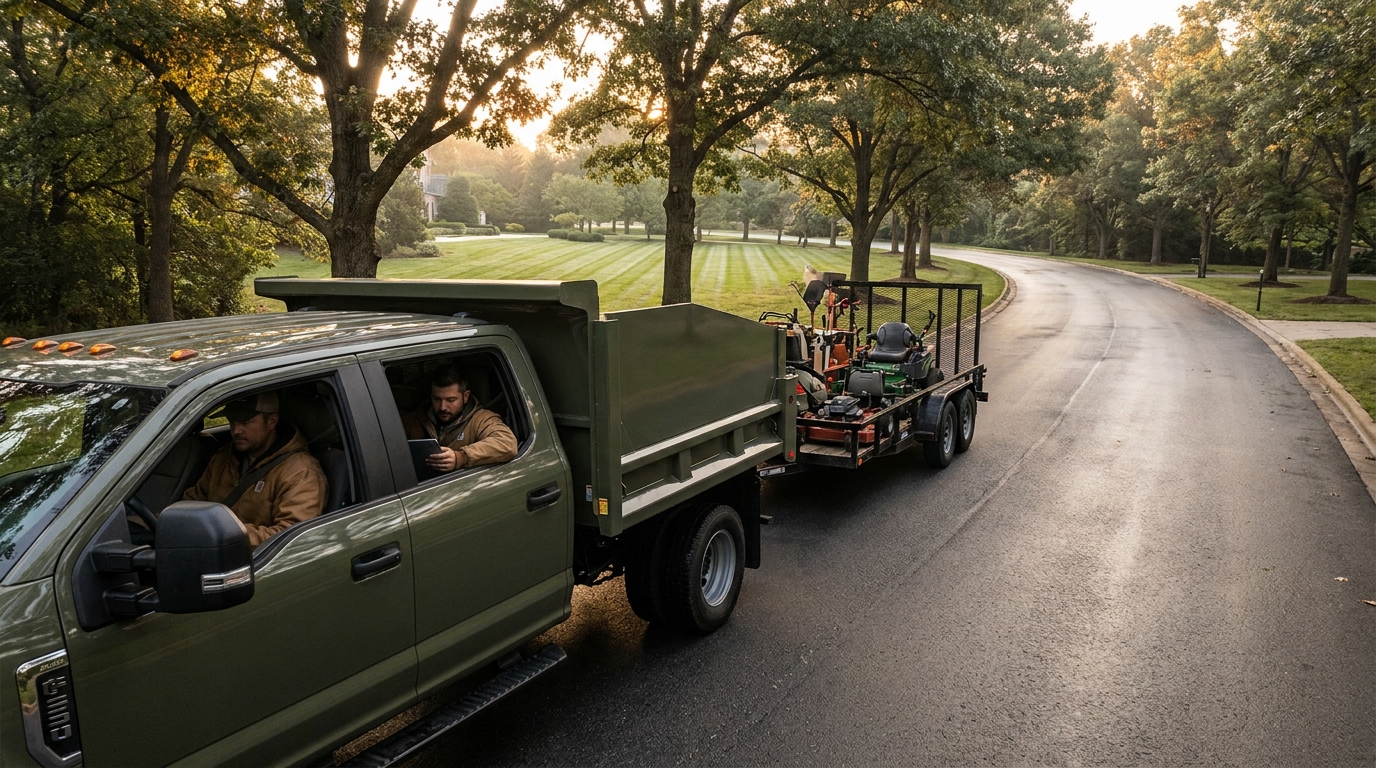
1. Your truck and mileage — usually the single largest deduction
You have two ways to deduct vehicle costs, and you generally pick one per vehicle in the first year you use it:
- Standard mileage method. Multiply business miles by the IRS standard rate (for 2026 it's roughly 70 cents per mile — the figure adjusts annually, so confirm the current rate). Drive 18,000 business miles in a year and that's about 18,000 × $0.70 = $12,600 in deductions, before you've added a single fuel receipt.
- Actual expense method. Add up real costs — fuel, repairs, insurance, registration, depreciation — and deduct the business-use percentage. If the truck is 80% business use and your total costs were $14,000, you deduct $11,200.
For a dedicated work truck that's thirsty and racks up repairs, actual expenses sometimes wins. For most owners the standard mileage method wins on simplicity and dollars — but only if you logged the miles. The number one reason landscapers lose this deduction is no contemporaneous mileage log. "I drive a lot for work" is not a record. A date, a starting and ending odometer or trip distance, and the business purpose for each trip is. Track the route from your shop to each job and back, plus supply runs and dump trips — that's all deductible business mileage. Commuting from home to a regular office is not, but travel between job sites is.
2. Equipment and the Section 179 deduction
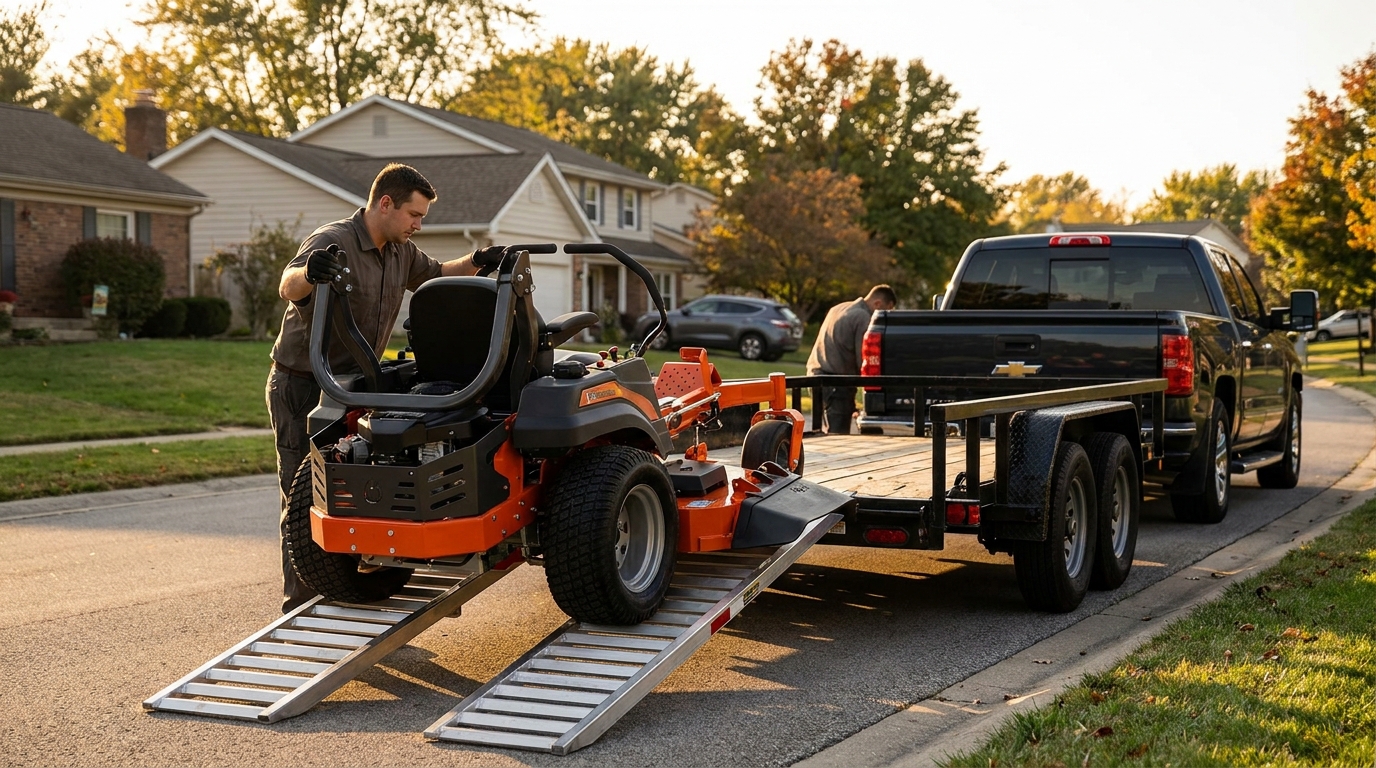
Normally a big purchase — a $14,000 zero-turn, a $4,000 trailer — gets depreciated over several years, meaning you deduct a slice each year. Section 179 and bonus depreciation let you deduct most or all of the cost in the year you buy and put the equipment into service instead.
Say you buy that $14,000 mower and $4,000 trailer in the same year — $18,000 of equipment. Under Section 179 you may be able to deduct the full $18,000 this year rather than spreading it out. At a combined 25% effective rate, that's roughly $4,500 less tax in the year of purchase. That's powerful, but it's a timing tool, not free money: you're pulling future deductions forward, and if you sell the equipment later there can be recapture. The smart play is to use it in a high-profit year to smooth out a big tax bill — not to buy gear you don't need just to "save on taxes." Spending a dollar to save a quarter is still spending a dollar.
Smaller tools — trimmers, blowers, hand tools, a $400 chainsaw — are generally deducted in full the year you buy them as supplies or under the de minimis safe harbor, no depreciation schedule required. Keep the receipts and categorize them consistently; our QuickBooks setup guide for landscapers walks through a chart of accounts that keeps equipment, supplies, and repairs in their own buckets so this is automatic at year-end.
3. The home office
If you run the business from home — scheduling, invoicing, taking calls, storing records — and a space is used regularly and exclusively for that, you can deduct it. Two methods:
- Simplified: $5 per square foot, up to 300 square feet, for a maximum of $1,500.
- Actual: the business-use percentage of your home (office square footage ÷ total) applied to rent or mortgage interest, utilities, insurance, and repairs. A 200 sq ft office in a 2,000 sq ft home is 10% — so 10% of those costs.
"Exclusively" is the catch. A laptop on the kitchen table doesn't qualify; a spare bedroom that's only ever the business office does. A detached garage or shed used solely for storing equipment and doing paperwork can count too. This is a legitimate deduction landscapers leave on the table out of an outdated fear that it's an audit magnet — it isn't, as long as the space genuinely meets the test and you can show how you measured it.
The everyday deductions landscapers forget
Individually small, collectively thousands of dollars. These are the line items that slip through when you're not categorizing expenses as they happen.
| Category | Examples landscapers miss |
|---|---|
| Materials & supplies | Mulch, soil, sod, fertilizer, plants, pavers, landscape fabric, fuel and oil for equipment |
| Insurance | General liability, commercial auto, workers' comp, equipment/inland marine, bond premiums |
| Software & tools | CRM and scheduling software, accounting software, payment processing fees, your website and domain |
| Marketing | Yard signs, truck wraps and decals, business cards, lawn-care ads, sponsorships, the cost of your business management software |
| Professional services | CPA and bookkeeping fees, legal fees, the cost of forming your LLC |
| Licenses & fees | Business license, pesticide applicator license, trade association dues, certifications |
| Phone & internet | The business-use percentage of your cell phone and home internet |
| Bank & financing | Business bank fees, credit card interest on business purchases, equipment loan interest |
| Subcontractor labor | Payments to 1099 crews and day labor (file the 1099-NEC — see below) |
| Education | Trade courses, certification renewals, industry conference admission and travel |
Notice how many of these only get captured if you're tracking expenses continuously rather than reconstructing the year every April. That's the whole argument for keeping the books current — covered in depth in our landscaping bookkeeping guide.
The gray areas that draw audits
These are where landscapers get into trouble — not because the deductions are illegal, but because they're easy to overreach on and hard to prove.
- Work clothing. Deductible only if it's not suitable for everyday wear — branded uniforms, high-vis vests, steel-toe boots, gloves, safety glasses. The jeans and t-shirt you'd wear anywhere are not deductible just because you mowed in them.
- Meals. A solo lunch between jobs is a personal expense, not a deduction. A meal with a prospective commercial client where you discuss the bid is generally 50% deductible — if you note who, when, and the business purpose. Feeding your crew on the job has its own rules; ask your CPA.
- "Is landscaping my own property deductible?" Almost never for your personal home. The narrow exception is the home-office percentage applied to landscaping costs that benefit the office portion — and even that is fact-specific and frequently challenged. Don't assume your own yard work is a business write-off.
- 1099 subcontractors. If you pay an unincorporated subcontractor or day laborer $600 or more in a year, you generally must collect a W-9 and file a 1099-NEC. Skip it and you can lose the deduction and face penalties. Collect the W-9 before you pay anyone the first time — chasing it in January is miserable.
Don't forget self-employment tax and quarterly estimates
The bill that ambushes new landscaping owners isn't income tax — it's self-employment tax: 15.3% (12.4% Social Security + 2.9% Medicare) on your net business earnings, on top of income tax. There's good news in both directions, though: you deduct half of your SE tax above the line, and the Qualified Business Income (QBI) deduction can let many owners deduct up to 20% of qualified business income. Your CPA will run these, but you should know they exist.
Because no employer is withholding tax for you, the IRS expects quarterly estimated payments — roughly mid-April, mid-June, mid-September, and mid-January for the prior year's fourth quarter. Miss them and you can owe an underpayment penalty even if you pay in full by April. The simplest defense: every time you get paid, move a percentage (many solo owners use 25–30% of profit) into a separate tax savings account, and pay your estimates from there. You never feel the April cliff because you've been setting the money aside all year.
How to make every deduction audit-proof
Here's the part the listicles skip. A deduction you can't substantiate is a deduction you shouldn't take — and might have to give back with interest if you're examined. Audit-proofing isn't complicated; it's just consistent. Four habits cover almost everything:
- A dedicated business bank account and card. The single highest-leverage move. When every business dollar flows through one account, your deductions are the account, not a memory exercise. Commingling personal and business spending is the fastest way to lose deductions and credibility.
- Categorize expenses as they happen. A purchase tagged "fuel" or "equipment repair" the day you make it is a clean record. A bank line that just says a dollar amount eleven months later is a guess. This is exactly what an expense tracker built for landscapers is for — log the cost, pick the category, attach the receipt photo, done.
- Keep a contemporaneous mileage log. Date, distance, and business purpose per trip. Reconstructed-from-memory logs are the classic audit casualty. If your jobs and routes already live in your system, you're most of the way there.
- Hold receipts for the things that get scrutinized. Equipment, vehicle costs, anything over a few hundred dollars, and meals. A photo attached to the transaction beats a faded thermal-paper receipt in a glovebox.
This is where running the business on a real system pays for itself at tax time. When your jobs, expenses, and invoices live in one place, the deductible picture is already assembled: Landscapey tracks expenses by category with receipt photos and rolls them into a profit-and-loss view, so the numbers your accountant needs are a report, not a forensic project. The software subscription itself is deductible, too.
A simple year-round tax routine
You don't need to think about taxes constantly — you need a light rhythm so April is a non-event:
- Weekly (10 minutes): categorize the week's expenses and snap receipts while you remember what they were for.
- Monthly (30 minutes): reconcile the business account, confirm every transaction is categorized, and move your tax percentage into the savings account.
- Quarterly: glance at year-to-date profit, make your estimated payment, and adjust your set-aside rate if profit is running hot or cold.
- Year-end: review big purchases for a possible Section 179 election, confirm all 1099-NECs are filed, and hand your CPA a clean P&L instead of a shoebox.
Do that and tax season stops being the worst week of your year. The deductions are there whether or not you claim them — the difference between the landscaper who keeps that money and the one who doesn't is almost never knowledge of the tax code. It's records.
Frequently asked questions
Can I write off a new truck for my landscaping business?
Yes, to the extent it's used for business. You'll choose between the standard mileage method and the actual expense method, and a heavy work vehicle may qualify for accelerated depreciation under Section 179. Keep a mileage log and your purchase documents either way.
Is my landscaping equipment fully deductible the year I buy it?
Often, yes. Small tools are typically deducted in full as supplies. Larger equipment is normally depreciated over several years, but Section 179 and bonus depreciation usually let you deduct most or all of the cost in the purchase year if it's profitable to do so.
How much should I set aside for taxes as a self-employed landscaper?
A common rule of thumb is 25–30% of net profit, set aside in a separate account and used to pay quarterly estimates. Your exact rate depends on your bracket, your state, and the QBI and SE-tax deductions — your CPA can dial it in, but setting aside too little is the most common cash-flow mistake.
Do I have to send 1099s to my subcontractors?
Generally, if you pay an unincorporated subcontractor or laborer $600 or more in a year for business work, you must file a 1099-NEC. Collect a W-9 from anyone you hire before you pay them, so you have the information when filing season arrives.
Is the cost of my landscaping software deductible?
Yes — business software, including CRM, scheduling, accounting, and payment processing fees, is an ordinary and necessary operating expense and is fully deductible. The same goes for your website and domain.
Stop reconstructing your deductions every April. Landscapey keeps your jobs, expenses, and invoices in one place so the deductible picture builds itself all year. See plans and pricing, or start your free trial and put this tax season's records on autopilot.