Every autumn the same two questions get asked in the same week. Homeowners search sprinkler winterization cost and get a page of cost guides. Lawn-care operators search the same phrase, because they are about to hitch up a compressor and want to know what everyone else is charging — and they get the same page of cost guides, written for the other person. This post is for the operator. It reads the cost guides so you do not have to, reads what contractors actually post on their own sites, and then does the arithmetic the cost guides never do: what a blowout day costs to run, and therefore what a stop has to bring in.
The short answer is that zone count — the thing every price list is organised around — is not what drives your cost. The compressor and the drive between stops are. Price for those and the zone count becomes a rounding fee, which is exactly how the contractors who post their prices treat it.
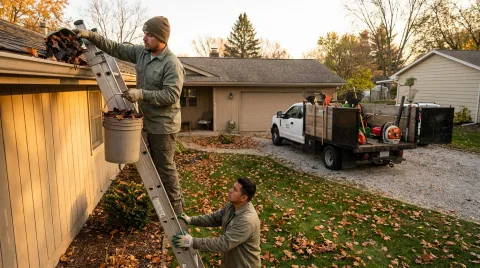
The same drive-time logic runs the other fall add-on, and it runs harder there. A standalone gutter company spends about two and a half hours of a nine-hour day between stops, and its $150-$295 per-story prices are paying for the truck to arrive; on a cleanup visit the truck has already arrived. Price the one-story at $140 - 24% under the specialist's blended $183 - and the contribution per stop comes out within a few dollars of theirs, because the cost that scales is ladder set-ups by story, not the linear feet every cost guide prices on. Gutter cleaning: the ladder math, and a two-column price list.
What customers are paying in 2026
Six cost guides sit on page one for the head term. All of them were read directly for this post on 12 September 2026 except Angi, which refused the fetch and is quoted from its search snippet only. Their headline figures:
| Source | Winterization | Spring start-up | Dated |
|---|---|---|---|
| HomeAdvisor | $93 average; $56–$137 typical; $40–$350 full range | $40–$150; tune-up $100 average | 17 Jun 2026 |
| Thumbtack | $68–$239 national range; $28 low, $608 high | — | 29 Jun 2026 |
| Angi (snippet) | $60–$150; $85 average | — | 8 Jul 2026 |
| HomeGuide | $50–$150 for up to 12 zones, +$5–$10 per extra zone | $60–$125; annual plan $140–$400 | not shown |
| LawnStarter | $59–$144; blowout method $85–$215 | $45–$140 | 27 Dec 2025 |
| Family Handyman | “around $80” in Minnesota | — | 4 Dec 2023 |
Read across the row and the market is not confusing: the middle of every range is somewhere between $75 and $100 for an ordinary residential system. The edges are where the guides go strange. Thumbtack’s $28 low is below the cost of the compressor rental it took to do the job, and its $608 high is a commercial property or a repair bill wearing a winterization label.
Two things worth noticing before you lean on any of these numbers. HomeAdvisor and LawnStarter publish the identical cost-by-zones table — 1–2 zones $50–$75, 3–4 zones $80–$100, 5–6 zones $100–$130, 7–8 zones $150–$250 — so two of the six sources are one source. And HomeAdvisor disagrees with itself on the same page: a $93 average in the headline, a $56–$137 typical range, and then “blowing out your sprinkler system costs an average of $100 to $250” four paragraphs later, with a zone table whose top band starts above the typical range’s ceiling. Blowing out is the method almost every professional uses. If the average is $93 and the blowout average is $100–$250, one of those numbers is not an average.

What contractors actually post
Cost guides are surveys of what homeowners report paying. Contractor price pages are what a business decided to charge and put its name on. Five of them rank on page one, and they are the more useful reading:
| Contractor | Posted winterization price | Structure |
|---|---|---|
| Landscape Management (Washington) | $75 for up to 10 zones, +$6 per additional zone | 2-service package $140; 3-service package $180 |
| Outback Landscape (Idaho) | $130 for up to 8 zones, +$5 per additional zone | flat + per zone |
| Pacific Lawn Sprinklers (multi-state) | “approximately $70–$150”, rising with zone count | range, quoted on site |
| Seattle Landscapes (snippet) | “around $150” for up to 8 zones | flat |
| r/lawncare thread (snippet) | “most people charge $60–$100 a visit”; $150 a year for two visits | per visit, or annual pair |
Two things stand out. First, the spread is real: $75 in one Pacific Northwest market and $130 in the Idaho one, for a smaller system, is a 73% gap between two businesses that both publish the number with confidence. Second, and more useful: every one of them prices the same way. A flat price that covers the ordinary system, then a small per-zone charge for the unusual one. Nobody prices by the zone from zone one. The cost guides’ tidy zone bands are a homeowner’s way of organising the world; the contractors’ way is a base price plus a rounding fee, and the next section is why.
One page on the SERP does try to answer the operator’s question directly: a HindSite Software post titled How Much Should I Charge For Sprinkler Winterizing? It is undated, it anchors on what the author charged “in the early to mid 70s” ($45–$47 for six or seven zones in southern New Jersey), and its wage assumption is $21 an hour. Its conclusion — “today we need to get a minimum of $75.00 or more, no matter if you are a large or small contractor” — happens to be roughly right, but the arithmetic underneath it belongs to a different decade. We rebuild it below with 2026 inputs.
Why zone count is the wrong thing to price on
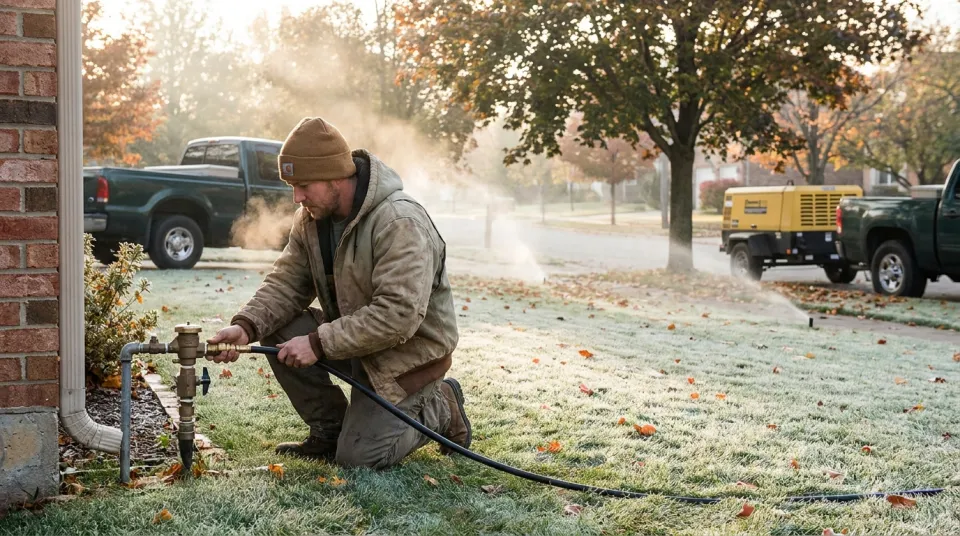
Here is what actually happens at a stop. You shut the water at the main, connect the compressor to the blowout port, open one zone from the controller, and push air through it until the heads run to mist. The manufacturer guidance is specific about the timing: K-Rain’s winterization instructions say no more than one minute of air per zone per pass, always with a zone open before the compressor starts, and repeat the cycle two or more times until only a fine mist appears. So an 8-zone system is eight minutes of air per pass, two passes, sixteen minutes of air. Add hooking up, closing the main, cycling the controller, restoring the backflow assembly and writing it up, and an ordinary residential stop is somewhere between 25 and 35 minutes. Call it 30.
Now the marginal zone. One more zone is two more passes of one minute: two minutes. At a fully loaded labour cost of $26.40 an hour — half of the two-person crew rate used throughout our pricing posts, because a blowout is a one-person job — that is 88 cents of labour plus two minutes of compressor time. The contractors charge $5 or $6 for it. That is not gouging; it is a sensible round number for a thing that costs under a dollar and takes two minutes, and it makes the invoice legible. But it also tells you where the money is not. If a zone is worth $6, a 6-zone system and a 10-zone system differ by $24, and the other $75–$130 on the invoice is being charged for something else.
That something else is the truck arriving. Every stop carries the same fixed load — the compressor for the day, the technician for the day, the drive from the last house — and the on-site time barely moves with system size. The base price is a drive-time price. Which means the two numbers that decide what you can charge are what the compressor costs you per day and how many houses you can get to.
The compressor decides the price
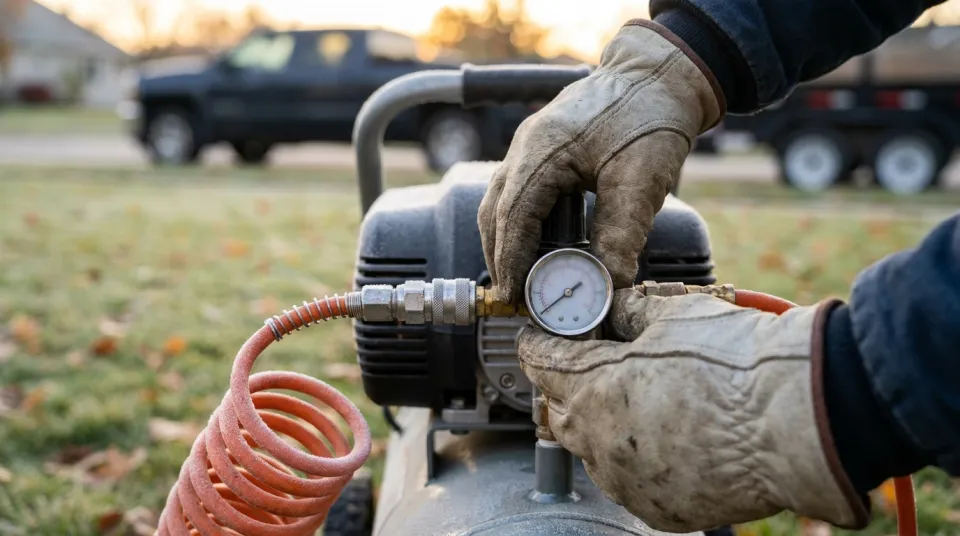
The cost guides quote compressor rental at $30–$60 a day, and that is true of the machine they mean: a homeowner-size portable that will do one house slowly. It is not the machine a route runs on. The guidance from people who sell compressors to landscapers is consistent. K-Rain says the unit must deliver 20–25 cubic feet per minute at no more than 50 psi. VMAC, which builds truck-mounted units for this trade, puts the ideal at 20–50 CFM at 50 psi, offers a sizing rule — the zone’s gallons per minute divided by 7.5 gives the CFM you need — and warns that a reciprocating compressor’s rated CFM is a burst figure that fades as the tank empties, so it needs a large receiver tank or the rotary-screw design that holds its rating continuously. ELGi markets its 75–185 CFM tow-behind diesels specifically for blowout work.
The 185 CFM tow-behind is what the high-volume operators pull, because it will clear a large residential main quickly and never waits to recharge. What it costs to rent in 2026, from published Denver-market rates compiled by CountBricks: United Rentals and Sunbelt at $165 a day or $550 a week; Arvada Rent-Alls at $194 a day, $696 a week, or $1,612 for four weeks. Delivery, if you cannot tow it yourself, adds $95–$185 each way. Denver is a blowout town, so those are the rates in a market where the machines are in demand in October; your market will differ, but the structure will not.
| Rental term (185 CFM tow-behind) | Published rate | Per working day | Beats the term above it after |
|---|---|---|---|
| Daily (United / Sunbelt) | $165 | $165 | — |
| Weekly (United / Sunbelt) | $550 | $110 (5 days) | day 4 |
| Four weeks (Arvada Rent-Alls) | $1,612 | $81 (20 days) | week 3 |
The blowout window in a freeze state is typically two to four weeks between the first hard-frost warnings and the ground locking up. A four-week rental covers it at about $81 a working day — if you have the stops to run every day. If you do not, a weekly rental for the one or two weeks you are actually full is $110 a day, and a daily rental for a single Saturday of your own mowing clients is $165. We could not find a purchase price for a new 185 unit that we could verify, so buying is not compared here; it is a five-figure decision that only makes sense with a second use for the machine.
The day’s math on the house book
This is the same illustrative 60-client mowing business used across our aeration, leaf removal and winter posts, so the numbers stay comparable: $52 a visit, a 32-week season, a two-person crew at $52.80 an hour fully loaded. For blowouts, one technician at $26.40 loaded, a nine-hour day, and a truck-and-fuel allowance of $60 a day, which is an assumption. Take 30 minutes on site and 10 minutes between stops on a tight route: 12 stops in an eight-hour working day. A subdivision where you can walk the hose to the next house will do 16; a rural route will do 8.
Fixed cost of the day, with a daily compressor rental: $165 + $237.60 + $60 = $462.60. With a weekly rental it is $407.60. Everything above that is contribution, and because the fixed load barely moves, the price per stop is almost entirely margin:
| Price per stop | Revenue, 12 stops | Contribution (daily rental) | Stops just to cover the day |
|---|---|---|---|
| $55 (the “beside the road” price) | $660 | $197.40 | 8.4 |
| $75 (HindSite’s floor; Landscape Management’s price) | $900 | $437.40 | 6.2 |
| $90 (this post’s house price) | $1,080 | $617.40 | 5.1 |
| $110 | $1,320 | $857.40 | 4.2 |
| $130 (Outback’s price) | $1,560 | $1,097.40 | 3.6 |
Read the last column first. At $55 you need more than eight paying houses before the day earns anything, and a rain day or two no-shows puts you underwater. At $90 you have covered the day by lunch. That is the whole argument against the $55 sign, and it is not about greed; it is that the price is being set as if the cost were the 30 minutes at the curb, when the cost is the day. HindSite made the same point with 1970s inputs — raise the price from $55 to $75 and you need 73 stops instead of 100 to bank the same $5,500 — and it survives the update.
Now the season. Fifteen working days in a three-week window at 12 stops is 180 blowouts per truck. On the house book, if half the mowing clients have in-ground irrigation (an assumption; in the freeze belt it is often more), that is 30 stops: $2,700 of revenue for two and a half days’ work, on driveways you already pull into weekly. The truck has capacity for six times that. A full window at $90 is $16,200 of revenue against $6,939 of fixed cost, $9,261 of contribution in three weeks — on a book whose whole mowing season, at the margins worked out in our pricing chart post, clears nowhere near that per week. The constraint is not the price or the machine. It is stops.
Pricing models that work
Four structures cover what the contractors post, applied to three system sizes:
| Model | 6 zones | 10 zones | 14 zones | Note |
|---|---|---|---|---|
| Flat to 10 zones + $6 (Landscape Management) | $75 | $75 | $99 | generous base, cheap to explain |
| Flat to 8 zones + $5 (Outback) | $130 | $140 | $160 | higher base, same shape |
| Zone bands (HomeAdvisor / LawnStarter) | $100–$130 | table ends at 8 | table ends at 8 | the table does not cover a large yard |
| House price: flat to 8 zones + $6 | $90 | $102 | $126 | base set from the day’s math above |
Flat plus per-zone is the model to copy. Set the base from your day — fixed cost divided by a realistic stop count, plus the margin you want — and set the zone cut-off where your ordinary customer sits, so that most invoices are one line. The per-zone add-on is there for the half-acre lot with fourteen zones and it earns its keep as a signal, not as revenue.
The package is where the real change happens. Landscape Management’s two-service package — winterization plus spring start-up for $140, or $70 a visit — discounts the $75 winterization by about 7% in exchange for a customer who has already bought next April. The three-service version at $180, adding a mid-season check, is $60 a visit for three visits nobody had to be sold separately. The Reddit thread’s “$150 a year for two visits” is the same shape. What a package does is turn a fall-only transaction into an account with a spring date on it, which is the point at which the irrigation customer starts to look like the mowing customer: recurring, scheduled, on your route. Our recurring-billing post goes through the invoice mechanics; the principle is that you are selling the calendar, not the visit.
Do not price the method. LawnStarter lists manual drain at $70–$150, automatic drain at $75–$165 and blowout at $85–$215 as if the customer picks one. The customer has the system they have; if it has a blowout port, you blow it out, and if it relies on drain valves you still blow it out because a drain valve leaves water in the low spots. Charge for the stop.
The three-week window: filling the truck
Because the constraint is stops, the selling problem is density, and the cheapest stops are the ones next to stops you already have. Three things that move the count:
- Your own book first. Every mowing client with a controller on the garage wall is a blowout at zero acquisition cost and zero extra driving on a day you are already on their street. Ask in September; the customers who say “we have a guy” are a price signal (ask what the guy charges) and the ones who say “we usually forget” are the ones who will call you in November about a cracked backflow.
- Neighbours, by the street. A blowout takes half an hour and the truck is visible from three doors down. Doorhangers on the six nearest houses with irrigation while the compressor runs is a route-density tactic more than a marketing one. Fill a cul-de-sac and the 10-minute drive between stops becomes a 2-minute walk, which is how a 12-stop day becomes a 16-stop day at the same fixed cost.
- Book the spring while you are standing there. The start-up visit is the same customer, the same driveway and the same truck six months later. Selling it as a package at the blowout, when the customer has just watched you work, converts better than a March postcard. It is also the visit that pays for the compressor rental in a month when you would otherwise be doing whatever you do in the winter.
Sequencing matters too. Blowouts sit in the same weeks as the leaf-removal peak and the last aeration round, and the compressor is on a daily clock. Most operators who run both give the compressor its own days — one truck, one technician, a blowout-only route — rather than trying to bolt three stops onto a leaf crew’s day, because a blowout route is the densest route of the year and a leaf route is one of the slowest.
The $750 mistake
The reason a professional blowout is worth paying for is the reason it is worth doing carefully. Outback Landscape’s page, which exists mainly to persuade the homeowner not to rent a compressor, gives the repair numbers: replacing a cracked one-inch backflow preventer, including the required testing, is $200–$750; rebuilding a broken manifold is $150–$400. Those are what a freeze costs when nobody comes. They are also what you owe when you come and get it wrong, because the two ways to break a system with a compressor are both operator errors:
- Too much pressure. K-Rain’s instruction is a hard 50 psi maximum. VMAC allows up to 80 psi on rigid PVC and says polyethylene “is more likely to break above 50 psi”. Most residential laterals are poly. A 185 CFM tow-behind delivers 100 psi by default; the regulator gets set to 50 before the hose is connected, every stop, and K-Rain’s note that “if the system can withstand 120 psi of water pressure, similar air pressure will not damage it” is a “common misbelief” is the sentence to remember. Air is compressible; water is not; the heads spin up to speeds they were never built for.
- Too long, or with nothing open. More than a minute of air on one zone heats the gears in the rotors and the fittings. Running the compressor with no zone open puts the full charge against the mainline and the backflow. K-Rain: a zone open before the compressor starts, a zone open until after it stops.
The practical consequence for pricing is that the technician is the product. The $55 operator with a rental compressor and no regulator is not your competitor; they are the source of your March repair calls. And the general-liability policy that covers a cracked backflow is not optional for this work — our insurance-cost post has what the carriers publish for a lawn-care business, and a fall of blowouts is exactly the exposure a starter tier should be checked against.
Running it in Landscapey
An honest note on where the software helps and where it does not. In Landscapey a blowout is a one-off job on the client’s record, priced at your base plus zones, invoiced from the same screen and payable by card on the invoice link. The route planner orders the day’s stops by location, which matters more on a blowout day than on any other day of the year, because the whole margin lives in the drive time. If you sell the two-visit package, send it as a quote from the Quotes screen, and when the customer approves it, invoice it once.
What the product will not do: represent a twice-a-year interval as a recurring job. Landscapey’s recurring frequencies are weekly, every two weeks and monthly, so a spring start-up plus a fall blowout is two one-off jobs on the calendar, not one recurring schedule, and the pre-paid package is a single invoice rather than an automatic renewal. That is the truthful description of how it works today. If you are running mowing, leaf removal and blowouts on the same book, the one plan covers all of it at $19.99 a month, and a free profile page goes up the day you sign up.
FAQ
How much does sprinkler winterization cost in 2026?
For an ordinary residential system, the six cost guides read for this post put the middle of the market between $75 and $100, with typical ranges of $56–$137 (HomeAdvisor), $59–$144 (LawnStarter) and $68–$239 (Thumbtack). Contractors’ own posted prices run from $75 to $130 for a base system plus $5–$6 per extra zone.
How much should a lawn-care business charge for a sprinkler blowout?
Set the base from the day, not the zone count. On the illustrative book above, a day costs about $463 to run with a rented 185 CFM compressor and one technician, and a tight route yields 12 stops. At $55 a stop you need 8.4 paying houses just to break even; at $90 you need 5.1. A flat $90 for up to 8 zones plus $6 a zone sits inside every published range and covers the day by lunch.
Is it worth buying a compressor for sprinkler blowouts?
Not on the strength of one three-week season. Published 2026 rental rates for a 185 CFM tow-behind are about $165 a day, $550 a week or roughly $1,612 for four weeks, which is $81 a working day if you run it every day of the window. Rent by the term that matches your stop count, and revisit buying only when the machine has a second job.
What size compressor do I need to blow out sprinklers?
Manufacturers’ guidance is 20–25 CFM minimum (K-Rain) and 20–50 CFM at 50 psi as the ideal (VMAC), sized by dividing the zone’s gallons per minute by 7.5. The pressure limit matters more than the volume: 50 psi maximum on polyethylene, up to 80 psi on rigid PVC. A tow-behind 185 CFM unit is about speed, not capability, and still gets regulated down to 50.
Should I charge per zone?
Charge a flat base for the ordinary system and a small per-zone fee above a cut-off. A marginal zone is two minutes of air and under a dollar of labour, so the $5–$6 the contractors charge for it is a legibility fee, not a revenue line. Pricing by the zone from zone one makes small systems look cheap and punishes the customer with the big lot, who is the one you want.
What happens if a sprinkler system is not winterized?
Water left in the lines freezes, expands and cracks whatever holds it. The parts that go first are the backflow preventer and the manifold, and Outback Landscape’s published repair prices are $200–$750 for a one-inch backflow including testing and $150–$400 for a manifold rebuild. That is the number to quote when a customer asks why the blowout costs $90.
Sources and limits
- Cost guides, read directly on 12 September 2026: HomeAdvisor (updated 17 June 2026), Thumbtack (updated 29 June 2026), LawnStarter (updated 27 December 2025), HomeGuide (no date shown), Family Handyman (4 December 2023, a Minnesota figure). Angi returned HTTP 403 to our fetch; its $60–$150 and $85 average are taken from its search snippet dated 8 July 2026 and are flagged as such in the table. Every figure is transcribed as published.
- Contractor prices are from the businesses’ own pages, read the same day: Landscape Management (Washington), Outback Landscape (Idaho Falls) and Pacific Lawn Sprinklers. Seattle Landscapes and the r/lawncare thread are quoted from search snippets only; Reddit refused the fetch.
- Compressor guidance is from K-Rain’s winterization instructions, VMAC’s air-compressor guide for landscapers and ELGi’s product pages, all read directly. Rental rates are from CountBricks’ 2026 Denver compilation, which cites United Rentals, Sunbelt and Arvada Rent-Alls list prices; those are one metro market’s numbers and are used for structure, not as a national rate.
- The HindSite Software post is undated, anchors on prices from the 1970s and a $21-an-hour wage, and is cited for its argument, not its inputs.
- The house book is an illustration, not a survey. 60 clients, one technician at $26.40 an hour fully loaded, a nine-hour day, $60 a day for truck and fuel, 30 minutes on site, 10 minutes between stops, half the book with irrigation. Every one of those is an assumption you should replace with your own before pricing anything.
- Time-on-site is derived from K-Rain’s one-minute-per-zone rule and two passes, plus an allowance for set-up; it is not a timed study. Rotor zones and long mains run longer.
- Landscapey’s own behaviour — one-off jobs, the three recurring frequencies, quotes and invoicing — was checked against the product the day this was written, and the plan price against the live pricing page. Everything else moves; verify before quoting.