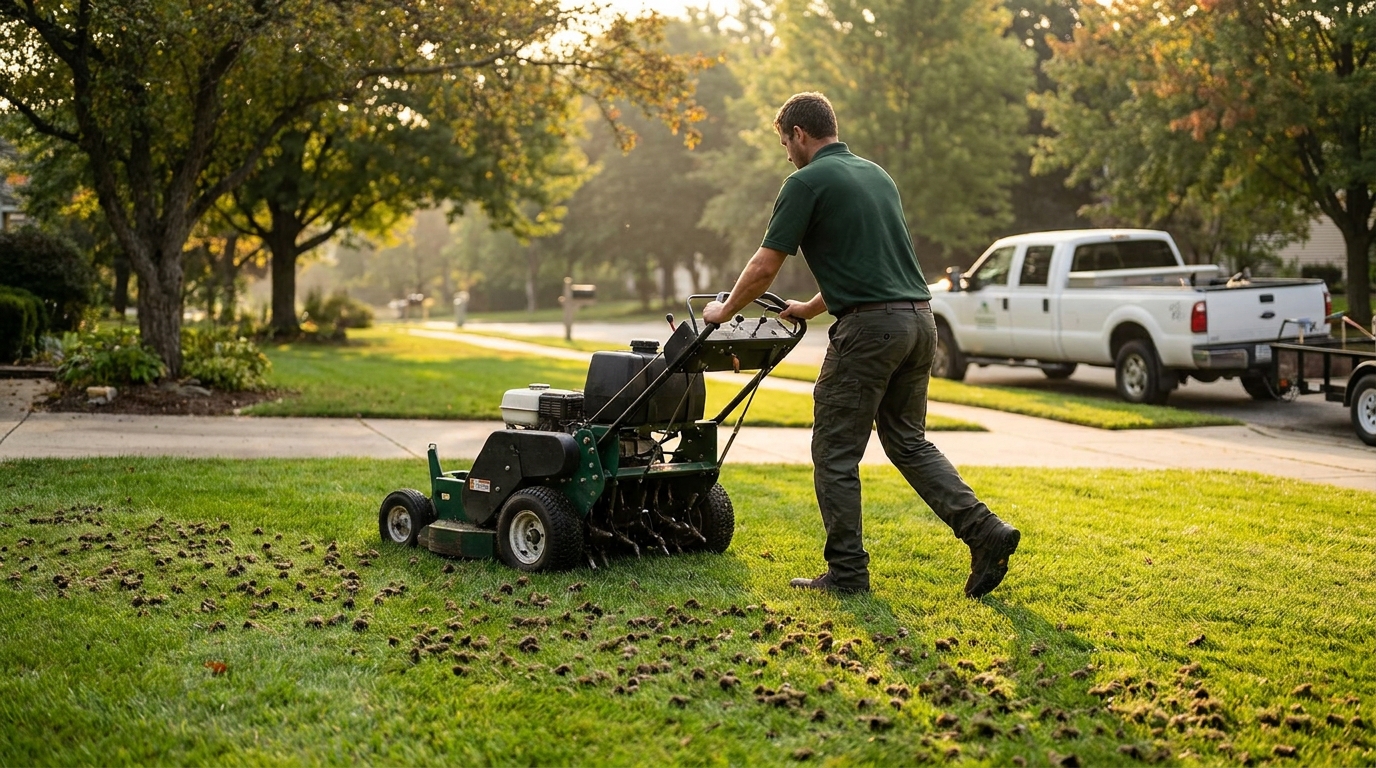
You have a customer asking what you'd charge to aerate their lawn, and you want a number you can say out loud without either losing the job or losing money on it. So you search "how much to charge for aeration" — an operator's question, phrased the way an operator phrases it — and Google hands you a stack of homeowner cost-comparison pages telling you what consumers pay, plus two forum threads where actual landscapers argue about it.
That mismatch would be tolerable if the consumer pages agreed with each other. They don't. Read literally, the pages currently ranking for that query price the same quarter-acre lawn anywhere from $74 to $4,900. Two of them contradict themselves on their own page.
This guide does the thing none of them do: build the number from your side of the transaction — machine time, mobilization, seed, and the route — and hand you a rate card you can defend at the tailgate.
Worth knowing what one more property on the route is actually worth before you price an add-on service. At $52 a visit against roughly $35.20 of marginal crew time, an extra client contributes about $16.80 a visit - $537 across a 32-week season, not $1,664. Run that against the cost of hiring your own replacement and it takes about 49 more clients, which is a second crew, not a busier one.
Aeration is one of the few rows where the published charts are close enough to be useful, and it is worth knowing how close. Four pricing guides read on the same day put a single aeration job at $120, an average of $140, a range of $75 to $205, and a range of $75 to $500 and up. That is agreement by the standards of this category - the same four sources disagree by 78% on a quarter-acre mow. We put all four charts side by side and added the column none of them print.
The other fall add-on with the same pricing mistake baked into every price list is the sprinkler blowout. Every list is organised by zone count, and a marginal zone is two minutes of air and about 88 cents of labour - which is why the contractors who post prices charge a flat base and $5 or $6 a zone above a cut-off. The base is a drive-time price: set it from what the day costs to run, not from the half hour at the curb. Sprinkler winterization pricing, worked on the same 60-client book.
The ranking pages price the same lawn from $74 to $4,900
Here is a quarter-acre lawn — 10,890 square feet, the American residential default — priced by each ranking source using that source's own stated method. No editorializing; just their numbers applied to one lawn.
| Source | Method as published | Price for 10,890 sq ft |
|---|---|---|
| LawnStarter (updated Dec 2025) | Its cost-by-size table, ¼-acre row | $116–$191 |
| LawnStarter (same page) | Its stated $0.07–$0.27 per sq ft | $762–$2,940 |
| Thumbtack (updated Aug 5) | Headline: "$159–$452, most people pay $268" | $159–$452 |
| Thumbtack (same page) | Its cost-by-size table, 10,000–15,000 sq ft row | $963 |
| Homewyse (May 2026) | $0.19–$0.45 per sq ft | $2,069–$4,900 |
| LawnSite contractor | "$20 per 1,000 sq ft" | $218 |
| LawnSite contractor | "$65 for a standard 80×120 lot" ($0.0068/sq ft) | $74 |
Bottom to top, that's a 66× spread on one lawn. If you built your price list by averaging page one, you'd land somewhere near $1,100 for a job most crews do for under $200.
The forum numbers at the bottom of that table are the only ones produced by people who own aerators. That is not a coincidence, and it's the first useful signal: the operators quoting on this SERP cluster tightly between roughly $0.007 and $0.02 per square foot, while the consumer cost pages scatter across two orders of magnitude.
Two of the top results contradict themselves
This is worth spelling out, because it's the reason you can't fix the problem by simply picking the most authoritative-looking page.
Thumbtack's headline says the national range is $159 to $452, and that most people pay $268. Further down the same page sits a cost-by-lawn-size table: under 1,000 sq ft averages $463; 1,000–5,000 sq ft averages $493; 5,000–10,000 averages $507; 10,000–15,000 averages $963. Every single row of that table is above the top of the headline range. The smallest lawn on the page costs $463 — eleven dollars more than the stated maximum, and $195 more than what "most people pay." Both numbers are on the same page, presented with equal confidence.
LawnStarter publishes $0.07 to $0.27 per square foot, then publishes a size table whose own rows imply something very different. Divide their ¼-acre figure ($116–$191) by 10,890 and you get $0.011–$0.018 per square foot. Divide their 1-acre figure ($392–$550) by 43,560 and you get $0.009–$0.013. Their published per-square-foot floor of $0.07 is roughly four times the ceiling implied by their own quarter-acre row, and about five and a half times the ceiling implied by their acre row.
The per-square-foot range isn't invented — it's just derived from their smallest lawns. Their 500 sq ft row ($35–$63) works out to $0.07–$0.126 per square foot, which is exactly where the published range comes from. Then it gets carried across the page as though it were universal.
That distinction matters enormously to you and not at all to a homeowner. A homeowner reads the row for their lawn and moves on. You take the per-square-foot number, put it in a spreadsheet, and price your entire season with it.
Why no single per-square-foot rate can be correct
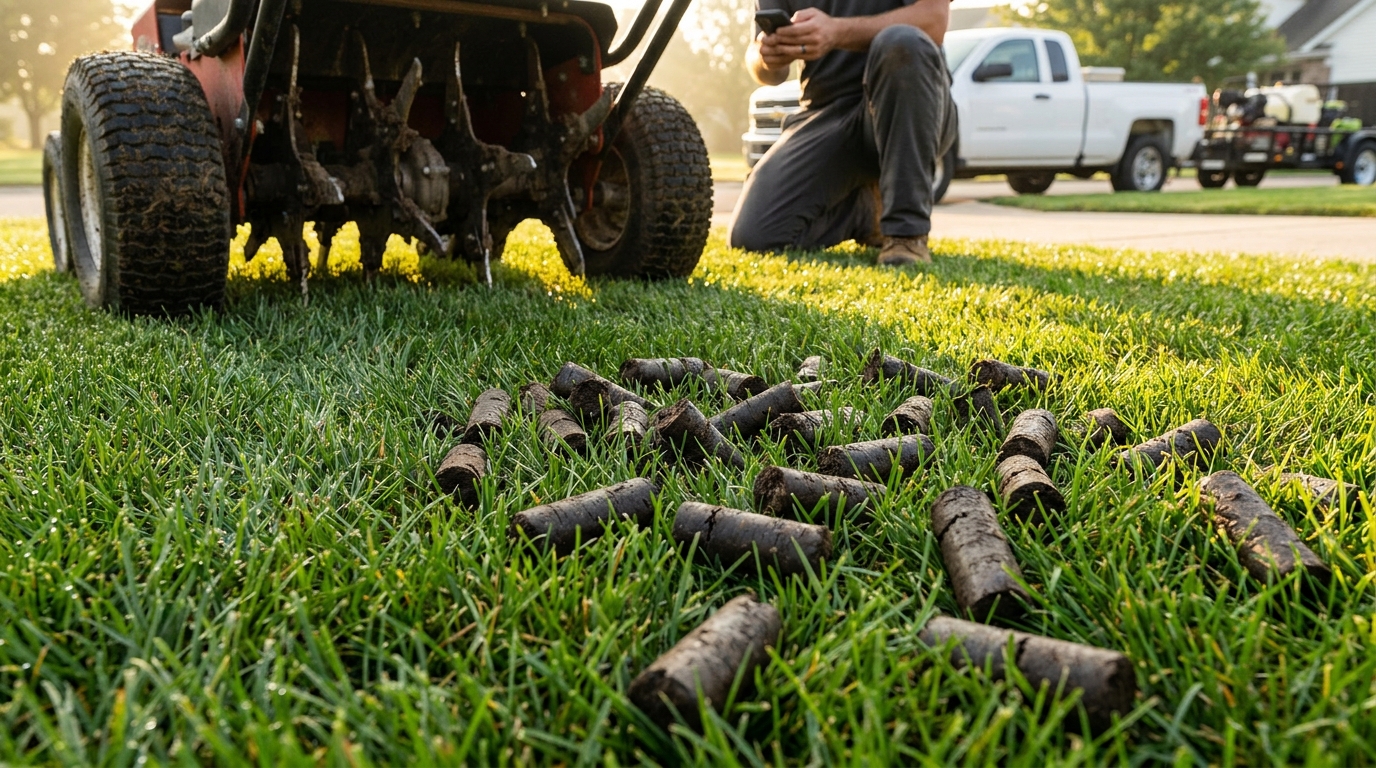
Aeration is not an area-priced service pretending to be a flat-rate one. It's a mobilization-priced service that the whole internet insists on pricing by area.
Run the clock on a real job. A 26-inch self-propelled walk-behind at a normal 3 mph covers 2.2 feet × 15,840 feet per hour ≈ 34,900 sq ft/hr in theory. Manufacturers of this class quote up to about 29,000 sq ft/hr. Now subtract reality: overlap, turning at every bed line, backing around trees, the strip along the fence, the second pass on the compacted path to the front door. Residential de-rating of 40% is generous, which puts you near 13,000 sq ft per productive hour.
So the machine time on an 8,000 sq ft lawn is about 37 minutes. Here's everything else:
- Drive from the last stop: 12 min
- Unload, ramp, stage the machine: 6 min
- Walk the lawn, flag irrigation heads, check the gate and the dog, talk to the customer: 8 min
- Reload and strap down: 6 min
That's 32 minutes of fixed cost before a single tine touches soil, and it does not shrink when the lawn does. Door to door, the 8,000 sq ft job runs about 69 minutes, of which 46% is mobilization.
Now watch what that ratio does as the lawn changes size:
| Lawn size | Machine time | Fixed time | Total | Fixed share |
|---|---|---|---|---|
| 4,000 sq ft | 18 min | 32 min | 50 min | 64% |
| 8,000 sq ft | 37 min | 32 min | 69 min | 46% |
| 20,000 sq ft | 92 min | 32 min | 124 min | 26% |
A single per-square-foot rate assumes the cost curve passes through the origin. It doesn't — it starts at half an hour. That's why a rate tuned on 500 sq ft lawns ($0.07+) is absurd on an acre, and a rate tuned on acres ($0.011) will bankrupt you on postage stamps. Any number that fits both is wrong for both.
What the job actually costs you
Take the same 8,000 sq ft lawn, one operator, a rented machine, three lawns in a four-hour rental block.
| Line item | Basis | Cost |
|---|---|---|
| Labor | 1.15 hr × $28.16/hr ($22 wage + 28% burden) | $32.38 |
| Aerator rental | ~$79 for a 4-hour block ÷ 3 lawns | $26.33 |
| Fuel, tine wear, truck | Per stop | $6.00 |
| Total direct cost | $64.71 |
Hold that number against the ranking pages. LawnStarter's ⅛-acre row tops out at $118 — a 45% gross margin before you've paid for insurance, the truck payment, or your own time selling the job. Their 500 sq ft row bottoms at $35, and your direct cost on a 500 sq ft lawn is still about $48 because the mobilization doesn't care. Priced off the bottom of that row, you pay thirteen dollars for the privilege of aerating someone's lawn.
Rental versus ownership, while we're here. A commercial walk-behind runs roughly $3,500 new at the light end, with used Ryan-class machines listing from about $1,800 and new stand-behind units well north of $9,000. Call it $6,000 for a machine you'd actually keep. At $26.33 of rental displaced per lawn, it pays for itself at 228 aerations — about two seasons for a crew doing 125 a year. Depreciated over five years and 625 lawns, that same machine costs you $9.60 per job instead of $26.33. The same arithmetic decides every machine on the trailer, and we ran it across a whole kit at 2026 manufacturer prices in what lawn care equipment actually costs per lawn.
A two-part rate card that survives contact with a driveway
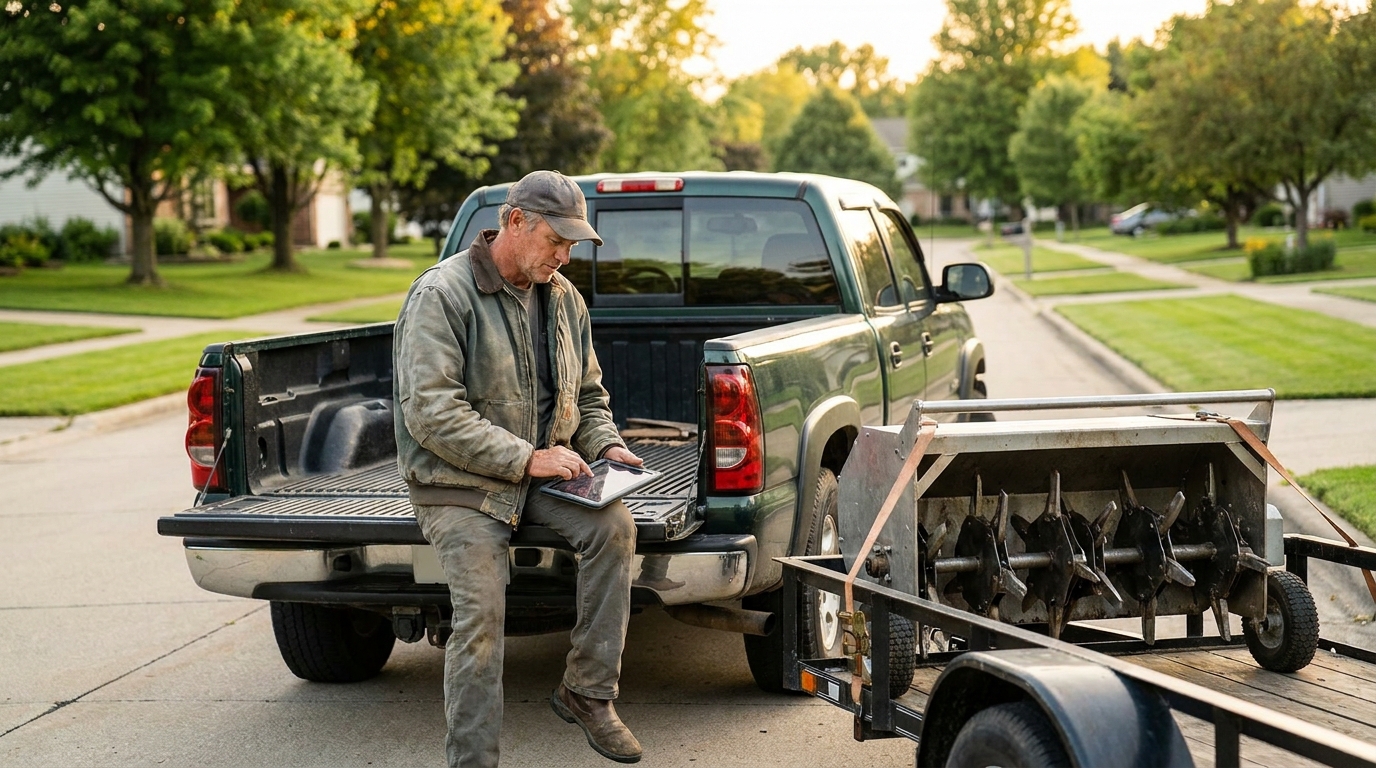
Because the cost curve starts at 32 minutes and then rises with area, your price should have exactly that shape: a trip charge plus a per-1,000-square-foot rate. Here's the structure with defensible numbers in it — $85 trip charge, $9.00 per 1,000 sq ft:
| Lawn | Sq ft | Price | Implied $/sq ft |
|---|---|---|---|
| Small city lot | 3,000 | $112 | $0.037 |
| Typical suburban | 5,000 | $130 | $0.026 |
| ⅛ acre | 5,445 | $134 | $0.025 |
| Common mid lot | 8,000 | $157 | $0.020 |
| ¼ acre | 10,890 | $183 | $0.017 |
| ½ acre | 21,780 | $281 | $0.013 |
| 1 acre | 43,560 | $477 | $0.011 |
Look at the right-hand column. The same rate card — one trip charge, one area rate, no exceptions — produces an effective per-square-foot price that falls from $0.037 to $0.011 as the lawn grows. That 3.4× slide is not a pricing error. It is the answer to "what's the per-square-foot rate for aeration," and the answer is that the question has no single number in it.
Sanity-check it against the outside world and it holds up honestly. Our ¼-acre price ($183) sits inside LawnStarter's $116–$191 row. Our acre price ($477) sits inside their $392–$550 row. We come in above their small-lawn rows — $134 against their $75–$118 at ⅛ acre — and that's deliberate: their small-lawn numbers don't cover a half-hour of mobilization, which is precisely the failure this whole article is about. If you want to match them there, match them knowing you're selling that job at roughly break-even to fill a route.
Two adjustments worth building in:
- Double pass on compacted clay: machine time doubles, mobilization doesn't. On the 8,000 sq ft job, direct cost goes from $64.71 to about $95 — so holding your margin means pricing at about $231, a 47% uplift, not 100%. Charging double for a double pass overprices you out of the job; charging nothing extra eats the difference.
- Minimum: the trip charge is your minimum. Below roughly 2,500 sq ft you are not selling aeration, you're selling a truck showing up. Price it that way and stop apologizing for it.
The overseeding add-on is where the money actually leaks
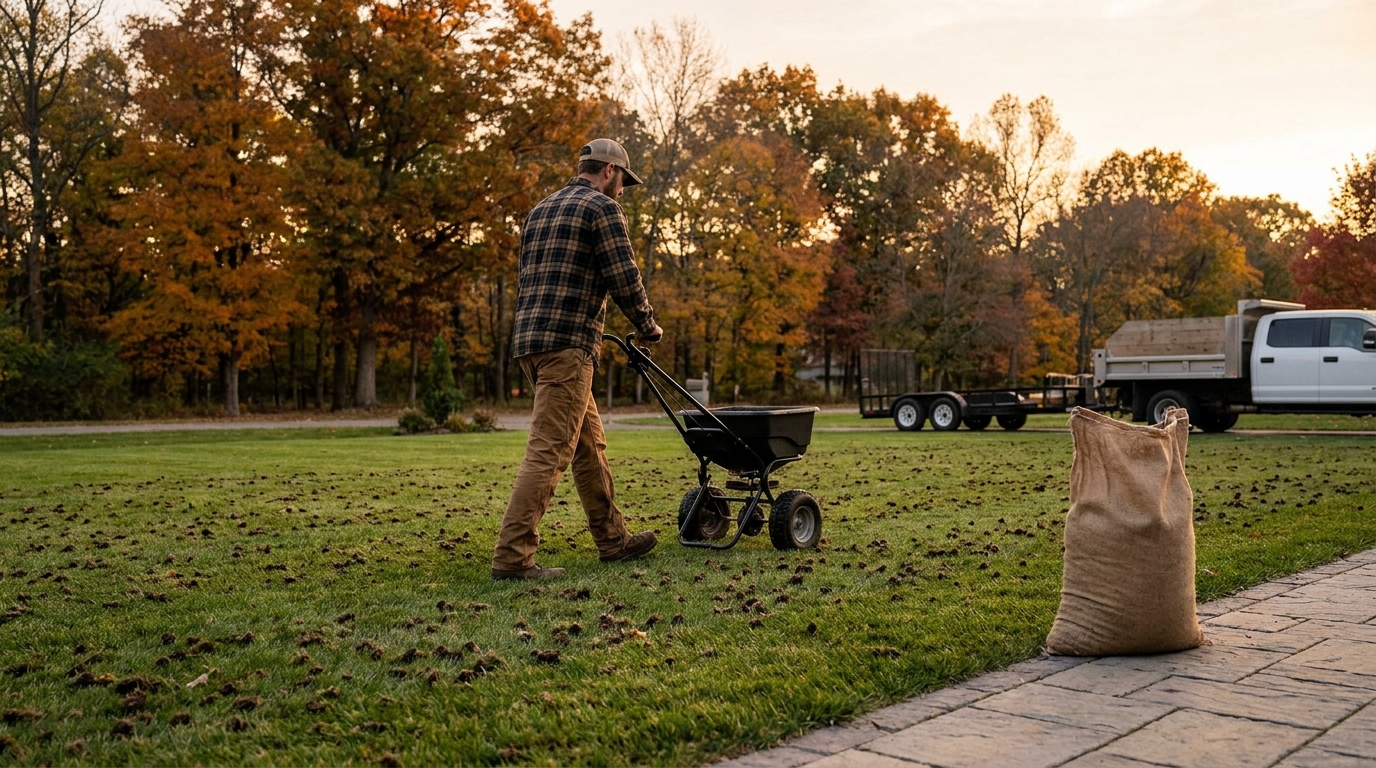
Almost every fall aeration turns into an aeration-and-overseed conversation, and this is where operators quietly hand back their margin — because seed is a real material cost and it scales linearly with area, which aeration labor does not.
The arithmetic, using current retail: a 50 lb bag of tall fescue blend runs about $165, or $3.30 per pound (professional-grade mixes land nearer $2.25). Extension guidance puts a new-lawn seeding rate at 6–8 lb per 1,000 sq ft, so the overseed rate is 3–4 lb per 1,000 sq ft on a thin lawn, and 5–6 on damaged turf.
At 4 lb per 1,000 and $3.30 per pound, that's $13.20 of seed per 1,000 square feet. Which means:
| Lawn | Seed needed | Seed cost | + starter fertilizer | Materials total |
|---|---|---|---|---|
| 5,000 sq ft | 20 lb | $66 | ~$25 | $91 |
| 8,000 sq ft | 32 lb | $106 | ~$40 | $146 |
| ¼ acre (10,890) | 43.6 lb | $144 | ~$54 | $198 |
Add a spreader pass and calibration — call it 18 minutes, about $8.45 of labor — and the true incremental cost of overseeding an 8,000 sq ft lawn is roughly $155.
Now the trap, stated plainly: the operator who tacks "$50 for overseeding" onto the ticket is about a hundred dollars underwater on materials alone. It feels like an add-on. It's a second job with its own cost of goods.
Priced properly, overseeding is $32 per 1,000 sq ft on top of the aeration price — $256 on that 8,000 sq ft lawn, which holds a 38% gross margin on the add-on. Total ticket: $413. For reference, one regional lawn-care firm publishes approximately $425 to aerate and seed a 5,000 sq ft lawn, and a contractor on Reddit quotes $180 per 1,000 sq ft for aeration plus overseeding with lime and a mesotrione starter. Neither is gouging. Both are carrying material costs the "$50 add-on" crowd hasn't priced.
Route density is the variable that decides your season
Go back to the cost table and change exactly one thing: how many aerations you do between loading the machine in the morning and unloading it at night.
At three lawns per rental block, the machine costs you $26.33 a job. At six, it's $13.17. At two, it's $39.50. Nothing about the lawns changed — only the density of the route. On a $157 ticket, that swing is roughly 17 points of gross margin, decided entirely by how you sequenced the day.
Drive time works the same way and hurts more. Twelve minutes between stops is a tight suburban route; twenty-five is a normal one if you booked in the order the phone rang. At $28.16 an hour loaded, that extra thirteen minutes costs $6.10 per stop — call it $37 across a six-stop day, every day, for the six-week window when cool-season aeration is actually worth doing.
This is the part of aeration pricing that isn't pricing at all. Aeration season is short, the machine is either on a trailer or on a lawn, and the operators who make money at it are the ones who cluster their bookings by neighbourhood instead of by the order customers called. If you're sequencing that by hand on a whiteboard, Landscapey's route optimization exists for exactly this: it reorders the day's stops by drive time, which is the single lever with the most dollars attached to it in this entire article.
Frequently asked questions
What's a fair per-square-foot rate for aeration?
There isn't one, and that's the honest answer. Because roughly half the cost of a residential aeration is mobilization, the defensible effective rate runs from about $0.037 per sq ft on a 3,000 sq ft lot down to $0.011 on an acre. If someone hands you a single per-square-foot number, ask what lawn size it was calibrated on — it's almost always the smallest one on their page.
Should I charge a minimum for aeration?
Yes, and your trip charge is it. Thirty-two minutes of load, drive, walk-through and reload happens whether the lawn is 800 sq ft or 8,000. An $85 minimum isn't aggressive; it's the cost of the truck being there, and below about 2,500 sq ft it's most of what you're actually selling.
Is it cheaper to rent or buy an aerator?
At roughly $79 per four-hour rental block spread over three lawns, you're carrying $26.33 per job. A $6,000 machine displaces that at 228 aerations — about two seasons at 125 a year — and then runs at about $9.60 a job on a five-year depreciation. Rent while you're proving demand; buy once you've booked two solid falls.
How much should overseeding add to the price?
About $32 per 1,000 sq ft. Seed alone is $13.20 per 1,000 at a 4 lb rate and $3.30/lb, and starter fertilizer adds $4–$6 more. On a quarter-acre lawn that's nearly $200 of material before labor — which is why a flat "$50 for seeding" add-on loses money on every lawn bigger than a courtyard.
Do I charge double for a double pass?
No — charge about half again. A second pass doubles machine time but doesn't touch the 32 minutes of mobilization, so your cost rises roughly 47% on a typical mid-size lawn, not 100%. Price the uplift at what it costs you, and you'll win the compacted-clay jobs your competitors are quoting at 2×.
Why do the cost pages disagree with each other so badly?
They're answering a different question than you asked. Consumer cost pages aggregate what homeowners report paying across wildly different lawn sizes, regions, and service bundles, then compress it into a headline range. That's a reasonable thing to publish for a homeowner deciding whether to call someone. It is not a cost model, and it falls apart the moment you try to run a price list off it — which is exactly what happens when an operator searches an operator's question and gets a consumer's page.
The short version
Price aeration the way it actually costs you: a trip charge that covers the half hour you spend not aerating, plus a per-1,000-square-foot rate that covers the part where you are. Start at $85 plus $9 per 1,000 sq ft, add $32 per 1,000 for overseeding, uplift 47% for a double pass, and hold a minimum you don't apologize for. Then spend your energy on the variable that moves more money than any of these: how tightly you can cluster the route during the six weeks when the window is open.
If you're tracking aeration jobs, per-property square footage, and recurring fall bookings across a spreadsheet and a phone, Landscapey keeps the whole thing in one place — properties, pricing, scheduling, routes and invoices — so next fall's quote takes thirty seconds instead of thirty minutes of guessing.
More pricing math from the same series: how much to charge for leaf removal, what to price bush trimming at, how to bid landscaping jobs, and — when your costs move and your prices haven't — how to write a lawn care price increase letter.