Search "hydroseeding cost" and page one answers the homeowner: somewhere between $0.06 and $0.26 per square foot, or a few thousand dollars an acre. Search the contractor's version, how much to charge for hydroseeding, and you land in forum threads where one operator asks whether $0.16 to $1.00 a square foot is too high and a Reddit commenter says they paid $900 for 6,000 square feet.
Those numbers are all real, and they disagree because they describe different jobs. This guide builds a hydroseeding quote from the cost side: slurry materials per tank, crew time per load, machine time, the trip, overhead and margin. Then it runs the model across lawn sizes, seed prices and prep work, so you can see where a flat per-square-foot rate makes money and where it loses it.
One rule up front. Every number in the model is an input you should replace. Your seed supplier, your mulch price, your wage and your market set the real figures. The structure of the quote is what carries over.
The short answer
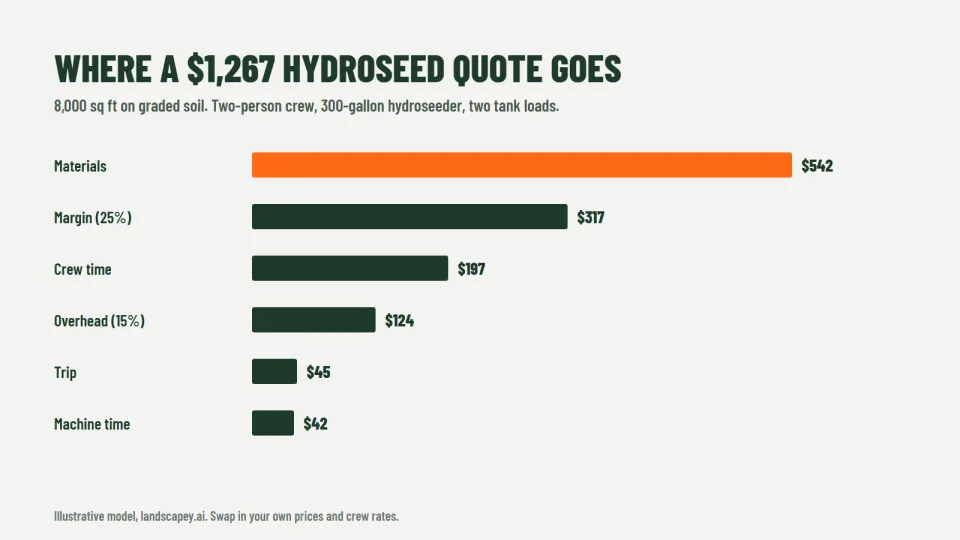
On the inputs below, a two-person crew with a 300-gallon skid-mounted hydroseeder spraying an 8,000 sq ft residential lawn on soil that is already graded comes to $1,267. That is:
- $0.16 per square foot, inside the $0.08 to $0.20 range the homeowner guides quote
- $542 of materials: 8 bales of wood/paper mulch with tackifier, 48 lb of seed, starter fertilizer and water for two tank loads
- $284 of crew, machine and trip cost: about 2 hours 20 minutes on site, plus travel
- $124 of overhead at 15% of direct cost, and $317 of margin, set at 25% of the price
Two things fall out of the model straight away. Small jobs cost far more per square foot, because the trip, setup and cleanup are the same whether you spray 1,500 square feet or 8,000. And soil prep, not the spraying, is what turns a $1,300 job into a $2,000 one, so it needs its own line on the quote.
What goes into a hydroseeding quote
Hydroseeding has a simpler cost structure than most landscape work. There are five pieces:
- Slurry materials. Seed, hydraulic mulch, tackifier, fertilizer and water. These scale almost exactly with square footage.
- Crew time. Setup, mixing each tank, spraying each tank, cleanup and travel. Mixing and spraying scale with the number of tank loads; the rest is fixed per job.
- Machine time. The hydroseeder's depreciation, engine fuel and upkeep, charged per hour it runs.
- The trip. Truck, trailer and fuel to get to the site and back.
- Overhead and margin. Insurance, the shop, the phone, software, your own time spent quoting, and the profit that makes the business worth owning.
Prep work (removing an old lawn, grading, adding topsoil, raking out rocks) is a sixth piece, and it is the one most likely to be underquoted. We'll treat it separately below.
Step 1: Materials per 1,000 square feet
Hydroseeding is a recipe, and the recipe is mostly mulch. Michigan's environmental agency puts the effective rate for wood fiber mulch at about 2,000 lb per acre, which works out to roughly 45 lb per 1,000 square feet, rising to around 3,000 lb per acre in very hot conditions. Larimer County, Colorado gives 2,000 to 3,000 lb of wood fiber per acre for its erosion work. Residential operators mostly sit at the bottom of that range.
The model uses these inputs:
| Material | Rate used | Price used | Cost per 1,000 sq ft |
|---|---|---|---|
| Hydraulic mulch (70/30 wood/paper, tackifier in the bale) | 45 lb (0.9 bale) | $41 per 50 lb bale | about $37 |
| Seed (turf-type tall fescue blend) | 6 lb | $3.25 per lb | $19.50 |
| Starter fertilizer | label rate | flat estimate | $6 |
| Water | about 300 gal per 4,000 sq ft load | $5 per load | about $1.25 |
| Total | about $64 |
The $41 bale is a retail listing for a 50 lb bale of 70/30 blend with tackifier included. Pallet pricing from a distributor is usually lower, so treat it as a ceiling. If you buy plain mulch and add guar tackifier yourself, Michigan's guidance gives about 1.5 lb of guar per 1,000 square feet as a standard rate; check the product label, because sources disagree.
Seed is the input that moves most by region. A cool-season tall fescue blend, a bluegrass mix, bermuda or a native mix can differ by a factor of three or more per pound, and seeding rates differ too. Use your supplier's price and the rate on the bag, not ours.
Bales are bought whole. An 8,000 sq ft job needs 360 lb of mulch, which is 7.2 bales; the model charges 8. Round up on every quote, or the leftover bale quietly eats your margin over a season.
Step 2: Crew and machine time
A 300-gallon unit such as Turbo Turf's HS-300 series is sold as covering up to 4,000 square feet per load. Retailers list the HS-300-XPW skid unit at about $13,000 and the smaller HS-300-E8 at about $6,000 to $6,200, before shipping, and several listings show multi-week lead times. That load size sets the rhythm of the job.
The model's time per job:
- Setup: 30 minutes to unhitch, run the hose, check the site and mark beds and walks to protect
- Per tank load: 20 minutes to fill and mix, 25 minutes to spray
- Cleanup: 20 minutes to flush the pump and hose, wipe overspray off concrete and siding, and load up
- Travel: 45 minutes round trip
For 8,000 square feet that is two loads and about 2 hours 20 minutes on site. With a crew of two at a loaded wage of $32 an hour (wage plus payroll taxes, workers' comp and any benefits), crew time is $197. The machine is charged at $18 an hour of site time, which covers depreciation on a $13,000 unit over five seasons, its engine fuel and annual service, for another $42. The truck and trailer trip is a flat $45.
Your filling time depends on the water source. A hydrant with a meter fills a 300-gallon tank in a few minutes; a customer's garden spigot can take three or four times as long. If you're filling from the house, ask about water pressure when you quote and add time.
Step 3: Overhead and margin
Direct costs on the 8,000 sq ft job come to $826. The model adds 15% for overhead ($124) and then sets the price so that margin is 25% of it, not 25% added on top. That distinction matters. Adding 25% to $950 gives $1,187 and a real margin of 20%. Dividing by 0.75 gives $1,267 and a real margin of 25%.
If you're not sure what your overhead rate is, our landscaping profit margin guide walks through working it out from last year's books. Most small crews land somewhere between 10% and 25%.
Price per square foot by lawn size
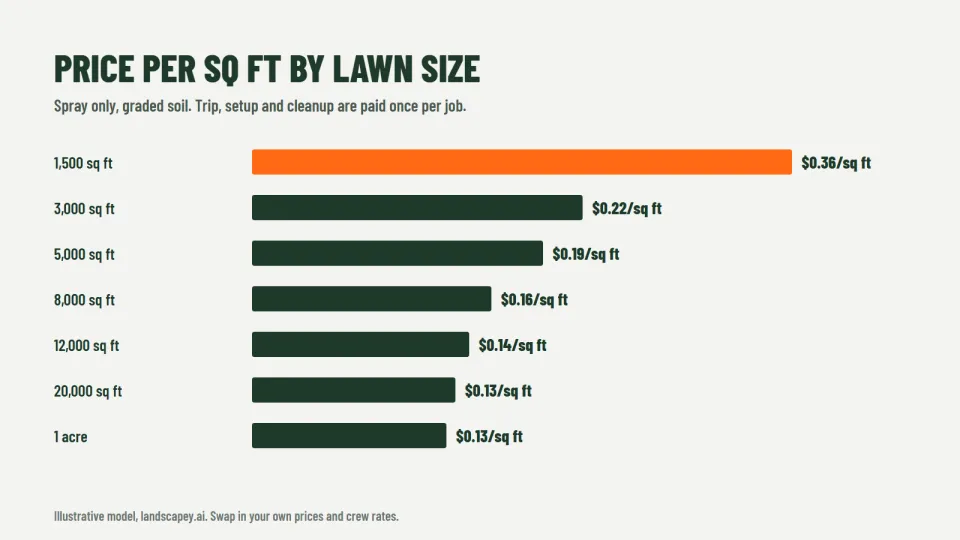
Run the same model at different sizes and the per-square-foot price falls steeply at first, then flattens:
| Lawn size | Tank loads | Time on site | Price | Per sq ft |
|---|---|---|---|---|
| 1,500 sq ft | 1 | 1 hr 35 min | $533 | $0.36 |
| 3,000 sq ft | 1 | 1 hr 35 min | $655 | $0.22 |
| 5,000 sq ft | 2 | 2 hr 20 min | $961 | $0.19 |
| 8,000 sq ft | 2 | 2 hr 20 min | $1,267 | $0.16 |
| 12,000 sq ft | 3 | 3 hr 5 min | $1,714 | $0.14 |
| 20,000 sq ft | 5 | 4 hr 35 min | $2,670 | $0.13 |
| 1 acre (43,560 sq ft) | 11 | 9 hr 5 min | $5,586 | $0.13 |
Three practical conclusions.
You need a minimum. A 1,500 sq ft patch still takes the trip, the setup and the cleanup. On these inputs it costs about $400 to do and prices at $533. A flat $0.16 rate would have billed $240 and lost money. Most operators set a job minimum somewhere around the price of their smallest sensible job; on this model that's about $500.
Quote a per-square-foot rate with a size band, not one number. A rate card that reads "$0.22 under 4,000 sq ft, $0.18 to 8,000, $0.15 to 15,000, $0.13 above" tracks the model closely and is still simple for the customer.
A 300-gallon machine is not an acreage machine. The consumer guides quote $2,000 to $4,000 an acre. That figure comes from contractors running 800 to 3,000-gallon units with lower mulch rates on erosion and roadside work, where one load covers a large area. At 11 loads an acre, a 300-gallon unit can't compete there, and on this model it shouldn't try. If acreage jobs are a big share of your calls, that's the signal to look at a larger machine, not to cut your price.
Price soil prep as its own line
Every number above assumes you arrive to bare, graded, raked soil. That is rarely what you find. Hydroseed only germinates as well as the seedbed it lands on, so the prep is where the result is won or lost, and where most underquoted jobs go wrong.
Price prep by the crew-hour, separately from the spray:
| Prep on the 8,000 sq ft job | Crew hours (2 people) | Total price | Per sq ft |
|---|---|---|---|
| None (graded, raked soil) | 0 | $1,267 | $0.16 |
| Light: rake out, pick rocks, roll | 2 | $1,463 | $0.18 |
| Medium: power rake, fine grade, roll | 4 | $1,659 | $0.21 |
| Heavy: kill and strip old lawn, regrade | 8 | $2,052 | $0.26 |
These add only crew time. Equipment rental (a sod cutter, a power rake, a tractor with a box blade), herbicide, dump fees and imported topsoil are on top, and topsoil adds up fast: two inches over 8,000 square feet is about 49 cubic yards before it's spread. Quote those at cost plus your usual markup, and show them as their own lines so the customer can see why one bid is $1,300 and another is $3,500.
This is also where the wide spread in homeowner quotes comes from. A Reddit commenter's "$900 for 6,000 square feet" and a forum poster's "$1.00 a square foot" can both be fair prices. One is a spray on a ready seedbed, the other includes stripping and grading a weedy yard.
How sensitive is the price to seed?
Seed is about 12% of the price on the base job, so even large swings in seed price move the total less than you might expect:
| Seed price per lb | 8,000 sq ft price | Per sq ft |
|---|---|---|
| $2.00 | $1,175 | $0.15 |
| $3.25 (base) | $1,267 | $0.16 |
| $5.00 | $1,395 | $0.17 |
| $8.00 | $1,616 | $0.20 |
The practical point: don't cheapen the seed to win a bid. Dropping from a $3.25 blend to a $2.00 one saves the customer $92 on an 8,000 sq ft lawn. If that cheaper seed means a thin stand and a callback, you lose far more than $92 on the return trip alone.
Hydroseeding vs sod: the price gap you're selling against
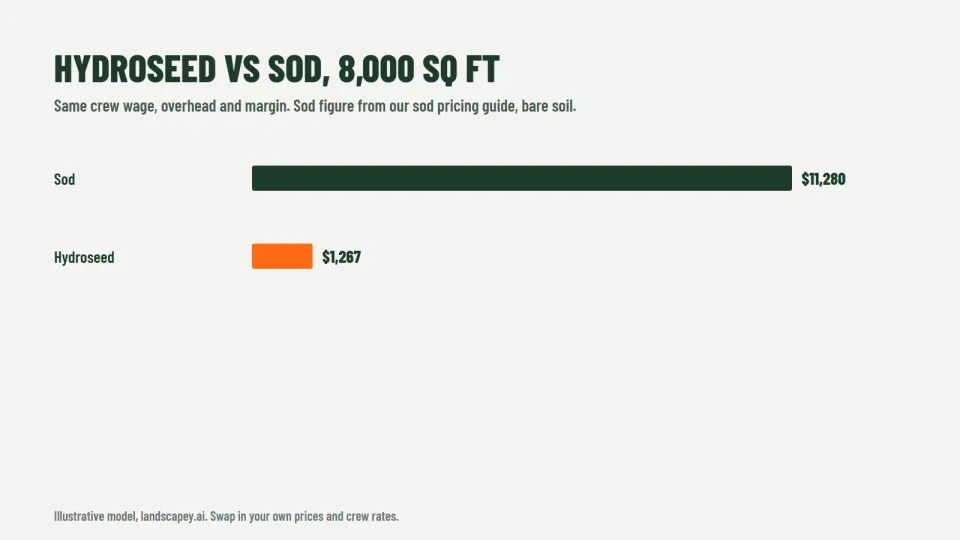
Many hydroseed customers are comparing you with sod, and the gap is big. Our sod installation pricing guide uses the same crew wage, overhead and margin, and comes to about $1.41 per square foot on bare soil. On 8,000 square feet that is about $11,300 for sod against $1,267 for hydroseed, close to nine times as much.
Sell the trade-off honestly, because the customer will find it out anyway:
- Hydroseed is much cheaper and gives a uniform stand of a seed mix you choose, with no seams.
- Sod is a lawn on day one. Hydroseed is a lawn in four to eight weeks, and only if the customer waters it.
- Hydroseed has a planting window. Cool-season grasses do best seeded in late summer and early fall; warm-season grasses want late spring and early summer. Sod goes down in a much wider window.
- Slopes favor hydroseed. The mulch and tackifier hold seed in place on banks where sod is hard to lay and pin.
If you offer both, quote both on the same estimate as options. The customer makes the choice, and you don't lose the job to a sod-only competitor because you only showed one price.
Write the watering terms into the quote
The most common hydroseeding complaint isn't price. It's "it didn't come up." Almost always, the seedbed dried out. The customer controls the watering after you leave, so your quote and invoice should say plainly:
- who waters (the customer), how often (typically light watering several times a day until germination, then deeper and less often) and for how long
- what your germination guarantee covers, if you offer one, and that it depends on the watering schedule being followed
- what a touch-up visit costs if bare patches need respraying, so it's priced before anyone is upset
- that heavy rain in the first days can wash mulch on slopes, and what you'll do if it does
A short printed watering sheet left at the door does more for your reviews than any discount.
Does buying a hydroseeder pay?
On these inputs, the 8,000 sq ft job earns $317 of margin plus $42 toward the machine. At about $360 a job, a $13,000 unit pays itself back in roughly 36 jobs of that size. If you already do seeding and overseeding, our aeration and overseeding pricing guide covers the fall service that most hydroseed customers also ask about.
A few things decide whether you reach 36 jobs:
- Demand is seasonal. In cool-season areas the busy windows are late summer to mid-fall and again in spring. Expect weeks where the machine sits.
- Builders and remodelers are the steady customers. New-construction lots and post-excavation repairs (septic, drainage, utility trenches) need seed on bare soil, often on a deadline.
- Renting first is cheap research. Some equipment rental yards carry small hydroseeders. Renting for your first handful of jobs tells you your real time per load before you spend five figures.
Putting it on the estimate
A hydroseeding estimate that gets approved, and doesn't get argued about later, usually has these lines:
- Site prep, with what's included (strip, grade, rake, roll) and any topsoil in cubic yards
- Hydroseed application, with square footage, seed mix name and rate
- Materials passed through if the customer chose a premium seed mix
- Touch-up visit, priced as an option
- Watering and germination terms in the notes
In Landscapey you can build that as a quote with line items, send it as a link the customer approves on their phone, and convert the approved quote straight into an invoice or a scheduled job. See landscaping estimate software for how quotes work, or start free and build your first hydroseed quote in a few minutes. The plan is on the pricing page.
FAQ
How much should I charge per square foot for hydroseeding?
On this model, about $0.13 to $0.22 per square foot for the spray alone on graded soil, depending on lawn size, with a job minimum around $500. Prep work is extra and can add $0.02 to $0.10 per square foot or more. Replace the model's inputs with your own costs before using any of these numbers.
What's a typical minimum charge for hydroseeding?
Enough to cover a full trip, setup, one tank load and cleanup, plus overhead and margin. On these inputs that is about $500. Below that you're paying to do small jobs.
How much does hydroseeding cost per acre?
Homeowner guides quote about $2,000 to $4,000 an acre, which reflects large-tank machines on erosion and commercial work. With a 300-gallon residential unit, this model comes to about $5,600 an acre because it takes 11 tank loads. Quote acreage on your real load count.
How many square feet does a tank of hydroseed cover?
It depends on the machine and the mix. Manufacturers rate 300-gallon units at up to about 4,000 square feet per load; larger units cover proportionally more. Thicker mulch rates for slopes or hot weather cover less.
Should I include watering in the price?
Usually not. The customer waters. Put the schedule in writing and make any germination guarantee depend on it. If you do offer a watering service, price it as separate visits.
Is hydroseeding cheaper than sod?
Much cheaper. On matching assumptions, about $0.16 per square foot against about $1.41 for sod on an 8,000 sq ft lawn. Sod gives an instant lawn and a wider install window, which is what the customer pays for.
Sources and limits
Mulch and tackifier rates are from Michigan's hydroseeding guidance for nonpoint source control and Larimer County, Colorado's hydromulching fact sheet. Machine prices and the 4,000 sq ft per load rating are from US retailer listings for Turbo Turf HS-300 units, checked November 2026 and excluding shipping. The mulch bale price is a single retail listing for a 50 lb 70/30 blend with tackifier. Homeowner price ranges are as printed by the consumer guides on page one of Google. The company, crew, wage, overhead and margin in the model are illustrative assumptions, not survey data, and no agronomist reviewed this guide. Your seed supplier and local extension office are the right sources for seed mixes and seeding dates in your area.