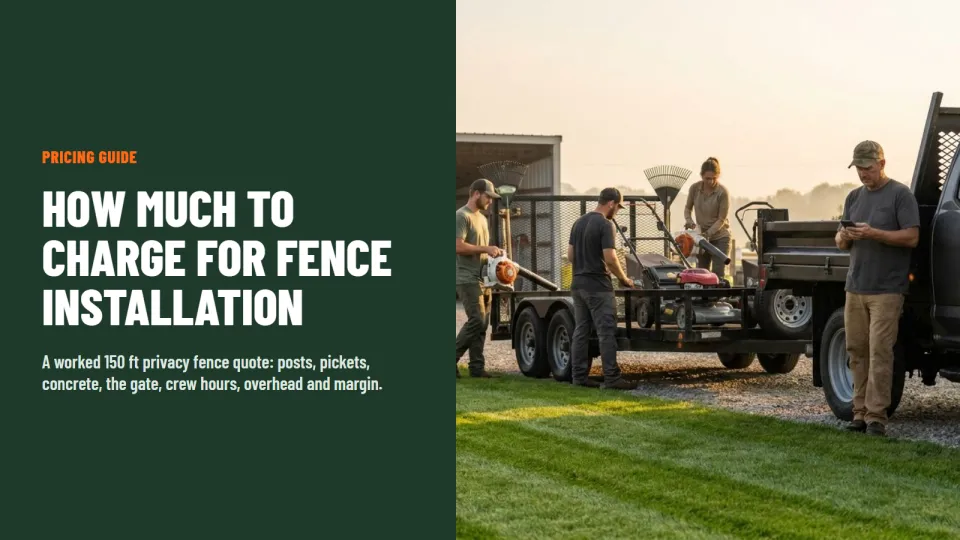
Search "fence installation cost" and the homeowner gets a range. 2026 cost guides put a 6-foot wood privacy fence at somewhere between about $25 and $55 per linear foot installed, and a typical 150-foot backyard job at roughly $3,500 to $10,000. Search the installer's version of the question, how much to charge for fence installation, and the answers get thin. You find a Reddit thread asking what a fair labor-only rate is, a few contractor blogs with a per-foot number and no working, and a lot of "it depends on the yard."
This guide does the installer's version properly. It builds a residential wood privacy fence quote from the cost side: posts, rails, pickets, concrete, fasteners, the gate, the auger, crew hours, trips, the permit, overhead and margin. Then it runs that model across fence length, wood species, tear-out, rocky ground, slopes, gates and height, so you can see what a per-foot price is really paying for.
One rule up front. Every number in the model is an input you should replace. Your lumber yard's prices, your wage, your overhead, your local permit rules and your market set the real figures. The structure of the quote is what carries over.
The short answer
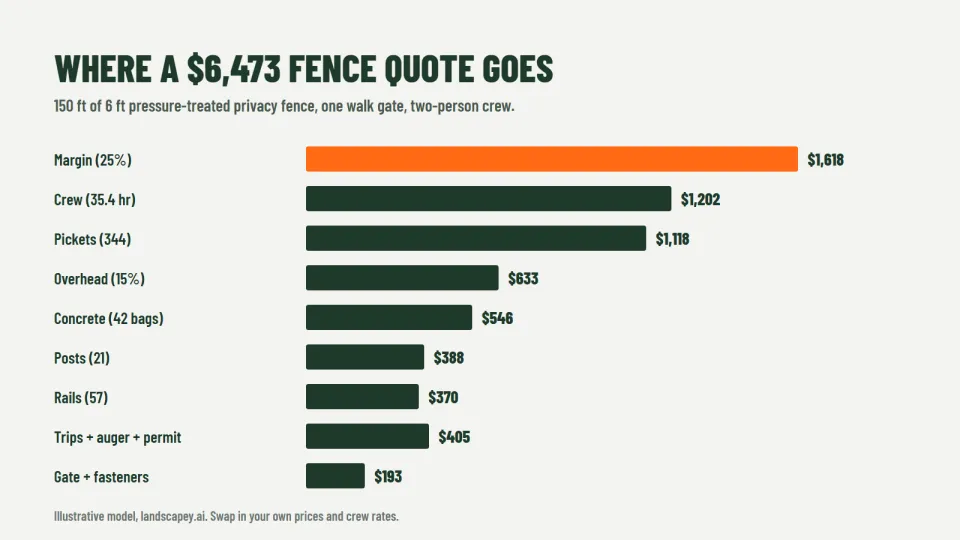
On the inputs below, a two-person crew installing 150 feet of 6-foot pressure-treated pine dog-ear privacy fence with one 4-foot walk gate (21 posts on 8-foot spans, two of them 6x6 gate posts, 19 sections of three rails, 344 pickets including 5% waste, two bags of fast-set concrete per post, a rented two-man auger for the post day, a permit, and a full walk-through at the end) comes to $6,473, or about $43 per linear foot. That breaks down as:
- $4,221 of direct cost
- $2,615 of materials: $1,118 of pickets, $546 of concrete, $388 of posts, $370 of rails, $110 of gate hardware and framing, and $83 of fasteners
- $1,202 of crew time (35.4 crew-hours at $34 burdened, spread over three short days so the post concrete can set before the sections go on)
- $150 of auger rental, $180 of trips and $75 for the permit
- $633 of overhead at 15% of direct cost, and $1,618 of margin, set at 25% of the price
Two things stand out. First, the $43 a foot sits inside the $33 to $53 per foot national range that HomeWyse publishes for wood privacy fence, so the model is not out of line with the market. Second, materials are 40% of the price and labor is only 19%. Fence is a lumber job before it is a labor job, which is why a quote built from "my guys cost X a day" alone comes out low every time lumber moves.
The model, line by line
Here is every input, so you can see which ones you would change first.
| Line | Input | Cost on the base job |
|---|---|---|
| Line posts | 19 x 4x4x8 ground-contact pressure-treated at $16 | $304 |
| Gate posts | 2 x 6x6x8 pressure-treated at $42 | $84 |
| Rails | 57 x 2x4x8 ground-contact (3 per section) at $6.50 | $370 |
| Pickets | 344 x 5/8 x 5.5 in x 6 ft dog-ear pine at $3.25 (150 ft, butted, +5% waste) | $1,118 |
| Concrete | 2 x 50 lb fast-set bags per post at $12.99 | $546 |
| Fasteners and brackets | $0.55 per linear foot | $83 |
| Walk gate | Hinges, latch, drop rod $65 + frame lumber $45 | $110 |
| Crew | 35.4 crew-hours at $34 burdened | $1,202 |
| Auger | Two-man auger, one rental day | $150 |
| Trips | 4 truck trips at $45 | $180 |
| Permit | Flat allowance | $75 |
| Direct cost | $4,221 | |
| Overhead | 15% of direct | $633 |
| Margin | 25% of price | $1,618 |
| Price | $6,473 |
A few of those inputs deserve a word.
- Ground-contact posts and rails. Pressure-treated lumber is sold in above-ground and ground-contact grades, and the price gap is real (a few dollars a post). Posts go in the ground, so they need the ground-contact stamp. Check the tag before you load the truck; a fence that rots at the base in six years is a warranty call you priced at zero.
- Concrete is bigger than people expect. At two 50 lb bags a post and about $13 a bag at retail (Ace and several hardware stores list Quikrete Fast-Setting at $11.99 to $12.99), concrete costs more than the posts it holds. If you set posts in gravel or tamped soil, or buy bulk, this line changes a lot.
- Pickets are the swing line. At $3.25 each, pickets are 17% of the whole price. Switching to cedar at about $5.75 a picket adds $860 of material and, after overhead and margin, about $1,320 to the price.
- The auger is rented for one day. Posts go in on day one; sections go on after the concrete sets. Renting the auger for the whole job is a common way to quietly lose $300.
Crew hours: where the 35 hours go
The labor side of the model uses unit hours you can check against your own job history:
| Task | Unit hours | Crew-hours on 150 ft |
|---|---|---|
| Layout, string line, 811 marks check | 2.0 per job | 2.0 |
| Load, unload, stage material | 1.5 per job | 1.5 |
| Dig, set, plumb, brace and concrete each post | 0.6 per post | 12.6 |
| Rails and pickets, per 8 ft section | 0.75 per section | 14.3 |
| Build and hang the walk gate | 3.0 per gate | 3.0 |
| Cleanup and walk-through with the customer | 2.0 per job | 2.0 |
| Total | 35.4 |
That works out to about $8 of crew cost per linear foot. Notice that number is a cost, not a labor price. If you quote "labor at $15 a foot plus materials," you are charging roughly $8 of wages and $7 that has to cover overhead, equipment, trips and profit on the whole job, including the lumber you bought and carried. Make sure the materials side is marked up as well, or that $7 is doing too much work.
Price per foot by fence length
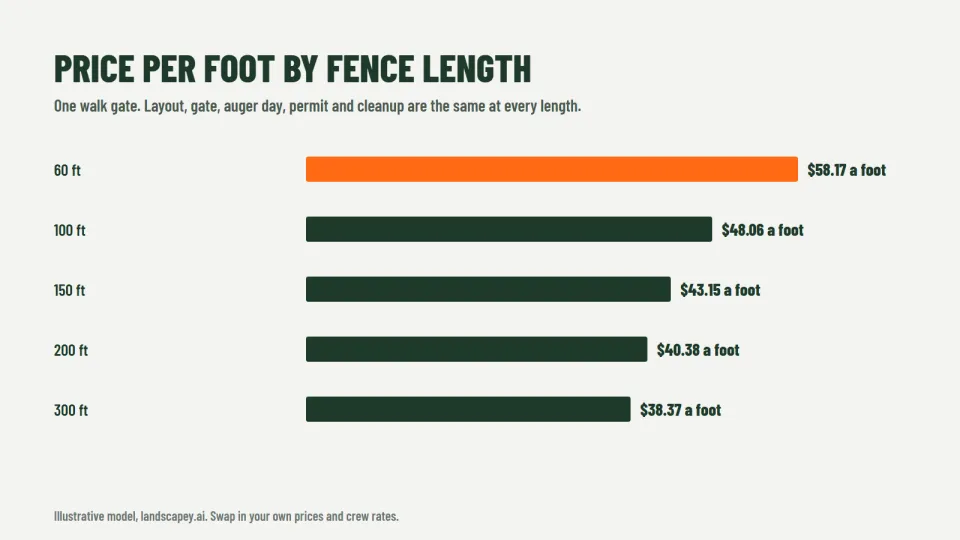
Per-foot pricing feels fair to customers, and it is how most of the cost guides talk. The trouble is that a fence job has fixed costs that do not scale with length: layout, the gate, the auger day, the permit, the first and last trips, and cleanup. Spread them over a short run and the per-foot price climbs fast.
| Length (one walk gate) | Price | Per linear foot |
|---|---|---|
| 60 ft | $3,490 | $58.17 |
| 100 ft | $4,806 | $48.06 |
| 150 ft | $6,473 | $43.15 |
| 200 ft | $8,076 | $40.38 |
| 300 ft | $11,511 | $38.37 |
The cleaner way to quote it is a job charge plus a per-foot rate. On these inputs, $1,500 per job (including one walk gate) plus $33 per linear foot matches the full model within about 1% at every length from 60 to 300 feet. That is easy to say on a driveway, easy to put in an estimate template, and it stops you from losing money on the 60-foot dog run.
What changes the price
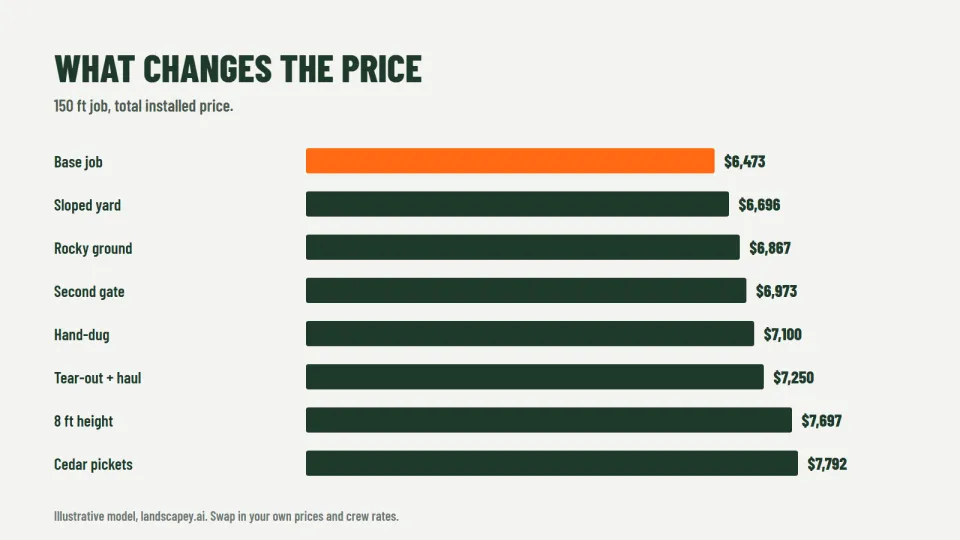
Here is the same 150-foot job with one thing changed at a time:
| Change | Price | Per foot | Why it moves |
|---|---|---|---|
| Base job (PT pine, 6 ft, one gate) | $6,473 | $43.15 | |
| Sloped yard, stepped sections | $6,696 | $44.64 | Sections take about 30% longer to hang |
| Rocky or root-bound ground | $6,867 | $45.78 | Post holes take about 60% longer |
| Second walk gate | $6,973 | $46.49 | Two more 6x6 posts, hardware and 3 hours |
| Hand-dug, no auger access | $7,100 | $47.33 | Post time more than doubles; rental drops off |
| Tear out and haul the old fence | $7,250 | $48.34 | About 10 more crew-hours plus a $150 dump fee |
| 8 ft height | $7,697 | $51.31 | Longer posts, a fourth rail, taller pickets |
| Cedar pickets | $7,792 | $51.94 | Pickets cost about 75% more each |
| Cedar plus tear-out | $8,569 | $57.13 | Both of the above |
The point of the table is not the exact dollars. It is that every one of these is visible at the site visit. Walk the line before you price it: push a probe bar into the ground where the posts will go, look for a gate you can get an auger through, ask whether the old fence stays or goes, and ask the HOA question. Each answer is a line item, and leaving one out is how a $43 fence becomes a $35 fence after the fact.
The flat-rate trap
Plenty of crews quote fence at a round number per foot they heard somewhere. Take $25 a foot, the figure some cost guides give as an average for basic pressure-treated fence. On this 150-foot job that is $3,750. The direct cost in the model is $4,221. At $25 a foot you are about $470 below cost before overhead or profit, and that is on a straight, flat, soft-soil job with one gate.
Can a fence company make money at $25 a foot? A high-volume fence installer buying lumber by the unit, setting posts in gravel and running a crew that does nothing but fence may well have lower costs than this model. That is a real advantage, and it is fair to acknowledge it. But a landscaping company that installs a few fences a year, buys retail lumber and sets posts in concrete is not that business, and should not price as if it were.
How to present the quote
Most customers have already looked at a cost guide. Give them a quote they can compare to it, with the decisions they control spelled out:
- The fence itself, as a job charge plus a per-foot price, with height, style and wood named.
- Gates as separate lines, each with its width.
- Tear-out and haul-away as its own line, priced per foot.
- Site conditions you found on the walk: slope, rock, access.
- Options, priced so they can say yes or no: cedar pickets, a cap board, a second gate, stain or sealer.
- Who handles the permit and the property line. In many places the homeowner is responsible for knowing where the property line is. Say in writing that they are, and that you will build where they mark.
If you already send quotes from your phone, this is a five-line estimate. In Landscapey's estimate tool you can save the fence as a template (job charge, per-foot line, gate, tear-out, cedar upgrade), adjust the footage on site and send it before you leave the driveway. If you want a refresher on building any quote from cost, our guide to bidding landscaping jobs covers the method, and the labor cost calculator will help you work out your own burdened hourly rate.
Permits, HOAs and call-before-you-dig
Fence rules are local, so keep this general and check your own city and county:
- Permits. Many cities require a permit for fences over a certain height, often 6 feet in back yards and lower in front yards. Some do not require one at all for residential wood fence. The model carries a $75 allowance; adjust it for your area.
- HOAs. Homeowner associations often set height, style, color and which side faces out. Ask for the HOA approval before you order lumber.
- 811. Call 811 (or use your state's online ticket) a few business days before you dig post holes. Every post hole is a dig.
- Setbacks and corner lots. Corner lots often have sight-triangle rules near the street. A fence that blocks a driver's view can be ordered down.
None of this is legal advice. It is a checklist so nothing on it lands on your margin.
Is fence work worth adding for a landscaping company?
For many landscapers, yes, with conditions. Fence work fits naturally next to the other install work you already price, like retaining walls and paver patios, and it fills the slower parts of the season when mowing routes thin out. The customer who asks for a fence is often redoing the whole back yard, and the stumps in the fence line are another quote (see stump grinding pricing).
The conditions: price it from cost, not from a flat per-foot number; rent or own the right auger; know your permit rules; and be honest about what you will not do (long commercial runs, chain link across a whole property, or ornamental steel are different trades). The landscaping profit margin guide is a good check on whether the margin you set here matches the rest of your work.
FAQ
How much should I charge per foot to install a wood privacy fence?
On the inputs in this guide, about $43 a foot for 150 feet of 6-foot pressure-treated pine with one gate, rising to about $58 a foot on a 60-foot run and falling to about $38 a foot at 300 feet. A job charge of $1,500 plus $33 a foot reproduces the model closely. Replace the inputs with your own prices before you use the numbers.
How much should I charge for fence installation labor only?
In this model, crew cost alone is about $8 a foot. A labor-only price has to carry overhead, trips, equipment and profit on top of that, and it carries no markup on materials, so labor-only quotes usually need a higher labor rate than the same job quoted with materials. Check that the customer's materials are on site, correct and ground-contact rated before you commit to a date.
How much should I charge for a fence gate?
In this model, adding a 4-foot walk gate to a fence job adds about $500 to the price: two 6x6 gate posts, hinges, a latch, a drop rod, frame lumber and about three crew-hours. Double drive gates take more time and heavier hardware, so price them separately.
Should I charge to remove the old fence?
Yes, as its own line. In this model, tearing out and hauling 150 feet of old fence adds about 10 crew-hours plus a dump fee, roughly $780 on the price. Customers often assume removal is included, so say clearly whether it is.
Is cedar worth quoting as an upgrade?
Quote it as an option and let the customer decide. On this job, cedar pickets add about $1,320 to the price, from $6,473 to $7,792. Some customers will take it for the look and the longer life; some will not.
How long does a 150-foot fence take?
In this model, about 35 crew-hours, which a two-person crew spreads over three short days: posts and concrete on day one, rails and pickets once the concrete has set, and the gate and walk-through at the end. Rock, slopes and tear-out stretch it.
Sources and limits
Homeowner price ranges come from published 2026 cost guides, read on 3 November 2026: HomeWyse lists $33.07 to $53.00 per linear foot for wood privacy fence, Inch Calculator gives $13 to $45 a foot with an average around $25, and HomeGnome puts privacy fence at $31.50 to $53.50 a foot. Fast-setting concrete is retail-listed at $11.99 to $12.99 per 50 lb bag at several hardware stores, and Home Depot lists both above-ground and ground-contact pressure-treated 4x4 posts. Picket, post, rail and gate prices in the model are assumptions within current retail ranges; contractor and bulk prices are usually lower. Crew hours, wage, auger rental, overhead and margin are assumptions, labeled as such. The whole model is illustrative and is meant to be rebuilt with your own numbers. Permit, HOA and property-line rules vary by location, and nothing here is legal advice.
Ready to quote it? Start free with Landscapey and build the fence, gates and options as line items, or see what the plan costs.