Ask a room of landscapers what they charge to install mulch and you get a spread from $50 to $150 a yard, plus "it depends." Ask Google and you get homeowner averages: $77 to $94 a yard installed, $0.71 to $1.38 a square foot. Neither tells you what your crew costs to weed, edge, haul and spread ten yards into a client's beds, or what to put on top so the job is still worth doing once the wheelbarrows are back on the trailer.
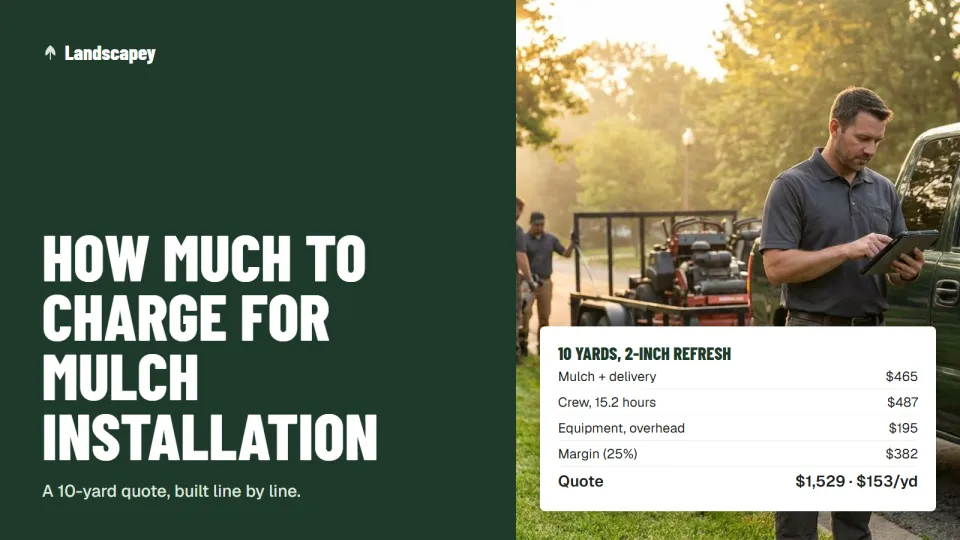
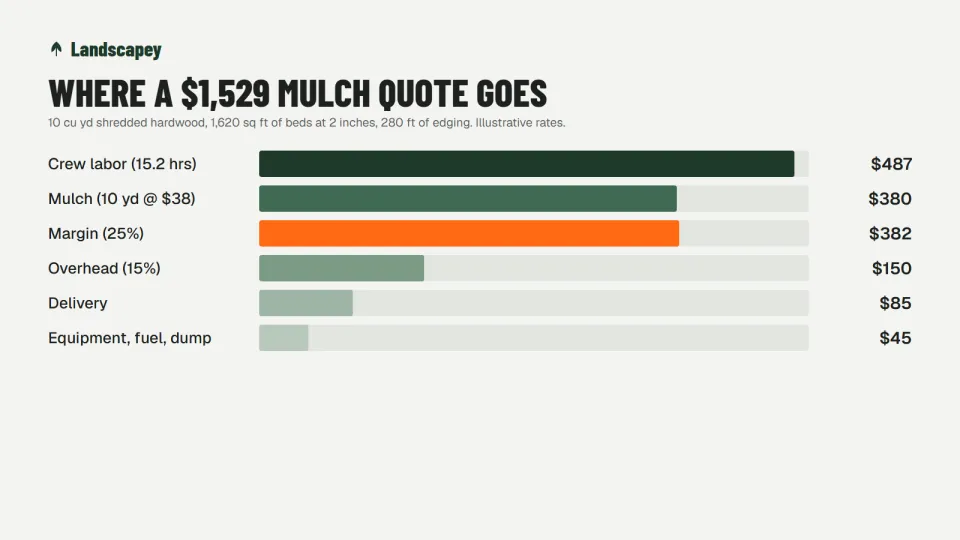
This guide builds a mulch quote from the bottom up. Every line is a cost you actually pay: the mulch by the yard, delivery, crew hours for each task, equipment and dump fees, then overhead and margin on top. The worked example lands at $1,529 for a 10-yard job with weeding and edging ($153 a yard), or $1,273 for spread-only ($127 a yard). The job-size table shows why a 2-yard touch-up has to cost close to $250 a yard, and why you can't win a 40-yard commercial bed at the homeowner average.
The rates in the example are illustrative and labeled that way. Swap in your own mulch price, wage and productivity and the same method gives you your number.
What page one says, and why it doesn't help you quote
The figures you'll see most often, as published on the sites themselves when we checked on October 26, 2026:
| Source | What it says | Written for |
|---|---|---|
| LawnStarter (updated October 5, 2026) | $77 to $94 per cubic yard installed, 2 to 3 inches, delivery and labor included | Homeowners |
| Homewyse (May 2026) | $0.71 to $1.38 per sq ft installed, roughly 2 inches deep, 534 sq ft example | Homeowners |
| A lawn care company's calculator (October 2026) | $135 per cubic yard delivered and installed, 1-yard minimum | Its own customers |
| A LawnSite forum thread (2017) | $50 to $72 a yard labor plus the mulch; 40 to 60 minutes per yard; $40 per man-hour minimum | Operators |
| A widely shared landscaping coach video (2024) | About $150 per yard, flexible on big jobs | Operators |
Two things stand out. First, the homeowner averages sit well below what operators actually quote. Second, at least one of them doesn't hold together on its own page. LawnStarter's headline is $77 to $94 a yard installed, but the same article lists bulk mulch alone at $30 to $135 a yard, and its "installed cost by type" table puts pine bark at $30 a yard installed. Thirty dollars is what a yard of pine bark costs at the supply yard. Nobody spreads it for free. Homewyse's breakdown has a similar problem: its mulch, labor and equipment lines show the identical dollar range, and they don't add up to its per-square-foot figure.
That's not a knock on those sites. They're written to give a homeowner a rough sense of the bill. If you quote off them, though, you're quoting off numbers that were never built from a crew's costs.
The operator-side search results are no better organized. For "how much to charge for mulching," the top results are a Reddit thread started by a garden-center employee, a Facebook group post asking what's fair for 16 yards by wheelbarrow, a Quora question, and a nine-year-old forum thread. The answers in them are real, but they're one person's market and one person's crew. The method below is how you get to your own.
Step 1: Measure the beds and convert to yards
Everything starts with volume. One cubic yard is 27 cubic feet, which is 324 square feet at one inch deep. Divide by your depth and you have coverage:
| Depth | Coverage per cubic yard | Typical use |
|---|---|---|
| 1 inch | 324 sq ft | Top-dressing faded mulch (color only) |
| 2 inches | 162 sq ft | Annual refresh over existing mulch |
| 3 inches | 108 sq ft | New beds or bare soil |
| 4 inches | 81 sq ft | Heavy weed suppression, play areas |
Most extension services recommend 2 to 3 inches for planting beds, and warn against piling mulch against trunks and stems. The "volcano" ring around a tree is the classic error, and it's one more reason the spreading takes time: someone has to pull mulch back from every trunk.
Practical measuring rules that keep the estimate honest:
- Measure, don't eyeball. A measuring wheel around each bed, then break odd shapes into rectangles and triangles. Satellite measuring tools are fine for big commercial beds; check them on site.
- Know what's already there. Two inches of old mulch means a 2-inch refresh, not a 3-inch install. Poke a trowel in. Over-applying year after year is how beds end up at 6 inches.
- Round up, then add 5 to 10 percent. Bulk loads settle, and the last half-yard always ends up short. Buying an extra yard costs $30 to $60. Making a second supply run costs far more.
- Write down linear feet of bed edge. You'll price edging separately, and it's the line most people forget.
For the worked example: a suburban property with 1,620 square feet of beds getting a 2-inch refresh. 1,620 / 162 = 10 cubic yards. The beds have about 280 linear feet of edge.
Step 2: Price the mulch and the delivery
Bulk mulch prices in 2026 consumer cost guides cluster around $25 to $50 a yard for plain shredded hardwood and $30 to $60 for dyed, with cedar and cypress higher. Those are retail. Your supply yard's contractor price is the only number that counts, and it moves with region, volume and season. Get it in writing and update it every spring.
For the example we'll use $38 a yard for dyed hardwood, and a supply-yard delivery fee of $85 for a single load (consumer guides cite $70 to $140; yours may be lower on a contractor account).
Two decisions here that change the quote:
- Delivery or your own truck. Hauling it yourself saves the delivery fee but costs a loading trip, fuel and truck wear. If your truck carries 3 yards and the job needs 10, that's four trips. Delivery almost always wins above about 5 yards.
- Bags or bulk. A 2-cubic-foot bag runs $3.25 to $6.50 retail, and it takes 13.5 bags to make a yard, so bags cost roughly a third more per yard before you count the time spent cutting them open and hauling away the plastic. Bags make sense for tiny jobs, tight access, or when the client wants a specific product only sold bagged.
Material plus delivery on the example: 10 x $38 + $85 = $465.
Step 3: Price the labor, task by task
This is where most mulch quotes go wrong. Operators quote "per yard" and think about the spreading, but the spreading is only half the hours. Break it into tasks:
| Task | Rate used (illustrative) | Example hours |
|---|---|---|
| Spreading (wheelbarrow, flat yard, short haul) | 0.75 person-hours per yard | 7.5 |
| Weeding and bed cleanup before mulch | 0.15 person-hours per 100 sq ft | 2.4 |
| Spade edging | 100 linear ft per person-hour | 2.8 |
| Travel, load and unload | Flat per job | 1.5 |
| Cleanup, blow off hardscape, tarp the pile spot | 0.5 hr + 0.05 hr per yard | 1.0 |
| Total | 15.2 person-hours |
The spreading rate matches what operators report: the LawnSite thread above says 40 to 60 minutes a yard. Yours will vary. Long wheelbarrow runs, hills, a back yard behind a gate, or a pile dumped on the street instead of the driveway can double it. Beds full of ground cover and perennials slow it down, because every yard has to be placed by hand rather than dumped and raked. Time your crew on three jobs and use your own average.
At a loaded labor rate of $32 an hour (wage plus payroll taxes, workers' comp and the rest; work out your own with our labor cost calculator), the example's labor is 15.2 x $32 = $487.
Add $45 for equipment, fuel and dumping the weeds and old debris. That's the direct cost of the job: $465 + $487 + $45 = $997.
Step 4: Add overhead and margin
Direct cost is what the job costs. It doesn't cover your insurance, your phone, the office hours spent quoting, the truck payment, or the estimate you gave that didn't close. That's overhead, and it has to be recovered on every job. The example uses 15 percent, which is $150, bringing the cost to $1,147.
Margin is what's left for the business after everything is paid. On a 25 percent margin, you divide by 0.75 (not multiply by 1.25, which gives you only a 20 percent margin):
$1,147 / 0.75 = $1,529. That's $153 a yard, or about $0.94 a square foot.
If the confusion between markup and margin is new to you, our landscaping profit margin guide walks through it with more examples. Short version: if you want 25 cents of every dollar to stay in the business, the divide-by method is the one that gets you there.
The same job, spread only
Plenty of clients want "just the mulch." Drop the weeding and edging and the labor falls to 10 hours ($320). Direct cost becomes $830, overhead $125, and the quote $1,273, or $127 a yard. That's the number to compare against the $135-a-yard calculator and the $150 coaching figure above. It's in the same range, and it's well above the homeowner averages, which is the point: $77 to $94 a yard doesn't cover a crew with real overhead.
How job size changes the price per yard
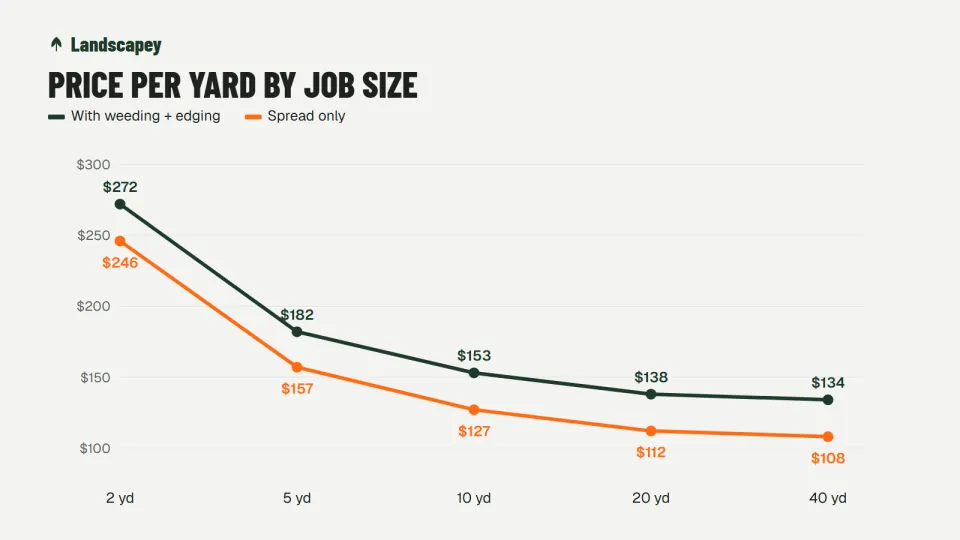
Travel, loading, setup and the delivery fee cost about the same whether you spread 2 yards or 20. Spread those fixed costs over fewer yards and the price per yard goes up fast. Using the same rates as above (beds sized at a 2-inch refresh, edge length scaled with area, a second delivery above 20 yards):
| Job size | Bed area | Quote with weeding + edging | Per yard | Spread only, per yard |
|---|---|---|---|---|
| 2 yards | 324 sq ft | $543 | $272 | $246 |
| 5 yards | 810 sq ft | $912 | $182 | $157 |
| 10 yards | 1,620 sq ft | $1,527 | $153 | $127 |
| 20 yards | 3,240 sq ft | $2,757 | $138 | $112 |
| 40 yards | 6,480 sq ft | $5,346 | $134 | $108 |
(The 10-yard line here is $2 off the worked example because edging is estimated from area in the table, not measured.)
What this means in practice:
- Set a minimum. A 2-yard job at $100 a yard is $200, and you'd lose money on it. Many operators set a job minimum of $300 to $500 for mulch, or a 3-yard minimum. Put it on the quote so it's not a surprise.
- Bundle small jobs. The 2-yard touch-up makes sense as an add-on to a spring cleanup visit that's already paying for the trip. Quote it separately and it's a money-loser; add it to a cleanup and the fixed costs are already covered.
- Big commercial beds compete on productivity, not price per yard. At 40 yards, the per-yard number flattens out. Winning there means a faster spreading rate (a skid steer or a mulch blower), not shaving the margin.
What the mulch itself does to the quote
The yard price of mulch matters less than people think, because labor is the bigger line. Same 10-yard job, same crew hours, different product:
| Mulch price per yard | Quote with weeding + edging | Per yard | Spread only | Per yard |
|---|---|---|---|---|
| $28 (natural hardwood, bulk) | $1,376 | $138 | $1,119 | $112 |
| $38 (dyed hardwood) | $1,529 | $153 | $1,273 | $127 |
| $50 (premium dyed) | $1,713 | $171 | $1,457 | $146 |
| $65 (cedar or cypress) | $1,943 | $194 | $1,687 | $169 |
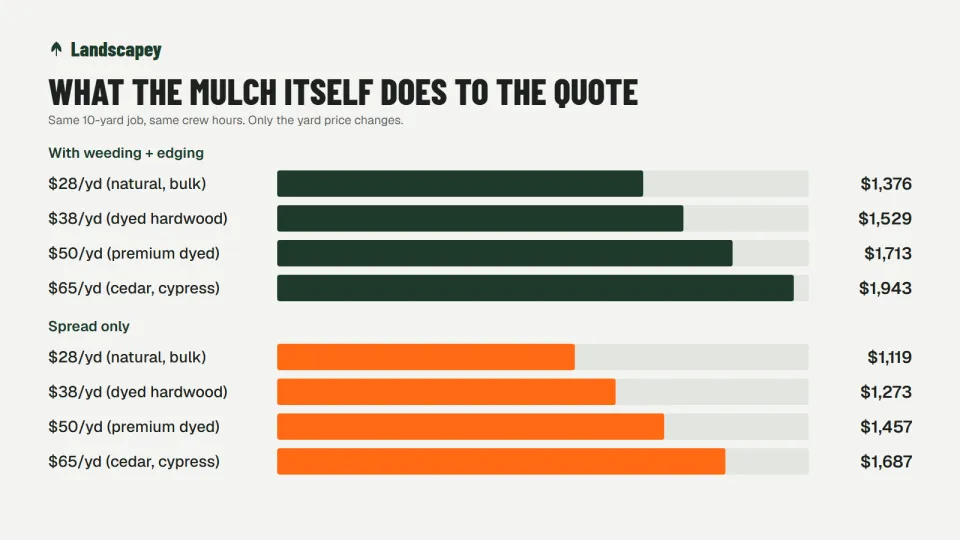
Note that each extra dollar of mulch adds about $1.53 to the quote, because overhead and margin ride on materials too. That's correct, not padding: you're fronting the money for the mulch, carrying the risk of over-ordering, and standing behind the result. If a client wants a cheaper quote, offering a natural hardwood instead of a premium dyed product is a real option to put on the table, and it saves them more than they'd guess.
Three ways to present the price
The method above gives you a number. How you present it to the client is a separate choice. Here's the same 10-yard job presented three ways:
| Method | How it works | Example quote | Best for |
|---|---|---|---|
| Per yard, installed | One rate per yard covering material, delivery and labor; weeding and edging as separate lines | 10 yd x $127 = $1,270, plus $259 for weeding and edging | Residential; easy for clients to compare year to year |
| Flat job price | One number for the whole scope | $1,529 | Clients who want one figure; you keep productivity gains |
| Hourly plus materials | Crew hours at a billing rate, materials at a markup | 15.2 hrs x $65 + $380 x 1.3 + $85 = $1,567 | Hard-to-scope jobs, tight access, unknown bed condition |
Per-yard pricing is the easiest to explain, but it hides the weeding and edging unless you break them out, and that's where disputes come from: "I paid for 10 yards of mulch, why are there weeds in it?" Whatever method you pick, list what's included (weeding, edging, pulling mulch back from trunks, cleanup) and what isn't (removing old mulch, fabric, hauling away excess). Our guide to bidding landscaping jobs covers how to write that scope so it holds up.
Things that should raise the price
- Old mulch removal. If the beds are already at 4 to 6 inches, the right job is to remove some before adding more. That's extra labor plus disposal fees (consumer guides cite $50 to $100 in disposal). Price it as its own line.
- Access. A back yard behind a 36-inch gate, a long haul uphill, or a pile that has to sit on the street all slow the spreading. Add 25 to 50 percent to the spreading hours, or quote hourly.
- Dense plantings. Beds packed with perennials or ground cover mean placing mulch by hand, not dumping and raking.
- Landscape fabric. Installing or repairing fabric is extra material and time. Many operators steer clients away from it under mulch anyway, since mulch breaks down on top and weeds root into it.
- Peak season. In most of the country, April and May are when every client wants mulch at once. If your schedule is full, there's no reason to price spring mulch at your slow-season rate.
Things that can lower it honestly
- Repeat clients on a schedule. A property you mulch every spring has known beds, known access and known depth. You can quote faster and spread faster, and you can afford a small loyalty discount.
- Bundling with a spring cleanup. The trip, the setup and the cleanup are already paid for by the cleanup visit, so the mulch add-on can carry a lower per-yard rate and still make more money than a standalone job.
- Volume pricing from your yard. Bigger orders often get better contractor pricing. Pass some of it along on the big jobs.
Running the numbers every spring
The trap with mulch pricing is that the number you picked three springs ago keeps going on every quote while mulch, fuel and wages move. Re-check four inputs every year before the rush: your supply yard's price per yard, the delivery fee, your loaded labor rate, and your crew's actual spreading time from last season. If any of them moved, your per-yard rate moved too.
This is where keeping your jobs, hours and invoices in one place pays off. When last year's mulch jobs are in your estimating software with the yards, the hours and the final invoice, checking whether you made money on them takes a few minutes, not an evening with a calculator. Landscapey keeps your clients, quotes, recurring jobs and invoices together, so next spring's mulch quote starts from what last spring's jobs actually cost. It's free to start, and $19.99 a month once you're invoicing through it.
If you're building out a full spring price list, our lawn care pricing chart covers the recurring services, and the sod installation pricing guide uses the same bottom-up method for turf. For the bed prep side of a new install, see garden bed preparation.
FAQ
How much should I charge per yard to install mulch?
Build it from your own costs, but with typical 2026 inputs ($38 a yard for mulch, $32 an hour loaded labor, 45 minutes a yard to spread, 15 percent overhead, 25 percent margin), a 10-yard spread-only job comes to about $127 a yard installed, and about $153 a yard with weeding and edging included. Small jobs run higher per yard; large jobs run lower.
How much mulch do I need for a bed?
One cubic yard covers 324 square feet at 1 inch deep. Divide by your depth: 162 square feet at 2 inches, 108 at 3 inches. Measure the beds, divide, round up, and add 5 to 10 percent for settling.
How long does it take to spread a yard of mulch?
Operators commonly report 40 to 60 minutes per yard per person by wheelbarrow on easy access. Long hauls, slopes, tight gates and dense plantings can double that. Time your own crew on a few jobs and use your average.
Should I charge per yard or per hour for mulching?
Per yard (or a flat job price) works best for residential jobs you can measure, because clients can compare it and you keep the benefit if your crew gets faster. Hourly plus materials is safer when you can't scope the job well: unknown bed condition, hard access, or old mulch that may need removing.
What's a good minimum charge for a mulch job?
Fixed costs like travel, loading and delivery make very small jobs unprofitable at a normal per-yard rate. Many operators set a minimum of $300 to $500, or a 3-yard minimum, and sell 1 to 2 yard touch-ups as add-ons to a spring cleanup visit instead.
Why are online mulch installation prices so much lower than what landscapers charge?
Homeowner cost guides are rough averages meant to give someone a sense of the bill, and some of them mix material-only prices into "installed" figures. They aren't built from a crew's labor, overhead and margin. When you build the quote line by line, $77 to $94 a yard rarely covers a professional crew.
Sources and limits
Published figures (LawnStarter, Homewyse, the operator calculator, the LawnSite thread, consumer mulch price guides) were read on October 26, 2026 and are quoted as their sites state them. The worked example's rates (mulch price, delivery fee, labor rate, task productivity, overhead and margin) are illustrative assumptions chosen to be typical, not survey data. Your supply yard's price and your own crew's timed productivity will give you a more accurate number than any figure here.