Ask a homeowner cost guide what a paver patio costs and you'll be told $10 to $24 a square foot. Ask landscapers who install them and the answers on Reddit run closer to $35 to $40 a square foot in the Midwest. Both numbers get quoted as "the going rate," and neither tells you what your crew costs to dig out, base, compact, lay, cut and sand a patio in a specific backyard, or what to put on top so the job is still worth it after the last bag of polymeric sand is swept in.
This guide builds a paver patio quote from the bottom up. Every line is something you actually pay for: excavation and haul-off, base gravel, bedding sand, pavers, edge restraint, joint sand, equipment, crew hours and travel, then overhead and margin. The worked example is a 20 x 20 ft (400 sq ft) concrete paver patio, and it lands at $11,559, or $28.90 a square foot. The tables after it show how that number moves with patio size, paver choice and your crew's real production rate, which is the single biggest swing in any hardscape bid.
The rates in the example are illustrative and labelled that way. Swap in your own supply-yard prices, wage and timed production and the same method gives you your number.
What page one says, and why it doesn't help you quote
These are the figures that come up most often, as published on the sites themselves when we checked on October 27, 2026:
| Source | What it says | Written for |
|---|---|---|
| LawnStarter (paver patio guide) | $10 to $24 per sq ft installed | Homeowners |
| LawnStarter (brick paver patio, updated late October 2026) | $14 to $24 per sq ft | Homeowners |
| Stone Center (2025 breakdown) | 300 sq ft patio: $3,000 to $5,100 | Homeowners |
| A paving company's 2025 guide | $15 to $30 per sq ft for most homeowners | Homeowners |
| r/landscaping thread (Midwest) | Around $35 to $40 per sq ft, lower at scale | Installers and buyers |
| Houzz thread (2017) | $12 to $15 per sq ft for labor | Homeowners asking installers |
The homeowner guides are averages meant to set expectations for a buyer. They don't know your base depth, your dump fees, your access, or how long your crew takes per square foot. Stone Center's 300 sq ft patio at $3,000 to $5,100 works out to $10 to $17 a square foot, which on our numbers below doesn't cover materials, equipment and labor on a 300 sq ft job before any overhead or profit. Meanwhile the operator-side results for "how much to charge for a paver patio" are a Reddit thread, a Facebook group, Quora, a Bogleheads forum post and a 2017 Houzz discussion. Nobody on page one shows the math. So here it is.
The five cost buckets in every paver patio
Every paver job, from a 120 sq ft landing to a 1,000 sq ft outdoor room, breaks into the same five buckets. Price each one and the per-square-foot figure falls out at the end instead of being guessed at the start.
- Dig and haul. Excavating to depth, plus getting the spoils off site. On a patio this is often the most underestimated line, because soil swells when you dig it and dump fees are charged on the loose volume, not the hole.
- Materials. Base gravel, bedding sand, geotextile fabric, pavers (plus waste), edge restraint and polymeric joint sand.
- Equipment. Plate compactor, a mini skid steer or tracked loader for the dig, and a cut-off saw with blades. Owned or rented, each one has a daily cost.
- Labor. Crew hours for the whole job at your loaded wage (wage plus payroll taxes, workers' comp and any benefits), plus drive time for every day on site.
- Overhead and margin. Your share of the truck, trailer, insurance, phone, software and office time, then the profit the business keeps.
If you haven't worked out your loaded labor rate yet, start with our labor cost calculator. It's the number every line below depends on.
Worked example: a 20 x 20 ft paver patio
The job: a 400 sq ft rectangular patio off the back door, 60mm concrete pavers in a simple running bond, decent access for a mini skid steer, ordinary soil, no existing slab to remove. A three-person crew. These are the assumptions, all illustrative:
- Excavation: 8 inches deep (4 in base, 1 in sand, 2.4 in paver, a little extra), with 6 inches of over-dig on each side so the base extends past the pavers. That's a 21 x 21 ft dig, 441 sq ft.
- Base: 4 inches compacted, which suits a walking patio on well-drained soil. Clay soils and freeze-thaw climates usually call for 6 inches or more.
- Base gravel: $32 a ton plus $100 delivery. Published 2026 guides put base gravel at roughly $15 to $40 a ton before delivery, so check your quarry.
- Pavers: $5.69 a sq ft, a current retail pallet price for a common 4 x 8 concrete paver. Your contractor price is probably lower. Pallets hold about 120 sq ft, and we order 7% over for cuts and breakage.
- Polymeric sand: $45 a 50 lb bag, covering about 75 sq ft on tight joints. Retail bags run roughly $35 to $88 depending on brand.
- Production rate: 5.7 sq ft per person-hour for the whole job, start to finish. That figure comes from one contractor's real 1,020 sq ft job (179.5 person-hours) published by SynkedUp. It's a real data point, not an industry average, which is exactly why you should replace it with your own.
- Loaded labor: $34 an hour.
- Overhead: 15% on direct cost. Margin: 25% of the final price.
Step 1: Dig and haul
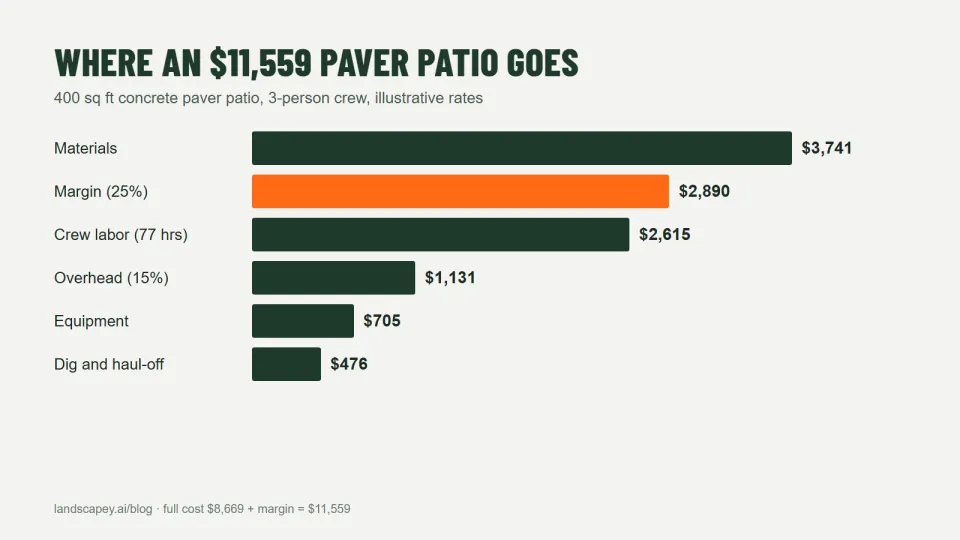
The dig is 441 sq ft x 8 in deep = 10.9 cubic yards of soil in the ground. Dug soil swells by around 25%, so you're hauling about 13.6 loose yards. At an illustrative $35 a loose yard for haul-off and tipping, that's $476. If you can leave clean fill on site for the client, this line shrinks. If you're paying for a roll-off dumpster in a city with high tipping fees, it can double.
Step 2: Materials
| Item | Quantity | Cost |
|---|---|---|
| Base gravel (4 in compacted, 20% compaction allowance) | 9.1 tons + delivery | $393 |
| Bedding sand (1 in) | about 1.5 tons | $59 |
| Geotextile fabric | 441 sq ft at $0.20 | $88 |
| Concrete pavers | 4 pallets, 480 sq ft at $5.69 | $2,731 |
| Edge restraint and spikes | 80 ft at $2.50 | $200 |
| Polymeric sand | 6 bags at $45 | $270 |
| Materials total | $3,741 |
Notice the pavers are almost three-quarters of the materials bill. Whole pallets are how most yards sell them, so a 400 sq ft patio with 7% waste (428 sq ft) still means buying four pallets (480 sq ft). Some yards take back full unopened pallets; most won't take back loose stone. Either price the leftover into the job or agree up front that the extra pavers stay with the client for future repairs, which they usually appreciate.
Step 3: Equipment
Three days of a plate compactor at about $95 a day, one day of a mini skid steer at $300 for the dig, and $120 for the saw and blades: $705. If you own the equipment, don't zero this line out. Charge yourself a daily rate that covers payments, maintenance and replacement, or your owned gear quietly subsidizes every bid.
Step 4: Labor
400 sq ft at 5.7 sq ft per person-hour is 70.2 person-hours. With three people that's about 23 crew-hours, so three working days. Add 45 minutes of drive time per person per day (6.75 hours) and the job is 76.9 person-hours x $34 = $2,615.
Travel is easy to forget on hardscape because the crew is on one site for days. But every day is a mobilization: load, drive, unload, and the reverse at night. On a five-day job that's real money.
Step 5: Overhead, margin and the price
| Line | Amount |
|---|---|
| Dig and haul | $476 |
| Materials | $3,741 |
| Equipment | $705 |
| Labor (76.9 hrs) | $2,615 |
| Direct cost | $7,538 |
| Overhead (15%) | $1,131 |
| Full cost | $8,669 |
| Price at 25% margin (full cost / 0.75) | $11,559 |
| Per square foot | $28.90 |
| Profit kept | $2,890 |
Margin is calculated on the price, not marked up on cost. A 25% markup on $8,669 would give you $10,836, which is only a 20% margin. If that distinction is fuzzy, our guide to landscaping profit margins walks through it.
$28.90 a square foot sits above the homeowner guides and a little below the Reddit installers. That's about where you'd expect a reasonably efficient crew on an easy site to land. It also explains why so many operators feel undercut by "$15 a square foot" quotes: on these costs, $15 a square foot is $6,000, which is less than the $7,538 the job costs before overhead.
How patio size changes the price per square foot
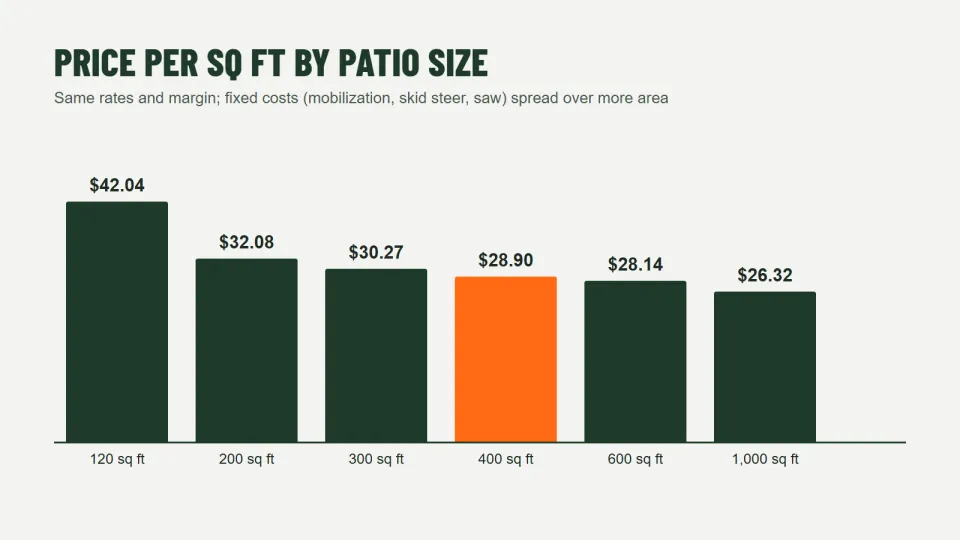
Some costs barely change with size: the skid steer day, the saw, delivery, and drive time per day. Small patios carry those fixed costs over fewer square feet. Same assumptions, different sizes:
| Patio size | Crew days | Person-hours | Direct cost | Price | Per sq ft |
|---|---|---|---|---|---|
| 120 sq ft (landing) | 1 | 23 | $3,290 | $5,045 | $42.04 |
| 200 sq ft | 2 | 40 | $4,184 | $6,415 | $32.08 |
| 300 sq ft | 3 | 59 | $5,922 | $9,081 | $30.27 |
| 400 sq ft | 3 | 77 | $7,538 | $11,559 | $28.90 |
| 600 sq ft | 5 | 117 | $11,011 | $16,883 | $28.14 |
| 1,000 sq ft | 8 | 193 | $17,165 | $26,320 | $26.32 |
The 120 sq ft landing costs $42 a square foot because one day of mobilization, a skid steer day and a saw rental land on a tiny area. That's not gouging. That's what small hardscape jobs cost, and it's why many installers set a minimum (often $3,000 to $5,000) rather than quote small jobs at their big-patio rate. Large patios come down, but slowly: even at 1,000 sq ft the materials and labor scale with area, so the per-foot price only drops about 9% from the 400 sq ft job.
Production rate is the number that makes or breaks the bid
Materials are easy to price because the supply yard tells you. Labor is where hardscape bids are won and lost, and it all comes down to square feet per person-hour, across the entire job, not just laying. Here's the same 400 sq ft patio at three production rates:
| Production rate | Person-hours | Labor cost | Price | Per sq ft |
|---|---|---|---|---|
| 4 sq ft / person-hour (first season, tough site) | 111 | $3,782 | $13,639 | $34.10 |
| 5.7 sq ft / person-hour (our example) | 77 | $2,615 | $11,559 | $28.90 |
| 8 sq ft / person-hour (dialed-in crew, open site) | 57 | $1,930 | $10,507 | $26.27 |
A crew that's 40% faster can quote about $2.60 a square foot less and keep the same margin. A crew that's slower than it thinks loses its whole profit without noticing until the job's done. The fix is boring and it works: on every patio, write down the square footage and the total person-hours from the first shovel to the last broom, then divide. After five or six jobs you have your own number, split by site type. That's how the contractor behind SynkedUp's 5.7 figure got theirs, and it's worth more than any published table, including this one.
If you're tracking crew time on paper, it's worth moving it somewhere you can actually add up later. Landscapey's estimates keep each job's line items with the client, so when you bid the next patio you can see what the last one really took.
How paver choice moves the quote
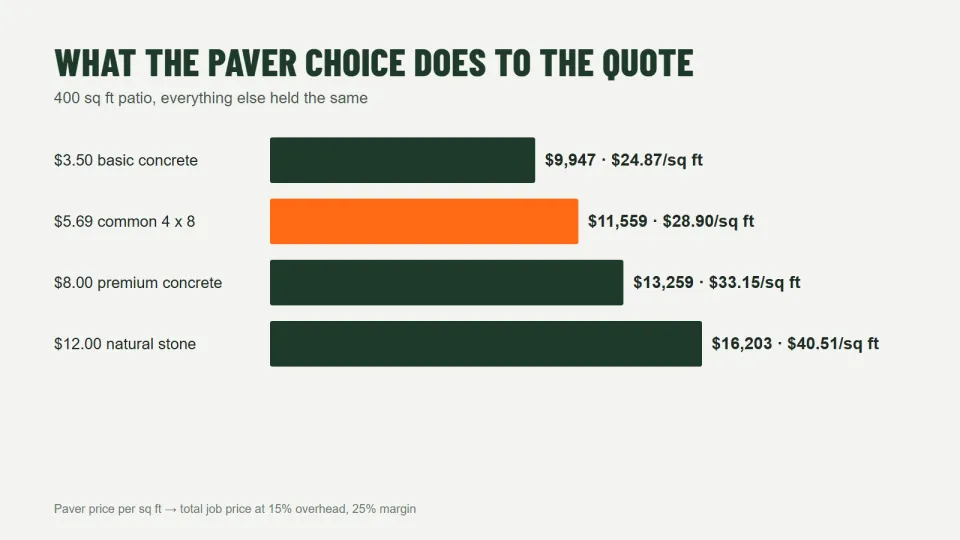
Pavers range from basic concrete to tumbled, textured and natural stone. Holding everything else the same, here's what the paver price per square foot does to the 400 sq ft job:
| Paver price | Paver cost (480 sq ft) | Job price | Per sq ft |
|---|---|---|---|
| $3.50 (basic concrete, contractor pricing) | $1,680 | $9,947 | $24.87 |
| $5.69 (common 4 x 8, retail pallet price) | $2,731 | $11,559 | $28.90 |
| $8.00 (premium textured concrete) | $3,840 | $13,259 | $33.15 |
| $12.00 (natural stone or porcelain) | $5,760 | $16,203 | $40.51 |
Because overhead and margin are applied to material cost too, every $1 a square foot on the paver adds about $1.84 a square foot to the price on this structure. Some installers prefer to put a smaller markup on materials and a larger one on labor, so a client's upgrade to a fancier stone doesn't balloon the quote. Either way is defensible. What isn't is pricing every option at one flat per-square-foot rate and absorbing the difference.
Natural stone and large-format porcelain also tend to lay slower, so in practice the jump to the bottom row is bigger than the table shows. Adjust the production rate as well as the paver price.
Site conditions to price separately
The worked example is an easy site. Real ones aren't. These are the conditions that most often turn a profitable patio into a loss, and how operators commonly handle each one:
- Existing concrete or old patio to remove. Price demolition and disposal as its own line, by the square foot or by the hour plus dump fees. Concrete is heavy, and tipping is often charged by weight.
- Restricted access. If a skid steer won't fit through the gate, everything moves by wheelbarrow and your production rate drops sharply. Re-run the labor line at a lower rate rather than adding a guess.
- Slope and steps. A patio on a grade may need a sitting wall, steps or extra base. Each step is its own small project; quote it separately.
- Curves, borders and patterns. Soldier-course borders, circles, herringbone and inlays all add cutting. Many installers add 10% to 25% to labor for complex layouts.
- Poor soil and drainage. Clay, high water tables and downspouts that dump onto the patio area may need deeper base, drain pipe or regrading. Find out before you quote, not after you dig.
- Utilities. Call 811 before every dig. It's free, it's the law in every state, and it protects both your crew and your margin.
Our article on hardscape vs softscape covers how these projects differ from planting work if you're adding hardscape to a maintenance business for the first time.
Presenting the price to the client
Three common ways to present the same $11,559 job:
- One fixed price, with a scope. "20 x 20 ft concrete paver patio, 4 in compacted base, polymeric sand joints, edge restraint, haul-off included: $11,559." Clean, easy to approve, and you keep the upside if your crew is faster. Spell out what's excluded (demolition, steps, lighting, drainage) so changes become change orders, not arguments.
- Good / better / best. The same patio in three paver grades ($9,947, $11,559 and $13,259 from the table above). Clients self-select, and many pick the middle.
- Per square foot. Useful as a ballpark on the phone, risky as the contract price, because the client will measure and the fixed costs don't shrink when they decide on a smaller patio.
Whichever you pick, put it in writing with the materials, base depth and the payment schedule. A deposit on order (to cover materials), a progress payment when the base is compacted and the balance on completion is common for multi-day jobs. Check your state's rules: some states cap home-improvement deposits. California, for example, limits a down payment to $1,000 or 10% of the contract price, whichever is less.
For the full process of turning a site visit into a written number, see our guide on how to bid landscaping jobs. And if you're quoting from a notepad, Landscapey lets you build the estimate as line items, send it as a link the client can approve, and turn it into a job and an invoice without retyping anything. It's $19.99 a month after a 14-day free trial.
A quick checklist before you send the quote
- Measured the patio and the dig area (with over-dig), not just the paver area.
- Picked base depth for the soil and climate, and priced gravel delivered.
- Calculated haul-off on loose volume, not the hole.
- Ordered pavers in whole pallets with 5% to 10% waste, more for complex patterns.
- Priced equipment by the day, including gear you own.
- Used your own production rate, adjusted for access and layout.
- Added drive time for every day on site.
- Applied overhead, then margin on price.
- Listed exclusions and the payment schedule.
Frequently asked questions
How much should I charge per square foot for a paver patio?
Build it from your costs instead of starting with a per-foot number. On typical 2026 material prices and a 25% margin, a 400 sq ft concrete paver patio on an easy site comes to about $29 a square foot. Small patios, premium pavers and hard access push that into the mid-$30s to $40s; large open-site jobs with a fast crew can land in the mid-$20s.
Why are online paver patio costs so much lower than contractor quotes?
Homeowner guides average a wide range of jobs and regions, some years old, and they aren't built from a crew's real labor, equipment, overhead and margin. When you price a patio line by line, $10 to $17 a square foot often doesn't cover the direct cost of the job.
How many square feet of pavers can a crew install in a day?
It depends heavily on the site and the crew. One contractor's published job data works out to about 5.7 sq ft per person-hour for the whole job, including excavation and base. At that rate a three-person crew completes roughly 135 sq ft of finished patio per eight-hour day. Track your own jobs to find your number.
Should I mark up materials on a paver job?
Yes. Ordering, picking up, staging, handling breakage and standing behind the product all cost you time and risk. Some installers use a smaller markup on materials than on labor so premium paver upgrades don't inflate the quote too much, but zero markup on materials means you're working for free on the biggest part of the bill.
How deep should the base be for a paver patio?
For a walking patio on well-drained soil, 4 inches of compacted base is a common minimum. Clay soils, poor drainage and cold climates with freeze-thaw cycles usually call for 6 inches or more, and driveways need more again. Follow the paver manufacturer's installation guide for your region, and price the deeper base into the dig, gravel and haul-off lines.
What's a reasonable minimum for a small paver job?
A small landing carries the same mobilization, equipment and setup as a bigger patio, which is why it comes out above $40 a square foot in our example. Many installers set a minimum job price in the $3,000 to $5,000 range, or bundle small paver work with a larger landscape project.
Sources and limits
Published figures (LawnStarter's paver and brick paver patio guides, Stone Center's 2025 cost breakdown, a paving company's 2025 guide, the r/landscaping and Houzz threads) were read on October 27, 2026 and are quoted as their sites state them. The production rate comes from one contractor's job published by SynkedUp (1,020 sq ft, 179.5 person-hours). Paver and polymeric sand prices are current retail listings; base gravel is within the range of published 2026 guides. Haul-off, equipment rental, labor rate, overhead and margin are illustrative assumptions chosen to be typical, not survey data. Your supply yard's prices and your own crew's timed production will give you a more accurate number than any figure here.