Search "stump grinding cost" and page one tells the homeowner what to expect: roughly $2 to $5 per inch of diameter, a $100 to $150 minimum, and an average job somewhere around $250 to $330. Search the contractor's version, how much to charge for stump grinding, and you land in arborist forum threads where one operator charges $2 to $3 an inch with a $75 minimum and the next says per-inch pricing doesn't track the work at all.
Both camps are partly right, and this guide shows why. It builds a stump grinding quote from the cost side: machine hours, operator time, the trip, cleanup, overhead and margin. Then it runs that model across stump sizes, wood types, batch sizes and grinding depths, so you can see where a flat per-inch rate makes money and where it quietly loses it.
One rule up front. Every number in the model is an input you should replace. Your grinder, your fuel, your wage and your market set the real figures. The structure of the quote is what carries over.
The short answer
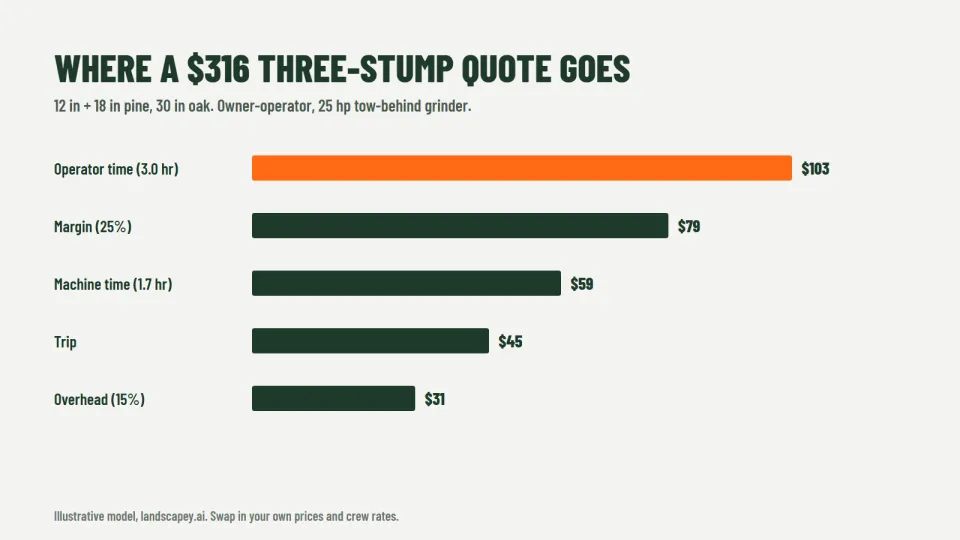
On the inputs below, an owner-operator with a 25-horsepower tow-behind grinder quoting three stumps in one backyard (a 12-inch and an 18-inch softwood plus a 30-inch oak, all ground 4 to 6 inches below grade, chips left in the holes) comes to $316. That is:
- $5.27 per inch of total diameter (60 inches)
- $206 of direct cost: $103 of operator time (about 3 hours on site), $59 of machine time (about 1 hour 45 minutes of grinding) and a $45 trip
- $31 of overhead at 15% of direct cost, and $79 of margin, set at 25% of the price
Two things fall out of the model straight away. A single small stump costs about $100 to $115 to do properly once you count the trip and setup, which is why minimums exist. And a batch of stumps on one property gets much cheaper per stump, which is why the consumer guides' $2 to $5 per inch only holds when you are grinding several at once.
Why per-inch pricing is both right and wrong
Per-inch pricing is popular for good reasons. It is quick to explain, a customer can check it with a tape measure, and it scales the price with the size of the job. The problem is what it scales with.
A stump's diameter grows in a straight line. The wood you have to chew through grows with its area, roughly the square of the diameter. Double the diameter from 12 inches to 24 and the per-inch price doubles, but the face you grind is about four times as large, and the root flare under it is bigger still. That is the forum operator's point: by the inch, the stump gets exponentially bigger and the price doesn't.
The other half of the job doesn't scale with the stump at all. Driving out, unloading, walking the yard, checking utility marks, loading back up and driving away cost the same for a 6-inch stump as a 36-inch one. On small stumps that fixed time is most of the cost.
So the honest version of per-inch pricing has three parts: a minimum that covers the trip and setup, a per-inch rate for the middle of the size range, and an adjustment for big stumps, hardwoods and deep grinds. The worked model below shows where each one kicks in.
The model: what a stump actually costs you
Here are the inputs. Each one is a stand-in. Change any of them and the quote changes with it.
| Input | Value used | What it stands for |
|---|---|---|
| Operator wage, loaded | $34 per hour | Wage plus payroll taxes, workers' comp and benefits. Use your own; the labor cost calculator walks through it. |
| Crew | 1 person | Owner-operator who also rakes and cleans up. A two-person crew is shown later. |
| Machine cost | $34 per engine-hour | A 25 hp tow-behind grinder: depreciation, teeth, maintenance and fuel. Built below. |
| Trip | $45 per job | Truck and trailer to and from the property, fuel and wear. Longer routes cost more. |
| Setup per job | 20 minutes | Walk the yard with the customer, confirm utility marks, unload, load back up. |
| Positioning per stump | 5 minutes | Move the machine, measure, clear rocks and surface debris. |
| Grinding time | 0.06 engine-minutes per square inch of diameter | Softwood, ground 4 to 6 inches below grade. A 24-inch stump takes about 35 minutes. |
| Hardwood factor | 1.4x grinding time | Oak, hickory, maple and similar dense wood. |
| Cleanup per stump | 5 min + 0.02 min per square inch | Rake chips back into the hole, blow off the lawn and beds. |
| Overhead | 15% of direct cost | Insurance, phone, software, office, the hours you spend quoting. |
| Margin | 25% of price | Profit. See landscaping profit margins for how to set yours. |
Building the machine rate
The $34 machine rate is the number most new stump grinders skip, and it is the one that decides whether the service pays for itself. On these assumptions:
- Depreciation: a used or entry-level 25 hp tow-behind grinder at $25,000, written off over 5 years at 300 grinding hours a year, is about $16.67 per hour.
- Teeth and maintenance: carbide teeth, pockets, belts, bearings and service, set at $12 per hour. Rocky soil can double this.
- Fuel: about 1.5 gallons an hour at $3.20 a gallon, or $4.80 per hour.
That adds up to about $33.50, rounded to $34. If you only grind 100 hours a year, depreciation alone triples to $50 an hour. Utilization matters more than purchase price.
If you rent instead of own, the math changes shape. Rental yards list stump grinders at very roughly $120 to $350 a day depending on size and region, according to HomeAdvisor's 2026 rental cost guide. A rental is a fixed daily cost, not an hourly one, so a rented machine only makes sense when you have a full day of stumps lined up. Booking a $250 rental for one $150 stump is the fastest way to lose money in this service.
The worked example: three stumps in one backyard
The job: a homeowner had three trees removed last spring and wants the stumps gone before they lay sod. The stumps are a 12-inch pine, an 18-inch pine and a 30-inch oak, measured across the widest point at ground level, including the root flare. The gate is 48 inches wide, so the tow-behind fits. The customer is happy to keep the chips in the holes.
Step 1: time on site
| Stump | Grinding (engine-minutes) | Positioning + cleanup | Operator minutes |
|---|---|---|---|
| 12 in pine | 8.6 | 12.9 | 21.5 |
| 18 in pine | 19.4 | 16.5 | 35.9 |
| 30 in oak (1.4x) | 75.6 | 28.0 | 103.6 |
| Job setup | 0 | 20.0 | 20.0 |
| Total | 103.7 | 77.4 | 181.0 |
The oak alone is more than half the day. That is the area effect at work: the 30-inch stump is half the job's diameter but about three-quarters of its grinding time.
Step 2: from time to price
| Line | How it is figured | Amount |
|---|---|---|
| Operator time | 181 min = 3.02 hr x $34 | $102.59 |
| Machine time | 103.7 min = 1.73 hr x $34 | $58.75 |
| Trip | flat | $45.00 |
| Direct cost | $206.34 | |
| Overhead | 15% of direct | $30.95 |
| Margin | 25% of price | $79.10 |
| Price | (direct + overhead) / 0.75 | $316.39 |
Quote it at $316, or $320 if you round. At 60 total inches, that is $5.27 an inch, right at the top of the consumer guides' $2 to $5 range. The same three stumps quoted at a flat $3 an inch would come to $180, which on these inputs is $26 below direct cost before a dollar of overhead.
That is not a claim that $3 an inch is wrong everywhere. An operator with a larger, faster machine, lower costs or a full day of stumps on one street can make it work. It is a claim that you should know which of those is true for you before you quote it.
Price by stump size: where the minimum comes from
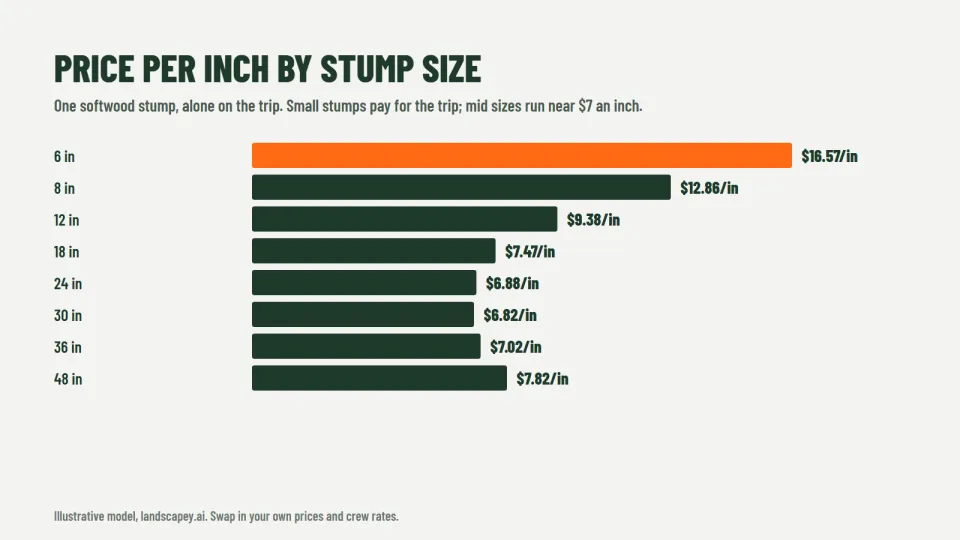
Run the same model on a single stump, alone on the trip, and the per-inch price swings a lot:
| Diameter | Softwood price | Per inch | Hardwood price | Per inch |
|---|---|---|---|---|
| 6 in | $99 | $16.57 | $101 | $16.82 |
| 8 in | $103 | $12.86 | $106 | $13.19 |
| 12 in | $113 | $9.38 | $119 | $9.88 |
| 18 in | $134 | $7.47 | $148 | $8.22 |
| 24 in | $165 | $6.88 | $189 | $7.88 |
| 30 in | $205 | $6.82 | $242 | $8.07 |
| 36 in | $253 | $7.02 | $307 | $8.52 |
| 48 in | $375 | $7.82 | $471 | $9.82 |
Three things stand out:
- Under about 12 inches, the trip is the job. A 6-inch stump costs $99 to do on these inputs, and almost all of that is driving, setup and cleanup. That is your minimum. The $100 to $150 minimums in consumer guides line up with it.
- Between about 18 and 36 inches, per-inch pricing works. The per-inch cost is nearly flat, around $7 for softwood. This is the size range where a flat rate is fair to both sides.
- Above about 36 inches, and on hardwoods, the curve turns up. A 48-inch oak costs $9.82 an inch to grind on this model. If your flat rate is set for 20-inch pines, it under-prices the big ones.
A practical price sheet built from this: a minimum that covers the first stump up to 12 inches, a per-inch rate above that, and a hardwood or oversize surcharge for anything over 36 inches or any dense species.
Batch pricing: why the second stump is cheap
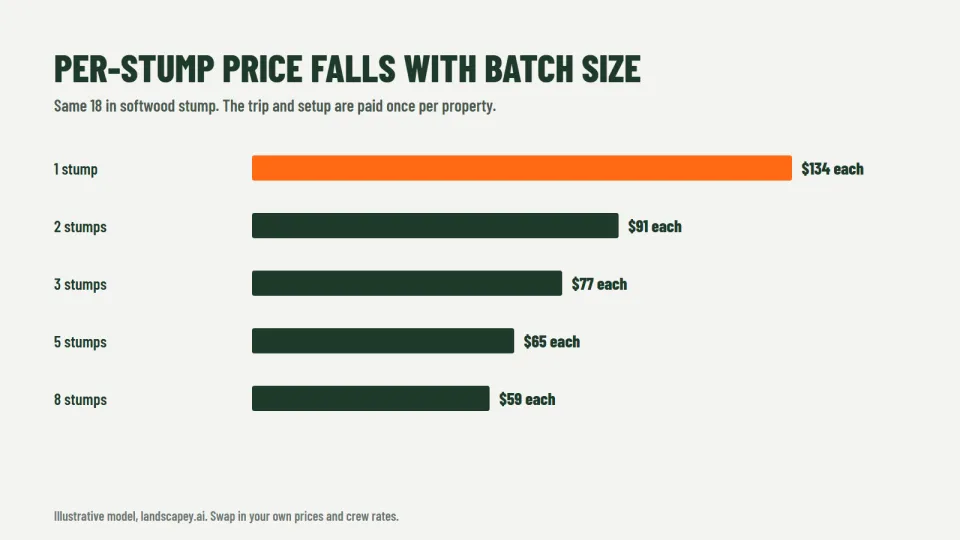
Once the machine is in the yard, every extra stump only costs its own grinding, positioning and cleanup. The trip and setup are already paid for. Here is the same model with 18-inch softwood stumps on one property:
| Stumps on site | Job price | Per stump | Per inch |
|---|---|---|---|
| 1 | $134 | $134 | $7.47 |
| 2 | $183 | $91 | $5.07 |
| 3 | $231 | $77 | $4.27 |
| 5 | $327 | $65 | $3.63 |
| 8 | $471 | $59 | $3.27 |
This is where the consumer guides' $2 to $5 an inch comes from. Five or more mid-size stumps on one property lands at $3 to $4 an inch on these inputs. It is a real price for a real job; it just isn't the price for one stump.
Two ways to use this. First, quote "first stump, then each additional" rather than a flat per-inch rate, so the customer sees the discount for bundling. Second, when you are already on a street for one customer, knock on the neighbors' doors. A second stump two houses down costs you a few minutes of driving, not a full trip.
The adjustments that change the quote
Grinding depth
The model assumes 4 to 6 inches below grade, which is enough to lay sod or mulch over. If the customer wants to replant a tree or put in a bed in the same spot, you may need to go 10 to 12 inches or more and chase the major roots. Arborist forum operators note that per-inch pricing stops applying once the stump has to come out deep for replanting. On this model, grinding a 24-inch softwood stump about twice as deep (2.2x the grinding time) moves the price from $165 to $237. Ask about depth on every quote and put it in writing.
Surface roots
Customers often expect the visible roots running out from the stump to go too. Grinding a root run is extra machine time and extra lawn damage. Price it per linear foot or as a time allowance, and list it as its own line so it is never a surprise.
Debris haul-away
Chips left in the hole are free to you. Hauling them away is not. Consumer guides put haul-away at around $2 to $3 per inch on top of the grind. On this model, adding a $60 dump fee and 90 minutes of loading and hauling at $34 an hour pushes the three-stump job from $316 to $487. If the customer wants the area ready for sod, you will also need topsoil to fill the hole once the chips are gone. If you lay the sod too, the sod installation pricing guide uses the same quote structure.
Access
The tow-behind needs a gate of roughly 3 feet or more and ground firm enough to cross. Narrow gates, steep slopes, retaining walls or a stump wedged against a fence or foundation mean a smaller walk-behind or handheld grinder, which is slower. Price a tight-access stump at your slower machine's rate, not your main one.
Rocks, metal and buried surprises
Rocks eat carbide teeth, and old fence posts, nails and wire in yard trees destroy them. A single stump full of rocks can cost more in teeth than you charged for the grind. Put a clause in every quote that hidden rock, concrete or metal is billed at your hourly rate, and probe the soil around the stump before you start.
Two-person crews
A helper speeds up cleanup and is safer on big jobs, but on stump grinding the machine is the bottleneck, not the hands. Running the worked three-stump job with two people at $34 an hour each takes the price from $316 to $474. Use a helper when the job needs one (big batches, haul-away, steep or awkward sites) and price for both people when you do.
Call 811 before you grind
A stump grinder cuts below the surface, which in most states makes it excavation for the purpose of the one-call law. Call 811 (or submit a request online) a few business days before the job so the utilities can mark their lines. Gas, electric and communication lines often run right past old trees, because the tree was there first and the utility went around it.
Utility marking covers the public lines up to the meter. It usually does not cover private lines the homeowner owns: irrigation, landscape lighting, a line to a detached garage, a dog fence. Ask the customer what is buried near each stump and write the answer on the work order. Build the 811 step into your setup time; it is part of the 20 minutes in the model.
How to present the price
Customers compare stump quotes mostly by the total and by whether the price was easy to understand. A clear quote does three things:
- Lists each stump with its diameter and price. It shows your measurement and lets the customer drop one if they want.
- States the depth, the cleanup and what happens to the chips. "Ground 4 to 6 inches below grade, chips raked into the hole, lawn blown clean" heads off most disputes.
- Lists the add-ons separately: root runs, haul-away, topsoil, deeper grind for replanting, hidden rock or metal at the hourly rate.
If you bid other work off the same walk-through, the approach in how to bid landscaping jobs applies: measure, cost it, then price it, in that order. Stump grinding also pairs well with services you may already sell. Customers having shrubs cut back are a natural upsell (see how much to charge to trim bushes), and stumps often sit in the middle of yards that need drainage or regrading work.
A quoting tool that stores your rates means you price the same stump the same way every time. In Landscapey's estimate builder you can save "stump grinding, per inch," "first stump minimum" and "hardwood surcharge" as line items, send the quote from your phone at the property and turn it into an invoice when the job is done.
Is stump grinding worth adding to a landscaping business?
It can be, with two conditions. The first is volume. The machine rate in this model assumes 300 grinding hours a year. A grinder that sits in the shop most of the season costs you the same depreciation either way, and the per-hour rate climbs fast. If you are not sure you will keep a machine busy, rent for full days and line up several jobs per rental until you are.
The second is pricing discipline. The work is short, so it is tempting to quote by feel. Minimums, batch discounts and hardwood surcharges are what turn a few hundred dollars of grinding into a profitable line instead of a favor.
Frequently asked questions
How much should I charge per inch for stump grinding?
On the inputs in this guide, about $7 to $8 an inch for a single mid-size softwood stump, falling to $3 to $5 an inch when you grind several on one property, with a minimum of about $100 to $115 for small stumps. Consumer guides publish $2 to $5 an inch. Build your own rate from your machine cost, wage and trip, then check it against those ranges.
What is a fair minimum charge for stump grinding?
Enough to cover the trip, setup and cleanup on a small stump plus your overhead and margin. On this model that is about $100. Consumer guides list $100 to $150 minimums, and arborist forum posters report $75 to $80 in some lower-cost markets.
How do you measure a stump for grinding?
Most operators measure the widest point across the stump at ground level, including the root flare. Measuring the cut face only under-counts stumps with a large flare. Say on the quote how you measured.
How long does it take to grind a stump?
On this model with a 25 hp grinder, a 12-inch softwood stump takes about 9 minutes of grinding and a 24-inch stump about 35 minutes, plus positioning and cleanup. A 30-inch oak takes over an hour. Bigger machines are faster; rocky ground and hardwoods are slower.
Should I charge more for hardwood stumps?
Yes, if they take longer, and dense hardwoods usually do. This guide uses 1.4 times the softwood grinding time. A per-stump hardwood surcharge or a higher per-inch rate for hardwoods both work; pick one and apply it consistently.
Is stump grinding the same as stump removal?
No. Grinding chews the stump down below grade and leaves the roots to rot in the ground. Removal pulls the stump and main roots out, usually with an excavator, which is far more work and leaves a large hole to fill. Quote them as different services.
Sources and limits
- Consumer price ranges: LawnStarter, "Pricing Guide: How Much Does Stump Grinding Cost in 2026?"; Lawn Love, "How Much Does Stump Grinding Cost in 2026?"; HomeAdvisor stump grinding cost guide (all ranking for "stump grinding cost," October 2026).
- Rental rates: HomeAdvisor, "How Much Does Stump Grinder Rental Cost in 2026?"
- Operator pricing practice: ArboristSite forum threads on stump grinding rates, minimums and per-inch versus hourly pricing.
- Every other number (machine price, hours of use, teeth and fuel cost, wage, trip cost, setup and grinding times, hardwood factor, dump fee, overhead and margin) is an illustrative input, not a market survey. Replace them with your own.
Ready to send stump quotes customers can approve from their phone? Start free with Landscapey or see pricing.