Search how much to charge for gutter cleaning and page one is, in order: a window-cleaning subreddit where operators ask each other, a per-foot cost calculator, a gig marketplace, a gutter-guard manufacturer, a Facebook lawn-mowing group where somebody’s customer asked and they “don’t know a price pls help”, a YouTube video, a Chicago contractor’s price list, and then a wall of homeowner cost guides. One written page on the whole first two pages is addressed to the person doing the work, and it belongs to a software company. Everyone else is answering the homeowner’s question, which is a different question.
This post is for the operator — specifically the lawn-care or landscaping operator who is already in the customer’s driveway every fall for the cleanup and keeps getting asked “while you’re here, could you do the gutters?” It reads the cost guides so you do not have to, reads the one contractor on page one who posts real prices, and then does the arithmetic none of them do: what a gutter job costs you in ladder time, why that time scales with stories and not linear feet, and what the job is worth when the drive to it has already been paid for by the leaf cleanup.
What customers are paying in 2026
Nine sources on the first two pages quote a per-linear-foot rate. Read across them and the number is anywhere from 70 cents to three dollars — a 4.3× spread on the same unit for the same job. On a typical 180-foot single-story house that is $126 at one end and $540 at the other.
| Source | Per linear foot | On 180 ft | Notes / dated |
|---|---|---|---|
| Homewyse | $1.12–$1.36 | $202–$245 | labour to 10 ft high only; 2-hour minimum; default job 264 ft; Sep 2026 |
| TaskRabbit | $0.80–$2.00 | $144–$360 | also $37/hr “starting”; updated 1 Sep 2026 |
| LeafGuard (snippet) | “around 80 cents” | $144 | “$160 for a standard home” — implies 200 ft; Oct 2024 |
| LeafFilter | $0.70–$1.30 one-story; $1.25–$2.50 two-story | $126–$234 / $225–$450 | “2026 adjusted” — see below |
| Angi, Chicago (snippet) | $0.75–$3.00 | $135–$540 | also $30–$60/hr; Feb 2026; page refused our fetch |
| FieldCamp | $0.95–$1.25 one-story easy access, up to $2.75 dormers | $171–$225 | the one operator-facing page; Jun 2025 |
| Housecall Pro | $0.80–$2.00 residential; $1.25–$3.50 commercial | $144–$360 | also $50–$100/hr; Jan 2026 |
| Gauntlet Gutters, CA (snippet) | $0.75–$1.50 | $135–$270 | “$150–$400 total”; Jan 2026 |
| FRS Roofing (snippet) | $0.80–$2.00 | $144–$360 | “$100–$300 typical”; Jun 2025 |
The per-visit “averages” disagree the same way. Bob Vila, citing HomeAdvisor and Angi, puts the national average at $163 with a $119–$228 typical range. Thumbtack, from its own pros’ estimates, says $233 is the most common price with a $163–$333 range. So one guide’s national average is the other guide’s floor. Liberty Home Guard’s snippet has an average of “around $160” inside a per-visit range of $50–$175 — an average sitting a few dollars under its own ceiling, which is not how averages behave. HomeGuide’s snippet says $160–$400. Housecall Pro says $125–$320. TaskRabbit says $120–$300 for an average home.
And then there is LeafFilter, whose 2026 cost page puts the national range at $191.25 to $528.75 and lists fifteen states at prices like $337.50–$431.25 (New Jersey) and $262.50–$693.75 (California). Look at the cents. Every one of the 32 figures on that page — the national pair and all thirty state endpoints — divides by 1.25 into a round-dollar number: $191.25 is $153, $528.75 is $423, $337.50 is $270, $693.75 is $555. The page is an older table with a flat 25% added and the label “2026 adjusted” put on it, published by a company whose product is sold on the promise that you will not need gutter cleaning. The same page recommends cleaning “three times a year on average” and says guards can cut the cost 50%. Hold that last claim; the contractor prices below say the opposite.
What contractors actually post
Cost guides are surveys of what homeowners say they paid. A contractor’s price page is what a business decided to charge and put its name on. One of those ranks on page one for this query — Sparkle Service, on Chicago’s North Shore — and two more come from the field-service software vendors writing for operators. Notice what unit all three use. None of them price by the foot.
| Source | One-story | Two-story | Three-story | Add-ons |
|---|---|---|---|---|
| Sparkle Service (contractor, Chicago North Shore, Jul 2026) | $150 under 2,000 sq ft; $180 to 3,000; $210 to 4,000; $240 to 5,000 | $195 under 2,000; $210 to 3,000; $210–$250 to 4,000; $290 to 5,000 | $295 to 3,000; $350 to 4,000; $405 to 5,000 | plastic guards +35%; aluminum guards +50%; detached garage from $60; twice-yearly plan 10% off; quarterly 20% off |
| FieldCamp (vendor, operator-facing) | $125–$150 under 1,500 sq ft; $150–$200 to 2,500; $175–$225 to 3,500 | $175–$225; $200–$275; $250–$325 | $250–$300; $300–$375; $350–$425 | downspout flush $5–$10, unclog $25–$50; guards +$50–$100; roof debris $50–$150; Oct–Nov +10–15% |
| Housecall Pro (vendor, operator-facing) | $100–$180 | $150–$275 | $250–$400+ | downspout $25–$75; heavy debris $50–$150; roof blow-off $75–$200; guard check $25–$50 |
Three things to take from that table. First, the contractor and both vendors price by stories, then size. Linear feet is how a gutter installer quotes, because material is sold by the foot; the cost guides borrowed the unit from the wrong trade. Second, Sparkle’s two-story price is 30% above its one-story price for the same square footage and its three-story price is roughly double — the shape every operator recognises and no cost guide explains. Third, the guard question: the company that actually cleans gutters charges 35–50% more when guards are on, and FieldCamp adds $50–$100, because a guarded gutter has to be un-clipped, cleared underneath and re-seated. LeafFilter’s “50% less” can only be a claim about fewer visits, not cheaper ones. If a customer with guards asks for a discount, that is the answer.
Sparkle also publishes something the cost guides never do: a timed job. A 3,100-square-foot home, $210, “approximately 1 hour”, 11 July 2026. Keep that number; the next section rebuilds it from the ladder up.
Why linear feet is the wrong thing to price on
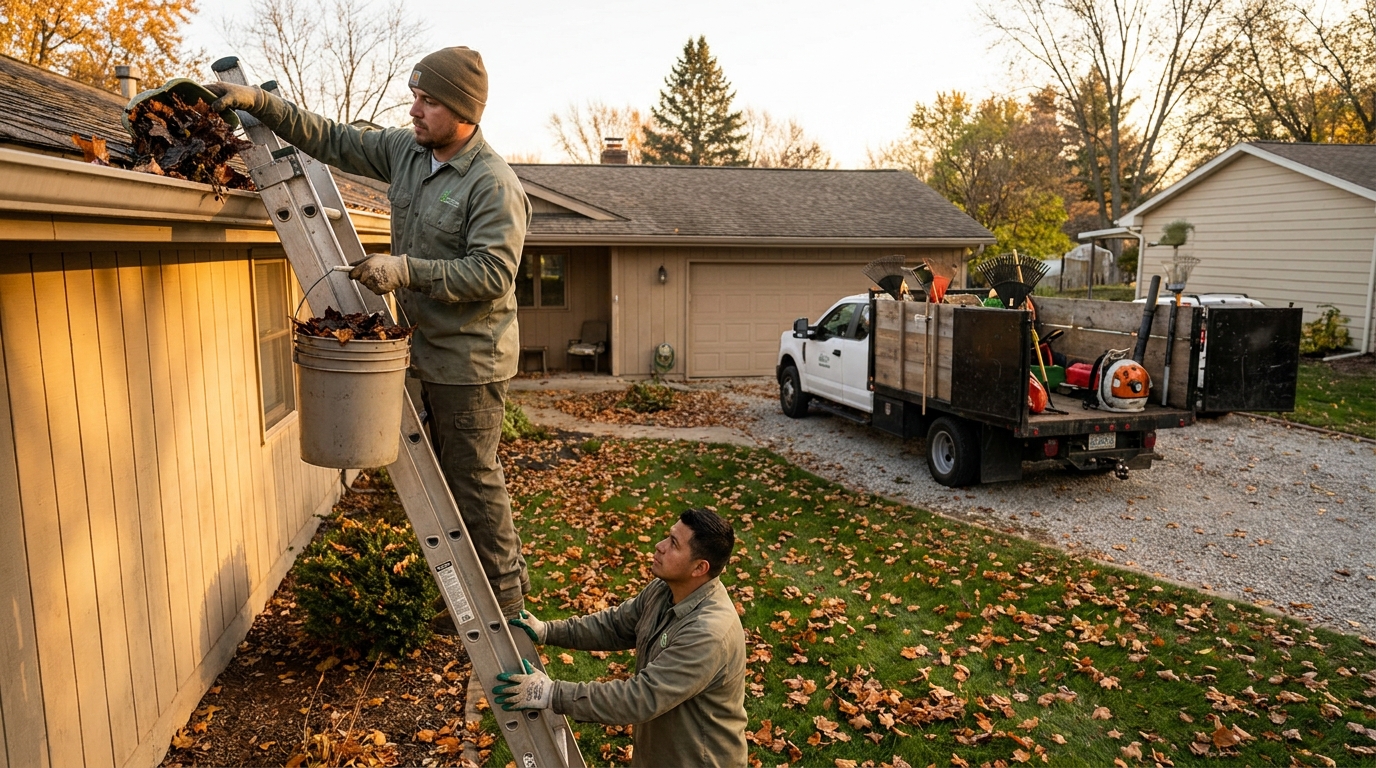
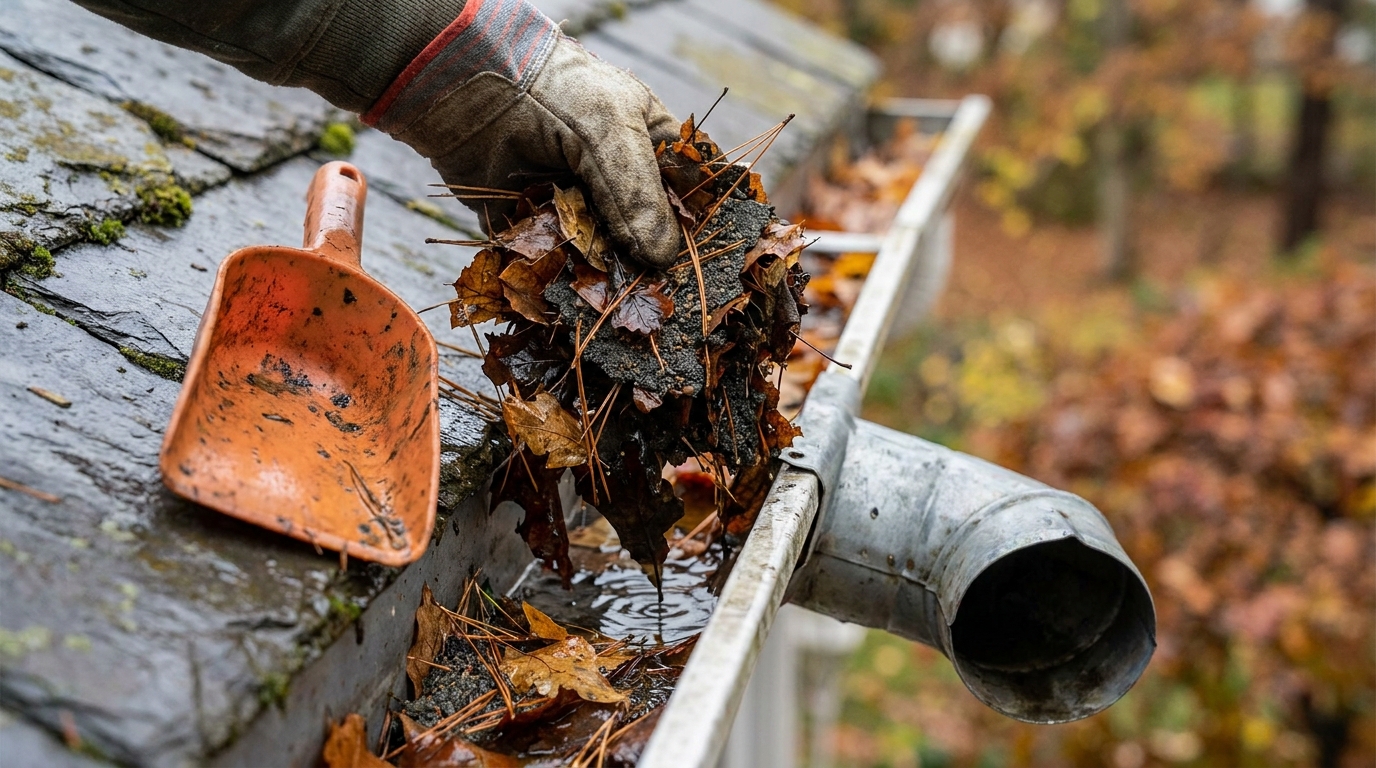
Here is what actually happens on a gutter job. You set an extension ladder against the fascia (or a stand-off bracket against the roof, so the rails are not on the gutter lip), climb, and clean what you can reach without moving your belt buckle outside the rails — call it three feet each way, six feet of gutter per set-up if you obey the rule, eight to ten if you stretch it the way most crews do. Then you climb down, move the ladder, re-foot it, climb again. Every foot of gutter gets cleaned once; every set-up costs a descent, a carry, a re-set and a climb whether that set-up serves six feet or ten.
Take a plain 1,800-square-foot ranch with 180 feet of gutter and six downspouts. At eight feet per set-up that is 23 ladder set-ups. On a one-story eave — a 20- or 24-foot ladder, nine or ten feet up — a set-up is about a minute and a half to come down, move and re-climb, and scooping eight feet of wet October leaves is another minute and a half to two and a half depending on how packed they are. Three to four minutes a set-up, 70 to 90 minutes for one person on the ladder. With a second person on the ground — footing the ladder, moving it while the climber bags, blowing the mess off the beds, flushing downspouts — the wall clock comes down to somewhere around 45 to 60 minutes. Add twelve minutes to flush six downspouts and ten to fifteen for each one that is actually clogged at the elbow, and an ordinary one-story house is 55 to 75 minutes for two people: two to two and a half labour-hours.
That squares with the two independent time sources on the SERP. National SoftWash, a wash-and-gutter contractor, puts a light single-story at 45 to 75 minutes and a heavy one at 90 minutes to two hours; Sparkle’s timed 3,100-square-foot job was about an hour. At the $26.40-an-hour fully loaded labour cost used throughout our pricing posts, the one-story job is $53 to $66 of labour and a few dollars of bags and dump fees. Against Sparkle’s $150 to $210, that is a business.
Now the same 180 feet on a two-story colonial, and this is the part the per-foot tables cannot see. The eave is 18 to 22 feet up. The ladder is a 28-footer — the Werner D1528-2, 300 lb rated, is $501 at Home Depot and weighs close to 60 lb — set at OSHA’s 4-to-1 angle, so the foot is seven feet out from the wall and every move is a two-hand carry of a long, heavy object around beds, AC units and window wells. A set-up on a two-story is three to four minutes before you have cleaned anything. Same 23 set-ups, same eight feet of scooping each: five to six minutes a set-up, 115 to 140 minutes for one person, 80 to 100 on the wall clock for two. Downspouts are longer, have more elbows and clog lower down, so add twenty minutes rather than twelve. Call it three and a quarter to three and a half labour-hours: $86 to $92 of labour, 1.6 times the one-story job for exactly the same footage.
Compare that to what the per-foot tables do with a second story. FieldCamp’s two-story rate is 1.3 to 1.5 times its one-story rate. LeafFilter’s is 1.8 to 1.9 times. Sparkle, who has to send a crew up the ladder, charges 1.3 times at the same square footage and lets the size bands do the rest. All of them are pricing the labour multiplier roughly; none of them are pricing the other thing that changes at 20 feet, which is what happens when the ladder goes over. The fall from a one-story eave is a bad afternoon. The fall from a two-story eave is the reason gutter cleaning has its own insurance category, and the reason the next section exists.
The three rules and the one phone call
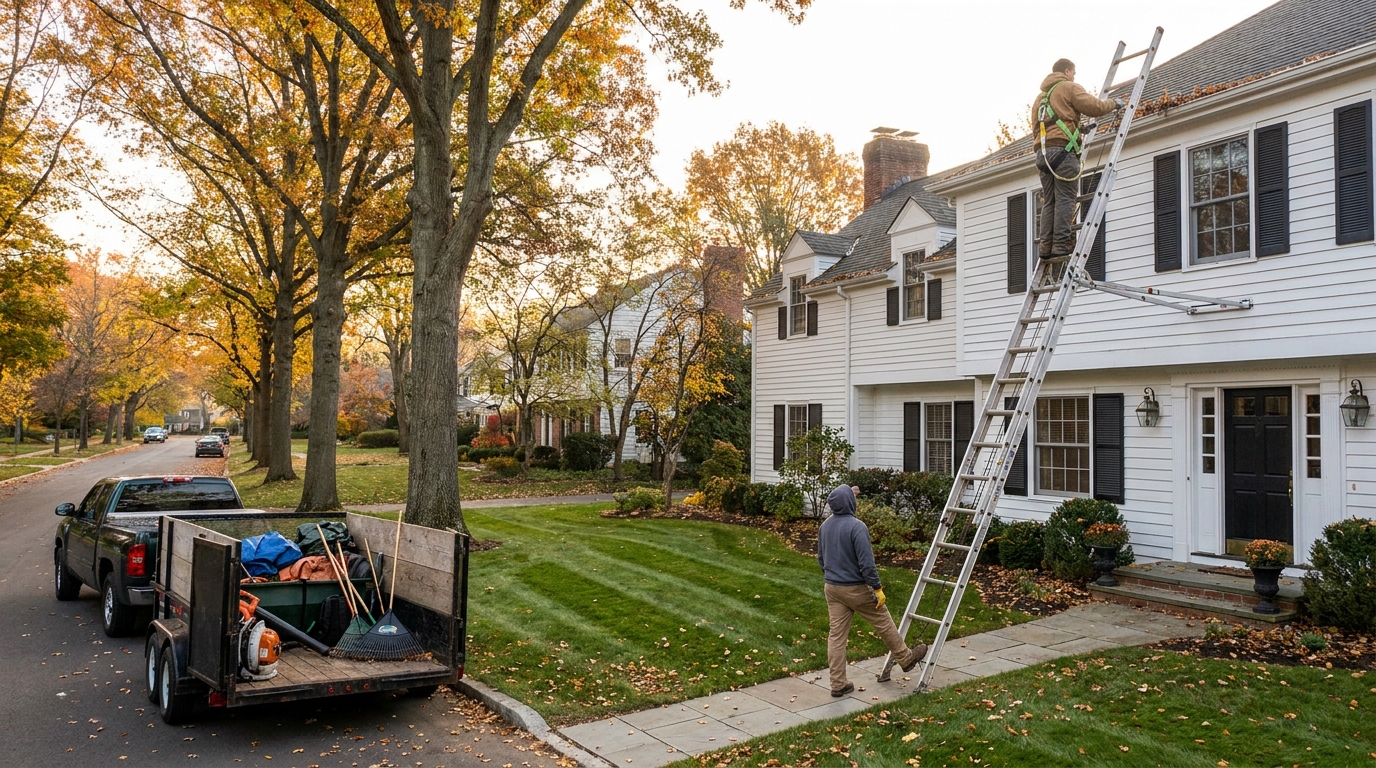
Before pricing a single two-story, three rules that cost nothing and one phone call that might. OSHA’s construction ladder standard (29 CFR 1926.1053) is the reference: the 4-to-1 rule — one foot out from the wall for every four feet of working length — the three-foot rule — if the ladder is used to get onto the roof, the rails extend at least three feet above the landing, or the top is tied off — and three points of contact at all times, which is why the bucket hangs from a hook and does not travel in a hand. Ladder-angle and three-foot violations are among the most-cited items in the whole standard, and they are the two that decide whether the ladder stays put when you lean.
The phone call is to your insurance agent, and the question is: is gutter cleaning listed in my class of operations, and is there a height limit on my policy? Lawn-care general liability is written for people who stand on the ground. Ladder and exterior work is often excluded, sub-limited or priced separately, and the way you find out otherwise is after a claim. Get gutters added in writing before the first two-story. Workers’ comp moves too: FieldCamp’s operator guide budgets 5 to 15% of payroll for comp on gutter work, against the low-single-digit rates a mowing-only payroll carries. If you have not read our breakdown of what lawn-care insurance actually costs, that is the base you are adding to. The premium bump for a season of ladder work is small next to one uncovered fall; it is not small next to zero, and it belongs in the price.
What the job is worth when the drive is already paid for
Everything above is what a standalone gutter company is looking at, and it explains their prices. Sparkle’s day is six or so stops at $150 to $295 with 20 to 30 minutes of metro driving between each one. On a nine-hour day, two and a half hours of it is unbilled windshield time; the $150 base is paying for the truck to arrive, the same way a sprinkler blowout’s base price is a drive-time price. Take the house book we use in every pricing post — 60 clients, a two-person crew at $52.80 an hour fully loaded, $60 a day for the truck — and run a standalone gutter day at six stops averaging $183: $1,100 of revenue, $475 of labour, $60 of truck, $30 of dump fees, about $535 of contribution, $89 a stop.
Now the landscaper’s version. You are already in the driveway for the fall cleanup. The trailer is open, the backpack blower is running, the crew is on the clock. The gutters are an extra 55 to 75 minutes on a one-story and 80 to 100 on a two-story, and the drive to the house cost you nothing, because the cleanup paid for it.
| Add-on job | Price | Labour | Bags / dump | Contribution | Per crew-hour |
|---|---|---|---|---|---|
| One-story, 180 ft, 6 downspouts | $140 | 2.25 h × $26.40 = $59.40 | $5 | $75.60 | $129 on a 65-minute job |
| Two-story, 180 ft, 6 downspouts | $215 | 3.4 h × $26.40 = $89.76 | $5 | $120.24 | $143 on a 90-minute job |
| Standalone gutter company, blended | $183 | incl. 25 min drive | $5 | $89 | $122 incl. the drive |
Read the last column against the mowing visit. On the same book the mowing stop is $52 for 40 minutes plus ten of driving: roughly $62 of revenue per crew-hour. The gutter hour on the same driveway brings in $129 to $143. The gutter add-on pays about twice the mowing hour, and the one-story version does it at $140 — 24% under the standalone company’s blended price — while matching their contribution per stop almost to the dollar ($75.60 against $89 on the cheaper job, $120 against $89 on the two-story). You can undercut the gutter specialist by exactly the drive you do not make and still come out ahead per stop, because they are paying for a truck to arrive and you are not.
Scale it to the book. Say 40 of the 60 clients have trees over the roof and gutters worth cleaning (an assumption; on a wooded lot it is nearer all of them), 30 one-story and 10 two-story, at the add-on prices above. That is $6,350 of revenue on visits already on the schedule, against 101 labour-hours ($2,680) and $200 of bags and dump fees: $3,470 of contribution from the fall window, with no marketing, no new customers and no new drive. Spread over the five or six weeks between leaf-drop and the first hard freeze it is about four and a half extra crew-days. Do the spring pass too — after the seed pods and pollen, when the same 40 houses need it again — and the add-on is a $12,000-a-year line on a mowing book.
What to charge
Two columns, because the number depends on whether you drove for it. The standalone column is where the market is, per Sparkle and the vendor tables; the add-on column is what you can charge on a cleanup visit and still out-earn the standalone company per stop. The minimums matter more than the ranges: Homewyse’s calculator carries a two-hour labour minimum for a reason, and the cost guides’ $50 and $70 lows are somebody with a blower attachment on a bungalow, not a crew with a ladder.
| Job | Standalone (you drove for it) | Add-on (already on site) |
|---|---|---|
| One-story, up to 2,000 sq ft, up to 6 downspouts | $150–$175 | $125–$140 |
| One-story, 2,000–3,000 sq ft | $175–$210 | $140–$165 |
| Two-story, up to 2,500 sq ft | $210–$260 | $185–$215 |
| Two-story, 2,500–3,500 sq ft | $250–$325 | $215–$260 |
| Three-story, or any eave over 24 ft | quote on site from $300, or decline | same |
| Downspout clogged at the elbow (beyond a flush) | +$25–$50 each | same |
| Gutter guards on | +35–50% | same |
| Roof valleys / blow-off | +$50–$150 | same |
| Detached garage or shed | +$50–$75 | same |
| Minimum, any job | $125 | $100 |
A few notes on using it. Count downspouts on the estimate, not feet. Six downspouts on 180 feet is normal; ten on 180 feet means inside corners and a complicated roof, which means more set-ups and more elbows, and the price goes up a band without measuring anything. Ask about guards before quoting, because the answer is a third of the price. The “or decline” on three stories is not a joke: a 28-foot ladder has a working reach of about 24 feet once you obey the angle and stay off the top rungs, a third-story eave is 28 to 32 feet, and a 40-foot aluminum ladder is a two-person lift that most lawn crews should not own. Price it at what a lift or a ground vacuum costs, or send it to someone who has one. And note what the standalone companies do with the season: FieldCamp’s operator guide adds 10 to 15% in October and November when everyone calls at once. You do not have to; the cleanup route is your queue, and the add-on price already beats theirs per stop. But if a non-client calls cold in the last week of October for a two-story, the standalone column plus the seasonal premium is the market rate, and charging it is not gouging.
The equipment, and the vacuum question
The ladder version of this business costs under $700 to start if you already own a blower, and a two-story ladder is most of it.
| Item | Price | What it does |
|---|---|---|
| Werner D1528-2 28-ft aluminum extension, Type IA (300 lb) | $501 at Home Depot | 27 ft nominal reach; the two-story ladder. A 24-footer is lighter and cheaper if you will only ever do one-story. |
| Ladder stand-off / stabiliser bracket | roughly $50–$100 | holds the rails off the gutter lip and widens the top footprint; the single best safety dollar on the list |
| Gutter scoop, bucket and S-hook, gloves, tarp | under $50 | the scoop is $5–$15; the hook is what keeps three points of contact honest |
| Blower gutter kit | $15–$17 generic; EGO AGC1000 $109.95 | cleans a one-story of dry leaves from the ground in minutes; useless on wet packed debris; clears nothing from a downspout; blows the mess onto the beds you just raked |
| Gutter vacuum, ground-operated, 40 ft reach | SkyVac 85 Elite from $3,079 (electric; needs a 6,500 W generator); SkyVac Interceptor from $6,399 (Honda gas) | takes the ladder out of a two-story job; the standalone gutter company’s tool |
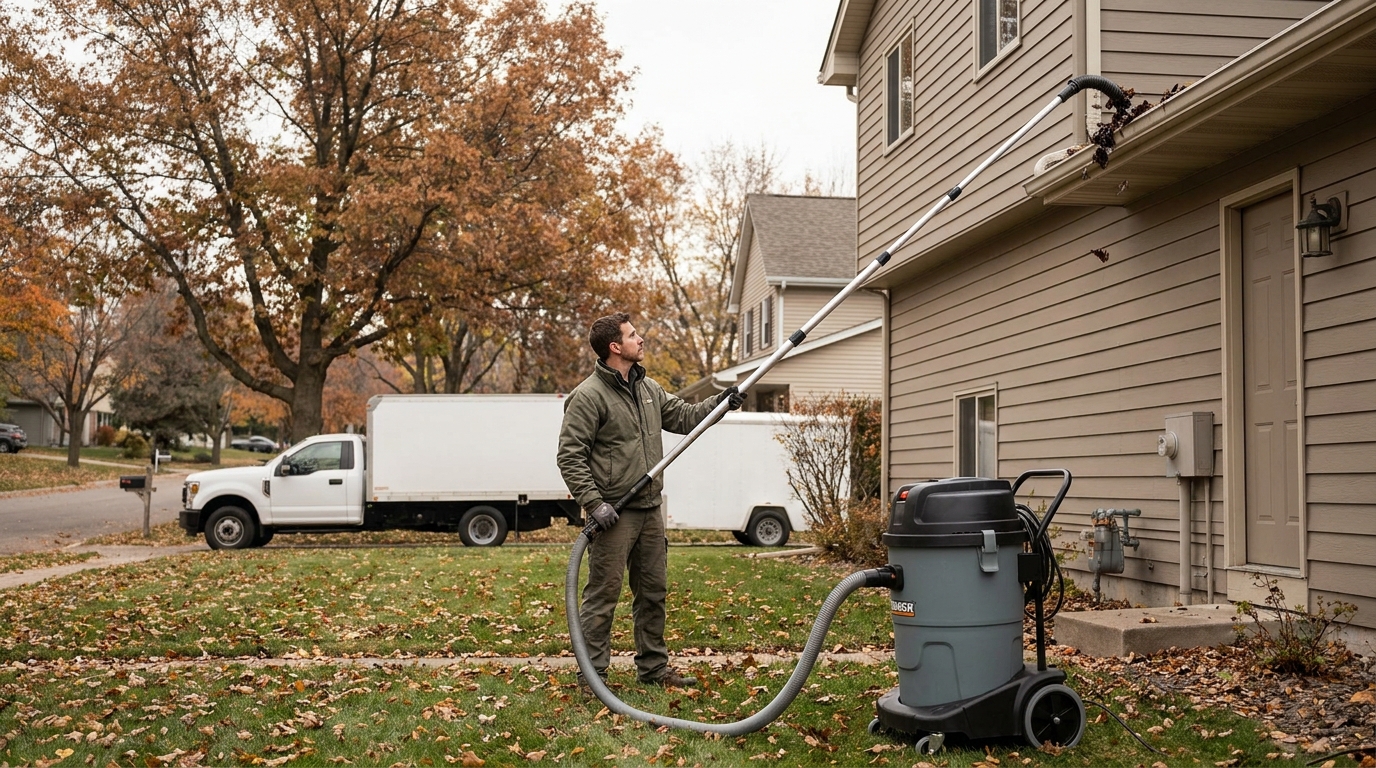
The vacuum is the interesting decision, because it changes both the labour and the risk. Cleaning a two-story from the lawn with a 40-foot pole and a camera on the end turns a two-person, 90-minute ladder job into a one-person job of roughly the same length, and removes the fall exposure entirely. On the two-story job above that is a saving of about one and a half labour-hours, $35 to $40 a job, plus whatever the insurance conversation gets easier by. At $4,000 all-in with a generator, the machine pays back in 100 to 115 two-story jobs. Sparkle, at six stops a day in a five-week window, is there before Thanksgiving. The house book has ten two-story gutter clients: ten seasons. For a landscaper, the vacuum is a safety purchase or a growth purchase, not a payback purchase — unless the two-story count climbs past thirty a season, at which point the arithmetic flips and so should you. Put it on the equipment list next to the aerator: a machine you rent the first year and buy the second if the stops are there.
Twice a year, sold once
Gutters want cleaning twice a year on most lots — late fall after leaf-drop, and spring after the seed pods, catkins and pollen — and three times under pines or a heavy oak canopy. That is a scheduling fact, and it is also a sales fact: the customer who says yes to the fall add-on says yes to the spring one at the same time if you ask. Sparkle sells it as a plan, 10% off for twice-yearly and 20% for quarterly. You do not need to discount that deep on a cleanup route, but the structure is right: quote both visits on one estimate, get one approval, and put both on the calendar in November.
Whatever you use to run the business, the thing to avoid is treating a twice-a-year service as a recurring job. In Landscapey, recurring jobs are weekly, every two weeks or monthly — there is no six-month interval, and we would rather say so than let the software invent one. Gutter cleaning is two one-off jobs: one dated for the fall cleanup visit, one dated for April. The quote carries both lines, the customer approves it online once, each visit gets its own invoice when the crew marks it done, and both sit on the route with the mowing stops so the optimiser sees them as what they are — an extra hour at an address the truck was already going to. If you are still quoting gutters on the back of a business card, the trial is free and the plan is $19.99 a month.
FAQ
How much should I charge per linear foot for gutter cleaning?
Ideally, you should not. Page one quotes $0.70 to $3.00 a foot, a 4.3× spread, because footage is the wrong driver: the cost is ladder set-ups and downspouts, and both scale with stories and roof complexity, not length. If a customer insists on a per-foot number, $1.00 to $1.25 a foot on a one-story and $1.50 to $1.85 on a two-story lands near the flat-by-story prices in the table above — but quote the flat price and let the footage be the customer’s concern.
How much more should a two-story house cost than a one-story?
About 30% to 50% more for the same square footage. The labour is about 1.6 times — every ladder set-up takes twice as long with a 28-foot ladder — and the risk is not linear at all. Sparkle charges $195 against $150 at the same size; FieldCamp’s tables run $175–$225 against $125–$150. Under 30% and you are subsidising the ladder; the customer will not notice, but your comp carrier will.
Do I need different insurance to clean gutters?
Possibly, and the only way to know is to ask your agent whether gutter cleaning is in your class of operations and whether your general liability carries a height limit. Lawn-care policies are written for ground work; ladder and exterior work is often excluded or sub-limited. Workers’ comp for gutter work runs 5 to 15% of payroll per FieldCamp’s guide. Get it added in writing before the first two-story, and put the premium in the price.
How long does a gutter cleaning take?
For a two-person crew on an ordinary 180-foot house: 55 to 75 minutes on a one-story, 80 to 100 minutes on a two-story, including flushing the downspouts. Add 10 to 15 minutes for every downspout that is actually clogged at the elbow and up to half an hour if guards have to come off. National SoftWash puts a light single-story at 45 to 75 minutes and a heavy two-story at up to two and a half hours; Sparkle’s timed 3,100-square-foot job was about an hour.
Should I buy a gutter vacuum?
Not for payback, unless you are doing more than about thirty two-story jobs a season. A SkyVac 85 Elite is $3,079 before the generator and saves roughly $35 to $40 of labour on a two-story, so it needs 100 to 115 such jobs to pay off. Buy it for the safety — it takes the ladder out of the job — or rent one for the fall window and see how many two-story stops you actually book.
Can I set gutter cleaning up as a recurring job?
Not in Landscapey, and not honestly in most CRMs: recurring means weekly, biweekly or monthly. Gutter cleaning is twice a year, so it is two one-off jobs on one approved quote — one on the fall cleanup visit, one in spring — each invoiced when it is done. That keeps the schedule truthful and puts both visits on the route the truck is already driving.
Sources and limits
- Cost guides, read directly on 13 September 2026: Homewyse (September 2026 calculator, labour to 10 ft, two-hour minimum, 264-ft default), TaskRabbit (updated 1 September 2026), Thumbtack (updated 31 March 2026), Bob Vila (23 April 2024, citing HomeAdvisor and Angi), LeafFilter (2026 “adjusted” page), Housecall Pro (30 January 2026). HomeGuide and Angi’s Chicago page returned HTTP 403 and Reddit refused the fetch; LeafGuard, Gauntlet Gutters, FRS Roofing, Liberty Home Guard and HomeGuide are quoted from their search snippets and flagged as such in the tables. Every figure is transcribed as published.
- The LeafFilter arithmetic is ours: each of the 32 dollar figures on the page divides by 1.25 into a whole-dollar amount. That is an observation about the numbers, not a statement about how they were produced; the page does not say.
- Contractor prices are from Sparkle Service’s own pricing page (Chicago North Shore, 30 July 2026, including its timed 3,100-square-foot job). FieldCamp (25 June 2025) and Housecall Pro are field-service software vendors writing for operators; their tables are cited as the operator-facing market view, not as surveys.
- Time on site is built from a set-up-count model (eight feet of gutter per ladder set-up, timed by story) and checked against National SoftWash’s published ranges and Sparkle’s timed job. It is not a timed study of our own. Steep pitches, inside corners, dormers and packed pine needles all run longer.
- Equipment prices are Home Depot’s listed price for the Werner D1528-2 and SkyVac USA’s “from” prices for the 85 Elite and Interceptor, both read the same day; the stand-off bracket range and the $4,000 vacuum-plus-generator figure are estimates. The EGO AGC1000 price is from a marketplace listing.
- The house book is an illustration, not a survey: 60 clients, a two-person crew at $52.80 an hour fully loaded ($26.40 each), $60 a day for the truck, 40 gutter-eligible clients split 30 one-story and 10 two-story, $5 of bags and dump fees a job. The standalone-company day (six stops at a $183 blend, 25 minutes between stops) is a model of Sparkle’s posted prices, not Sparkle’s books. Replace every assumption with your own before pricing anything.
- Insurance is described in general terms on purpose. Whether your policy excludes ladder work is a question for your agent and your declarations page, not for a blog post. OSHA references are to 29 CFR 1926.1053; a lawn crew on a residential job may fall under the general-industry standard (1910.23) instead, which carries the same 4-to-1 and three-point rules.
- Landscapey’s own behaviour — one-off jobs, the three recurring frequencies, quotes with online approval, per-visit invoicing and route optimisation — was checked against the product the day this was written, and the plan price against the live pricing page. Everything else moves; verify before quoting.