Ask ten lawn care owners how much to charge for lawn mowing and you will hear "a dollar a minute", "$50 minimum", "$150 an acre" and "whatever the guy down the street charges, plus five". The published guides are not much tighter: LawnStarter puts a typical mow at $44 to $71 a visit, and Jobber's range for a mowing service runs from $50 to $250.
All of those can be true and still not tell you whether the Hendersons' quarter-acre lot makes you money at $45. This guide builds a mowing price from the cost side: how many paid minutes a stop really takes, what the crew and the equipment cost per minute, then overhead and margin. It then runs the same model across lawn sizes, drive times, crew sizes and mower widths, so you can see where your floor is and what moves it.
One rule up front: every number in the model is an input you should replace. Your wages, your mower, your route and your market set the real figures. The structure is what carries over.
The short answer
On the inputs below, a two-person crew with a 52-inch mower, cutting a 7,000 sq ft lawn weekly on a route with 8 minutes of driving between stops, has a cost-based floor price of $44 a visit. That is:
- $23 of labor: about 49 paid minutes between the two of them, at $28 an hour loaded
- $6 of equipment and truck
- $4 of overhead at 15% of direct cost, which puts break-even at $33
- $11 of margin, set at 25% of the price
$44 is the bottom of LawnStarter's $44 to $71 range, which tells you something: the low end of the market is priced at roughly a careful operator's floor. The money is made in the middle of the range, at $50 to $60 for this lawn, and on tight routes.
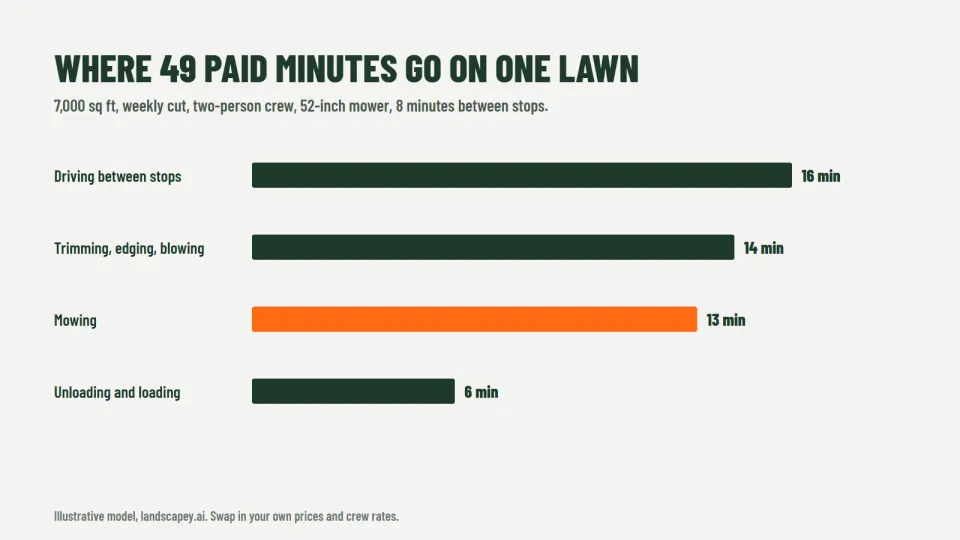
The more useful finding is where the time goes. Of those 49 paid minutes, only 13 are spent cutting grass. The rest is trimming, edging, blowing, loading and driving. That is why a lawn twice the size does not cost twice as much to mow, and why pricing by the square foot misleads on residential work.
What goes into a mowing price
A mowing visit has five cost pieces. Four of them are time.
- Mowing time. Square feet of turf divided by what your mower really covers on that kind of lot, not what the brochure says.
- Detail time. String trimming, edging the hard surfaces and blowing off. This follows the length of edges and the number of obstacles more than the area.
- Fixed time per stop. Parking, dropping the gate, unloading, loading, strapping down. About 3 minutes of clock time, paid for every person on the crew.
- Drive time. The minutes between this stop and the next, again paid for everyone in the truck.
- Equipment and truck. Fuel, blades, belts, tires, repairs and depreciation, charged per hour the machine runs, plus the truck and trailer cost of getting there.
Overhead and margin go on top. If you already know your numbers for those, skip to the tables. If not, the next three steps build them.
Step 1: Get your mowing rate honest
Exmark publishes the standard productivity formula for a mower, with an allowance for turns and overlap:
Acres per hour = speed in mph x cutting width in inches / 124 (that is 80% efficiency; dividing by 99 gives the 100% figure most sales sheets quote).
A 52-inch deck at 5 mph comes out at 2.1 acres an hour, about 91,000 sq ft. Nobody mows a fenced back yard at that rate. Open-field numbers assume long straight passes; a residential lot is gates, beds, trees, a trampoline and a dog run. So the model derates the chart figure by lot size:
| Turf area | Share of chart rate | Effective rate (52-inch, 5 mph) |
|---|---|---|
| 3,000 sq ft | 25% | 22,800 sq ft/hr |
| 7,000 sq ft | 35% | 31,800 sq ft/hr |
| 15,000 sq ft | 46% | 41,900 sq ft/hr |
| 1/2 acre | 51% | 46,800 sq ft/hr |
| 1 acre | 61% | 55,900 sq ft/hr |
| 2 acres | 71% | 65,100 sq ft/hr |
Those derates are our planning estimates, not measured data. The way to replace them is cheap: time the mower, start to stop, on ten of your own lawns of known size. Ten stopwatch readings will beat any chart, including this one.
Detail time is modelled as 5 minutes plus an amount that grows with the square root of the area, because edges grow with the perimeter, not the area. On a 7,000 sq ft lawn that gives 14 minutes of trimming, edging and blowing, against 13 minutes of mowing. With two people those overlap, so the crew is on site for about 17 minutes.
Step 2: Labor, equipment and the truck
For the 7,000 sq ft lawn, the paid minutes add up like this:
| Task | Paid minutes (2 people) | Share |
|---|---|---|
| Driving between stops (8 min each) | 16.0 | 32% |
| Trimming, edging, blowing | 14.3 | 29% |
| Mowing | 13.2 | 27% |
| Unloading and loading (3 min each) | 6.0 | 12% |
| Total | 49.5 | 100% |
At a loaded wage of $28 an hour (pay plus payroll taxes, workers' comp and paid time off), 49.5 minutes costs $23.08.
Equipment is charged for the time it runs: the mower at $9 an hour for 13 minutes is $1.98, the trimmer, edger and blower at $3 an hour for 14 minutes is $0.71, and the truck and trailer add $3.00 for the hop between stops. That is $5.69, and a direct cost of $28.77 for the visit.
If you are a solo owner-operator, keep the wage line. Paying yourself nothing on paper is how a $35 lawn looks profitable right up until you hire your first employee.
Step 3: Overhead and margin
Overhead is everything the business pays that no single lawn causes: insurance, the shop or storage unit, phone, software, bookkeeping, marketing, and your own unbilled time quoting and scheduling. The model uses 15% of direct cost, which adds $4.32 and puts break-even at $33.09.
Margin is set at 25% of the selling price, so the price is break-even divided by 0.75: $44.11, of which $11.03 is profit. If you want to check your own overhead percentage rather than borrow ours, our landscaping profit margin guide walks through it.
Two rates fall out of that, and they are the ones to remember:
- About $107 per crew hour, drive time included, is the floor for this two-person crew. That is $53.50 per person per hour, inside the $32 to $68 an hour LawnStarter reports and the $30 to $65 Jobber lists.
- About $80 per crew hour is break-even. Below that, the crew is costing more than it brings in.
Lawn mowing prices by lawn size
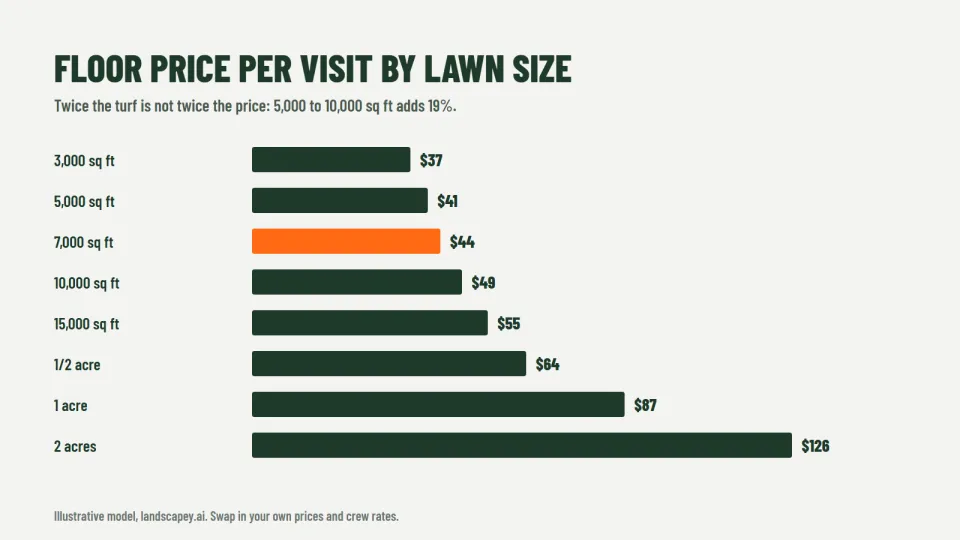
Same crew, same route, weekly cut, different lawns:
| Turf area | Crew time on site | Floor price | Per 1,000 sq ft | LawnStarter range for the size band |
|---|---|---|---|---|
| 3,000 sq ft | 12 min | $37 | $12.19 | $41 to $61 (up to 1/4 acre) |
| 5,000 sq ft | 15 min | $41 | $8.17 | |
| 7,000 sq ft | 17 min | $44 | $6.30 | |
| 10,000 sq ft | 19 min | $49 | $4.86 | |
| 15,000 sq ft | 23 min | $55 | $3.69 | $49 to $69 (1/4 to 1/2 acre) |
| 1/2 acre | 28 min | $64 | $2.92 | |
| 1 acre | 40 min | $87 | $1.99 | $59 to $114 (1/2 to 1 acre) |
| 2 acres | 62 min | $126 | $1.45 | $99 to $264 (1 to 2 acres) |
Three things to take from the table.
Size matters less than you think. Going from 5,000 to 10,000 sq ft doubles the turf and raises the floor by 19%, from $41 to $49. The drive, the load-out and most of the trimming do not care how big the lawn is.
Per-square-foot pricing breaks on small lawns. Jobber and LawnStarter both quote $0.01 to $0.06 a square foot. The floor here runs from about 1.2 cents on a 3,000 sq ft lawn down to 0.15 cents on two acres, an eightfold spread. A single per-foot rate will overcharge the acre lot and lose money on the small one. If you want a formula, use a base charge plus a per-1,000 rate. On these inputs, $34 plus $1.40 per 1,000 sq ft fits the floor within about $2 from 3,000 sq ft up to half an acre.
Per-acre rates fall fast. The floor is $87 for one acre and $63 an acre at two. Jobber's $150 to $200 an acre is a market rate for a single acre lot, not a number to multiply by ten.
What is a good minimum charge?
On this model a 2,000 sq ft postage-stamp lawn still costs $33 to service with margin, because the stop itself costs that much. LawnStarter reports typical minimums around $30. If your floor on the smallest lawn you take is $33 to $37, a $40 to $45 minimum is defensible, and anything under $35 gives up margin on even the smallest lawn for a two-person crew on an average route.
Route density moves the price more than lawn size
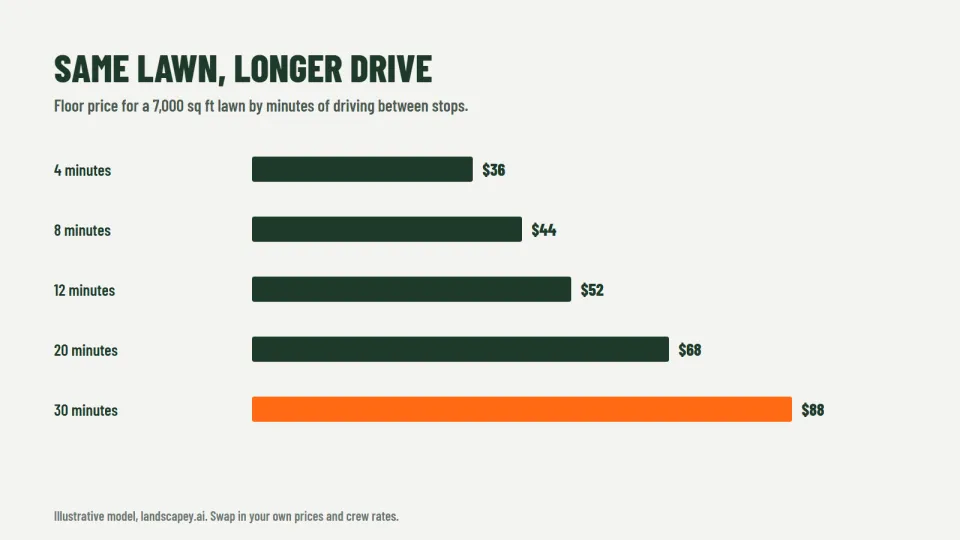
Here is the same 7,000 sq ft lawn with nothing changed but the drive between stops. The second half of the table assumes you charge a flat $50 either way, which is how most routes are actually priced.
| Drive between stops | Floor price | Stops in 8 hours | Day's revenue at $50 | Day's cost | Day's profit |
|---|---|---|---|---|---|
| 4 min | $36 | 23 | $1,150 | $623 | $527 |
| 8 min | $44 | 19 | $950 | $629 | $321 |
| 12 min | $52 | 16 | $800 | $626 | $174 |
| 20 min | $68 | 13 | $650 | $665 | -$15 |
| 30 min | $88 | 10 | $500 | $662 | -$162 |
The crew costs about the same to run all day whatever the route looks like. What changes is how many lawns that cost is spread over. Four extra minutes of driving per stop costs this crew four lawns a day and about $200 of profit. At 20 minutes between stops, a $50 lawn loses money.
This is the real answer to "what should I charge the one client across town". Not $50. On these inputs a lone stop 20 minutes off the route needs $68 to earn the same margin as the lawn next door to another client. It is also why the second lawn on a street is worth a discount and a door hanger: it is nearly free to reach.
Tightening the route is usually worth more than raising prices. Grouping clients by day and area, and ordering each day's stops properly, is the job of scheduling and routing software; Landscapey's schedule orders a day's stops for the shortest drive in one tap.
The dollar-a-minute rule, tested
The oldest rule in the trade is a dollar per man-minute on site. On the 7,000 sq ft lawn the crew spends 33.5 man-minutes on site, so the rule says $33.50.
That is break-even on this route, not a price. The rule ignores drive time, so it only works when the drive is short: at 4 minutes between stops the floor is $36 and the rule is close; at 8 minutes it is $11 light; at 12 it is $19 light. If you like pricing by the minute, the number on these inputs is about $1.30 per on-site man-minute, or $0.90 per paid man-minute once driving is counted.
Solo, two-person or three-person crew?
| Crew | Floor price | Minutes per stop (with drive) | Stops in 8 hours | Day's profit at $50 |
|---|---|---|---|---|
| Solo | $36 | 38 | 12 | $274 |
| Two | $44 | 25 | 19 | $321 |
| Three | $52 | 20 | 23 | $253 |
A solo operator has the lowest floor, because only one person is paid to sit in the truck. Adding a second person gets seven more lawns done in a day and raises the day's profit. A third adds only four more, because there is one mower and the drive now costs three wages; on quarter-acre lots the third person costs more than they bring in. Bigger properties and a second mower change that answer.
The solo figure includes $28 an hour paid to the owner, so a solo operator at $50 a lawn earns the wage plus the $274.
Weekly, biweekly and overgrown lawns
Longer grass means slower passes, double cutting and more clippings to deal with. The model stretches mowing time and, to a lesser degree, detail time:
| Condition | Mowing time | Floor price | Against weekly |
|---|---|---|---|
| Weekly | 13 min | $44 | |
| Every two weeks (35% slower) | 18 min | $50 | +14% |
| Overgrown first cut (twice as long) | 26 min | $62 | +41% |
| Knee-high (three times as long) | 40 min | $80 | +82% |
The slow-down factors are planning estimates; spring growth in a wet year will beat them. The practical rules: price biweekly service 15% to 20% above weekly, quote the first cut on a neglected lawn as its own line at 1.5 to 2 times the regular price, and say on the quote what height triggers a long-grass charge. LawnStarter notes most companies add a fee somewhere between 6 and 12 inches.
Does a bigger mower lower the price?
| Mower | Chart rate | Floor, 7,000 sq ft lot | Floor, 1 acre |
|---|---|---|---|
| 21-inch push, 3 mph | 0.5 acres/hr | $83 | $225 |
| 36-inch, 4.5 mph | 1.3 acres/hr | $52 | $114 |
| 52-inch, 5 mph | 2.1 acres/hr | $44 | $87 |
| 60-inch, 6 mph | 2.9 acres/hr | $41 | $75 |
| 72-inch, 7 mph | 4.1 acres/hr | $38 | $65 |
The jump from a push mower to a 36-inch machine is the big one: it takes $31 off the floor of a quarter-acre lot. Past 52 inches the savings on small lawns are a few dollars a stop, because mowing is already under a third of the paid time, and a 60-inch deck does not fit through a 48-inch gate. Big decks earn their keep on acre lots and commercial turf. The table holds the machine cost at $9 an hour for every size to isolate the speed effect; in practice the larger mowers cost more to own. If you are weighing a purchase, see what a lawn care business really needs on the trailer.
From a per-cut price to a season price
Clients think in visits; your cash flow is better served by months. On a 30-visit season, the same lawn at different prices:
| Per visit | Season (30 visits) | Flat monthly, 8 months | Margin per visit | Margin |
|---|---|---|---|---|
| $44 | $1,320 | $165.00 | $10.91 | 25% |
| $50 | $1,500 | $187.50 | $16.91 | 34% |
| $55 | $1,650 | $206.25 | $21.91 | 40% |
| $60 | $1,800 | $225.00 | $26.91 | 45% |
Because the cost of the stop is fixed at about $33, every dollar above break-even is margin. Moving this lawn from $44 to $50 raises the price 14% and the profit 55%.
The same arithmetic runs the other way. At $35 the lawn clears $1.91 a visit. A two-person crew doing 19 such stops a day, five days a week for 30 weeks, makes 2,850 stops and $5,455 for the season. The same route at $50 makes $48,194. If your book has drifted under the floor, a price increase letter is the fix: $5 a visit across 100 weekly clients is $15,000 a season.
Flat monthly billing evens out a season that has five-visit months and three-visit months, and it stops the "you only came three times" phone call. In Landscapey a recurring mowing job can bill either way, a flat monthly amount or per visit, and per-visit invoices pull in the visits from the schedule. Our guide to billing recurring landscaping clients covers when each model fits.
Setting your price: the five-minute version
- Work out your crew cost per hour. Loaded wages for everyone in the truck, plus equipment and truck, plus overhead. Here that is about $80.
- Divide by your margin target. $80 / 0.75 is $107 an hour. That is your target rate for every paid minute, driving included.
- Count stops, not hours. Divide the working day by your real minutes per stop, drive included. At 25 minutes that is 19 stops; $107 x 8 hours / 19 stops is $45 a lawn.
- Check it against the market. If the going rate is $50 to $60, charge that and keep the difference. If it is $35, the answer is a tighter route or a different neighbourhood, not a $35 lawn.
- Set a minimum, a biweekly rate and a long-grass charge, and put all three on the quote.
Then save the lawn as a service in your software with its price and its visit length, so the next quote takes a minute. In Landscapey, an approved quote converts into a recurring job on the schedule, and the invoices follow from it; you can start free and build the route before the season does. For the other lines on a full-service proposal, see our lawn care pricing chart, aeration pricing and leaf removal pricing guides.
FAQ
How much should I charge to mow a lawn?
For a typical suburban lawn of 5,000 to 10,000 sq ft, most of the US market sits between $44 and $71 a visit according to LawnStarter. On our model a two-person crew on an average route has a floor of $41 to $49 across that size range, so $50 to $60 leaves a healthy margin. Work out your own floor first, then price at market above it.
How much should I charge to mow one acre?
On these inputs the floor for one open-ish acre with a 52-inch mower is $87, and $126 for two acres. Published ranges run from $59 to $114 for half-acre to one-acre lots. Acre lots vary more than small ones: trees, slopes and fence lines can double the time, so time the first cut and adjust.
Should I charge by the hour, the square foot or the job?
Quote a flat price per visit. Clients understand it, and it pays you for getting faster. Use an hourly figure internally, about $107 per crew hour on these inputs, to check that each lawn carries its share. Per-square-foot rates only work as a base charge plus a per-1,000 rate.
Is a dollar a minute still a good rule?
Only on a very tight route. A dollar per on-site man-minute covers cost here but leaves no margin once 8 minutes of driving per stop is counted. About $1.30 per on-site man-minute is the equivalent with margin.
How much more should I charge for biweekly mowing?
About 15% to 20% more per visit than weekly. The grass is longer, the cut is slower, and in peak growth you may need to double cut or bag. On this model the floor moves from $44 to $50.
What should my minimum mowing charge be?
Enough to cover a stop with margin even on the smallest lawn. Here that is about $33 to $37, so a $40 to $45 minimum is reasonable. A solo operator on a tight route can go lower; a three-person crew cannot.
Sources and limits
- Market price ranges: LawnStarter, "How Much Does Lawn Mowing Cost in 2026?" (updated November 4, 2026): $44 to $71 per visit, average $57; $32 to $68 per hour; $0.01 to $0.06 per sq ft; size-band table; minimums around $30; long-grass fees from 6 to 12 inches. Jobber Academy, "How Much to Charge for Lawn Mowing in 2026": $30 to $65 per hour, $50 to $250 per mowing service, $0.01 to $0.06 per sq ft, $150 to $200 per acre.
- Mower productivity: Exmark's productivity chart formulas (mph x width of cut / 99 at 100% efficiency; / 124 at 80%).
- The crew size, $28 loaded wage, equipment rates, truck cost, 15% overhead, 25% margin, 30-visit season and 8-minute drive are illustrative inputs, not survey data. The residential derates on the chart rate, the detail-time formula and the long-grass factors are our planning estimates. Replace every one with your own timed numbers.
- Prices vary widely by region. A floor is the least you can charge and still earn your margin; it is not a recommendation to charge the least.