
Every template you will find for a lawn care price increase letter says roughly the same thing: costs are up, fuel is up, we value your business, your price is going up. Most of the ones ranking today were written in 2022 or 2023, and they all lean on the same justification — fuel.
Here is the problem. If you actually run the fuel number for a route day, it is worth about half a dollar per stop. Your customers fill their own tanks. They know roughly what fuel does. Anchoring a 7% increase on the one input they can independently check is the fastest way to make a defensible increase look like a money grab. This piece does the arithmetic instead: what changed in 2026, how much of an increase actually holds your margin, how many customers you can afford to lose, when to send the letter, and what to write.
If the reason for your increase is labor cost rather than materials, it is worth knowing exactly what is happening to the seasonal labor supply before you write the letter - our FY2027 H-2B breakdown lays out the cap numbers, the filing deadlines, and the cost lines the program creates.
If you are already writing to clients about next season, put both decisions in the same letter. The rate is one; the billing schedule is the other, and it is the one nobody asks for in December because by then the grass has stopped and the value is invisible. Spreading the same annual total across twelve months instead of eight moves $38,297 into the months that were previously empty, on the 60-client book we use throughout.
It helps to know what the increase is actually worth before you write the letter. On a 60-client weekly book - 1,920 visits a season - the difference between the low and high end of a single published pricing-chart row, $25 against $80 for a quarter-acre mow, is $105,600 of season contribution on identical work. Same crew, same route, same minutes. That is the arithmetic behind the number you are about to send.
What actually changed in 2026
Fuel is genuinely up this year, and by more than most seasons. These are the figures from the U.S. Energy Information Administration's July 2026 Short-Term Energy Outlook, the government forecast the fuel industry itself works from:
| Fuel (U.S. retail average) | 2025 actual | 2026 forecast | 2027 forecast | 2025 to 2026 |
|---|---|---|---|---|
| Regular gasoline | $3.10/gal | $3.64/gal | $3.09/gal | +$0.54 (+17.4%) |
| On-highway diesel | $3.66/gal | $4.61/gal | $4.02/gal | +$0.95 (+26.0%) |
Within this year it has been worse than the annual average suggests. Gasoline averaged more than $4.20/gal in the second quarter of 2026 before easing to a forecast $3.80 for the third quarter and roughly $3.40 by the fourth. Diesel spiked to $5.38 in the second quarter and is forecast at $4.64 for the third. If your worst fuel weeks were in May and June, that is why.
Now look at the 2027 column. The EIA expects both fuels to fall next year — gasoline all the way back to $3.09, essentially where it sat in 2025, and diesel down 59 cents off this year's average. That is the single most important fact in this article for anyone about to write a letter. A rate increase justified on fuel is a rate increase your customers can argue with in six months. Build the increase on something that does not reverse.
Run the number before you blame fuel
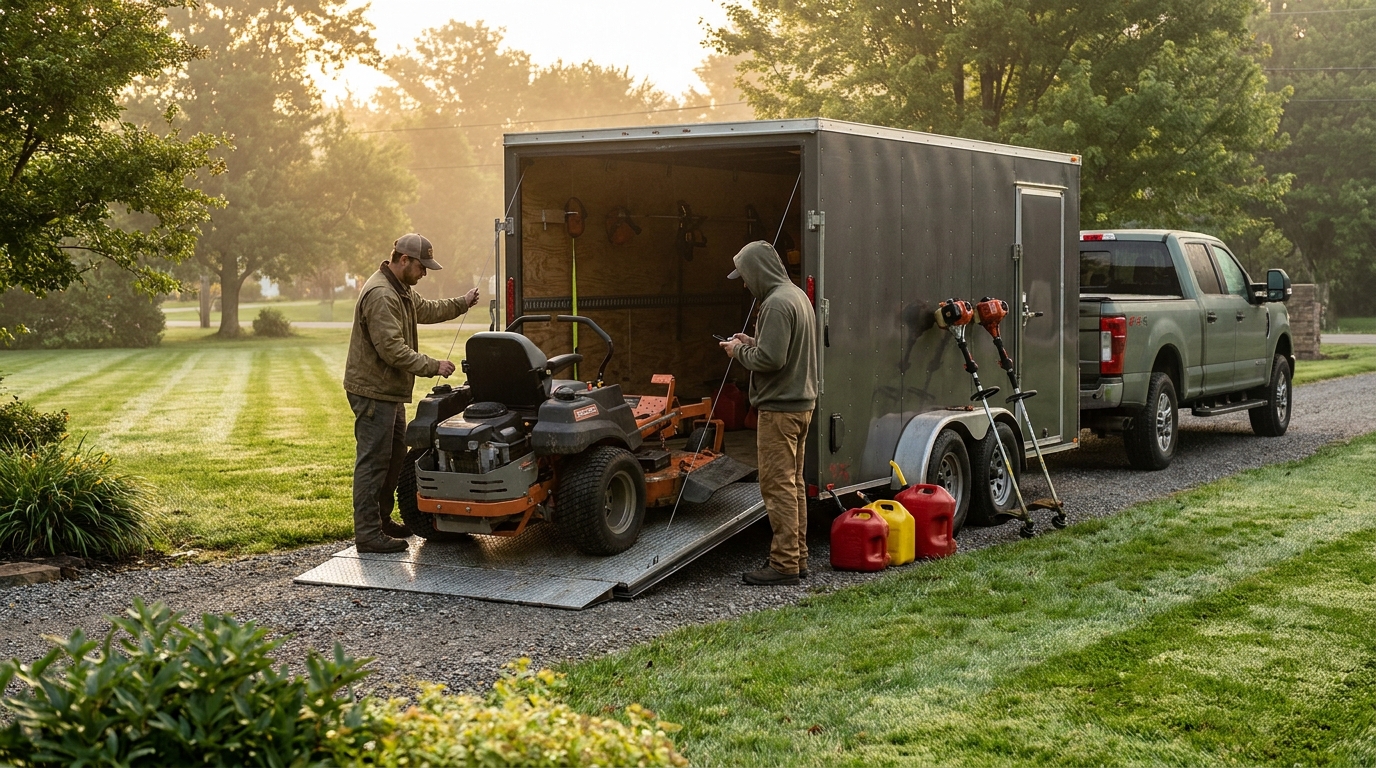
Take a normal two-person maintenance crew: one gas pickup pulling an enclosed trailer at about 9 mpg loaded, 60 route miles a day, 16 stops, plus a 60-inch zero-turn burning roughly 1.5 gallons an hour across six cutting hours.
- Truck: 60 miles at 9 mpg = 6.7 gallons a day. At 2025 prices that is $20.67. At 2026 prices, $24.27. Up $3.60 a day.
- Mower: 9 gallons a day. $27.90 in 2025, $32.76 in 2026. Up $4.86 a day.
- Total fuel increase: about $8.46 a day, spread across 16 stops = $0.53 per stop.
On a $50 mow, that 17% fuel jump is worth 1.1% of your price. It is real, and it is nowhere near a 7% increase.
Now price the same day's labor. Two people at $22/hour fully loaded — wage plus payroll taxes plus workers' comp, not the number on the pay stub — is $44/hour of crew cost. A nine-hour day is $396. A 4% wage move adds $15.84 a day, or $0.99 per stop: roughly double what a 17% fuel increase did, off a percentage move less than a quarter the size.
That is the whole point. Fuel is loud and visible; labor is quiet and about seven times heavier. Add insurance renewals, equipment replacement at current prices, and parts, and the honest sentence in your letter is about the cost of putting a trained crew in front of a house — not about the pump.
How much should you actually raise?
There are two different targets here and most operators never separate them, which is why "I raised prices and I am still not making money" is such a common story.
Target 1: hold the same dollars of gross profit per job. If your costs rise by c and your gross margin is m, the increase you need is (1 − m) × c. Only the cost portion of the price inflated, so only that portion needs covering.
Target 2: hold the same margin percentage. Then the increase is simply c — the whole price scales with costs. This is the right target if you are trying to grow, because flat dollars on a bigger cost base is a shrinking business.
Assuming costs up 5% across the year:
| Your gross margin | Increase to hold gross profit dollars | Increase to hold margin % |
|---|---|---|
| 25% | 3.8% | 5.0% |
| 35% | 3.3% | 5.0% |
| 45% | 2.8% | 5.0% |
| 55% | 2.3% | 5.0% |
Two things fall out of that table. First, the thinner your margin, the bigger the increase you need just to stand still — which is the opposite of how most people guess. Second, none of these are the 8–10% figure that gets thrown around in forums. If you have not raised prices in three or four years, you are not solving one year of cost inflation, you are solving four, and the number gets large fast. That is an argument for raising a little every year, not a lot rarely.
If you do not know your gross margin, stop and work it out before you write anything — our breakdown of landscaping profit margins walks through a full worked profit and loss statement. Every number on this page depends on that one.
How many customers can you afford to lose?
This is the question that actually keeps owners from sending the letter, and it has a real answer. If your gross margin is m and your price increase is p (both as decimals), the share of customers you can lose and still end up with the same gross profit is:
Allowable loss = p ÷ (m + p)
| Gross margin | +3% increase | +5% | +7% | +10% |
|---|---|---|---|---|
| 30% | 9.1% | 14.3% | 18.9% | 25.0% |
| 40% | 7.0% | 11.1% | 14.9% | 20.0% |
| 50% | 5.7% | 9.1% | 12.3% | 16.7% |
Read the 40% row: a 7% increase leaves you ahead unless more than one customer in seven cancels. Real-world attrition on a well-communicated single-digit increase to established customers is nowhere near that. The math is usually far more forgiving than the fear.
Three honest caveats, because a formula this clean always has them:
- It assumes the customers you lose are average. They rarely are. The ones who leave over 5% are usually your lowest-value, highest-complaint accounts, which makes the real break-even better than the table.
- It ignores route density. Losing eight scattered customers across town costs you far more than the formula says, because your windshield time barely drops. Losing eight houses on one street can genuinely improve your day. Density, not count, is what matters.
- It ignores replacement cost. Every cancelled account you refill costs marketing money and sales time, so treat the table as a floor, not a target.

When to send it
Timing does more work than wording. For most maintenance operations the window is late summer through early fall for the following season, which is exactly where the calendar sits now. The version of this you never have to send is a stated escalator in the agreement itself — we priced what each contract clause is worth against a 60-client book.
| Timing | How it lands |
|---|---|
| August–September, effective next season | Best. Months of notice, nothing changes mid-service, and it reads as annual planning rather than a reaction. |
| 30–60 days before renewal | Fine. This is the minimum professional notice for a recurring service. |
| Mid-season, effective immediately | Worst. Reads as a reaction to one bad month and invites a comparison quote at the peak of the shopping season. |
| With the invoice, unannounced | Never. The cheapest way to turn a 5% increase into a cancellation. |
Give at least 30 days. Send it separately from an invoice — a price change buried in a bill reads as something you hoped would not be noticed.
The letter
Most templates fail the same way. Here is the shape to avoid:
"Due to rising costs of fuel, labor, and materials beyond our control, we regret to inform you that we must implement a price adjustment at this time. We value your business and appreciate your understanding."
It is apologetic, it hides the number, "beyond our control" invites an argument you cannot win, and "price adjustment" fools nobody. Say the number, say when, say what they get, and stop.
Hi [Name],
I am writing with plenty of notice about your service rate for the 2027 season.
Starting [March 1, 2027], your weekly mowing service will move from [$45] to [$48] per visit — an increase of about [7%]. Everything else on your service stays the same: same crew, same day of the week, same scope.
The honest reason is wages. Keeping experienced people on a crew costs more than it did two years ago, and I would rather charge a fair rate and keep the same team on your property than cut hours and send whoever is available. Insurance and equipment replacement have moved as well.
This is my first increase since [2024], and I intend to keep future adjustments small and annual rather than occasional and large.
Your first invoice at the new rate will be [March 2027]. Nothing changes before then, and there is nothing you need to do. If you would like to talk it through, call me directly at [phone].
Thank you for [six] seasons — it is genuinely appreciated.
[Name], [Company]
What that letter does: leads with notice, names the number and the effective date in the first two lines, gives one true reason instead of a list, promises a cadence, confirms nothing changes today, and offers a phone call rather than a reply-to-cancel form. It does not apologise for being a business.
Rather than retype that around your own numbers, fill it in below and copy the result. It runs entirely in your browser — nothing is sent anywhere, there is no signup, and the effective date starts 30 days out on purpose.
Write the price-increase letter
Fill in the details and a client-ready letter writes itself on the right. Copy it or download it — no signup, and nothing you type ever leaves your browser.
Runs entirely in your browser — nothing you type is sent anywhere.
Sending the letter is the easy part. Landscapey handles what comes after the new rate lands — recurring invoices, card payments and the books, in one place.
Start freeDo not raise everyone the same amount
A flat across-the-board percentage is easy and slightly wrong, because your accounts are not equally profitable. Before you send anything, sort your recurring customers into three buckets:
- Dense and profitable. Tight to your route, no drama, pay on time. Modest increase, or none — these accounts are why the route works. Protect them.
- Average. The bulk of the book. This is where your headline number goes.
- Out of the way, slow-paying, or high-maintenance. The 20-minute drive for one $40 lawn. Quote these at what they would actually have to be worth, which is often 15–25% up. Some will leave. That is the point: an unprofitable account leaving during a rate change is a resignation you did not have to write.
Doing this properly requires knowing what each client has actually paid you and how they sit on the route — which is a record-keeping problem before it is a pricing one. It is also much easier to defend a number when you can see a client's full history in one place, which is the point of running the book in landscaping business software rather than in a notebook and a spreadsheet.
After you send it
Set a reminder for 30 days out and count three things: how many customers cancelled, how many pushed back and stayed, and what your revenue per stop actually became. Compare the cancellation number against your row in the break-even table above. If you came in well under it — which is the usual outcome — you have just learned that you had room, and next year's increase should not be an agonising decision.
The billing structure matters here too. Operators on a flat monthly agreement absorb an increase far more smoothly than those billing per visit, because the customer is comparing one predictable figure rather than re-evaluating a price every time a truck shows up; our guide to billing recurring landscaping clients covers both models. And if the increase does cost you a handful of accounts, refilling them is a known process — see how to get lawn care customers.
Frequently asked questions
How much should I raise lawn care prices in 2026?
Work it from your own numbers rather than a rule of thumb. Take your cost inflation for the year, multiply by (1 − your gross margin) to hold your gross profit dollars, or use the full cost inflation figure to hold your margin percentage. For most maintenance operations with costs up around 5%, that lands somewhere between 3% and 5% for a single year. If it has been several years since your last increase, you are covering all of those years at once and the number will be considerably higher — which is an argument for raising annually.
What should a lawn care price increase letter say?
Four things, in this order: how much notice you are giving, the old price and the new price with an effective date, one honest reason, and confirmation that the service itself is unchanged. Avoid "price adjustment", avoid apologising, and avoid listing every cost you face — a single true reason is more convincing than five.
Should I blame fuel costs for a price increase?
No, even in a year like this one. Fuel really did rise 17% for gasoline and 26% for diesel from 2025 to 2026, but run it per stop and it is worth roughly half a dollar on a $50 mow. Customers buy fuel themselves and can sense the mismatch. Worse, the EIA forecasts both fuels falling in 2027, gasoline back to about $3.09 — so a fuel-based justification will be provably stale by next spring. Anchor on labor, which is bigger and does not go backwards.
How many customers will I lose if I raise prices?
Fewer than you fear, and you can calculate what you can afford. The break-even is p ÷ (m + p): at a 40% gross margin, a 7% increase leaves you ahead unless more than 14.9% of customers cancel. Well-communicated single-digit increases to established customers with real notice usually come in far below that. The accounts most likely to leave are typically your least profitable ones.
When is the best time to send a price increase?
Late summer to early fall, effective at the start of the next season. It gives months of notice, does not change anything mid-service, and reads as annual planning rather than a reaction to a bad month. Thirty days is the minimum professional notice; sending it attached to an invoice with no warning is the most reliable way to trigger a cancellation.
Should I raise prices for every customer by the same amount?
No. Segment first. Accounts that are dense on your route and pay on time deserve a smaller increase, because route density is what makes the day profitable. Scattered, slow-paying or high-maintenance accounts should be re-quoted at what they would need to be worth — often 15–25% higher. Some will decline, which is a useful outcome rather than a loss.
The short version
Fuel had a genuinely bad year in 2026 and it is still the weakest argument in your letter, because it is small per stop and the forecast says it reverses in 2027. Work out your gross margin, apply (1 − m) × c to hold your profit dollars, check your allowable churn against p ÷ (m + p), segment your book so the unprofitable accounts get the number they have always deserved, send it in early fall with the price and the date in the first two lines, and count the cancellations against the table afterwards. Then do it again next year, smaller.
If your recurring rates, client history and route currently live across a notebook, a spreadsheet and your memory, that is the harder half of this job. Landscapey keeps recurring jobs, per-client billing history and route planning in one place, so a rate change is an update rather than an archaeology project — you can see pricing here or start a free trial.
Fuel price figures in this article are from the U.S. Energy Information Administration Short-Term Energy Outlook, July 2026 edition. Cost and margin examples are illustrative — run the formulas on your own numbers.