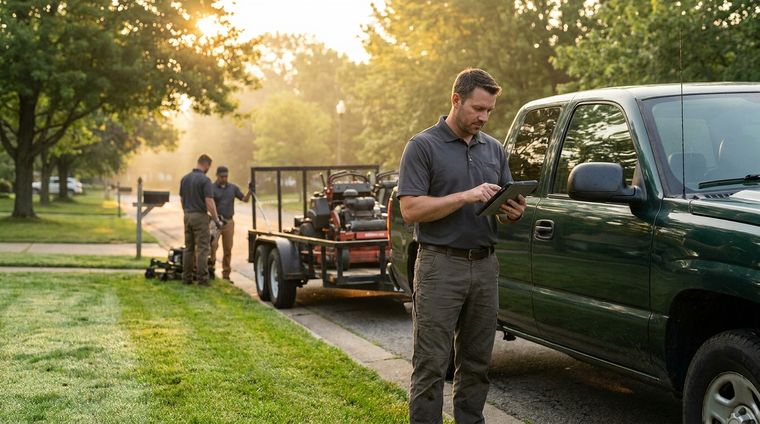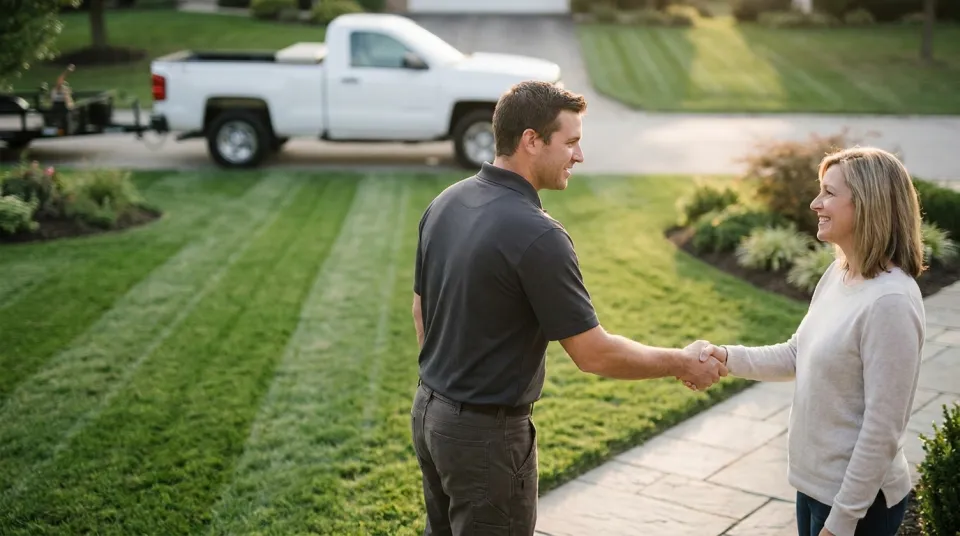
Ask most lawn care owners how they get customers and you'll hear the same answer: word of mouth. It's a great start, but word of mouth is a current you can't steer. It dries up in winter, it doesn't scale with your truck count, and it leaves you guessing where next month's work comes from. The operators who grow predictably treat customer acquisition like a system with a handful of repeatable channels feeding it.
This guide walks through the channels that actually move the needle for lawn care and landscaping businesses in 2026, in rough order of return on the effort. None of them require a big ad budget. All of them compound if you run them consistently.
The cheapest new customer is the one who already called you and got voicemail. Before spending on marketing, it is worth measuring how many enquiries are reaching you and dying at the ring - what missed calls cost a landscaping business has a two-week counting method and four fixes that cost nothing.
Start with the math, not the marketing
Before you chase leads, know what a customer is worth. A weekly mowing client at $45 a cut over a 30-week season is roughly $1,350 a year, and a good one stays three or four years. That number tells you how much you can spend to win one and how hard it's worth working to keep them. Most owners dramatically underspend on acquisition because they're only looking at the first invoice, not the lifetime.
It also reframes the goal. You don't need 200 leads a month. You need a steady trickle of the right customers in routes you can service profitably. Density beats volume every time.
1. Claim and work your Google Business Profile
For a local service, your Google Business Profile is the single highest-leverage free asset you have. When a homeowner searches "lawn care near me," the map pack shows up before any website. If you're not in it, you're invisible for the exact moment someone is ready to buy.
Claim the profile, pick the right primary category (Lawn Care Service or Landscaper), fill in your service area by ZIP, add real photos of your crew and finished lawns, and keep your hours current. Then post updates every couple of weeks. Google rewards active profiles, and an owner who posts a before-and-after every other week will outrank a stale competitor who set it up once and forgot it. For the full playbook on ranking in the local map pack — citations, service-area pages, and review velocity — see our guide to local SEO for landscapers.
2. Make reviews a system, not an afterthought
Reviews are the currency of local search. They lift your map ranking and they're the first thing a cautious homeowner reads before letting a stranger onto their property. The mistake is treating them as something that "just happens." Build a routine: the day after you finish a job, send a short text with a direct link to your review page. That's it.
Ask every satisfied customer, not just the ones who gush. A steady drip of recent, specific reviews ("they edged the beds perfectly and showed up on time") is worth far more than a pile of old five-stars. If a review mentions a service by name, even better, it helps you rank for that service.
3. Win the block you're already on
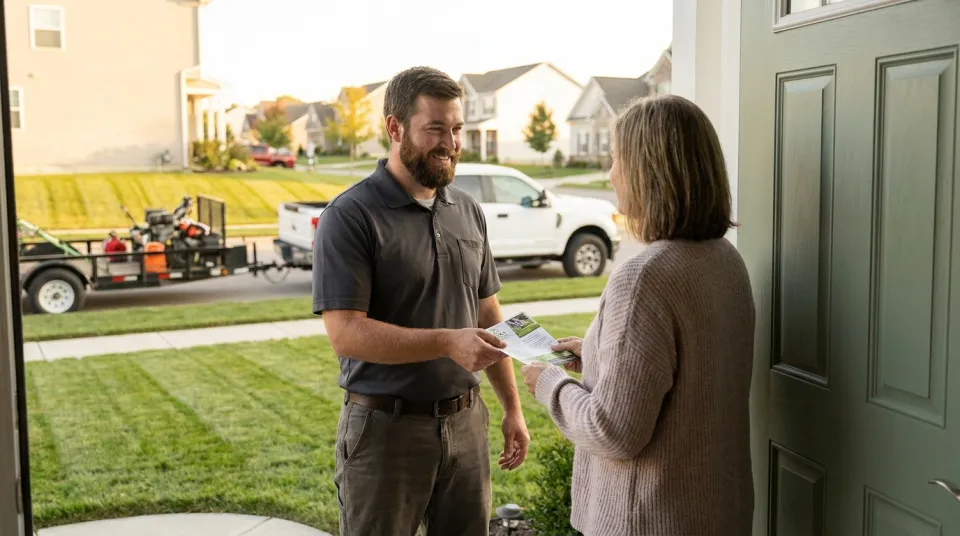
The cheapest customer to acquire is the one next door to a job you're already doing. When your crew is on a street, that's the moment to market it. Door hangers on the five nearest houses, a yard sign while you work, a quick "we're doing your neighbor's place, want a free quote?" knock. Your truck is already there; the marginal cost is almost zero and the routing is perfect. Buying a thousand of them is a different decision entirely, and the arithmetic on lawn care flyers and door hangers is not what the print shops imply.
This is how you build the route density that makes a lawn care business actually profitable. Ten customers on one street beats thirty scattered across the county, because windshield time is the silent killer of margins.
4. Build a referral engine your customers can't forget
Happy customers will refer you if you make it easy and give them a reason. A simple "$25 off your next service for every neighbor you send us" works because it's concrete and mutual. Mention it when you collect payment, put it on the invoice, and follow up once a season.
The key is to ask at the right moment, right after you've done visibly great work, not six months later in a generic email. Systematize the timing and referrals stop being luck.
5. Give yourself an online front door that converts
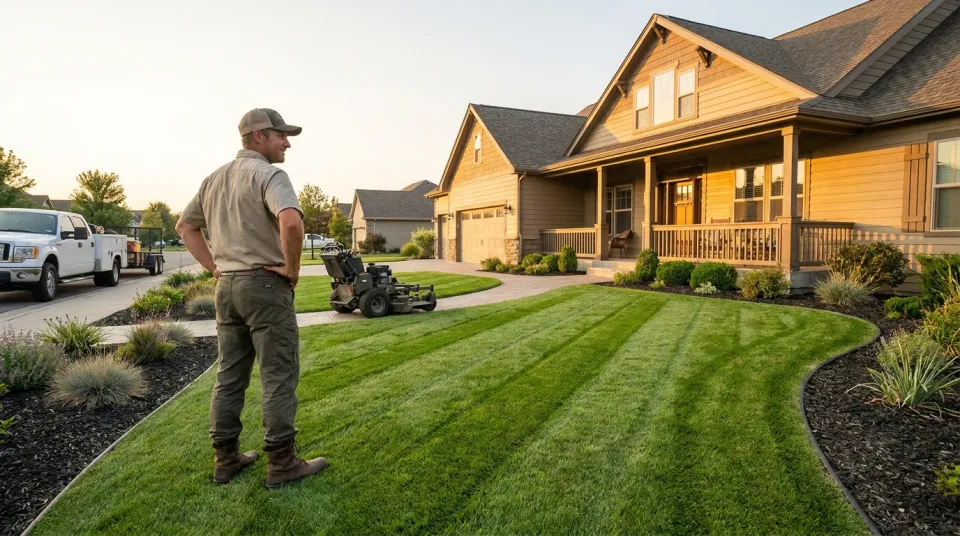
Most lawn care websites are brochures. A homeowner lands, reads a paragraph, and leaves with no easy way to ask for a quote. You want the opposite: a page built to turn a visitor into a lead. That means your services laid out clearly, real photos of your work, reviews front and center, your service area, and a quote form that's right there, not buried behind a "Contact" tab.
This is exactly why every Landscapey account comes with a public profile page the moment you sign up. It's a search-friendly page with your services, service area, photos, and reviews, plus a quote form that drops requests straight into your leads list, so you can respond before a competitor does. It's an acquisition channel that works while you're out mowing. You can start a free trial and have yours live the same day.
6. Respond in minutes, then bid to win
Speed is an underrated acquisition channel. Studies of home-service leads consistently show the first contractor to respond wins the lion's share of jobs, often more than half. A lead that sits for a day is usually a lead that already hired someone else. Set up text or email alerts so a new quote request never goes cold.
Getting the lead is only half the job, though, you still have to turn it into signed work. If your close rate is soft, it's usually the estimate, not the lead. Our guide on how to bid landscaping jobs walks through pricing your time correctly and writing a proposal that sells itself.
7. Turn one-time jobs into recurring revenue
Retention is acquisition's quiet twin. The customer you keep is one you never have to win again. After a one-off cleanup or mulch job, offer a recurring plan: "want me to keep it looking like this every two weeks?" Recurring contracts smooth your cash flow, fill your schedule in advance, and turn unpredictable spring rushes into a stable book of business.
Recurring-first scheduling and automatic invoicing make this painless to run at scale, which is one of the things to look for when you compare landscaping software for your business.
8. Track where every customer actually comes from
You can't grow what you don't measure. For every new client, log how they found you: Google, referral, door hanger, yard sign. After a season you'll know which channels are pulling their weight and which are wasting your time. Most owners are shocked to find one or two channels drive 80% of their best customers, and they double down on those instead of spreading thin.
A CRM that tracks lead source for you turns this from a spreadsheet chore into something automatic. That's the difference between guessing and knowing.
A 90-day plan to your first 20 customers
Channels are useless as a list; they work as a sequence. If you're starting from near-zero — a new crew, a new market, or just a slow book — here's how to stack the cheapest, fastest channels first and let the slower ones compound behind them. One thing worth settling before the first mow: what a lawn care business license actually requires where you operate, because the answer changes the moment installs or spraying join the menu.
- Days 1–14: build the front door. Claim and fully fill out your Google Business Profile, set up your profile page with services and your service area, and put a real photo on both. Wire up lead alerts so nothing sits unanswered. This is the foundation every other channel points back to.
- Days 15–45: work what you already have. Text every past and current customer for a review with a direct link. Ask each one for a referral with a concrete offer. The day you're on a street, door-hang the five nearest houses and plant a yard sign. These cost almost nothing and produce the first leads within a week or two.
- Days 46–90: tighten and convert. Respond to every new lead in minutes and turn one-off jobs into recurring plans at the moment the work looks great. Start logging where each new customer came from. By day 90 you'll see which one or two channels are actually carrying you — and that's where the next quarter's effort goes.
Twenty clustered, recurring customers is a profitable book for a one- or two-person crew. You get there faster by running these in order than by chasing every tactic at once.
Time your push to the season
Green-industry demand is not flat, and your acquisition effort shouldn't be either. The homeowner's intent to hire spikes at predictable moments, and the operators who win the season are the ones already visible when it does.
The biggest window is late winter into early spring — the weeks before the first mow, when homeowners are looking ahead and locking in a provider for the year. Your Google Business Profile, reviews, and quote form need to be in place before that surge, not during it, because the contracts signed in March feed the whole season. A second, smaller window opens in fall around cleanups, aeration, and leaf removal — a natural moment to convert one-off customers into next year's recurring plans. In the off-season, don't go dark: that quiet stretch is when you build the assets (reviews, photos, referral asks) that pay off the moment spring arrives. That window only pays if the work is priced right, and leaf work is the easiest thing on the fall list to underprice: here is how much to charge for leaf removal once disposal runs and drive time are inside the number.
Frequently asked questions
What's the fastest way to get lawn care customers?
Optimize your Google Business Profile and ask every recent customer for a review, then market the streets you're already servicing with door hangers and yard signs. These cost almost nothing and produce leads within weeks, far faster than paid ads you have to learn first.
Do I need to pay for ads?
Not to start. Most lawn care businesses can build a full book from free channels, Google Business Profile, reviews, referrals, and route-density marketing, before ever buying an ad. Add paid search later only if you've maxed the free channels and still want more volume in a specific area.
How many customers do I need to be profitable?
Fewer than you think, if they're clustered. Twenty recurring weekly clients on tight routes can out-earn forty scattered ones because you spend less time driving. Focus on density and recurring work, not a big raw customer count.
When should I start marketing for the season?
Before it starts. The contracts that fill your spring are signed in late winter, so your profile, reviews, and quote form should be live and polished weeks ahead of the first mow. If you wait until you're already busy to start marketing, you've missed the window that sets up the whole year.
Who are the best customers for a lawn care business?
The best customers aren't the ones who are cheapest to win — they're the ones with the highest lifetime value and the lowest cost to serve. Rank prospects on four things. Recurring vs. one-time: a weekly mowing client on a flat-monthly plan is worth 20–30x a single spring cleanup, so a signed recurring account beats ten one-off calls. Route density: customers clustered on the same street or subdivision cut your drive time and fuel to almost nothing, so a tight cluster of $150/month yards can out-earn scattered $250 ones. Reliable payment: commercial accounts (HOAs, small offices, property managers) sign renewable contracts and pay on terms, while some residential one-offs churn or haggle. Referral pull: a happy customer in a close-knit neighborhood is a lead magnet. Chase density and recurring revenue first — a small book of the right customers beats a big book of scattered, price-sensitive ones. For the larger renewable accounts specifically, see how to get commercial landscaping contracts.
How do I get more lawn care referrals?
Referrals don't happen by accident — you engineer them. Three moves that actually move the needle. Ask at the moment of delight: right after a customer compliments a finished job, not in a random email — a simple "we grow mostly by word of mouth, do you know a neighbor who'd want a quote?" converts far better than a generic ask. Make it worth their while: a two-sided incentive (say, $25 off both the referrer's and the new customer's next invoice) removes the awkwardness and gives everyone a reason to act now. Remove the friction: hand them your profile page link so passing your name along is one tap, and every referred lead lands in the same inbox you already work. Track who refers the most and thank them by name — those are your best customers. Because your crew is already on that street, neighbor-to-neighbor referrals also tighten your route density, so each one is worth more than the single job it brings in.
The channels above are built for winning residential customers. If you’re ready to go after larger, renewable accounts — office parks, HOAs, and property-manager portfolios — the playbook is different: it runs on bids, proposals, and net-30 terms. Our guide to how to get commercial landscaping contracts covers where to find them and how to win the bid.
Getting lawn care customers isn't about one magic tactic, it's about running a few reliable channels at the same time and tracking what works. Landscapey gives you the front door (a profile page that captures leads), the speed (instant lead alerts), and the retention tools (recurring scheduling and invoicing) to turn that flywheel — all in one piece of landscaping software built for the trade. Start a free trial or see the single, everything-included plan on the pricing page.