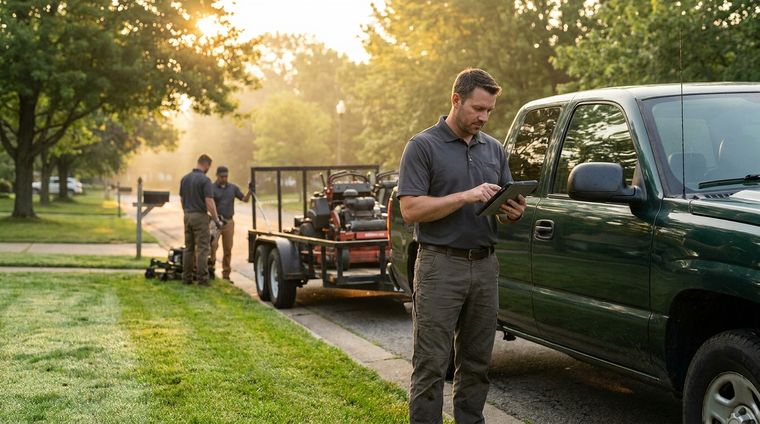
You're staring at a yard that's slipping fast. The grass is too high, the beds are messy, the shrubs need work, and the last guy either ghosted you or showed up with a quote that made no sense. If you're searching for a yard care specialist near me, don't start with random stars and a hope for the best. Start by deciding whether you need a one-off project or recurring maintenance, because those are two different hires with two different contracts, two different pricing models, and two different ways to get burned.
Table of Contents
- What You Actually Need Before You Start Searching
- Where to Search for Local Landscapers
- Vetting Licensing, Insurance, Reviews, and Portfolios
- How to Compare Quotes and Spot Hidden Costs
- Hiring for One-Off Projects vs. Recurring Maintenance
- Timing, Seasonality, and When to Actually Reach Out
- Your Hiring Checklist and Common Questions
What You Actually Need Before You Start Searching
Stop typing yard care expert near me until you can describe the job in one paragraph. If you don't define the work first, you'll compare companies that are built for totally different jobs, and that's how people end up with wrong scopes, bad timing, and ugly invoices. Outdoor property care is a large, labor-heavy occupation, with 929,930 U.S. outdoor maintenance and groundskeeping workers in May 2023 and a median hourly wage of $19.13, according to the BLS occupational profile for landscaping and groundskeeping workers. That scale matters because local operators come in all sizes, from solo crews to routed maintenance companies to larger shops that can handle full-service work.
Separate the job type before you call anyone
A one-off project is a defined install or renovation, like sod, a patio, drainage correction, planting, or a full yard reset. A recurring maintenance job is repeated care, like mowing, edging, pruning, weeding, and seasonal cleanup. Don't mix them up. A company that's great at install work may be a poor maintenance fit, and a maintenance crew may not have the design, equipment, or warranty structure for a major project.
Write down three things before you search. First, what's wrong with the property now. Second, what “done” looks like. Third, what you can spend without creating a headache later. Keep it simple and factual, because the first conversation should be about scope, not sales talk.
Practical rule: if you can't explain the job in under a minute, you're not ready to compare bids yet.
Decide what kind of operator you need
A solo operator can be great for light, repeatable maintenance, especially if the property is straightforward. A crewed company is usually the better call for larger properties, time-sensitive projects, or anything that needs multiple people and better scheduling discipline. If the work is recurring, ask yourself whether you want one truck showing up on a route or a company that can flex around weather and seasonal changes. If it's a project, look for the team that can finish it without stretching a simple job across half the month.
Your brief should also include access issues, gates, steep areas, irrigation hardware, pets, and any hard deadline. A clean brief saves everyone time and gives you a better read on who listened. That's the first filter. If a contractor can't respond clearly to a clear brief, skip them.
Where to Search for Local Landscapers
The channel you use shapes the shortlist you get. A vague search tends to return whoever is loudest online, not whoever is most suitable for your property. The better move is to search by ZIP code plus service type, then compare results across more than one source so you're not trapped by one directory's ranking logic. For local lawn care service marketplaces, the common flow is simple, enter a ZIP code, review ranked providers, then request quotes, and that pattern shows up across services like LandscapeRatings, Best Pick Reports, Airtasker, Bark, and HomeGuide.

Use Google Maps, directories, and referrals together
Google Maps is useful because it shows location, service area signals, photos, and review patterns. It does not tell you much about crew capacity, routing quality, or whether the company can keep up once the busy season hits. Marketplace directories like HomeGuide, Thumbtack, and Bark are useful for fast filtering, but they're still lead-gen tools, so you need to verify the business after discovery. Referral networks still matter more than many admit. A neighbor who has lived through a season of cleanups, missed visits, and billing quirks is often a better signal than a stranger with a polished profile.
Local nurseries, HOA managers, and property managers can be excellent sources too, especially if you care about reliability more than glossy branding. The point is to build a blended list. One source gets you speed. Another gives you context. A third gives you reality.
Don't overtrust the web footprint
A sharp contradiction in this market is that some of the most available local operators don't have much web presence at all. One lead-extraction source claims there are 353,000 U.S. landscaping companies without websites, and says many can still be found in Google Maps if their profile is set up well. That means the best local fit may not be the prettiest website or the top-ranked lead page. It may be the crew that's already working in your area and hasn't invested in SEO.
Use at least two channels, then aim for a shortlist of 5 to 8 names. That's enough to compare without wasting your weekend, and not so many that you drown in callbacks. If you want to understand why some gardening pros get found online better than others, the logic behind local visibility is worth reading in Landscapey's local SEO guide for landscapers. Then stop searching and start screening.
Vetting Licensing, Insurance, Reviews, and Portfolios
Many homeowners make the expensive mistake. They get a friendly phone call, maybe a nice price, and then skip the boring verification steps. That's how under-scoped jobs happen, and that's how pricing fights start. HomeGuide recommends comparing at least three estimates and checking licensing, insurance, bonding, warranties, and detailed written estimates, while Thumbtack advises verifying licenses in the relevant state database and reviewing portfolios and client reviews before hiring, both of which are laid out in its landscaping hiring guidance.

Check the basics in the right order
Start with licensing. Don't ask if they're “licensed” in a casual sense, ask for the exact business name and verify it in the relevant state or local database. Then confirm insurance. If the crew is working around walkways, irrigation, utility lines, or structures, you want proof that they can cover damage if something goes wrong. After that, read the reviews for patterns, not stars.
A long list of five-star reviews means very little if the same complaints keep showing up in the comments. Watch for repeated mentions of poor communication, surprise charges, unfinished cleanup, or crews that don't show when promised. Those patterns matter more than the average rating.
If three reviews mention the same problem, treat it like a real operating issue, not a coincidence.
Demand proof that matches your job
Portfolios should match your property type. If you need maintenance, don't let someone sell you a gorgeous patio gallery. Ask for before-and-after photos of jobs like yours, not just their best-looking work. If you're hiring for recurring service, ask how they document service, handle missed visits, and communicate schedule changes. If you're hiring for a project, ask for examples of completed installs, not renderings or staged photos.
You can also use review management behavior as a signal. A company that responds thoughtfully to criticism usually has systems in place. A company that ignores complaints often ignores customers too. If you want a useful reference for what healthy review handling looks like from the business side, see Landscapey's review management guidance. For homeowners, the takeaway is blunt. If the paperwork is vague, the review patterns are messy, or the photos don't match your job, move on.
How to Compare Quotes and Spot Hidden Costs
Get three written quotes, not one, and don't compare them until they use the same structure. A single bid tells you very little. Three bids show scope gaps, pricing habits, and who is paying attention. Thumbtack says project pricing is broad, with a national average that runs from about $850 to $3,432, which makes sense because scope varies so much. Treat that range as a warning, not a target. The best quote is usually the one that explains the job the clearest, not the one that looks cheapest. For a concrete example of what a clear, itemized quote looks like, see our sample job quote template. See Thumbtack's landscaping near me cost guidance.
Force every quote into the same shape
Each estimate should answer the same questions. What work is included. What materials are included. What is excluded. What starts the job. What finishes the job. If one quote says “cleanup included” and another says nothing about disposal, those are not comparable. They are different jobs wearing similar numbers.
Look for buried costs in the places people ignore. Site prep, haul-away, permits, irrigation tie-ins, bed edging, stump removal, and final cleanup are common places where a cheap quote gets padded later. If a contractor won't itemize those pieces, assume you are the one carrying the risk.
A clean quote should also state whether the price is fixed, time-and-materials, or subject to change orders. If the contractor cannot define how extra work gets approved, you will end up arguing about money after the crew is already on site. That is how a low bid turns into a frustrating invoice.
Ask the questions that expose weak bids
Use the same short list on every contractor.
- What exactly is included: Make them list labor, materials, disposal, and cleanup separately.
- What changes the price: Ask how unexpected grading, roots, rock, or access issues are handled.
- What's the warranty: Get the warranty in writing, especially for installs and plant replacement.
- Who approves extras: Require written approval before anything beyond the original scope starts.
Best practice: the cheapest bid is often the one that forgot something important.
If a quote looks low because it leaves out cleanup or material specifics, it is not a bargain. It is a future conversation. The job goes smoother when the contractor writes like a professional and bills like one too.
Hiring for One-Off Projects vs. Recurring Maintenance
This is the split most search results ignore, and it's the one that matters most. A one-off project hire and a recurring maintenance hire are not interchangeable. One is about execution against a finite scope. The other is about consistency, routing, and how the company behaves when the calendar gets messy.

For projects, demand precision and finish details
If you're hiring for a one-off project, ask about crew size, timeline, and who is supervising the job. Ask how they handle milestones, especially on larger installs where you don't want to pay everything up front. Warranty matters here too. So does a clear end point, because “almost done” is how projects drag on.
Project work should feel controlled. You should know the scope, the start date, the finish date, and what happens if conditions change. If a contractor talks loosely about the work but can't explain the sequence, that's a sign the job may be managed loosely too.
For maintenance, routing and reliability matter more
Recurring maintenance is a different animal. You're not just buying mowing. You're buying route discipline, seasonal flexibility, and communication when weather hits. Ask whether the company offers routed weekly service, how they handle seasonal changes, what happens if a crew is late, and whether they can slot one-off add-ons into the same workflow. Those questions matter because maintenance is about repeated execution, not one perfect visit.
Contract terms should match that reality. Maintenance should spell out visit frequency, seasonality clauses, and termination terms. Don't lock yourself into a long, vague agreement if the company can't explain how missed visits or weather delays get handled. A month-to-month or similarly flexible setup is often cleaner than a contract that sounds neat but works badly in the field.
If you want a better way to think about this operationally, Landscapey is one option among others for businesses that need to track one-off jobs and recurring jobs in the same system, because the work categories are different and the scheduling logic has to reflect that. The broader point is simple. A yard care professional who excels at installs may not be the same company you want showing up every Tuesday.
Timing, Seasonality, and When to Actually Reach Out
Too many homeowners wait too long. They notice the yard in the first warm stretch, then call everyone at the same time as every other homeowner in town. That's the worst moment to shop. Industry data says December through February is an ideal outreach window because outdoor care professionals are slower and planning ahead for spring, according to a lead-extraction source on landscaping companies without websites. That's when you get more attention, more responsiveness, and usually a less frantic sales process.
Book before you need the work done
If you want a spring project, start in late winter. If you want recurring maintenance, confirm the start date before the first rush of growth. That gives the company time to route the property properly and gives you time to compare options without panic. Waiting until the week the lawn looks bad means you're negotiating with whoever still has a slot.
Seasonality is also useful as a tiebreaker. If two quotes look similar, the contractor who can schedule cleanly in the off-peak window often has stronger routing or better planning. The contractor who promises everything immediately in peak season may be overcommitting.
Use the off-season to ask better questions
Winter outreach is the moment to ask about service calendars, crew coverage, add-on work, and communication habits. It's also when you can push harder on contract details without sounding difficult. Companies that care about next season will answer clearly. Companies that just want the fastest signature will keep everything vague.
Reach out a month before you actually need service, not the week you're already behind.
That advice saves money, and it also secures your bargaining position. Once the weather turns and every phone is ringing, you stop negotiating and start hoping. Don't do that to yourself. Book early, especially if the work is recurring or tied to a deadline like a sale, event, or move-in.
Your Hiring Checklist and Common Questions
Use this as your no-nonsense screen. If a candidate can't clear these items, don't hire them.
- Scope defined: You know whether this is a project or recurring maintenance.
- Three written quotes: Each quote uses the same scope and similar line-item detail.
- License verified: The business name matches the state or local record.
- Insurance confirmed: You've seen proof, not just heard a promise.
- References checked: You've called or read enough to see patterns.
- Contract signed: Warranty, payment terms, visit frequency, and termination terms are written down.
For recurring service, keep the contract simple. If it's long, vague, or hard to exit, you're taking on more risk than you need. For projects, don't release money without knowing the milestone structure. If the work changes, the paperwork should change too.
A few questions come up every time. Yes, a deposit can make sense, but only when it's tied to real scheduling or material procurement and not treated like a blank check. If something gets damaged, the only acceptable answer is a pre-job walkthrough plus clear insurance coverage. If a recurring service isn't working, stop arguing about vibes and use the contract terms to end it cleanly. Keep the communication short, factual, and written.
Simple rule: good landscapers don't fear written terms, because written terms protect both sides.
If you're ready to stop wasting time on sloppy bids and unreliable crews, use Landscapey to centralize leads, jobs, scheduling, and routing for the kind of local work that keeps an outdoor business busy. It's built for nearby customer inquiries, recurring service, and quote-to-invoice workflows, which is exactly what this market runs on.