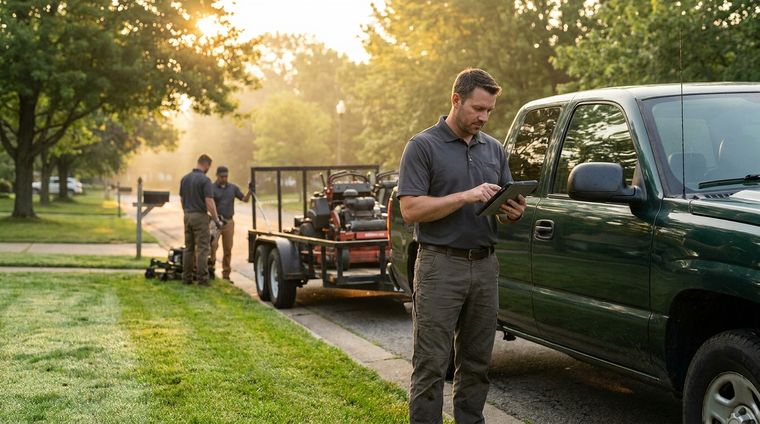
Your crew is loading mowers before sunrise, one truck is waiting on a trailer pin that's always missing, and someone is asking which pickup had the last oil change. That's not “just busy.” That's a fleet, whether you call it that or not. For a landscaping business, vehicle fleet management is the system that stops trucks, trailers, fuel, maintenance, and routes from living in everyone's head and turning into expensive guesswork.
When you're running 1 to 15 trucks, the job is simple to describe and hard to control. You need the right truck on the right route, the trailer hooked up, the tools loaded, the driver on time, and the vehicle back in the yard without drama. If you don't track that flow, you lose time in small pieces, missed service, extra fuel burn, surprise repairs, and crews that spend too much of the day moving asphalt instead of cutting grass.

Table of Contents
- What Vehicle Fleet Management Means for Landscapers
- The Five Core Components of a Landscaping Fleet
- KPIs That Matter for a Small Landscaping Fleet
- Choosing the Right Tracking Method for Your Crew Size
- A Practical Implementation Roadmap for Landscapers
- Realistic ROI and Cost Scenarios for a Landscaping Fleet
- Common Pitfalls and How to Avoid Them
- Bringing It All Together and Next Steps
What Vehicle Fleet Management Means for Landscapers
A landscaping foreman juggling three trucks, two trailers, and a seasonal crew is already doing vehicle fleet management, even if nobody has put a label on it. The only question is whether it's being done from memory, or from a system that records what's happening day to day. Once more than one truck or trailer is in play, you're managing assets, not just driving them.
For a small lawn-care company, the definition is practical. Vehicle fleet management means knowing which vehicle is assigned to which crew, which trailer is on the road, when each unit needs service, how much fuel it's burning, and whether it's being used well enough to justify keeping it. That's the difference between “We think truck 7 is due soon” and “Truck 7 is overdue, and it's assigned to the route that can't afford a breakdown.”
The landscaping version matters more than a lot of trades because your work changes fast. Spring cleanup, weekly mowing, mulch season, and winter work all change the shape of the fleet. You don't need a giant logistics setup, but you do need a way to keep the yard, the route plan, and the vehicles aligned.
Practical rule: If a vehicle, trailer, or driver assignment lives only in someone's memory, it's not managed. It's vulnerable.
At a minimum, treat the fleet as five linked parts, vehicles, drivers, maintenance, fuel, and jobs. If one part drifts, the others follow. A late oil change becomes a roadside failure. A messy route plan turns into extra fuel and overtime. A trailer that isn't tracked disappears into the daily scramble, and that's how small shops bleed margin without noticing it.
The Five Core Components of a Landscaping Fleet

Tracking and asset visibility
The first job is simple, know where the truck and trailer are. A modern fleet system does far more than show a dot on a map. It acts as the operational record for position, mileage, engine hours, fuel use, idle time, speeding, diagnostics, battery health, and utilization, which is why it's not just a GPS toy, it's the memory of the fleet. That's straight from how fleet systems are built and used in practice, not theory, and it's the backbone of real control (source).
For groundskeeping professionals, tracking solves yard chaos. If one crew is pulling a dump trailer to mulch jobs and another is heading out with a mower trailer, you need to know who has what before the day goes sideways. When equipment goes missing, the issue is usually not theft, it's weak visibility.
Maintenance and service control
Maintenance is where small fleets lose money fast. A missed service on a work truck can kill the whole day, and a skipped inspection often shows up later as a bigger repair. The right habit is to track preventive work before reactive work takes over, because breakdowns don't just cost repair dollars, they interrupt routes, crews, and customer commitments.
Technical fleet KPI guidance puts maintenance alongside fuel, utilization, safety, and cost-per-mile as one of the few metrics that matter, because it connects directly to uptime and spend (source). That matters in landscaping because a dead truck mid-mow doesn't just create a repair ticket. It creates a crew problem, a customer problem, and usually a rescheduling mess.
Routing, fuel, and safety
Routing decides how much windshield time you waste between stops. Fuel control tells you whether the route plan is sloppy, the driver is idling too long, or the vehicle itself is getting expensive to operate. Safety closes the loop, because a driver who speeds through neighborhoods, brakes hard, or mishandles a trailer drives up risk and wear at the same time.
A fleet isn't healthy if the vehicles run, but the routes are sloppy and the driving is rough.
These pieces can't be managed alone. A better route lowers fuel use, which makes cost analysis clearer. Maintenance records help explain why one truck is costing more than another. Driver behavior shows up in fuel burn and tire wear. The whole thing works only when the data is connected.
KPIs That Matter for a Small Landscaping Fleet

A small fleet does not need a wall of dashboards. It needs a tight set of numbers that show whether trucks, trailers, and crews are making money or burning it up. For a mowing crew, that usually comes down to cost per mile, fuel cost per job, vehicle utilization, preventive versus reactive maintenance, and whether the day starts on schedule.
The numbers to check every week
Cost per mile tells you whether a truck is getting too expensive to keep on the road. Use one consistent method to total fuel, repairs, tires, and routine service against miles driven, then compare truck to truck. If one unit is far worse than the rest, stop guessing and inspect it closely.
Fuel cost per job gives you a faster read on route quality. A route can look profitable until you see how much fuel the truck burned hauling a trailer across town for a short mowing stop. Idling matters here too. A 2026 industry summary says idling can waste about $3,500 to $4,500 per vehicle per year in a typical service fleet, and telematics often cuts fuel consumption by 10% to 15% in the first year (source). That is reason enough to stop treating fuel as a fixed cost.
Practical rule: If you cannot tie fuel to a job, a route, or a vehicle, you are guessing at profit.
The numbers to check every month
Vehicle utilization matters because some trucks in small fleets sit too much. Fleet optimization guidance says operators should study at least 90 days of telematics data and often find 15% to 20% of vehicles below 50% utilization (source). That tells you where a truck should be reassigned, sold, or retired instead of being left to collect dust.
For maintenance, keep the question simple. Are you fixing problems before they stop a route, or after? Track every service ticket as preventive or reactive, then review the mix each month. If reactive work keeps taking over, the fleet is running too close to the edge.
If you want a quick labor cost check after you sort out the fleet basics, use this labor cost calculator to pressure-test your crew expense on real jobs.
Choosing the Right Tracking Method for Your Crew Size
Not every landscaping company needs hardware in every truck on day one. A solo operator with one pickup and one trailer needs control, not complexity. A five-truck business needs better reporting than a spreadsheet can usually deliver, and once you hit the upper end of a small fleet, vague tracking turns into expensive blind spots.
| Method | Best For | Monthly Cost Range | Setup Time | Data Quality |
|---|---|---|---|---|
| Notebook or spreadsheet | Solo operators and very small crews with predictable routes | Lowest, usually just time and admin effort | Fast | Basic, depends on discipline |
| Phone-based GPS app | Small crews that want live location and simple route visibility | Moderate | Fast to moderate | Good for location, weaker for maintenance and asset history |
| Full telematics platform | Crews that need maintenance, fuel, driver behavior, and reporting in one place | Highest | Moderate | Strong, most complete |
A notebook can work if you have one person who never skips entries. The problem is consistency, not intelligence. The second that person gets busy, the records fall apart. For a 1 to 3 truck operation, that can still be enough if the routes are simple and the owner stays involved.
A phone-based GPS app is the middle ground. It gives you live location and some route discipline without installing hardware everywhere. That's a smart move for a crew that's growing but still watches expenses closely. If you're already struggling with maintenance records or fuel control, though, a phone app won't fix those problems by itself.
A full telematics setup is the right answer once the trucks are earning enough to justify detailed control. It gives you the vehicle history, driver behavior, service reminders, and reporting depth that spreadsheets can't match. The extra visibility becomes valuable fast when trailers, seasonal crews, and maintenance windows start overlapping.
For crew management and dispatch coordination, pair whatever tracking method you use with a system that keeps assignments clean, landscapey.ai/blog/crew-management-software. That keeps the fleet from becoming a separate island of data.
Don't buy the biggest system you can find. Buy the smallest system that stops your current mistakes.
A Practical Implementation Roadmap for Landscapers

The cleanest rollout starts with inventory, not software. Write down every truck, trailer, mower trailer, dump trailer, and major equipment item, then assign each one to a person. If a unit floats between crews, that's fine, but it still needs an owner. No asset should exist in the business without a name next to it.
Weeks one and two
Build one master list and stop relying on loose text threads. Put the trucks, trailers, VINs if you have them, service intervals, and primary assignments in one place. That's your baseline, and without it, any later system will be built on sand.
Then choose one source of truth for jobs and routes. A scheduling or CRM tool is usually enough at this stage, because the main benefit is not fancy analytics. The benefit is getting dispatch, route planning, and crew assignment out of memory and into a repeatable process.
Weeks three to six
Layer in tracking and maintenance reminders. Start with the vehicles that cause the most pain, not the whole yard at once. If one truck always disappears from the schedule or one trailer gets forgotten, fix that first.
Use the early data to set simple rules. A truck with repeated service misses gets a tighter reminder. A route with too much deadhead time gets reworked. A driver with frequent hard braking gets coached, not ignored. Don't start with perfection. Start with visibility.
Weeks seven to twelve
Add fuel tracking and cost review. By this point, you should be able to tell which vehicles are carrying their weight and which ones are dragging the fleet down. Keep the review short, monthly is enough for a small shop, as long as someone looks at the numbers and acts on them.
The 2024 to 2025 electrification guidance makes a broader point that applies here too, implementation only works when the business has already quantified its vehicle types, demand, and operational needs (source). The lesson for fleet managers is simple. Don't add complexity before you've mastered the basics.
Realistic ROI and Cost Scenarios for a Landscaping Fleet
A four-truck landscaping shop with loose routing and manual fuel logs leaks money in ordinary ways. Drivers take the long path between properties, idling slips by, and maintenance waits until something breaks instead of being scheduled on time. None of that looks dramatic during the day, which is why it keeps happening.
The owner usually feels it first in the paperwork. One truck gets used too hard because it is the dependable one, one trailer stays in constant circulation because nobody tracks it as a separate asset, and service happens after a warning light or a roadside failure. A significant problem is admin time, because someone has to rebuild the week from receipts, texts, and memory instead of managing routes and repairs as they happen.
A tighter setup changes the picture fast. Routes get grouped better, assignments are clear, and fuel plus maintenance get reviewed on a set schedule. The first gains are usually the easiest ones to see. Less wasted driving. Fewer surprise repairs. Less time spent hunting for which unit is where. Teams that start with clear routing rules usually find the quickest savings by tightening dispatch and reducing idle time, especially when they use route planning tools built for small crews.
The hidden win is control over the assets you already own. A right-sized fleet is easier to defend than a bloated one, and fleet-optimization guidance from analysts at ADL makes the same point by linking utilization review to cutting excess capacity. For a grounds maintenance company, that can mean one truck no longer sits unused through the slow season, or one trailer gets reassigned instead of duplicated.
The fuel side matters too. Telematics benchmark reporting has shown that fuel use often falls once tracking is in place and the crew stops wasting miles and idle time, which is why fuel and route discipline usually produce the clearest early return (source). For a small landscaping fleet, that is where the money is. Not in fancy dashboards. In fewer deadhead miles, fewer idle hours, and fewer units sitting in the yard earning nothing.
Common Pitfalls and How to Avoid Them
The biggest mistake is tracking vehicles without changing decisions. A lot of shops install GPS, glance at a map, and then keep running the same bad routes, the same overloaded truck, and the same skipped maintenance pattern. Data that doesn't change behavior is just expensive decoration.
A second mistake is buying too much software too early. You don't need every dashboard, every integration, and every report on day one. You need clean assignments, service dates, fuel visibility, and enough route discipline to stop obvious waste. More software won't fix bad habits.
Driver buy-in matters too. If the crew thinks tracking exists only to catch them doing something wrong, they'll resist it or work around it. The better move is to use the data to reduce breakdowns, shorten routes, and keep workdays predictable. Drivers usually care about that as much as owners do.
If your team sees fleet management as punishment, the rollout is broken.
Another blind spot is trailers. Too many landscaping businesses manage trucks and treat trailers like invisible attachments. That's a mistake. Trailers carry expensive equipment, they affect route planning, and they're part of the fleet whether anyone writes them down or not.
Skipping maintenance records is the last trap worth calling out. If you don't know what was done, when it was done, and which unit needs attention next, you're setting yourself up for repeat failures. Keep the records simple, but keep them complete. The point isn't paperwork. The point is fewer dead trucks and fewer ruined afternoons.
Bringing It All Together and Next Steps
For landscaping professionals, vehicle fleet management isn't a corporate overhead function. It's the operating system of the business. When you keep the five core pieces aligned, tracking, maintenance, routing, fuel, and safety, the fleet stops surprising you and starts supporting growth.
The smartest next step is not buying a giant platform. It's getting every truck, trailer, route, and crew assignment into one clean system and using a few KPIs that matter. Once that foundation is in place, the business gets calmer, the trucks get used better, and weekends stop disappearing into cleanup work.
If you're ready to stop running your trucks from memory, use Landscapey to centralize jobs, routes, and day-to-day operations in one place. It gives landscaping teams a practical way to keep the fleet tied to the schedule instead of scattered across texts and spreadsheets. Start with a cleaner system this week, and you'll feel the difference by the next busy route day.