
Ask the internet what landscapers do in the winter and you get a list. Snow removal, holiday lights, gutter cleaning, firewood, hardscapes, equipment repair, Christmas trees, ice rinks. I read fifteen results for that query on 2026-09-01 and every single page that answered it answered it the same way: as a menu. Seventeen ideas. Eight ways. Ten services.
Not one of them priced the problem the menu is supposed to solve.
The question underneath "what do landscapers do in the winter" is never really about activities. It is about a specific hole in a specific bank account, and the useful answer has a dollar figure in it. So this is the arithmetic version. How big is the hole, in one stated book of business. What each off-season option actually returns against it. And the second answer almost nobody publishes, which is that you can shrink the hole without selling anything extra at all.
There is a second off-season number, and it is the one that reaches your household rather than your payroll. Keep paying yourself a level $3,429 a month through the quiet 4.6 months and keep one employee on at $4,591, and $36,892 has to come out of a bank balance to reach spring on per-visit billing. We worked the owner-pay side of the same book here - same 60 clients, same $52, different question.
One cold-season variable is now written into municipal code, and it does not point the same way in every town. The two published gas-blower phase-outs both carve out the fall in 2026 - Portland permits gas October through December, and Lower Merion lifts its ban on 2 October. By 2028 they invert: Portland bans December outright while Lower Merion permits it. Two gradual schedules, drafted independently, ending up on opposite months. There is no national calendar to buy equipment against. The schedules side by side.
The off-season is also when the exam gets sat. A commercial pesticide applicator credential is cheap - Pennsylvania is $60 in exams and $40 a year, Minnesota $76 a year - but New York makes you work a full year as a technician before you can hold it, so the calendar matters more than the fee. On the 60-client book used throughout these posts, a five-step program that 40 clients take is $13,000 of revenue on routes you already drive, and it is sold in the same months you would be studying. Which credential, what nine states charge, and the neonic rules that change the product list.
Before any of that, there is one more product on the way in. In a freeze state the sprinkler-blowout window is two to four weeks, and one truck at 12 stops a day runs about 180 blowouts across it; at $90 a stop that is $16,200 of revenue against roughly $6,900 of fixed cost, $9,261 of contribution in three weeks. Sold as a package with the spring start-up, it also books next April while you are standing in the driveway. Sprinkler winterization: what customers pay, what contractors post, and the arithmetic underneath both.
The last thing to sell before the season closes is also the first thing to sell for spring: gutters want cleaning after leaf-drop and again after the seed pods and pollen, and the customer who says yes in November says yes to April on the same quote. On the 60-client book, 40 gutter-eligible houses at add-on prices are $6,350 of revenue and about $3,470 of contribution per pass on visits already scheduled - a roughly $12,000-a-year line once the spring pass is booked, with no new customer and no new drive. Gutter cleaning pricing, standalone and as a cleanup add-on.
The stated book, so every number here is checkable
I am going to use the same book of business we used in our leaf removal pricing guide, because carrying one set of assumptions across posts is the only way the arithmetic stays honest:
- 60 maintenance clients on weekly service
- $52 a visit
- a 32-week season
- one two-person crew at $52.80 an hour fully loaded — wages, payroll tax, workers' comp, the truck
Your market is not this market. A Georgia operator mows closer to 44 weeks; a Minnesota operator closer to 26. The structure of the maths is the part that travels, not the figures.
The hole is 20 weeks and $42,240 wide
Start with the revenue. Sixty clients at $52 is $3,120 a week. Across a 32-week season that is $99,840 — a decent one-crew book.
Now look at when it arrives. Thirty-two weeks is about 7.4 months. That leaves 20 weeks, roughly 4.6 months, at zero. If you bill per visit, which most maintenance operators do, the money stops the week the mowing stops.
| Measure | In season (32 wks) | Off season (20 wks) |
|---|---|---|
| Maintenance revenue | $99,840 | $0 |
| Per month | $13,556 | $0 |
| Crew cost at 40 crew-hours/week | $67,584 | $42,240 |
$42,240 is the number that matters. That is what a two-person crew costs to keep for twenty weeks at $52.80 an hour, forty crew-hours a week — $2,112 a week, about $9,177 a month. It is the real cost of the answer "we keep everyone on through the winter," and it is the figure every listicle on that results page leaves out.
It is also not the whole bill. Truck payments, general liability, the shop, your phone, and the owner's own draw all run in January exactly as they run in June. The $42,240 is just the payroll floor.
Option A: sell your way out of it
This is the answer the whole first page of Google gives, so let us actually cost it. Four options come up on nearly every list. They are not equivalent, and two of them are not really revenue at all.
| Option | What it really is | Honest constraint |
|---|---|---|
| Snow & ice | Genuine replacement revenue, per-push or seasonal contract | Weather risk sits entirely on you, and it needs a truck, a blade and an insurance rider you do not already own |
| Holiday lighting | Genuine replacement revenue, ~6-week window | Sold in September and October, not December — and see the pricing problem below |
| Gutters, pressure washing, cleanups | Shoulder-season work, mostly November | Extends the season by weeks, does not fill January |
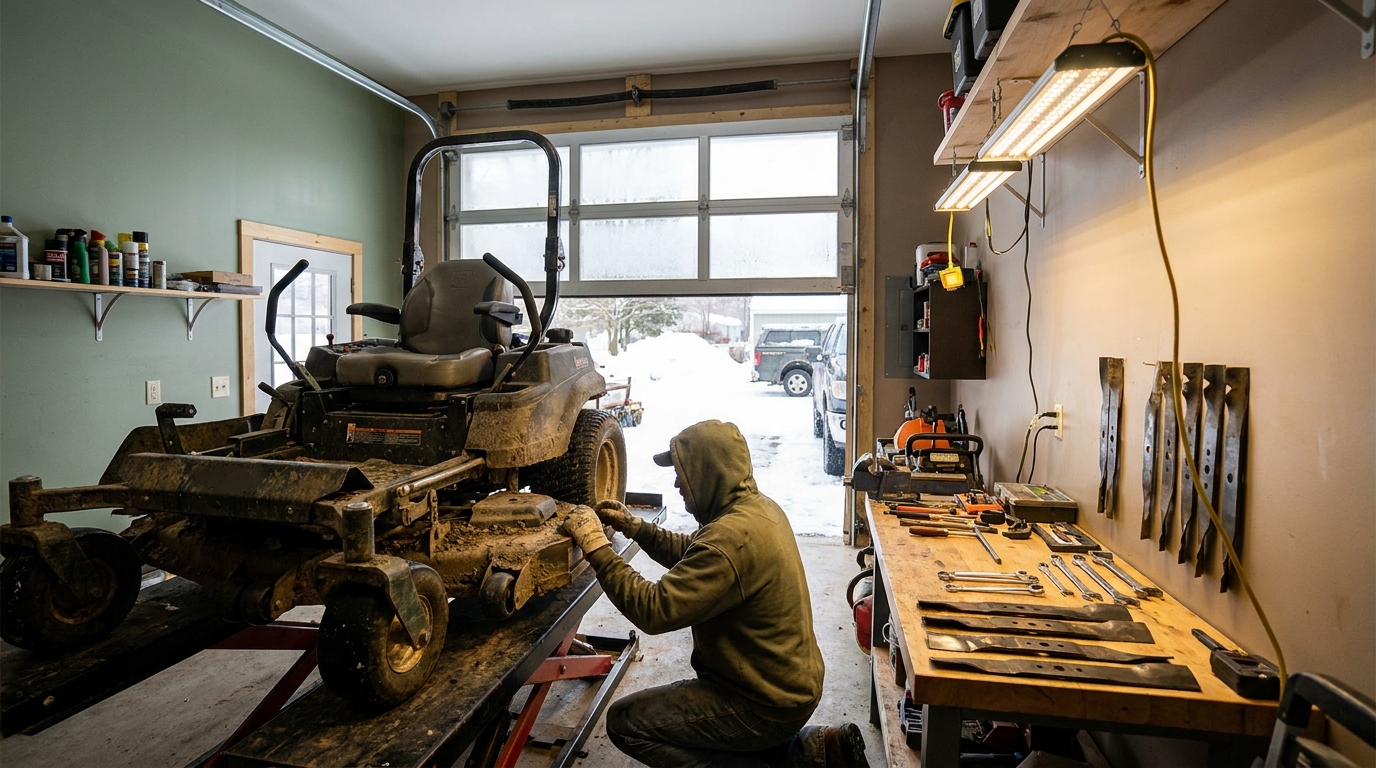
| Equipment service, planning, sales | Cost avoidance and next-season revenue | Real value, but it pays no wages this quarter — do not count it as income |
That last row is where a lot of off-season advice quietly cheats. Sharpening blades and rebuilding decks in February is genuinely worth doing and it is not money coming in. Neither is "work on your marketing."
Snow is the strongest of the four, and I am not going to re-derive its pricing here because we have already published it: our average cost of snow plowing guide puts standard residential per-visit clearing at $60 to $110, with the broader national band running $100 to $125 and outliers from $50 to $200, and the commercial snow removal pricing calculator covers seasonal-contract structure. If snow falls where you work, start there.
The holiday lighting numbers disagree by 65%, and it bites at the quote
Lighting is the option most often recommended to operators who cannot plow, so I went and read the pricing pages directly rather than quoting search snippets. Two of the four I tried returned HTTP 403 to our fetch and are excluded rather than characterised from a snippet. The two that returned in full:
| Source (read 2026-09-01) | Typical job | Labor only, per linear foot | Materials, per linear foot |
|---|---|---|---|
| Thumbtack, updated Apr 13 2026 | $260–$661 common; $133 low, $1,338 high | $1.25–$3.00 | $0.50–$2.00 |
| christmaslights.io, published Jun 26 2026 | $432 average; $219–$673 | $2.00–$5.00 | $0.50–$2.00 |
The materials figures match exactly. The labor figures do not. Thumbtack's labor-only midpoint is $2.13 a foot. christmaslights.io's is $3.50. That is a 65% spread on the same unit for the same service, read on the same day.
On a 150-foot roofline that is $319 against $525. If a homeowner has priced the job off one page and you have priced it off the other, you are $206 apart before either of you has said anything unreasonable. This is the same failure mode we documented when a review directory listed a competitor's flat per-company price as a per-user price — the number is not wrong so much as the unit is undeclared, and the person standing in the driveway in November eats the difference.
One more figure worth treating carefully: christmaslights.io publishes regional averages of Northeast $650, Midwest $515, Southwest $400, Northwest $350 — and Southeast $750, the highest of the five. A region with lower labor costs and the least winter demand topping the table is counterintuitive enough that I would not build a route plan on it. I am reporting it because it is what the page says, not because I can vouch for it.
How many houses does it actually take? Ninety-eight.
Here is the arithmetic no listicle runs. Take christmaslights.io's $432 average install. To cover the $42,240 off-season crew cost with holiday lighting alone:
$42,240 ÷ $432 = 98 installations.
You have sixty clients. Ninety-eight jobs is 1.63 times your entire book — every customer you have, plus thirty-eight you do not, all installed inside a six-week window that ends on Christmas Eve. And that is gross revenue, before the lights, the ladders, the extra insurance and the takedown labour in January.
Now the realistic version. Suppose you sell lighting to a quarter of your existing clients, which would be a good year:
| Attach rate | Jobs | Revenue at $432 | Weeks of crew cost covered |
|---|---|---|---|
| 25% | 15 | $6,480 | 3.1 of 20 |
| 50% | 30 | $12,960 | 6.1 of 20 |
| 100% | 60 | $25,920 | 12.3 of 20 |
A good lighting season covers about three weeks of a twenty-week winter. Selling it to literally every client you have still leaves you seven and a half weeks short. That is not an argument against holiday lighting — $6,480 is $6,480 — it is an argument against treating the service menu as the answer. The menu is a patch. It was never going to be the plan.

Option B: stop filling the hole and start flattening it
The second answer costs you nothing to deliver, because the work is already done and already sold. It is a billing question, not a services question.
Bill the same $99,840 across twelve months instead of eight. Nothing about the service changes: same 32 weeks of visits, same crew, same clients, same annual total. Only the invoice schedule moves.
| Per-visit billing | Flat monthly billing | |
|---|---|---|
| Annual revenue | $99,840 | $99,840 |
| Apr–Nov, per month | $13,556 | $8,320 |
| Dec–Mar, per month | $0 | $8,320 |
| Cash reaching you across the 20 off-season weeks | $0 | $38,297 |
$38,297 arrives in the months that were previously empty, and it arrives without you selling one additional service, buying a plough, or knocking on a single new door. Against the $42,240 payroll floor it covers 91%.
And now the line this whole post exists to make:
Flat-monthly billing ($38,297) plus a realistic 25% holiday-lighting attach ($6,480) is $44,777 — which clears the $42,240 crew cost by $2,537. Neither one clears it alone. The billing change does 86% of that work and the service you were told to go sell does 14%.
What flat-monthly billing actually costs you
Three honest downsides, because this is not free money and anyone who tells you it is has not run it:
- You give up $5,236 a month in peak season. June feels worse. If your peak-season cash is already funding equipment purchases, moving to flat-monthly changes when you can buy.
- A client who cancels in February has been paying for service you already delivered — and one who cancels in September has not yet paid for it. Which direction the exposure runs depends on your billing start month, and it is the single clause that decides whether this works. Get it written down; our lawn care contract template breakdown covers what each clause costs you.
- It is a September conversation, not a December one. Nobody agrees to keep paying through winter after the mowing has already stopped. You pitch it while the grass is still growing and the value is visible out the window — the same timing logic as a lawn care price increase letter.
Note also what it does not do. At $8,320 a month against $9,177 of monthly crew cost, flat-monthly billing does not let you keep a full crew busy all winter. It keeps the owner paid, the trucks insured and the lights on. Anyone promising it does more than that is selling something.
What to actually do, in September
The reason this is a September post and not a December one is that every option above has to be sold before the season ends:
- Work out your own $42,240. Crew hourly cost × hours a week you intend to keep paying × your off-season weeks. Without that number the rest is vibes.
- Count your season. Not the calendar year — your actual first and last cut. That is your 32.
- Price your book both ways. Annual total ÷ 12 is the flat-monthly figure. If it is close to what your winter fixed costs are, you have found the plan.
- Make the renewal call now, with next season's rate and the twelve-month schedule in the same conversation. One call, two decisions.
- Pick one off-season service, not four. Whichever you can sell to your existing clients without new equipment. Depth beats breadth in a six-week window.
- Decide about the crew honestly and early. Twenty weeks at $2,112 is a real commitment; a good employee told in September that there are 20 unpaid weeks coming will find another job by October, which may be the right outcome for both of you.
Where Landscapey fits, and where it does not
We build a CRM for landscapers, so state the interest plainly. Recurring maintenance agreements in Landscapey bill flat-monthly or per-visit — the flat-monthly structure above is a setting on the job, and the visits keep generating on their schedule whether the invoice is monthly or per-cut. Invoices take card payments through Stripe directly into your own account with 0% taken by us. Pricing is $19.99/month (listed against $29.99 as launch pricing) or $199.99/year, with a 14-day free trial that requires a card to start. Those figures were read off our own live pricing page today.
The limits, in the same breath. Landscapey has one login per business — there are no separate crew accounts, so if your winter plan involves dispatching two plough trucks independently, we are not the tool. We do not do job costing or overhead recovery, so we cannot tell you whether that $52 visit is priced correctly in the first place; if that is your actual question, look at what a healthy landscaping profit margin looks like and at software built for it. And we have no snow-specific features — no per-push triggers, no salt tracking, no weather-triggered billing.
Frequently asked questions
What do most landscapers actually do in the winter?
Where it snows, the honest answer is snow and ice work; where it does not, it is a mix of shoulder-season cleanups, holiday lighting and hardscape or installation projects, plus a lot of unpaid equipment and planning work. What the popular lists omit is that for most one-crew operations none of it replaces maintenance revenue — it supplements it while the owner absorbs the gap.
How much money does a landscaper lose over the winter?
On the book above — 60 clients, $52 a visit, 32-week season — twenty weeks with no maintenance revenue against a two-person crew running 40 hours a week at $52.80 fully loaded is $42,240 of payroll with no income behind it, before trucks, insurance and the owner's own draw. Run the same three numbers for your business; the method matters more than my figures.
Is holiday lighting worth it for a lawn care business?
Worth it, yes. Sufficient, no. At an average install of $432, selling lighting to a quarter of a 60-client book returns $6,480 — just over three weeks of a twenty-week off-season. Covering the whole gap with lighting alone takes 98 installs, more than one and a half times that entire client list, inside a six-week window.
Should I bill monthly or per visit for lawn maintenance?
Per-visit is simpler and matches cash to work. Flat-monthly spreads the same annual total across twelve months, which on the book above moves $38,297 into the four months that were previously empty. The trade is $5,236 a month less in peak season and a cancellation clause you have to get right. Most one-crew maintenance operations are better served by flat-monthly; project-heavy or install-heavy businesses usually are not.
When should I ask clients to switch to twelve-month billing?
Before your last cut, while the service is visibly happening. Ask in December and you are asking someone to pay for a lawn they are looking at through a frosted window. Ask in September and you are renewing a service they are watching you perform.
Do I have to lay off my crew for the winter?
That depends on whether your off-season plan clears roughly $2,112 a week per two-person crew, and on the reality above: flat-monthly billing on its own covers about 91% of that, and one good off-season service adds another 15%. Together they clear it on this book. Neither does alone — which is the whole reason to decide in September rather than discovering it in January.
Sources and limits
- The book of business is illustrative and stated, not surveyed. 60 clients, $52 a visit, 32 weeks, $52.80 an hour fully loaded — carried deliberately from our leaf removal guide so the two posts can be checked against each other. It is not a claim about the average American landscaping company.
- Holiday lighting figures were read directly on 2026-09-01 from Thumbtack's Christmas light installation prices page (last updated Apr 13, 2026) and christmaslights.io's pricing article (published Jun 26, 2026). Two other pages in the same results set returned HTTP 403 to our fetch and were excluded rather than summarised from a snippet.
- Thumbtack's headline range is ZIP-localised — the $260–$661 figure was served for 28311 — so treat it as one market, not a national average. The per-linear-foot figures are presented on that page as general guidance.
- Snow pricing is not derived here. The $60–$110 residential per-visit band and the $100–$125 national figure come from our own previously published snow plowing guide and are reproduced, not re-researched, in this post.
- The 91% / 86% / 14% splits are arithmetic on the stated book only. Change any of the four inputs and they move. They are offered as a method for ranking your own options, not as industry benchmarks.