
Search for a landscaping business owner salary and page one hands you a number in about four seconds. Search a second time and it hands you a different one. That is not a quirk of the query — three of the pages currently ranking cite the same named source and report $49,686, $91,395 and $127,973. A 2.58x spread, one attribution, all three read on the same morning.
None of that is useful to someone trying to decide what to move from the business account to the personal account on the first of the month. So this piece does something the ranking pages do not: it takes one ordinary maintenance book — 60 weekly clients, $52 a visit, a 32-week season, one employee — and works the owner's pay out of it line by line, then says plainly which part of that pay was a wage and which part was a return on owning the thing. Those are two different numbers, and blending them is exactly why the tables cannot agree.
Three page-one results, one source, three different numbers
Read directly on 2 September 2026, not from search snippets:
| Page | Figure it reports | Attributed to | Page date |
|---|---|---|---|
| Aspire (youraspire.com) | $49,686 national average; state range $33,766 (FL) to $53,582 (AK) | ZipRecruiter | 2 Aug 2024 |
| okason.com | $91,395 average; 25th pctile $43,000; 90th pctile $175,000+ | ZipRecruiter | 20 Feb 2026 |
| Housecall Pro | $127,973 average; low end $25,500; 90th pctile $293,500 | ZipRecruiter (2026 data) | 21 Jan 2026 |
Three things are worth saying out loud about that table.
The spread is not explained by dates. The two 2026 pages are $36,578 apart on their own. The 2024 page is the outlier only in the sense that it is lowest; it is not the reason the other two disagree.
One of them attributes the same figure to two sources. okason lists "$91,395 (ZipRecruiter)" and "$127,973 (HouseCallPro)" side by side as if they were independent readings. They are not — Housecall Pro's own page attributes its $127,973 to ZipRecruiter. So a page-one article is presenting one source's number twice, at two values, as corroboration.
And they are not all measuring the same thing. okason says "average salary" in one place and "owner take-home" in another, on the same page, without saying whether either is before or after self-employment tax. A gross wage and a take-home figure are separated by roughly the whole of a tax bill, and no page on that results set states which of the two it is quoting.
We could not read ZipRecruiter's own page: it returned HTTP 403 to our fetch. So it appears here only as what three other pages attribute to it, never as a figure we verified at the source. That is the same treatment we gave two unreachable pages in last week's off-season pricing work, and it is the only honest way to handle a source you could not open.
Owner pay and net margin are two different draws on the same dollar
The most-shared table on this query breaks owner pay down by company revenue. It is a genuinely useful shape and worth reproducing, because the problem with it is instructive rather than fatal:
| Annual revenue | Net margin range | "Realistic owner pay" |
|---|---|---|
| Under $200K | 8–12% | $25,000–$45,000 |
| $200K–$500K | 9–14% | $40,000–$75,000 |
| $500K–$1M | 10–15% | $65,000–$110,000 |
| $1M–$2M | 10–15% | $90,000–$150,000 |
| Over $2M | 8–13% | $130,000–$200,000+ |
Now put a real business in the first row and the two columns start arguing. A $99,840 book at the middle of its stated owner-pay band pays the owner $35,000. What is left is $6,148, which is 6.2% net margin — below the 8% floor in the same row. Pay the top of the band instead and margin goes negative.
That is not a mistake in the table so much as a missing sentence. Owner pay comes out first and net margin is what survives it. They are sequential draws on one dollar, and a table that prints them as parallel columns invites you to add them together, which no business in that row can afford. Every figure below is stated in that order: wage first, ownership return second.
Run it on a real book
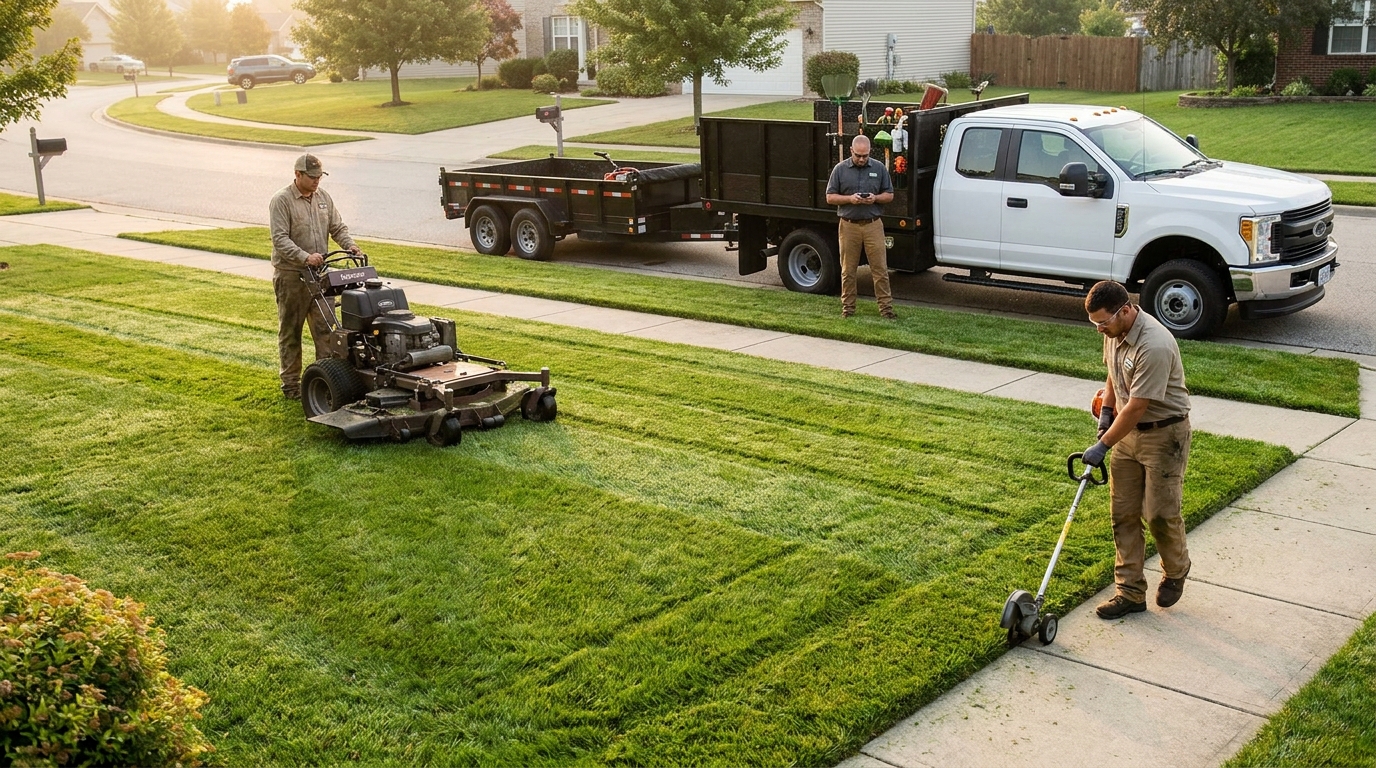
Same book we have used all season, so the numbers are comparable across our pricing pieces: 60 weekly maintenance clients, $52 a visit, a 32-week season, a two-person crew costing $52.80 an hour fully loaded — that is $26.40 a head, wages plus payroll tax, workers' comp and the rest. The two people are the owner and one employee. Forty crew-hours a week covers 60 properties at about 40 minutes each door to door.
These are stated assumptions, not measured ones. Change the client count or the visit price and every line below moves; the structure is the part worth keeping.
| Line | Working | Amount |
|---|---|---|
| Season revenue | 60 clients × $52 × 32 weeks | $99,840 |
| Employee wage, fully loaded | $26.40/hr × 40 hrs × 32 weeks | −$33,792 |
| Fuel, truck and equipment | season | −$4,800 |
| Equipment repair + replacement reserve | season | −$4,000 |
| Insurance (liability, commercial auto, workers' comp) | year | −$6,000 |
| Truck payment / depreciation | year | −$7,200 |
| Phone, software, licences, admin | year | −$1,400 |
| Marketing | year | −$1,500 |
| Available to the owner | $41,148 |
Against page one, that $41,148 is 17% below the lowest of the three published figures and 68% below the highest. It is not a disaster and it is not a failure — it is what a well-run one-crew maintenance business pays the person who owns it. The published numbers are not wrong so much as they are describing businesses with more crews.
The half of your pay you earned with your hands
Here is the split nobody on that results page makes, and it is the whole point.
The owner rode the mower for 1,280 hours — 40 hours a week for 32 weeks — doing work that is worth exactly what they pay someone else to do it. At the same $26.40 fully loaded rate, $33,792 of that $41,148 is a wage the owner earned as labour.
Which leaves $7,356 as the return on owning the business. On $99,840 of revenue, that is 7.4% — and it sits just below the 8% floor of the margin band the popular table assigns to this revenue row. The two figures agree, once you stop letting owner pay and margin occupy the same column.
Then apply the test that follows from it, which is the most uncomfortable arithmetic in this business. Could the business hire someone to replace the owner? It would cost another $33,792 against $7,356 of available return — a $26,436 hole. At $52 a visit against roughly $35.20 of marginal crew cost, each additional client contributes about $16.80 a visit, or $537 across a 32-week season. Closing $26,436 needs about 49 more clients.
And 109 properties at 40 minutes each is 72.7 crew-hours a week, which one crew cannot do. So the honest answer is that funding your own replacement means a second crew, a second truck and a different overhead line — which is precisely why the jump from one crew to two is the hardest jump in this trade, and why so many owners stay at one crew and quietly call their wage a salary.
The column no salary table has
Every figure on page one is annual. Landscaping revenue is not.
The $41,148 is earned across 32 weeks — about 7.4 months — and spent across 12. A $3,429 monthly draw is perfectly reasonable and the season supports it. The 4.6 months with no mowing in them do not.
It gets worse if you keep your employee through the winter rather than laying them off, which is what you do if you want them back in March. Twenty weeks at 40 hours and $26.40 is another $21,120, or $4,591 a month.
| Off-season month | Per-visit billing | Flat-monthly billing |
|---|---|---|
| Cash in | $0 | $8,320 |
| Owner draw | −$3,429 | −$3,429 |
| Retained employee | −$4,591 | −$4,591 |
| Net | −$8,020 | +$300 |
Same annual revenue. Same crew. Same draw. Billed per visit, the identical book delivers $13,492 a month for 7.4 months and nothing for 4.6, so $36,892 has to come out of a bank balance to get to spring. Billed flat-monthly — the same $99,840 divided by twelve — it delivers $8,320 every month and clears the off-season by $300 a month without selling anything new.
That is not a trick. It is the same money arriving on a different schedule, and it is the single highest-leverage change available to a business at this size. We ran the fuller version of this in what landscapers actually do in the winter, where the same book faces a $42,240 payroll floor if it keeps a full two-person crew year-round. The mechanics of switching are in how to bill recurring landscaping clients.
What to actually pay yourself
Five steps, in order. The order matters more than the numbers.
- Pay yourself the wage first, at replacement rate. Whatever you would pay a competent person to do your hours on the mower — that is a cost of doing business, not a reward for owning one. Write it down as a wage. In the book above it is $33,792.
- Look at what is left, and call it what it is. $7,356 is the return on ownership. If that number is at or near zero, you own a job with extra paperwork — which is a completely legitimate business, but it should be a decision rather than a surprise.
- Set the draw monthly, not seasonally. Divide the annual figure by twelve and move it on the same day each month. A draw that tracks the mowing calendar teaches you nothing and empties the account in February.
- Hold the off-season number back before you draw anything. On this book that is $36,892 under per-visit billing. If you cannot hold it, that is the argument for changing the billing schedule, not for skipping the draw.
- Re-run it in October, not January. You need the decision before the season ends, while you still have clients on the phone and something to offer them.
Every figure here is before income tax and before self-employment tax, and how much of it survives depends on whether you file as a sole proprietor or an S corporation. That is a conversation with an accountant, not a blog post — but notice that none of the three page-one figures says which side of that line it sits on either.
Where the number lives in your books
The reason most owners cannot answer "what do I pay myself" is not arithmetic, it is that the inputs live in four places: invoices in one system, expenses in a shoebox, payroll at a provider and the truck payment on a bank statement. You cannot compute a wage-versus-return split without revenue and costs sitting in the same table.
Practically, that means: every visit invoiced and marked paid so revenue is a real number rather than an estimate; expenses categorised as you go rather than in April; and the owner's draw recorded as its own line, separate from both wages and profit, so next year's version of this calculation takes ten minutes. The bookkeeping piece covers the categories, and the margin piece covers what the leftover should look like once the wage is out.
What Landscapey does and does not do here, plainly. It runs the client, job, scheduling, routing, invoicing and expense side, and it bills recurring work either flat monthly or per visit — the one product feature this whole article leans on — so the off-season table above is a setting rather than a project. Financials shows revenue and expenses by period, and invoices sync one-way to QuickBooks. It is $19.99 a month at launch pricing against a listed $29.99, or $199.99 a year, with a 14-day trial that requires a card, and card payments run through your own Stripe account with 0% taken by us.
It does not run payroll, it does not track an owner's draw as its own account, and it will not compute your compensation for you — the split in this article is arithmetic you do once a year with an accountant, not a screen in the app. It is also one login per business with no separate crew accounts. If you need multi-user payroll and owner-comp reporting inside the same tool, we are not it yet.
Frequently asked questions
What is the average landscaping business owner salary?
There is no single trustworthy figure. The three most visible pages report $49,686, $91,395 and $127,973 while citing the same source. A better question is what your own book supports: on 60 weekly clients at $52 with one employee, about $41,148 is available to the owner, of which roughly $33,792 is a wage for the hours worked and $7,356 is the return on ownership.
Should I pay myself a salary or take an owner's draw?
That is a tax-structure question — sole proprietors take draws, S corporations generally must pay a reasonable W-2 salary and may then distribute the remainder. Either way the calculation above is the same; only the mechanism and the tax treatment change. Ask an accountant before choosing, because the answer affects your self-employment tax bill directly.
What percentage of revenue should the owner take?
Percentage-of-revenue rules are the reason the published numbers are so far apart, because the right percentage depends entirely on how many of the hours the owner works themselves. On the book above the total draw is 41% of revenue, but only 7.4% of it is an ownership return. Both numbers are true and they describe different things.
Why is my pay so much lower than the published averages?
Most likely because you are one crew and the averages are weighted by businesses running several. The published 90th-percentile figures ($175,000 to $293,500) describe operations with multiple crews and an owner who has stopped riding. Getting there is a crew-count problem, not a pricing problem.
How do I raise it without adding clients?
Three levers, in order of how fast they work: price, route density and billing schedule. A 7% increase on 60 clients at $52 is $6,989 a season and lands almost entirely in the ownership return — how to write the letter that does it. Tighter routes cut drive time, which is the cost that produces no revenue. And moving to flat-monthly billing does not raise the annual total at all, it just stops the winter from eating it.
Should I pay myself during the off-season?
Yes, and at the same monthly figure — that is the entire point of dividing by twelve. What changes is where the money comes from: either a balance you deliberately held back during the season, or a billing schedule that keeps cash arriving in January. Skipping the draw is not a saving, it just moves the shortfall onto your household.
Sources and limits
- All three published figures were read directly on 2 September 2026 from youraspire.com (page dated 2 Aug 2024), okason.com (20 Feb 2026) and housecallpro.com (21 Jan 2026), not from search snippets.
- ZipRecruiter's own page returned HTTP 403 to our fetch and is reported here only as what those three pages attribute to it. We did not verify any figure at that source and do not present one as verified.
- The revenue-band table is reproduced from knowyournut.com (14 Jun 2026). We reproduce it because it is a useful shape, and disagree only with reading its two columns as additive.
- The 60-client book is a stated assumption, not a survey. $52 a visit, a 32-week season, $26.40 an hour fully loaded per crew member, and the itemised overhead above are the same figures we have used across our pricing articles so the numbers stay comparable. Your market, route density and insurance will differ, sometimes by a lot.
- Everything here is pre-tax and ignores entity structure, retirement contributions and health insurance, any of which can move the take-home figure by five figures. This is arithmetic to take to an accountant, not a substitute for one.
The short version
The published landscaping business owner salary figures disagree by 2.58x while citing one source, because they blend a wage with a return on ownership and then average across businesses of wildly different crew counts. On an ordinary 60-client, one-employee book, $41,148 is available to the owner: $33,792 of it is a wage for 1,280 hours of work, and $7,356 — 7.4% of revenue — is what the business paid for being owned. Funding your own replacement from that would take about 49 more clients and a second crew.
The faster win is not in the annual number at all. It is in the shape of it: the same $99,840 billed flat-monthly instead of per visit turns a $36,892 winter hole into a $300-a-month surplus, and it is the only change on this list that costs nothing and sells nothing.
That $41,148 / $7,356 split is also the single largest variable in what this business would sell for. The first number is SDE, the second is EBITDA, and different buyers use different ones — a 5.6-fold difference before any multiple is applied. We ran nine published valuation rules against this exact book in what a landscaping business is actually worth, and the answers ran from $22,068 to $299,520.