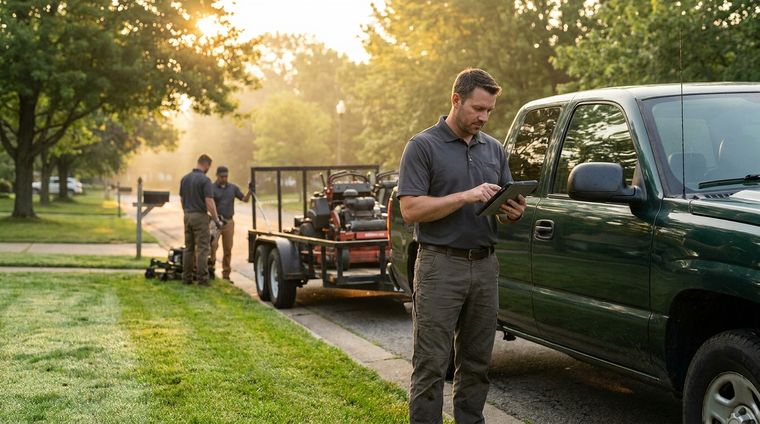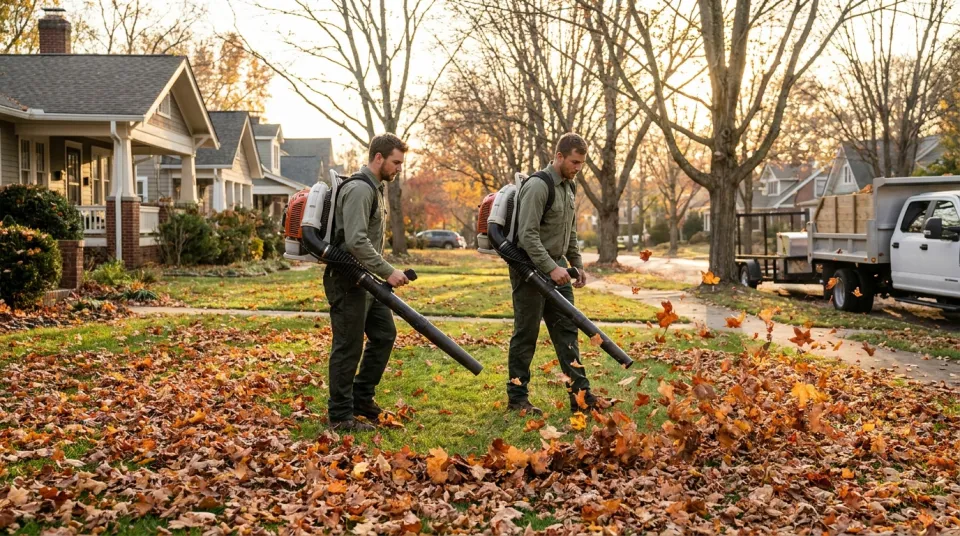
More than 200 US cities, counties and local jurisdictions now restrict or ban gas-powered leaf blowers, and the rules land hardest in the eight weeks that start right about now. If you run fall cleanups, this is the season the ordinance actually touches your day.
Here is the problem with every page that ranks for this question: they are all written for the person who hears the blower, not the person holding it. Municipal pages tell you the date. News stories tell you the vote. Advocacy sites tell you the emissions. Not one of them prices the machine you would have to buy, and none of them tells you what the switch does to a season's margin.
So this post does that. Every equipment price below comes from the manufacturer's own listing, read on 8 September 2026. The arithmetic uses the same cost book we have carried through our lawn care pricing chart and profit margin posts, so you can check it against your own numbers.
Blowers are not the only equipment line on a regulatory clock this year. The most common grub-control actives - the neonicotinoids - are already off residential lawn programs in New Jersey and Maine, come off New York turf on 1 January 2027 and Connecticut turf on 1 October 2027, and have become licensed-applicator-only purchases in Massachusetts, Maryland, Colorado, Rhode Island and Washington. Different mechanism from a blower ban, same lesson: the calendar is local. What the rules do to a lawn program, and the license that goes with it.
Three completely different rules all get called a "ban"
The single most expensive mistake here is treating these as one thing. They are not. There are three distinct rule types and they have opposite consequences for a fleet you already own.
| Rule type | What it actually does | Example | Effect on your existing fleet |
|---|---|---|---|
| Sale ban | Prohibits the sale of new gas equipment. Running what you own stays legal. | California, statewide, from 1 January 2024 | None today. Bites when a machine dies. |
| Use ban | Illegal to operate a gas blower at all, regardless of when you bought it. | Washington, DC, from 1 January 2022 | Immediate. The machine becomes scrap in that jurisdiction. |
| Phased or seasonal use ban | Legal in some months, illegal in others, on a schedule that tightens year by year. | Portland, OR; Lower Merion, PA | You need a calendar, not a policy. |
California is the one that gets misreported constantly. The statewide rule covers small off-road engines — spark-ignition engines of 25 horsepower or less, which is the whole lawn and garden category — and it bans the sale of new units. If you own a gas backpack blower in Fresno, you can still run it. What you cannot do is replace it with another one. That is a slow-motion conversion mandate rather than a switch, and it means the real deadline for a California operator is not a date on a calendar; it is the day their current machine stops starting.
The two published phase-out schedules permit opposite months
Portland and Lower Merion are the two phased schedules that surface on page one for this query, and putting them side by side produces something neither page mentions.
| Year | Portland, OR — gas permitted | Lower Merion, PA — gas permitted |
|---|---|---|
| 2026 | October – December | 2 October – 31 May |
| 2027 | October – December | May, and November – December |
| 2028 | None (year-round ban) | November – December |
| 2029 | None | None (year-round ban) |
In 2026 both jurisdictions carve out the fall. Portland permits gas October through December; Lower Merion's ban lifts on 2 October. Two independently drafted phase-outs, in different states, both landing on the same exemption — which is the clearest signal in this whole debate that regulators know the blower is doing necessary work in leaf season.
By 2028 they invert. Portland bans December outright while Lower Merion still permits it. The same crew, the same machine, the same month — legal in one town and illegal in the other, and the town that is stricter flips.
There is no national schedule to plan a fleet against. That is the finding, and it is the reason a five-year equipment plan built on "the rules are all heading one way" will be wrong somewhere.
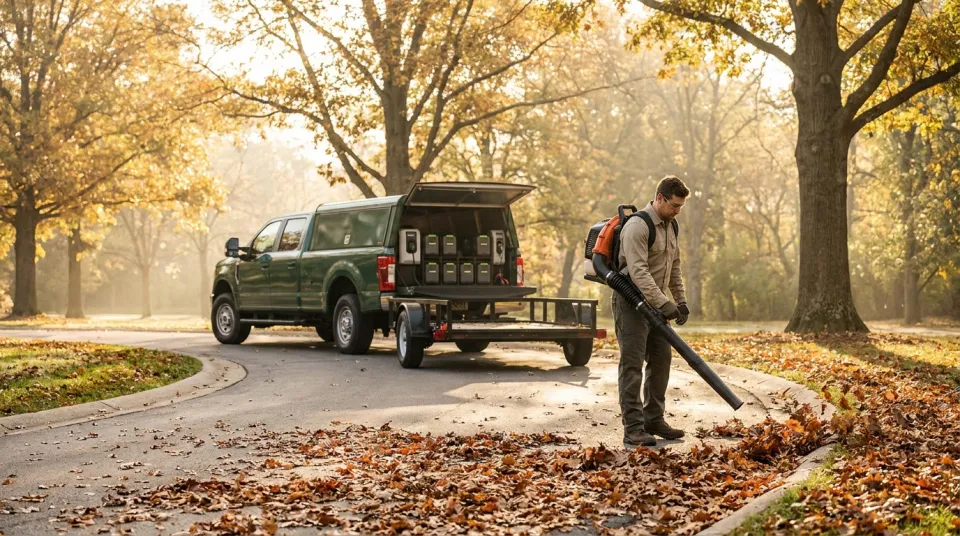
And the map is not converging — it is splitting
While cities tighten, three states have gone the other way and passed preemption laws that prohibit local governments from banning gas-powered equipment at all: Texas in 2023, Georgia in 2024, and Florida in 2026. In those states a city council can vote for a ban and the vote does not survive contact with state law.
Two other movements are worth knowing because they show the shapes this takes beyond a flat ban. Colorado prohibited state agencies from using gas equipment during the summer ozone months beginning June 2025 — a procurement rule, not a use ban, which lands on whoever holds the state grounds contract. And in Virginia, the Attorney General issued an opinion in 2024 confirming localities can restrict gas blowers through their noise ordinances, which is why Virginia cities have been moving one at a time rather than waiting for a state law.
If you operate in one metro this is a simple question. If you cross a state line — and plenty of crews do, around DC, Kansas City, Philadelphia, Charlotte — you are looking at two regulatory directions at once.
What converting a crew actually costs
Here is where every other page stops and the arithmetic starts. To keep it honest, both machines below are from the same manufacturer, both are the professional backpack class, and both prices are the manufacturer's own listing read on 8 September 2026.
| Gas backpack | Battery backpack | |
|---|---|---|
| Model | STIHL BR 800 | STIHL BGA 300 |
| Listed price | $749.99 | $749.99 (bare tool) |
| Power source included | Yes — add fuel | No |
| Blowing force | 41 N | 26 N |
| Air speed | 239 mph | 192 mph |
| Weight | 25.9 lb | plus a 20.9 lb battery |
| Run time per fill or charge | Refuel in seconds | 61 minutes |
Read the first row again. The battery unit costs exactly the same as the gas unit before it has any way to turn on. The battery that gives it that 61 minutes — the AR 3000 L, 1,520 Wh, 20.9 lb — is $1,390.99 on its own.
So one working battery blower is $2,140.98 against $749.99 for the gas equivalent. That is 2.85 times the price, and it buys 36.6% less blowing force: 26 N against 41 N. You are paying nearly triple for a machine that moves noticeably less leaf per pass, which on a wet November cleanup is not a rounding error — it is the difference between one pass and two.
The run-time constraint nobody prices
Sixty-one minutes is the number that decides everything, and it is the number the ordinance pages never mention. A gas blower's run time is the size of your fuel can. A battery blower's run time is a hard stop.
Take a two-person crew running eight cleanup stops a day. How many batteries you need depends entirely on how much of each stop is actually blower time, so here is the range rather than a single made-up figure:
| Blower minutes per stop | Blower minutes per day | Batteries per operator | Kit cost per operator | Two-person crew |
|---|---|---|---|---|
| 10 (light tidy-up) | 80 | 2 | $3,531.97 | $7,063.94 |
| 20 (typical cleanup) | 160 | 3 | $4,922.96 | $9,845.92 |
| 30 (heavy leaf load) | 240 | 4 | $6,313.95 | $12,627.90 |
The same two-person crew on gas costs $1,499.98, complete, ready to work.
So the conversion premium is $5,563.96 in the light case, $8,345.94 in the typical case, and $11,127.92 in the heavy case. Chargers are extra and are not in those figures.
One caveat stated plainly rather than papered over: we could not verify a first-party recharge time for that battery, so the table assumes you carry the day's power rather than topping up between stops. If you can reliably recharge on the truck at lunch, the count drops by roughly a third. If you cannot, it does not, and buying too few batteries is how a crew ends up standing in a yard with a dead pack and a customer watching.
What that does to a 60-client book
Dollars are abstract. Clients are not. Here is the same cost book we have used throughout: 60 recurring clients at $52 a visit, a 32-week season, a two-person crew fully loaded at $52.80 an hour, 40 minutes a stop, which leaves $16.80 of marginal contribution per visit.
Each client therefore contributes $537.60 across a full season. Which makes the conversion premium legible:
| Scenario | Premium over gas | Client-seasons consumed | Share of the book |
|---|---|---|---|
| Light tidy-up | $5,563.96 | 10.3 clients | 17.3% |
| Typical cleanup | $8,345.94 | 15.5 clients | 25.9% |
| Heavy leaf load | $11,127.92 | 20.7 clients | 34.5% |
In the typical case, converting one two-person crew costs the entire season margin of 15 and a half clients. Not a month of their margin. The whole season. On a 60-client book that is a quarter of everything you earn, spent on equipment that does the same job slightly worse.
That is the number the debate is missing, and it explains the resistance far better than the usual framing does. It is not that operators dislike quiet machines. It is that the machines cost a quarter of a book.
The running costs actually favour battery, and it does not close the gap
Being fair to the other side of this, because a comparison that only argues one way is not worth reading.
Electricity is nearly free. That 1,520 Wh battery is 1.52 kWh a charge. Six charges a day across a two-person crew is 9.12 kWh. At any residential rate between $0.12 and $0.25 per kWh, that is $1.09 to $2.28 a day. Across a 40-day cleanup season it is under $100.
Battery life is not the constraint people assume. The AR 3000 L is rated for up to 1,200 charge cycles before it settles at 80% capacity. In a three-battery kit each pack cycles roughly once per working day, so at around 200 working days a year that is about six years of service. Batteries are the capital cost, not a consumable.
And the maintenance case is real but we are not going to put a number on it. No two-stroke mix, no plugs, no filters, no carburettor. Every operator we have read says this saves money. Nobody publishes a figure we could verify, so we are not inventing one.
Net: the operating economics genuinely favour battery. They just do not repay an $8,346 premium quickly enough to matter to a business deciding what to do this October.
The incentives are not remotely close to the cost
California allocated roughly $30 million to help operators switch. Spread across the state's equipment population that works out to about $15 per machine.
Fifteen dollars against a $1,390.99 battery is 1.1% of one battery — and a crew needs six of them. This is worth stating flatly because it reframes the whole policy argument: the subsidy is not small, it is three orders of magnitude below the thing it is subsidising. (That $30 million figure is the one number in this post that comes from a secondary source rather than a government page, so treat it as approximate.)
Who actually gets fined, and why the fine is not your real risk
Washington, DC has the clearest published enforcement regime, so use it as the model.
- Fines are up to $500 for each offense.
- When a complaint names a hired landscaper, the department goes after the landscaper first. The property owner is the fallback if the contractor cannot be identified.
- Enforcement is entirely complaint-driven. A complaint must be filed within seven days of the violation, must be signed, and the department states it will not routinely conduct site visits to verify.
- Investigations take up to 30 business days.
Now the part that matters more than the fine. Portland writes the obligation onto the property owner: a property owner must ensure that any contractor or property manager they hire does not use a gas leaf blower. Read that as an operator and it stops being a regulatory question. Your client is the one who catches the complaint, and your client is the one who fixes the problem by hiring somebody with battery equipment.
So the exposure is not $500. The exposure is the account. On a 60-client book at $537.60 of season contribution each, losing three clients to a neighbour's complaint costs more than the fine ever will — and unlike the fine, it does not come with a letter warning you first. If your lead pipeline is not replacing those accounts, that is the real bill.
What to actually do this fall
Concrete, in the order we would do it:
- Sort your client list by jurisdiction before the leaves drop, not after. Most operators find the affected accounts are clustered in two or three towns rather than spread across the book. If it is 8 of 60 clients, you buy two battery kits, not six.
- Check the rule type, not the headline. A sale ban means you keep working and plan replacements. A use ban means those stops need battery gear this season. A phased ban means you need the month, not the year.
- Price the affected stops separately. Battery equipment is slower per pass at 26 N. If a cleanup takes 20% longer on battery, the stop needs to bill 20% more, and that is a conversation to have before October, not a margin hit to absorb in November. Our price increase letter template covers how to word it.
- Convert one crew, not the fleet. Buy the kit for the crew that runs the regulated route. The economics above are brutal at fleet scale and survivable at one crew.
- Log it as equipment, and look at it against the season. An $8,346 purchase in October distorts your books unless you can see it beside the revenue it protects. This is the same discipline that pricing leaf removal properly requires.
Where Landscapey fits, and where it does not
Being specific, because vague product claims are worthless.
What helps. Landscapey stores each client's service area by ZIP code resolved to a city and state, so your client list is already grouped the way an ordinance is written — sorting the book by jurisdiction is a list you already have rather than a spreadsheet you build. "Leaf removal" and "Yard cleanup (spring/fall)" are both in the standard service list, so the affected work is already tagged. Recurring jobs bill flat monthly or per visit, so if you reprice the regulated route you can change the rate without rebuilding the schedule. And expenses carry an Equipment category, so the conversion lands in Financials against the season it happened in.
What does not. We checked the codebase rather than relying on memory: there is no equipment register, no per-machine asset tracking, no depreciation schedule, no compliance calendar and no jurisdiction rules engine. Landscapey will not tell you that Tuesday's route crosses into a banned town. It is one login per business, with no separate crew accounts. If you want software that tracks which blower is on which truck and warns you before the crew arrives, buy something built for asset management — we are a CRM, and we will not pretend otherwise.
Landscapey is $19.99 a month, listed against $29.99, or $199.99 a year against $359.88, with a 14-day card-required trial and 0% taken from your invoices. You can start free and have your client list sorted by town this afternoon.
Frequently asked questions
Is my existing gas blower illegal in California?
No. California's statewide rule bans the sale of new small off-road engine equipment from 1 January 2024. Equipment you already own remains legal to operate. Individual California cities — Los Angeles and Walnut Creek among them — have their own separate use restrictions, so check the city as well as the state.
How much is the fine if I get caught?
It depends entirely on the jurisdiction. Washington, DC publishes fines of up to $500 per offense. Many ordinances publish no figure at all, which is why we only cite the ones that do. The bigger financial risk is losing the account, not paying the fine.
Does the ban apply to me or to my customer?
Often both. DC pursues the landscaper first and falls back to the property owner. Portland writes the duty onto the property owner, requiring them to ensure their contractor complies. Assume you are liable, and assume your customer thinks they are too.
How many batteries does a crew really need for a day of cleanups?
On a professional backpack blower running a 1,520 Wh backpack battery, expect around 61 minutes per charge. Two to four packs per operator covers most cleanup days depending on leaf load. Buy for your heaviest week, not your average one.
Are battery blowers as powerful as gas?
Not yet, in the flagship backpack class. The gas unit compared here delivers 41 N of blowing force against 26 N for the battery model from the same manufacturer — 36.6% more. On light, dry material the difference is manageable. On wet matted leaves it means more passes.
Will these bans reach my state eventually?
Not necessarily. Texas, Georgia and Florida have passed preemption laws blocking local bans, and the trend is genuinely splitting rather than converging. Plan for your own jurisdictions, not for a national direction that may never arrive.
Sources and limits
- Equipment prices and specifications are the manufacturer's own published listings for the STIHL BR 800, BGA 300 and AR 3000 L, read on 8 September 2026. Dealers set their own retail prices, so what you pay locally will differ. We compared two models from a single manufacturer deliberately — cross-brand comparisons smuggle in brand positioning alongside the technology difference.
- Regulatory details come from the jurisdictions' own pages where we could read them: the DC Department of Licensing and Consumer Protection for the DC ban and its $500 penalty, and the City of Portland for the phase-out schedule and the property-owner duty. Lower Merion's schedule and the $30 million California allocation come from a secondary industry source dated 2 June 2026 and are flagged as such.
- Several page-one sources were excluded rather than paraphrased. The PIRG policy map, the Walnut Creek city page and the Lower Merion ordinance page all returned HTTP 403 to our fetch. We do not characterise pages we could not read, which means this post is missing the most complete jurisdiction map available.
- The cost model rests on stated assumptions, not measurements. Eight stops a day, 10 to 30 minutes of blower time per stop, and no mid-day recharging are our assumptions and are printed as such. We could not verify a first-party recharge time for the battery, which is the single biggest unknown in the battery-count table.
- Ordinances change constantly, and this is not legal advice. Every date here was accurate on 8 September 2026. Before you buy equipment or quote a job on the strength of it, confirm the current rule with the jurisdiction directly — municipal schedules get amended mid-cycle, as Virginia's localities demonstrated repeatedly through 2026.
If you are also pricing the other half of the cold season, our breakdown of snow removal contracts runs the same kind of arithmetic on seasonal versus per-push pricing, and what landscapers do in the winter covers keeping a crew paid through the gap. The same hidden-cost pattern runs through autonomous mowing: our commercial robotic mower analysis found a published $199-per-month connectivity fee that consumes 62% of the labor the machine saves.