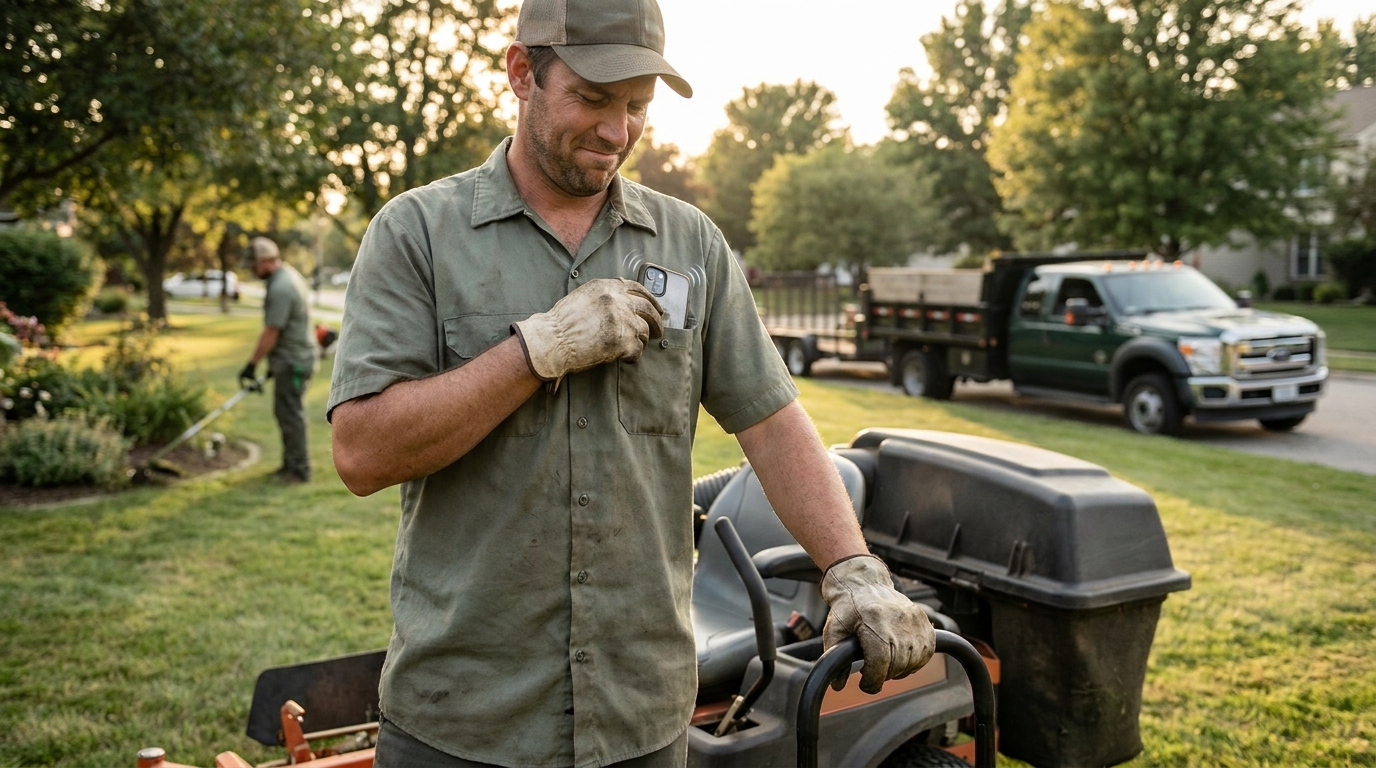
Every landscaping business has the same leak, and it is not in the truck. The phone rings at 10:40 on a Tuesday morning while you are on a mower with ear protection on, and by the time you get to it there is a missed call from a number you do not recognise. No voicemail. You call back at six. Nobody answers, because whoever it was already booked the person who picked up.
This month the biggest software company in the category moved on exactly that problem, and the way it priced the move is worth reading carefully - because it tells you what the industry thinks answering your phone is worth, and it also shows you how easy it is to get talked into paying for the expensive version of a cheap fix.
I read Jobber's own pricing page and its own AI Receptionist page on 28 August 2026 rather than relying on any of the dozens of "Jobber pricing 2026" summaries floating around. Those summaries disagree with each other and all of them disagree with the page. Below is what the page actually says, what the honest arithmetic on missed calls looks like when you do it yourself, and four ways to plug the leak that cost less than the software.
Not every lost account starts with a missed call. Where gas leaf blowers are restricted, enforcement is complaint-driven and the published penalty is modest - Washington DC caps it at $500 per offense and pursues the landscaper before the homeowner. But Portland writes the duty onto the property owner, who must ensure the contractor they hire does not use gas. That turns a neighbour's complaint into a reason to replace you, and at $537.60 of season contribution per client, three lost accounts cost more than three fines. Which towns, and what the switch costs.
What actually changed at the top of the category
Jobber now sells four tiers, not three. The three most people know - Core, Connect, Grow - have been joined by Plus, and Plus is the one carrying the new lead-capture features: a sales Pipeline, a Marketing Suite, and an AI-powered Receptionist that answers your calls and texts.
Here is the list price ladder as published on 28 August 2026, at no commitment, billed monthly. Note that the price now moves with your team size, which is new information for anybody working off an older comparison:
| Plan | 1 user | 5 users | 10 users | 15 users |
|---|---|---|---|---|
| Core | $49/mo | contact sales | contact sales | contact sales |
| Connect | $139/mo | $199/mo | $299/mo | $399/mo |
| Grow | $199/mo | $299/mo | $399/mo | $499/mo |
| Plus | not offered | $499/mo | $599/mo | $699/mo |
Two things in that table are worth slowing down for. Plus has no one-person option at all - the entry point is a five-user plan at $499 a month. And Core is a single-user plan. If you have read anywhere that Jobber "starts at $29 a month," that number is a one-user, twelve-month, billed-annually promotional rate, and the page itself carries a banner reading "Offer ends Aug 31."
For completeness, here is the promotional column next to the list price it reverts to, again as published on 28 August 2026, on the annual billing option:
| Plan (1 user unless noted) | Promo, billed annually | Reverts to | List, monthly |
|---|---|---|---|
| Core | $21/mo for 12 months | $29/mo | $49/mo |
| Connect | $70/mo for 12 months | $99/mo | $139/mo |
| Grow | $105/mo for 12 months | $149/mo | $199/mo |
| Plus (5 users) | $280/mo for 12 months | $399/mo | $499/mo |
None of this is a criticism of Jobber. It is a good product and the promo is a real discount. The point is narrower: the number you have in your head for what it costs is probably a promotional single-user rate, and your business is probably not a single user.
The one number Jobber publishes about its own AI receptionist
Jobber's AI Receptionist page carries a claim that is more useful than any of the industry statistics you will find on this topic, because it is first-party and specific. In its own FAQ, Jobber states that for the average home services business its Receptionist handles over 20 calls per week without a human stepping in.
Take that at face value for a second and it is a striking number. Twenty calls a week is not an after-hours trickle. That is three a day, every day, arriving at a business whose owner is outdoors, on equipment, with gloves on. Whatever your view of AI answering services, that figure is a fair description of how much inbound a working home-services business actually gets - and of how much of it lands while nobody can pick up.
The price of never missing a call - and the one Jobber does not print
Here is the part that took the longest to pin down, and the part I would want to know before a sales call.
Jobber's Receptionist FAQ says the feature is "available as an add-on to any plan, and is included at no additional cost with the Plus plan," and directs you to the add-ons section of the pricing page for full details. I went to the add-ons section of the pricing page. Receptionist is listed there with a description and a "Learn More" link, and no price.
That is not an oversight on a page that is shy about numbers. The same add-ons section publishes exact figures for everything else it charges for: card processing at 2.9% plus $0.30, Tap to Pay at 2.7% plus $0.30, bank payments at 1%, instant payouts at an additional 1%. The payment rates are printed. The Receptionist rate is not.
So as of today the practical answer to "what does AI call answering cost on Jobber?" is one of two things. Either it is a number you get on a sales call, or it is $499 a month - the entry price of the plan that bundles it. For a landscaping business with a crew of three, that is the honest figure to plan against until they publish otherwise.
The per-user mechanic that turns $49 into $107
The second thing missing from most comparisons is the seat charge. On every Jobber tier, additional users are $29 per user per month, and Jobber defines a user broadly: anyone who accesses the account at the office or in the field to view or manage the team's schedule.
That definition matters for landscaping specifically, because the whole point of putting the schedule on phones is that the crew can see it. Work the arithmetic on a realistic small operation:
| Setup | Base | Extra users | Monthly list total |
|---|---|---|---|
| Owner only, Core | $49 | none | $49 |
| Owner + 2 crew, Core | $49 | 2 x $29 = $58 | $107 |
| Owner + 4 crew, Grow (5 users included) | $299 | none | $299 |
| Owner + 4 crew, Plus (5 users included) | $499 | none | $499 |
A three-person operation on the cheapest plan is at $107 a month at list, not $49 - and $107 a month is $1,284 a year before you have processed a single payment. That is not a hidden fee; it is printed on the page. It is just not in the headline.
Why I am not going to tell you missed calls cost you $126,000 a year
Search "cost of missed calls" and you will hit the same handful of statistics over and over: that 62% of business calls go unanswered, that missed calls cost small businesses $126,000 a year, that 78% of customers buy from the first business that answers, that responding in five minutes makes you 21 times more likely to qualify a lead, that fewer than 3% of callers leave a voicemail.
I tried to trace those. Nearly every one of them is published by a company that sells call answering, AI receptionists, or lead-response software. Several cite each other. The ones that name an original source name a study that is either paywalled, a decade old, or about a different industry. I could not verify a single one of those figures against a primary source I would be willing to put in print here, so I am not putting them in print.
The closest thing to a defensible outside data point on response speed is academic rather than promotional: research published in the Harvard Business Review in 2011 on the short life of online sales leads found that firms responding within an hour were roughly seven times more likely to have a meaningful conversation with a decision maker than those responding an hour later. That is a real study, and it is also fifteen years old and about web form leads at B2B companies, not about somebody phoning a landscaper about a hedge. Useful as a direction. Useless as a dollar figure for your business.
The honest position is this: nobody credible knows what missed calls cost your landscaping business, including the people selling you the fix. But you can work it out, and it takes two weeks.
Do the math with your own numbers
Here is a model with every assumption exposed, so you can change the ones that are wrong for you. The formula:
Annual leak = missed calls per week x share that are new prospects x share that never come back x close rate x value of a client x 52
Now a worked example for a two-truck maintenance operation. I have deliberately chosen conservative inputs:
- 12 inbound calls a week, of which you get to 8. That leaves 4 missed.
- 1 in 4 of the missed ones is a new prospect. The rest are existing clients, your supplier, or spam. So 1 prospect a week.
- Half of those prospects never come back - they call the next landscaper on the map. So 0.5 genuinely lost contacts a week, about 26 a year.
- You close 30% of the maintenance prospects you actually speak to. That is roughly 8 clients a year you never got the chance to quote.
- A weekly mow at $45 across a 30-visit season is $1,350 of season revenue per client.
Eight clients at $1,350 is about $10,800 a year in season revenue that never reached your quote pile. Against that, Grow at list for a single user is $2,388 a year and Plus at five users is $5,988 a year.
So on those inputs the leak is bigger than the fix - which is exactly the conclusion every vendor wants you to reach, and it is why you should be suspicious of it, including when I write it. Change two assumptions and it inverts. If only 1 in 8 missed calls is a new prospect rather than 1 in 4, and most of them do call back, the same model spits out well under $3,000 and the $499 plan is a bad trade. The output is entirely a function of inputs you have never measured.
So measure them. For two weeks, keep a note in your phone: every missed call, whether you recognised the number, and whether they ever came back. Fourteen days of real data on your own business beats every statistic in this article, mine included.
Four cheaper ways to stop the leak
If the two weeks of counting tells you that you do have a leak, an AI receptionist is one fix, and it is the most expensive one on the list. Start with these.
1. Make the after-hours request not need a phone call at all
The single highest-leverage change for most landscaping businesses is having somewhere a homeowner can describe the job and leave their details at 9pm without talking to anybody. A quote form on a page that ranks for your name and your town captures the request you were never going to answer, and it does it for free, all night, without a per-minute charge. It will not catch the caller who insists on speaking to a person - but it catches the large share who would rather type than talk, and who are currently hitting your voicemail and hanging up.
2. Turn on automatic text-back for missed calls
A missed call that gets an immediate "Sorry, on a job - what do you need and where are you?" text converts far better than one that gets silence. This is a headline feature of paid AI answering products, and it is also a setting in most modern phone systems and in plenty of free or near-free apps. Check what your carrier and handset already do before you pay somebody for it.
3. Change your voicemail greeting to set a callback time
The reason people do not leave voicemails is that a voicemail feels like shouting into a void with no idea when anyone will listen. A greeting that says "I'm on a job until 4, leave your address and what you need and I will call you back this evening" converts a hang-up into a message, because it makes the wait finite. This costs nothing and takes ninety seconds.
4. Batch your callbacks and actually keep the window
Two fixed callback windows - one at lunch, one at the end of the day - beat a scattered attempt to answer live while running equipment, and they beat calling back at 8pm when people are eating. The discipline matters more than the tool. If the fifteen minutes at lunch is real, you will beat most of your local competition without spending anything.
5. Then, if the leak is still real, buy the answering service
Human answering services and AI receptionists both work. Get the per-minute or per-month number in writing before you commit, and compare it against the leak you actually measured - not against a statistic from a company that sells the service.
Where Landscapey sits in this, honestly
I should be straight about our own product, because a page about missed calls that quietly implies we solve missed calls would be exactly the thing this article is complaining about.
Landscapey does not answer your phone. There is no AI receptionist, no call forwarding, no voice product, and none is planned for the near term. If a live human or AI picking up the phone is the thing you need, we are not the answer and one of the products above is.
What we do cover is the other half of that leak - the request that does not need a phone call. Every Landscapey account gets a public profile page with a quote form on it, the form drops straight into your Leads list, and you can turn a lead into a client without retyping anything. That is the 9pm homeowner who would rather type than talk, captured and sitting in a list in the morning.
The other thing to be straight about: Landscapey is one login for the business. There are no per-crew-member seats, which means there is no $29 per user to add up, and it also means we genuinely cannot serve a crew who each need their own login. That is a real limitation and it is the honest reason some businesses in this category should be on Jobber or Aspire rather than on us. Our plan is a single $19.99 a month, or $199.99 a year, with a 14-day trial - the full pricing is here and there is nothing underneath it.
Frequently asked questions
How many calls does a landscaping business actually miss?
There is no trustworthy industry figure - the widely quoted percentages come from companies selling the fix. The only number worth having is your own, and two weeks of counting will get it.
How much does Jobber's AI Receptionist cost?
As of 28 August 2026, Jobber does not publish a price for it. Its FAQ describes it as an add-on available on any plan, and states it is included at no extra cost with the Plus plan, which starts at $499 a month for five users. The add-ons section of the pricing page lists Receptionist without a figure, while publishing exact rates for card processing and payouts.
Is an AI receptionist worth it for a solo landscaper?
Probably not as a first purchase. A solo operator's cheapest wins are a working quote form, an automatic text-back, and a voicemail greeting that promises a callback window. Measure the leak first; the answering service is the fix you buy when the free ones are not enough.
Will my customers hang up on an AI?
Some will. Jobber publishes demo lines so you can call its Receptionist yourself and hear how it handles a real conversation before you buy - which is a fair offer and worth taking up if you are considering it. Call it once as a difficult customer, not an easy one.
Does Landscapey answer my phone?
No. We capture web quote requests through your public profile page into your Leads list. We have no voice product.
What is the cheapest way to stop losing after-hours leads?
A page a homeowner can find and submit a request on at 9pm, plus a voicemail greeting that names a callback time. Both are free and between them they catch most of what you are losing.
Sources and limits
- First-party, read 28 August 2026: Jobber's public pricing page and AI Receptionist feature page - all plan names, the four-tier structure, the per-team-size ladder, the $29 per user charge, the "Offer ends Aug 31" promotional banner, the payment processing rates, the statement that Receptionist is included with Plus, and the "over 20 calls per week" figure.
- Not published, and stated as such: the standalone price of the Receptionist add-on. It is absent from the add-ons section it is referred to.
- Secondary and dated, labelled in the text: the 2011 Harvard Business Review research on lead response speed. Fifteen years old, about online B2B leads, cited only for direction.
- Deliberately excluded: the widely circulated missed-call statistics (62%, $126,000, 78%, 21x, 3%). Each traces back to a vendor selling call answering, and I could not verify any of them against a primary source.
- The worked model is a model. Every input in it is an assumption, chosen to be conservative and stated in the open so you can replace it. It is not a measurement of your business.
- Prices change. Everything above is a snapshot of one morning, and the promotional column expires on 31 August 2026 by Jobber's own notice. Check the page before you buy.
If you want the longer version of the Jobber numbers, we keep a running breakdown in how much Jobber costs, a wider survey of the category in what lawn care software actually charges, and the alternatives comparison in Jobber alternatives for landscapers. If the leak you are trying to plug is on the marketing side rather than the phone side, start with how to get lawn care customers.