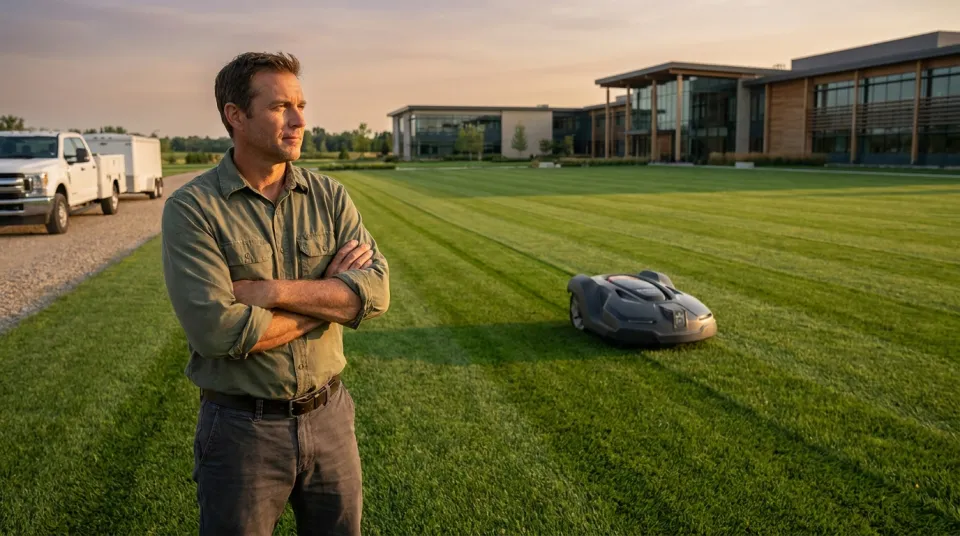
Autonomous mowing is the headline technology story in the green industry this year, and it is being sold hard into a real problem. Roughly 70% of landscaping companies report difficulty filling open positions, 54% of contractors name recruiting and retention a top business risk, and the H-2B program is capped at 66,000 visas against demand that routinely exceeds it. A machine that mows without a person on it is a plausible answer to that.
So we went looking for the number an owner actually needs: what does a commercial robotic mower cost per season, and how many seasons until it pays for itself?
We read the first twenty organic results. Ten are manufacturer product pages. Four are roundups of manufacturer product pages. Two are homeowner reviews. One is a Reddit thread and one is a trade-show video. Every single party publishing on this topic has a machine to sell. Not one page runs a profit-and-loss on the decision.
This post does. Every price below is first-party, read from the manufacturer's own site on 9 September 2026, and every assumption in the arithmetic is labelled as one.
The price ladder is not a ladder
Kress publishes prices for its full robotic line, which makes it the most useful catalogue on the SERP — most of its competitors do not publish anything. Here is the whole range with coverage, sorted by price, and a column nobody prints: cost per acre of stated capacity.
| Model | Price | Stated coverage | Cost per acre |
|---|---|---|---|
| KR161 | $1,499.99 (sale) | 0.25 acres | $5,999.96 |
| KR172 | $1,699.99 (sale) | 0.5 acres | $3,399.98 |
| KR173 | $1,999.99 (sale) | 0.75 acres | $2,666.65 |
| KR272 | $2,499.99 | 0.5 acres | $5,000.00 |
| KR174 | $2,699.99 (sale) | 1.25 acres | $2,159.99 |
| KR282 | $2,999.99 | 0.5 acres | $6,000.00 |
| KR276 | $3,599.99 | 1.5 acres | $2,400.00 |
| KR284 | $3,599.99 | 1 acre | $3,599.99 |
| KR286 | $4,299.99 | 1.5 acres | $2,866.66 |
| KR233 | $5,999.99 (sale) | 3 acres | $2,000.00 |
| KR236 | $13,799.99 | 6 acres | $2,300.00 |
| KR236S | $14,299.99 | 6 acres | $2,383.33 |
| KR237 | $14,999.99 | 7 acres | $2,142.86 |
| KR238G | $43,999.99 | 20 acres | $2,200.00 |
| KR800 | $59,999.99 | 7 acres | $8,571.43 |
Two things fall out of that last column immediately.
The KR237 and the KR800 both cover seven acres. One is $14,999.99 and the other is $59,999.99. That is exactly four times the price for the same stated coverage, a $45,000.00 difference, from the same manufacturer, on the same page, read the same afternoon. There are real engineering reasons a flagship costs more — build quality, deck width, terrain handling, duty cycle. But a buyer working from stated coverage alone, which is how every roundup on page one organises its comparison, cannot see any of that. The spec that gets compared is the spec that hides the gap.
And the ladder inverts in the middle. The KR272 at $2,499.99 covers half an acre. The KR173 at $1,999.99 covers three-quarters of an acre. The KR272 costs $500.00 more and mows a third less ground. There are feature differences between them, but if you sized your purchase by acreage — the obvious way to size it — you would pay more for less and never know.
Across the full line, cost per acre runs from $2,000.00 to $8,571.43. That is a 4.29× spread within one brand's catalogue. Sizing by acreage is not a shortcut; on this price list it is a trap. The same discipline applies to the rest of the trailer — we walked the full lawn care business equipment list the same way.
The fee nobody puts in the payback
RC Mowers does not publish a price for its A-60 autonomous mower. Neither does Scythe Robotics for its machine — both send you to a demo request form. What RC Mowers does publish, to its credit, is the recurring cost: $199 per month connection and data fee, with the first year included in the purchase.
Nobody amortises that. Run it out:
- Year 1: $0 (included)
- Years 2 through 5: 48 months × $199 = $9,552.00
- Annual cost from year 2 onward: $2,388.00
Over a five-year hold, the connectivity subscription alone costs $9,552.00. That is 1.6 times the outright purchase price of a three-acre Kress KR233 — a fee larger than a machine. And it is a fee on a machine whose price the vendor will not tell you until you are on a sales call.
To be precise about what we do and do not know: this fee is RC Mowers' published figure for RC Mowers' machine. The Kress units listed above advertise "integrated 4G," and we could not establish their subscription terms from the public catalogue. Assume every connected machine carries a recurring line and ask for the number in writing before you sign.
The structural mistake: a robot is a property, not a tool
Here is the error underneath most of the enthusiasm, and it is not an arithmetic error — it is a category error.
A zero-turn mower is a crew asset. It rides the trailer, and one machine touches eight or ten properties a day, five days a week. Its cost spreads across roughly 2,000 property-visits a season.
A robotic mower is a property asset. It lives on one lawn. It amortises across 32 visits a season, not 2,000. That single difference is why the residential math and the commercial math give opposite answers, and why a page organised by machine — which is every page on that SERP — cannot tell you which one you are in.
So run both.
Case one: the residential mowing book
We will use the same house book we have used in every pricing piece on this site, so the numbers stay comparable: 60 clients, $52 per visit, a 32-week season, a two-person crew at $52.80 per hour fully loaded, 40 minutes on site. That gives $35.20 of direct cost per visit and $16.80 of marginal contribution — $537.60 per client-season against $1,664 of revenue. Across the whole book that is $32,256.00 of annual contribution. If those figures look unfamiliar, start with how landscaping profit margin is actually built up per visit.
A typical suburban lawn is about a quarter acre. The cheapest Kress that covers it is the KR161 at $1,499.99.
Equipping the book — one machine per lawn, because that is what a property asset means — costs 60 × $1,499.99 = $89,999.40. That is 2.79 years of the entire business's contribution, spent before a single visit has been eliminated.
Now the part the vendor pages skip. Suppose you do it anyway. What is your cost to serve that client afterwards?
- Machine, amortised over an assumed five-year life: $300.00/year
- Trimming, edging and blowing, which the robot does not do — twice monthly for eight months, 20 minutes at $52.80/hr: $281.60/year
- Electricity, assumed: $25.00/year
- Total: $606.60/year
Against the $1,126.40 a year that client currently costs you to serve, that is a saving of $519.80 per client-year. Real money. But look at what it actually buys you, because it is not what the pitch implies.
It does not buy you a bigger margin, because the $52 is a visit fee, not a mowing fee. A homeowner with a robot on their own lawn is not going to keep paying $138.67 a month for a service that no longer shows up. The revenue does not survive the automation intact.
What the $519.80 buys is price room. You can cut that client's annual bill from $1,664 to $1,144.20 — from $138.67 a month to $95.35, a 31% price cut — and earn exactly what you earn today. That is a genuinely powerful defensive weapon against a competitor undercutting you on price. It is not a productivity upgrade. It is a different pricing model, and if you deploy it thinking you are buying efficiency you will be surprised by your own P&L.
Case two: commercial turf, where the numbers work
Now the account these machines are actually built for.
Assumptions, all stated: a mowing rate of 2.0 acres per hour — the midpoint of RC Mowers' own published 1.5–2.5 ac/hr for a 60-inch machine, so this is the vendor's figure, not ours. The same $52.80/hr crew rate. A 32-week season cut weekly. And mowing counted as 65% of on-site time, because the robot does not trim, edge or blow, so you only recover the mowing share.
That yields $549.12 of recoverable labor per acre per season. Apply it to the price ladder:
| Model | Price | Acres | Labor recovered / season | Payback |
|---|---|---|---|---|
| KR161 | $1,499.99 | 0.25 | $137.28 | 10.9 seasons |
| KR174 | $2,699.99 | 1.25 | $686.40 | 3.9 seasons |
| KR233 | $5,999.99 | 3 | $1,647.36 | 3.6 seasons |
| KR236 | $13,799.99 | 6 | $3,294.72 | 4.2 seasons |
| KR237 | $14,999.99 | 7 | $3,843.84 | 3.9 seasons |
| KR238G | $43,999.99 | 20 | $10,982.40 | 4.0 seasons |
| KR800 | $59,999.99 | 7 | $3,843.84 | 15.6 seasons |
Read the payback column, not the price column. From 1.25 acres to 20 acres, the payback is essentially flat at 3.6 to 4.2 seasons — a fourteen-fold range of machine size, and the answer barely moves. Buying a bigger machine does not buy you a better return; it buys you a bigger account you can serve at roughly the same return.
And the payback blows out at both ends, for opposite reasons. The KR161 takes 10.9 seasons because a quarter-acre lawn contains almost no labor to recover — that is case one, restated as a payback period. The KR800 takes 15.6 seasons because it is priced at four times its coverage class. The worst two returns on the entire list are the cheapest machine and the most expensive one.
Then subtract the fee
Every figure above ignores connectivity. Put RC Mowers' published $199/month back in and apply it to that seven-acre account:
$2,388.00 a year against $3,843.84 of recovered labor. The subscription consumes 62% of the labor you just saved.
On the house book's terms, $2,388.00 a year is the entire annual contribution of 4.4 residential clients — a fee, not a machine, quietly eating a twelfth of a 60-client book. A payback of 3.9 seasons calculated without it is not close to right; carry the fee and the middle of that table moves toward eight to ten seasons on a machine with an assumed five-year life. That is the difference between an investment and a lease you did not price.
So who should actually buy one?
On this arithmetic, three cases hold up:
- You hold large, simple, contiguous turf on contract. Campuses, sports complexes, HOA common ground, cemeteries, municipal parks. Three acres and up, open, few obstacles, a multi-year agreement so you actually get four seasons to recover the money. This is the case the numbers support and it is not a marginal one.
- You genuinely cannot hire. If a crew slot has gone unfilled for a season, the comparison is not machine-versus-labor, it is machine-versus-declining-the-work. A 3.9-season payback against revenue you would otherwise turn away is a different and much better trade. This is the honest version of the labor-shortage argument, and it depends on your hiring reality, not on the industry's.
- You want price room on a defended residential route. Deliberately, as a pricing strategy, with the revenue change modelled in advance — not as an efficiency play.
And two cases where it does not:
- A standard residential mowing book. $89,999.40 of machines, 10.9-season paybacks, and revenue that does not survive the automation. Buy a better route instead.
- Any purchase where the vendor will not put the recurring fee in writing. If the machine price requires a sales call and the subscription is disclosed after it, you cannot compute a payback, which means the payback is not the thing being sold to you.
What to ask before you sign
- Machine price, in writing, before the demo. Two of the four commercial vendors on page one publish no price at all.
- The recurring fee, per month, and what happens if you stop paying it. Ask specifically whether the machine still mows without connectivity.
- Cost per acre of stated coverage. Do the division yourself. A 4.29× spread exists inside a single catalogue.
- What share of on-site time is actually mowing on this account? Walk it. If it is 40% rather than 65%, every payback above stretches by half again.
- Expected service life and who services it. A five-year life is our assumption, not a manufacturer commitment.
- Winter storage, transport and theft cover. A machine that lives on a client's property is exposed in ways a trailered mower is not.
Track the answer, don't estimate it twice
Every number in this post is a projection. The only figure that settles the argument is the one your own books produce two seasons from now, and that requires having logged the purchase against the account it serves from day one.
In Landscapey, Equipment and Equipment rental are expense categories, so a machine purchase and a monthly connectivity fee both land in your financials rather than in a note on your phone — the same habit we argue for in business expense tracking. Pair that with the recurring job and invoice history for the account the machine sits on, and after a season you can compare what that property earned against what the machine cost — which is the comparison this entire category is currently asking you to make on faith.
To be clear about what it does not do: Landscapey has no equipment register, no asset tracking, no depreciation schedule, no machine telemetry and no robotic fleet management. If you are running autonomous mowers at scale you will want dedicated asset-management software alongside it. What it gives you is the revenue and cost side of the account, which is the side the payback question actually turns on.
If you are weighing this decision, the honest next step is cheaper than a demo: work out what your three largest turf accounts cost you in mowing labor this season. Landscapey is $19.99/month with a 14-day trial, and you can start tracking those accounts before the fall shoulder season ends.
Frequently asked questions
How much does a commercial robotic mower cost?
Published prices from Kress on 9 September 2026 ran from $1,499.99 for a quarter-acre unit to $59,999.99 for a seven-acre flagship, with most commercial-capable units between $5,999.99 and $14,999.99. Two of the four commercial-focused vendors on page one — RC Mowers and Scythe Robotics — publish no machine price at all and route buyers to a demo request.
What is the payback period on a robotic mower for a lawn care business?
On our model — $52.80/hr two-person crew, 2.0 ac/hr, 32-week season, mowing at 65% of on-site time — payback is 3.6 to 4.2 seasons for machines between 1.25 and 20 acres of coverage, before connectivity fees. It stretches to 10.9 seasons on a quarter-acre residential lawn. Adding a $199/month subscription consumes about 62% of the recovered labor and pushes mid-range paybacks toward eight to ten seasons.
Do robotic mowers replace a crew?
No. They replace the mowing portion of a visit, which we model at 65% of on-site time on turf-heavy accounts. Trimming, edging and blowing still require a person. RC Mowers' own published claim is that one operator manages up to three machines, so the labor requirement falls sharply but does not reach zero.
Are robotic mowers worth it for residential lawn care?
Not as an efficiency purchase. A robotic mower is a per-property asset, so a 60-client book needs 60 machines — $89,999.40 at the cheapest quarter-acre price, against $32,256.00 of annual contribution. The saving is real at about $519.80 per client-year, but it functions as room to cut price by roughly 31%, not as extra margin, because a client with a robot on their lawn will not keep paying a full visit fee.
What is the recurring cost of an autonomous mower?
RC Mowers publishes $199 per month for connection and data, with the first year included in the purchase — $9,552.00 across years two to five. Other manufacturers advertise integrated cellular connectivity without publishing subscription terms. Get the figure in writing before purchase, along with what the machine does if the subscription lapses.
Does the labor shortage change the math?
Only if it is your labor shortage. Around 70% of landscaping companies report difficulty filling positions and the H-2B program is capped at 66,000 visas, but industry-wide statistics do not pay for a machine. If a crew slot on your operation has genuinely gone unfilled for a season, the comparison shifts from machine-versus-labor to machine-versus-turning-work-away, and the purchase gets much easier to justify.
Sources and limits
- All machine prices and coverage figures are first-party, read from Kress's US robotic mower catalogue on 9 September 2026. Several are marked as sale prices and will move. The $199/month connection and data fee and the 1.5–2.5 ac/hr mowing rate are RC Mowers' own published figures for the A-60, read the same day.
- Cost-per-acre and payback columns are our arithmetic on stated coverage, not manufacturer claims. Stated coverage is a maximum under favourable conditions; real properties with obstacles, slopes and irregular boundaries will fall short of it, which lengthens every payback in this post.
- The labor model rests on four stated assumptions: $52.80/hr fully-loaded two-person crew, 2.0 ac/hr mowing rate, 32-week season, and mowing at 65% of on-site time. The 65% figure is the softest of the four and it moves the answer most — at 40% every payback stretches by roughly half again. Walk your own accounts rather than adopting ours.
- The five-year service life is our assumption, not a manufacturer commitment, and no maintenance, repair, blade, winter storage, transport or insurance cost is included anywhere in this post. All of them are real and all of them push in the same direction. The same pattern showed up when we costed the gas leaf blower ban: a battery backpack at the same MSRP as its gas equivalent, before the battery.
- Labor-market figures are reported, not first-party. The ~70% difficulty-filling figure, the 54% top-risk figure and the 66,000 H-2B statutory cap come from industry reporting and association commentary; we have not independently verified them and they describe the industry, not your operation.
- We did not test any machine. This is a cost analysis built from published prices and a labor model, not a product review. For cutting quality, reliability and terrain handling, the operator threads and the manufacturer demos are better sources than we are.
- We sell landscaping CRM software, not mowers, and we have no commercial relationship with any manufacturer named here. That is also why we are able to publish a payback table: we are not selling the machine at the end of it.
The short version
Autonomous mowing is real, and on large contracted turf the numbers hold up at a roughly four-season payback that barely changes across a fourteen-fold range of machine size. On a residential mowing book it is not an efficiency purchase at all — it is a pricing model, and a $90,000 one.
The two facts that decide it are the ones hardest to find: cost per acre varies 4.29× inside a single catalogue, and a published $199/month fee eats 62% of the labor a machine saves. Neither appears on a page written by someone selling you the machine — which, on this SERP, is everyone.