
Searching for a lawn care contract template gets you about forty of them in ten seconds. They are free, they are legally reasonable, and most of them are missing the four paragraphs that decide whether your maintenance book makes money.
I read the templates ranking for this term on 2026-08-06 and counted words. Across five of the free-template pages, the phrases per visit and flat monthly appear zero times. So do auto-renew, escalation and price increase. Rain shows up twice across all five pages combined. Those are not decorative details. On a 60-client book they are worth tens of thousands of dollars a year, in both directions, and this article prices every one of them.
Full disclosure before you read further: we build Landscapey, a CRM for landscapers, so we are not neutral about software. We are neutral about contracts. We do not sell a contract template, we do not have a document builder, and nothing below is legal advice. Contract law varies by state and a local attorney should read anything you plan to sign. What we can tell you is what each clause does to your cash, because that is arithmetic.
One clause carries more weight than the rest if you bill a flat monthly rate year-round: cancellation. A client who leaves in February has been paying for work already delivered; one who leaves in September has not yet paid for it. Which way the exposure runs depends entirely on your billing start month. Here is the off-season cash arithmetic that clause is protecting, and why the conversation has to happen before the last cut.
What the free templates actually contain
Five template pages, read on 2026-08-06 with a full desktop browser user agent. The counts are of the words as they appear on the page a searcher actually lands on:
| Template page | "per visit" / "flat monthly" | "rain" / "weather" | "auto-renew" / "escalation" |
|---|---|---|---|
| eForms, lawn care service contract | 0 / 0 | 0 / 0 | 0 / 0 |
| eSign, lawn care service contract | 0 / 0 | 0 / 0 | 0 / 0 |
| LegalTemplates, lawn care contract | 0 / 0 | 1 / 1 | 0 / 0 |
| TemplateLab, 40 lawn care contracts | 0 / 0 | 1 / 1 | 0 / 0 |
| SignWell, landscaping contract | 0 / 0 | 0 / 1 | 0 / 0 |
The limit of that method, stated plainly: several of these pages gate the actual .docx or .pdf behind a download, so the counts measure what the page shows you, not necessarily every line of a gated file. One row is a true full-text read: eForms prints a complete sample lawn care service contract inline on the page, and in that full sample the words per visit, flat monthly, rain, weather, late fee and increase each appear zero times.
The two software vendors ranking on the same term do better, and still stop short. Jobber's contract guide lists seven required elements and gives exactly one number, a $60 visit times twelve visits; skipped visits and automatic renewal are not discussed, and the cancellation section asks how much notice is required without recommending a period. RealGreen's guide lists ten essential clauses and does mention "per visit (e.g., $50 per cut) or a flat monthly fee" plus "1.5% interest per month on overdue balances", but offers no comparison of the two billing models, and rain and renewal escalation go unaddressed. Its termination example is "30 days written notice", presented as an example rather than a recommendation.
None of that makes the free templates bad. They exist to do the legal scaffolding — parties, scope, indemnity, signatures — and they do it competently for zero dollars. The gap is operational, not legal. A lawyer's template protects you in a dispute. It does not tell you which sentence pays for your December.
The book we are pricing against
Every number below runs on one worked example. Change the inputs to yours; the shape holds.
- 60 recurring maintenance clients, weekly mowing
- $52 per visit
- 32-week season (roughly April through November)
- Two-person crew at $52.80 per hour loaded ($22/hr wage each plus about 20% burden)
- Diesel at $4.61 a gallon, the EIA Short-Term Energy Outlook figure for 2026 on-highway diesel
Season revenue: 60 clients times 32 visits times $52 = $99,840. That is the book. Now watch how much of it six sentences move.
Clause 1: the billing model, which is the whole contract
This is the clause the templates skip entirely, and it is the one that decides your cash flow. There are two honest ways to write it.
Per visit. The customer pays $52 each time you cut. Simple, fair-feeling, and it puts 100% of your $99,840 into eight months. December through March you invoice nothing.
Flat monthly. The same annual total divided by twelve is $8,320 a month. That moves $33,280 into the four months per-visit billing pays you nothing at all. The work does not change. The billing sentence does.
Then weather gets a vote. Say three visits per client wash out over a season:
| Scenario | Per-visit contract | Flat-monthly contract |
|---|---|---|
| Dec-Mar revenue | $0 | $33,280 |
| 3 rained-out visits per client | -$9,360 (180 visits never billed) | $0 lost |
| 3 extra visits per client in a wet year | +$9,360 billed | 180 visits of unpaid work |
| Swing on one sentence | +/- $9,360 = 9.4% of the season | |
Neither model is correct. They are bets on your weather and your discipline. Flat monthly wins if your season is unpredictable and you hold the line on extras; per visit wins if your route is reliable and you would rather bill what you actually did. What is genuinely wrong is leaving it out, which is what almost every free template does, because then the answer gets decided in an argument in October. If you want the model compared in more depth, we wrote the long version in how to bill recurring landscaping clients.
The sentence to add: name the model, name the number, and say what a month contains. "Client pays $8,320 per year in twelve equal monthly installments of $693.33, covering the mowing season as scheduled in Exhibit A" leaves nothing to interpret.
Clause 2: weather, and who eats the skipped visit
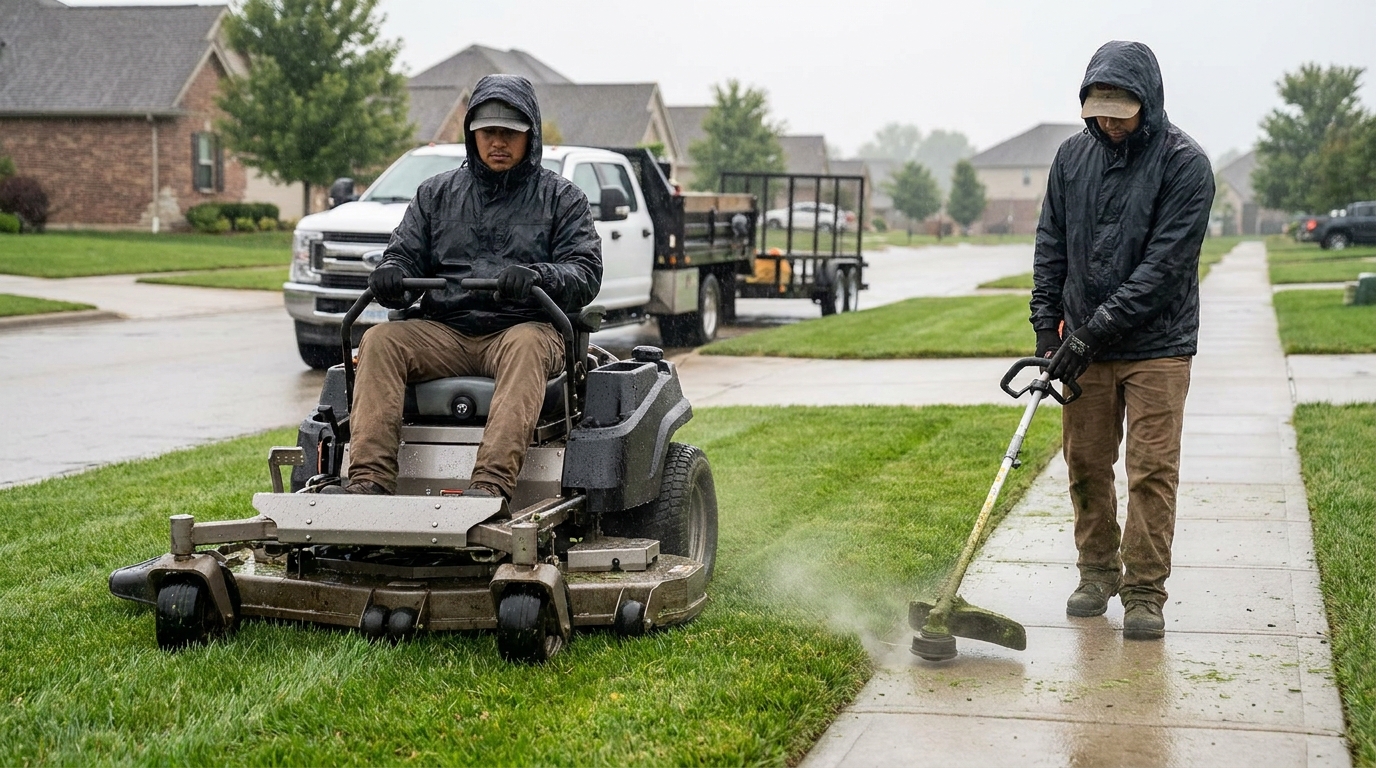
Across the five template pages above, the word rain appears twice in total. For a business whose entire schedule is outdoors, that is a strange omission.
The question a weather clause answers is narrow: when a scheduled visit does not happen because of weather, is it (a) skipped and not billed, (b) skipped and still billed under the flat-monthly total, or (c) made up within a stated window? All three are defensible. Only one of them can be true in your contract.
The number attached to it is the $9,360 above. And there is a second cost the templates never mention: the rescheduling itself. A washed-out Tuesday does not disappear, it lands on Wednesday, which already had sixteen stops. Absorbing it costs overtime or costs you the stops you push. On a 16-stop route, thirty extra road miles a day is $15.37 of diesel at 9 mpg and about $52.80 of crew time — labor runs roughly three and a half times fuel, which is why the answer is almost never "just drive more." We worked that through in landscaping maintenance software.
The sentence to add: "Services missed due to weather will be performed within N business days where conditions permit. Under flat monthly billing, missed visits do not reduce the monthly fee." Pick your N and mean it.
Clause 3: renewal, and the escalator that saves you the annual letter
Zero of the five template pages mention automatic renewal, escalation or a price increase. This is the most expensive omission on the list, because it is the only clause that compounds.
A one-line escalator — a stated annual percentage increase that takes effect on renewal — costs nothing to invoke, because the customer agreed to it at signing. Here is a 3% escalator against the same $99,840 book, holding the client count flat:
| Year | No escalator | 3% annual escalator | Difference |
|---|---|---|---|
| 1 | $99,840 | $99,840 | $0 |
| 2 | $99,840 | $102,835 | +$2,995 |
| 3 | $99,840 | $105,920 | +$6,080 |
| 4 | $99,840 | $109,098 | +$9,258 |
| 5 | $99,840 | $112,371 | +$12,531 |
| 5-year total | $499,200 | $530,064 | +$30,864 |
Thirty thousand dollars from one sentence, on a book that never grew. And the year-five run rate is $12,531 a year higher, which is the part that matters, because that is the number every future year starts from.
Two honest limits. First, this assumes the escalator itself causes no cancellations. It is a mild assumption when the increase was disclosed at signing and lands at 3%, but it is an assumption. Second, 3% does not cover a cost shock. The EIA's July 2026 Short-Term Energy Outlook put 2026 on-highway diesel at $4.61 a gallon against $3.66 in 2025 — a 26% move. An escalator smooths ordinary drift; it does not absorb that. When you need more than the escalator, you still need the conversation, and we wrote the script for it in the lawn care price increase letter.
The sentence to add: "This agreement renews automatically for successive twelve-month terms unless either party gives written notice at least thirty days before the renewal date. Rates increase 3% at each renewal." Check your state's rules on automatic renewal disclosure before you use it — several states regulate how auto-renewing consumer agreements must be presented.

Clause 4: scope, or six minutes a visit
Every template has a scope section. Almost none of them prices what happens when scope drifts, and drift in this business is not dramatic. It is six minutes.
One bed edge nobody asked you to do. One hedge that was in the way. One bag hauled to the curb. Six unbilled minutes a visit, on the model book:
- 60 clients x 32 visits = 1,920 visits a season
- x 6 minutes = 11,520 minutes = 192 crew hours
- x $52.80 loaded = $10,138 a season
- Which is 24 eight-hour crew days, or nearly five weeks of one crew's year
- And 10.2% of the $99,840 book
The inversion, because it matters. Those six minutes may be exactly why the client renews and refers you. The honest reading is not "you lost $10,138", it is "you spent $10,138 on retention without ever deciding to." A scope clause does not ban the extras. It prices them, so the decision is yours. If your margin is thinner than you would like, this is usually where it went — see landscaping profit margin for the full P&L view.
The sentence to add: list what a visit includes, then one line for everything else. "Work outside the scope above is quoted separately and billed at $X per hour, two-person crew, one-hour minimum."

Clause 5: payment terms and late fees
Two of the five template pages mention a late fee at all. RealGreen's guide names 1.5% per month, which is the common commercial figure. Whether you can charge it, and at what rate, is governed by state usury and consumer-protection law, so this is a genuine "ask your attorney" item rather than a number to copy.
What is not a legal question is when you invoice. Under flat monthly, invoicing on the first for the month ahead means you are never financing a customer's work. Under per visit, weekly invoicing beats monthly by roughly two weeks of float on every dollar. On a $99,840 book that is around $3,800 of cash permanently sitting on the wrong side of the ledger.
The sentence to add: "Invoices are issued on the first of each month and are due on receipt. Balances unpaid after 30 days may be subject to a late charge of X% per month, and service may be suspended until the balance is cleared." The suspension right is the part that actually gets you paid.
Clause 6: cancellation notice, and what it is honestly worth
Thirty days written notice is the industry default, and it is worth less than people think. A client who quits in mid-June leaves 20 weeks on the table: 20 visits at $52 is $1,040 of season revenue gone. Thirty days of notice is about four visits, or $208 — it recovers 20% of the loss at best, and only if you cannot refill the slot.
So write the clause, but write it for the right reason. A notice period buys scheduling time, not money. It gives you four weeks to fill the stop before the route loses density, and route density is where the margin lives: the crew drives the same loop whether the sixteenth stop exists or not, so the marginal stop is nearly all contribution. What actually protects the book over years is Clause 3, not this one.
The sentence to add: "Either party may cancel with 30 days written notice. Under annual flat-monthly billing, the client remains responsible for services already performed in excess of payments received at the date of cancellation." That second half is what stops someone from taking the whole season at the winter-subsidised monthly rate and leaving in November.
The clause-by-clause summary
| Clause | In most free templates? | Worth on a $99,840 book |
|---|---|---|
| Billing model (flat monthly vs per visit) | No | $33,280 of winter cash; +/- $9,360 on weather |
| Weather and missed visits | Almost never | $9,360, plus the reschedule cost |
| Auto-renewal with escalator | No | $30,864 over five years at 3% |
| Scope boundary | Named, never priced | $10,138 a season at six minutes a visit |
| Payment timing and late fees | Sometimes | About $3,800 of float |
| Cancellation notice | Yes | About $208 per client; buys time, not money |
Add up the recurring items and one afternoon rewriting six paragraphs is worth more than most of the equipment decisions you will make this year.
Lawn care contracts vs landscaping install contracts
Everything above is a maintenance agreement: recurring, seasonal, priced per visit or per month. A landscaping install or design-build contract is a different animal and should not be forced into the same document. It needs a fixed scope with drawings or an itemised estimate, a progress-payment or deposit schedule, an explicit change-order process with pricing, material substitution and allowance language, a completion date with weather-delay provisions, and lien-waiver handling. Several states publish required-terms guidance for landscape contractor agreements — Oregon's Landscape Contractors Board, for instance, publishes a sample contract precisely because certain terms are required by statute there. Check your own state before you adapt anything.
If you are chasing the commercial side, where the contract is usually theirs rather than yours, we covered winning that work in how to get commercial landscaping contracts.
Where Landscapey fits, and where it does not
Straight answer: Landscapey does not generate contracts. There is no document builder and no e-signature in the product. If you need the paper, use one of the free templates above or an attorney, and do not let anyone sell you software as a substitute for either.
What the software does is hold the terms after they are signed, which is where they usually get lost. A recurring job is stored as flat monthly or per visit, so the billing model you wrote into the contract is the one that invoices. A rained-out day gets reshuffled by moving individual visits without touching the job's recurrence, so the schedule recovers and the recurring bill does not silently change. Quotes go out as a link the customer can approve. Invoicing runs through Stripe Connect directly to your account with no platform fee, so what you charge is what you keep, minus the card rate you can look up yourself.
The gaps, named: no contract or document builder, no e-signature, no multi-user crew accounts (Landscapey is a single-operator login today), no chemical application tracking, no CAD or design takeoff, no GPS crew tracking. If you need any of those, several other tools do them well and we have written honestly about which. Plans are $19.99 a month with a 14-day trial, or you can just start an account and see whether the schedule-to-invoice loop is the part you were missing.
Frequently asked questions
Do I really need a written contract for weekly mowing?
For a single cleanup, no. For anything recurring, yes — not because you expect a dispute, but because the recurring relationship has six variables (price, frequency, scope, weather, renewal, cancellation) and a handshake stores none of them. A one-page agreement that answers those six is more useful than a fifteen-page one that answers three.
Should I bill flat monthly or per visit?
Flat monthly if your season is weather-volatile and you can hold a scope line, because it puts about a third of your annual revenue into the months you would otherwise earn nothing. Per visit if your route is reliable and you would rather bill exactly what you performed. The mistake is not picking one; it is not writing down which one you picked.
What should the contract say about rain?
It should say what happens to the visit and what happens to the invoice, separately. Those are two different questions and most disputes come from answering only the first. Under flat monthly the standard is that a missed visit does not reduce the monthly fee, made up within a stated window where conditions allow.
Can I raise prices in the middle of a contract term?
Generally not unilaterally, which is exactly why the renewal clause matters. Write a stated escalator that takes effect at renewal and you never have to. When costs move faster than your escalator, you are back to asking, and asking well is its own skill.
How much cancellation notice should I require?
Thirty days is the common default and it is fine. Just be clear about what it is for: it buys you four weeks to refill the route slot, not meaningful compensation. Pair it with a settle-up line so an annual flat-monthly client cannot take the expensive half of the season and leave before the cheap half.
Is a free lawn care contract template good enough?
As a legal skeleton, usually yes, and the price is right. As an operating document, not without edits — the free ones are silent on the billing model, near-silent on weather, and silent on renewal escalation. Take a free template, add the six sentences above, and have a local attorney read the result once. That is a couple of hundred dollars against a five-figure annual difference.
This article is operational guidance, not legal advice. Contract requirements vary by state and by the type of work; have a licensed attorney in your state review any agreement before you use it.