Search for lawn care flyers and you get a wall of storefronts. Zazzle, Canva, Adobe Express, PosterMyWall, template.net, 4over4, printit4less, Crownmax, Etsy, Pinterest. Every one of them will sell you the artifact. Not one of them tells you what the campaign costs.
That is not a small omission. The printing is the cheap part, and on a door-hanger campaign it is not even half the bill. What follows is the arithmetic: real 2026 print prices read off the vendors' own ladders, the current USPS postage rate, the labor line nobody prints, and the break-even math that tells you whether a drop paid for itself. Where a number is my assumption rather than a fact, I say so.
What the flyers themselves cost in 2026
Here is 4over4's live price ladder for its 4.25" x 5.5" lawn care flyer, read on August 13, 2026. I picked it because it is one of the few vendors on this search result that publishes a full ladder rather than a "starting at" teaser.
| Quantity | Order total | Per flyer |
|---|---|---|
| 50 | $39.54 | 79.1¢ |
| 100 | $57.11 | 57.1¢ |
| 500 | $108.75 | 21.8¢ |
| 1,000 | $126.32 | 12.6¢ |
| 5,000 | $241.65 | 4.83¢ |
| 10,000 | $431.66 | 4.32¢ |
| 25,000 | $783.15 | 3.13¢ |
The same flyer costs 79.1 cents or 3.13 cents depending only on how many you order. That is a 25x spread inside one price list.
The marginal math is sharper than the average. Going from 500 flyers to 1,000 adds $17.57 for 500 more pieces, which is 3.5 cents each. The first 50 cost 79.1 cents each. The last 500 in a 1,000-piece order cost 4% of what the first 50 cost, on the same order form, on the same day.
Door hangers are a different product with a different ladder. Same vendor, same day:
| Quantity | Order total | Per door hanger |
|---|---|---|
| 250 | $290.41 | $1.16 |
| 500 | $311.24 | 62.2¢ |
| 1,000 | $332.08 | 33.2¢ |
| 5,000 | $887.86 | 17.8¢ |
| 10,000 | $1,249.11 | 12.5¢ |
Look at the first three rows. Going from 250 to 500 costs an extra $20.83. Going from 500 to 1,000 costs an extra $20.84. You can double a 500-piece door hanger order for four cents a piece, while the first 250 pieces cost $1.16 each. There is a flat spot in the middle of that ladder where quantity is almost free, and the entry rung is the single worst value on the sheet.
4over4's own page makes the pitch this way: "Fifty lawn care flyers cost $39.54, and one signed weekly-mowing account covers that many times over." That is arithmetically true. A weekly mowing client at $52 a visit over a 32-week season is $1,664, which covers $39.54 forty-two times over. It is also the most misleading sentence on the page, and the reason is in the next section but one: fifty pieces is not a campaign. It is a rounding error with a receipt.

The cost that never appears on a print quote
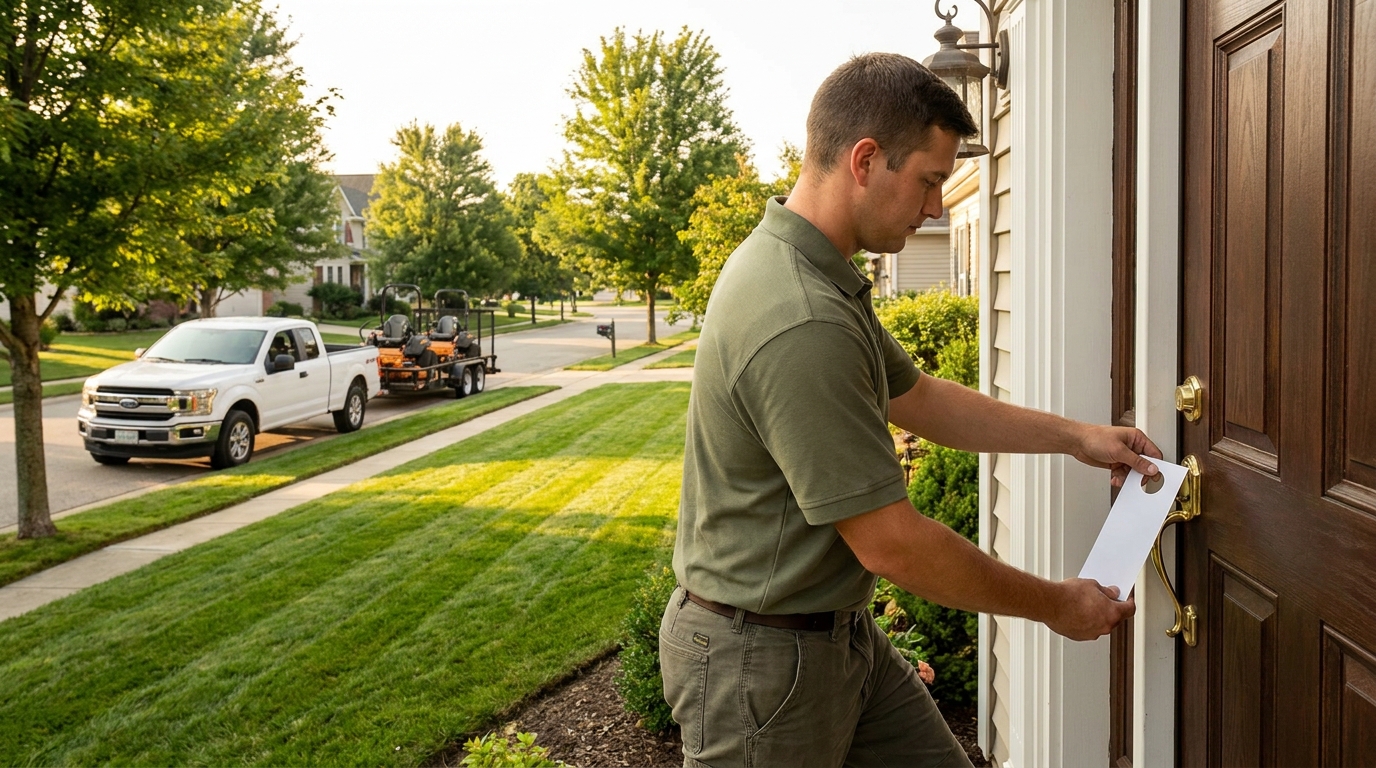
A door hanger has to be walked to a door. That is the entire product difference, and it is the entire cost difference.
Nobody publishes a defensible doors-per-hour rate and I am not going to invent one, because it swings enormously with lot size, whether the houses have long driveways, whether you are dodging dogs, and whether the person doing it is motivated. So here is the arithmetic exposed at three rates instead, costed at $26.40 per person-hour — half of the $52.80 loaded two-person crew rate this site has used since the leaf removal pricing breakdown. Substitute your own rate; the shape does not change.
| Doors per person-hour | Hours for 1,000 | Labor cost | Print (1,000) | All-in | Labor share |
|---|---|---|---|---|---|
| 40 | 25.0 | $660.00 | $332.08 | $992.08 | 66.5% |
| 60 | 16.7 | $440.00 | $332.08 | $772.08 | 57.0% |
| 80 | 12.5 | $330.00 | $332.08 | $662.08 | 49.8% |
At every plausible rate, the walking costs at least as much as the printing. At 60 doors an hour it costs a third more. Every page on this search result prices the 43% and stays silent on the 57%.
There is a second cost hiding in those hours, and it is worse than the money. Sixteen hours is two full working days. In August, two working days is roughly 24 mowing stops you did not make. If you send a crew member instead of going yourself, you are paying wages during production hours; if you go yourself, you are the one not mowing. Neither version is free, and neither shows up on the print quote.
The same 1,000 doors, delivered two ways
USPS sells a product that solves exactly this problem, and none of the template shops mention it. Every Door Direct Mail is currently 26 cents per piece in postage for EDDM Retail (USPS Marketing Flats), with a minimum of 200 pieces and a maximum of 5,000 per day per ZIP Code. You do not buy a mailing list and you do not address anything; the pieces go to "Postal Customer" on the carrier routes you select.
Put the two campaigns side by side at 1,000 doors:
| Line | Door hangers | EDDM flyers |
|---|---|---|
| Print, 1,000 pieces | $332.08 | $126.32 |
| Postage | — | $260.00 |
| Delivery labor | $440.00 (16.7 hrs) | — |
| Prep and paperwork | — | $52.80 (2 hrs, assumed) |
| All-in | $772.08 | $439.12 |
| Cost per delivered piece | 77.2¢ | 43.9¢ |
| Your hours | 16.7 | 2 |
Mailing is 43% cheaper than walking, and it costs you two hours instead of seventeen. That inverts the folk wisdom completely. Door hangers feel free because the labor is yours and you never invoice yourself for it. Postage feels expensive because it is a line item you actually pay.
The 2-hour prep figure is my assumption, not a measured number: EDDM Retail requires bundling in fixed counts, completing PS Form 3587, and taking the mailing to a Post Office. If your first one takes four hours, the comparison still holds by a wide margin.
Two honest points for door hangers, because the cost table is not the whole argument. A door hanger is physically on the handle the customer touches, which mail is not. And a door hanger can be dropped on the exact five houses either side of a job you are already doing, which is the highest-converting canvassing there is and costs essentially nothing because you are standing there. The case against door hangers is a case against buying a thousand of them and blocking out two days, not a case against carrying fifty in the truck.
The response rate everyone quotes, and why it is not in my math
Every direct-mail article you will find leads with the same number: 4.4%, credited to the ANA/DMA Response Rate Report. I read three of those pages on August 13, 2026 and the picture is worse than "unverified."
- Mailpro publishes 4.4% as "the average direct mail response rate," with no edition year.
- CRST publishes 4.4% and says the most recent edition was released in July 2025.
- Doceo calls it "the latest 2026 numbers from the ANA/DMA Response Rate Report" in its opening line, then labels the same figure "ANA/DMA 2025" in its own comparison table and again in its FAQ. One page, two years, one number.
All three cite a report that sits behind a paywall, and all three are published by companies that sell direct mail. That is not a reason to assume they are wrong, but it is a reason not to build your budget on their headline.
The substance matters more than the sourcing. CRST is the only one of the three that breaks the average apart, and its breakdown is the one that applies to you: a house list of existing customers runs 5% to 9%, while a prospect list — explicitly including "an EDDM route mailed to Local Postal Customer rather than a named individual" — runs 2% to 4.4%. The famous 4.4% average is the ceiling of the bucket you are actually in, not the middle of it. A landscaper who budgets against 4.4% is budgeting against a blended figure that includes mailings to people who already buy from them.
So I have not used a response rate anywhere in this article's conclusions. Here is what I used instead.
Break-even, which needs no assumption at all
You do not need to know your response rate to decide whether to run a drop. You need to know how many customers it takes to pay for itself, and that is division.
The standing book on this site: a recurring client at $52 a visit over a 32-week season is $1,664 of revenue. At a 45% gross margin — the figure worked through in the landscaping profit margin breakdown — that client contributes $748.80.
| Campaign (1,000 pieces) | All-in cost | Break-even on revenue | Break-even on margin |
|---|---|---|---|
| Door hangers | $772.08 | 0.46 clients | 1.03 clients |
| EDDM flyers | $439.12 | 0.26 clients | 0.59 clients |
On revenue, a 1,000-door hanger drop pays for itself with half a customer. On margin, it needs almost exactly one. That distinction is where most flyer post-mortems go wrong. "I got two customers, it cost $772, so I made money" is only true if you compare the $772 against $1,498 of contribution rather than $3,328 of revenue — and it is the contribution that has to cover the truck, the insurance and your own pay.
Expressed as a response rate, assuming 40% of the people who call actually sign (state your own; mine is a placeholder), break-even is 0.26% for door hangers and 0.15% for EDDM. Both sit far below even the low end of the prospect-list range those vendor pages publish. The math says a competently executed drop should clear break-even comfortably. I would still plan against the low end, because the people publishing the high end sell mail.
What a client actually costs you, by response rate
This is the table the storefronts do not run. One thousand pieces, 40% of responses signing, cost per acquired client:
| Response rate | Responses | Clients | Door hangers | EDDM flyers |
|---|---|---|---|---|
| 0.25% | 2.5 | 1.0 | $772 | $439 |
| 0.5% | 5 | 2.0 | $386 | $220 |
| 1% | 10 | 4.0 | $193 | $110 |
| 2% | 20 | 8.0 | $97 | $55 |
Now return to the 50-flyer entry rung. At 50 pieces, a 2% response is one phone call, and at a 40% close that is 0.4 of a customer. The vendor's claim that one mowing account covers $39.54 many times over is true and irrelevant, because fifty pieces will usually produce no account at all. You are not buying a small campaign at 79 cents a piece. You are buying a lottery ticket at 25 times the bulk unit price. If the budget is $40, the honest advice is to save until it is $150 and order 1,000.
One comparison I will draw carefully. The Google Ads cost-per-click on lawn care leads is about $46 — but that is the term on which lead vendors advertise to you, not the term homeowners search, and a click is not a customer. I have not measured the homeowner-side auction, so treat $46 as evidence that somebody thinks your attention is worth a lot, not as a benchmark for your own ad account.
The real argument for mail, and it is not the price
Everything above says EDDM is cheaper. That is the boring reason. The good reason is geographic.
EDDM is sold by USPS carrier route. A carrier route is not a marketing segment; it is the physical sequence one letter carrier walks or drives in one shift. It is contiguous by construction. So when responses come back from a single EDDM route, they are clustered by definition — you cannot buy a mailing list that is more tightly geographic than the route a postal worker already walks.
For a mowing business that is the whole ballgame. The leaf removal math showed what happens when stop density collapses: four stops in a day instead of twelve changes a profitable service into an unprofitable one without a single price changing. Eight new clients scattered across a metro is a routing problem you will be paying for every week until they churn. Eight new clients on two adjoining carrier routes is a morning.
So the metric that matters is not response rate, it is response density: what fraction of the replies land on streets you already drive. And that is the one number a saturation mailing can be engineered to control, because you choose the routes.
The honest limit on that argument: a carrier route is contiguous, but it is contiguous with itself, not with your book. Selecting the route that touches your existing stops is the entire skill, and it requires knowing where your clients actually are on a map rather than in your head. Pick a route across town and you have bought yourself a tightly clustered second territory you now have to drive to.

What to put on it
Design advice is the one thing this search result is not short of, so this is deliberately brief and limited to the things that interact with the arithmetic above.
- A price, or a price range. The single biggest driver of response is whether the reader can tell if you are in their budget without calling. If you will not publish a number, publish a starting number.
- The street name. "We already mow on Ridgeline Drive" is proof, it is local, and it costs nothing. It is also the only line on the piece that a national competitor structurally cannot write.
- One action, one channel. A phone number and a QR code to a quote form is fine. A phone number, a website, a QR code, three social handles and an email address is not a call to action, it is a menu.
- A reason the timing matters. Mid-August through September is when fall cleanup and aeration and overseeding get booked, which is the one time of year a homeowner is actively deciding rather than passively ignoring.
- Something to write down. If you cannot tell which drop produced which client, you will run the same campaign for three years without knowing whether it works. A distinct phone extension, a promo word, or just asking every caller and writing it down.
What to leave off: clip art of a mower, "quality service at affordable prices," and any claim you would not put in a service agreement.
Where Landscapey fits, and where it does not
We sell a CRM for landscapers, so it is worth being blunt about which half of this article our software touches.
| Landscapey does not | Landscapey does |
|---|---|
| Design flyers or door hangers | Keep every client with a real address, so you can see where your book actually is before you pick a route |
| Order or price printing | Plan and optimize the routes those new stops have to fit into |
| Select EDDM carrier routes or handle postage | Turn an inbound quote request into a client in one step |
| Track campaign response or attribute a client to a drop | Give you a free public profile page that produces inbound quote requests at no cost per lead |
| Provide multi-user crew accounts, so the person hanging doors cannot log their own progress | Bill the recurring work the campaign wins, flat monthly or per visit |
There is no campaign tracker in the product. There is no field where you enter "door hangers, Maple Street, 1,000 pieces, August 14" and see what it earned. If that is the feature you need, we do not have it, and no amount of route optimization substitutes for it.
What we do have is the other end of the same problem: the customer acquisition channels that do not cost 44 cents a door. Every Landscapey signup gets a public profile page with a quote form on it, indexed and free, which is the only channel in that article with a marginal cost of zero. The whole plan is $19.99 a month with a 14-day trial, and the profile is included rather than upsold.
Frequently asked questions
How much do 1,000 lawn care flyers cost?
About $126 to print at 4over4's August 2026 prices, or 12.6 cents each. Delivering them is the real cost: $260 in EDDM postage to mail them, or roughly 16 hours of labor to hang them. All-in, budget $439 to mail 1,000 or $772 to hang 1,000.
Are door hangers or flyers better for a lawn care business?
At scale, mailed flyers win on cost by 43% and cost you two hours instead of seventeen. Door hangers win in one specific case: the handful of houses immediately around a job you are already on, where the labor is free because you are standing there. Buy a small box for that, not a pallet.
What response rate should I expect from lawn care flyers?
Nobody publishes a verifiable landscaping-specific figure, and the widely quoted 4.4% direct mail average comes from a paywalled report, blends in mailings to existing customers, and is republished by companies that sell direct mail. The one breakdown I found puts saturation mail to strangers at 2% to 4.4%. Plan against break-even instead: you need roughly one signed client per 1,000 door hangers to cover the campaign on margin.
What is EDDM and can a lawn care business use it?
Every Door Direct Mail is a USPS product that delivers an unaddressed piece to every home on a postal carrier route you select. Postage is currently 26 cents per piece for EDDM Retail, the minimum is 200 pieces and the maximum is 5,000 per day per ZIP Code. You do not need a mailing list, and the carrier route gives you tighter geographic clustering than any list you could buy.
How many flyers should I order?
More than you think, because the price ladder collapses. At 4over4, 500 flyers cost $108.75 and 1,000 cost $126.32 — the second 500 are 3.5 cents each. The 50-piece and 250-piece entry options are the worst value on the sheet and are too small to reliably produce a single customer.
Is a flyer campaign cheaper than buying leads?
At a 0.5% response rate and a 40% close, a mailed campaign works out around $220 per acquired client, and at 1% around $110. Lead marketplaces and paid search charge per lead or per click rather than per customer, so the comparison depends entirely on your close rate. The channel with no per-lead cost at all is your own profile page and your existing customers' referrals.
Sources and limits
Print prices are 4over4's published ladders for its lawn care flyer (4.25" x 5.5") and lawn care door hanger products, read August 13, 2026. Other printers will differ, sometimes a lot; the shape of the ladder is the point, not the specific vendor. Postage, minimums and daily limits are from the USPS Every Door Direct Mail page, read the same day.
The labor rate of $26.40 per person-hour, the 45% gross margin, the $52 visit and the 32-week season are this site's standing example book, not measurements of your business. The doors-per-hour figures, the 2-hour EDDM prep estimate and the 40% close rate are stated assumptions with the arithmetic exposed so you can substitute your own. No response rate is used in any conclusion in this article, deliberately, and the one range quoted is attributed and bounded.
What is missing here that I could not verify: the ANA/DMA report itself is paywalled, so the response figures above are quoted as what three vendors publish, not as findings. I did not measure homeowner-side ad costs. And print pricing moves — if you are reading this months from now, the ladders will have shifted even if the argument has not.
None of this is a substitute for tracking your own results. The whole reason this article is arithmetic rather than advice is that one drop in your own ZIP code, honestly measured, beats every benchmark on the internet. Start a free trial and at least the client and route side of it will be written down.