Section 179 lets a landscaper deduct the full cost of a mower, trailer, or work truck in the year it goes into service, instead of spreading the deduction over several years. For 2026, the limit is $2,560,000, so no ordinary landscaping company will reach it. The rules that matter are the Dec. 31 in-service deadline, your business income limit, and what the write-off is really worth.
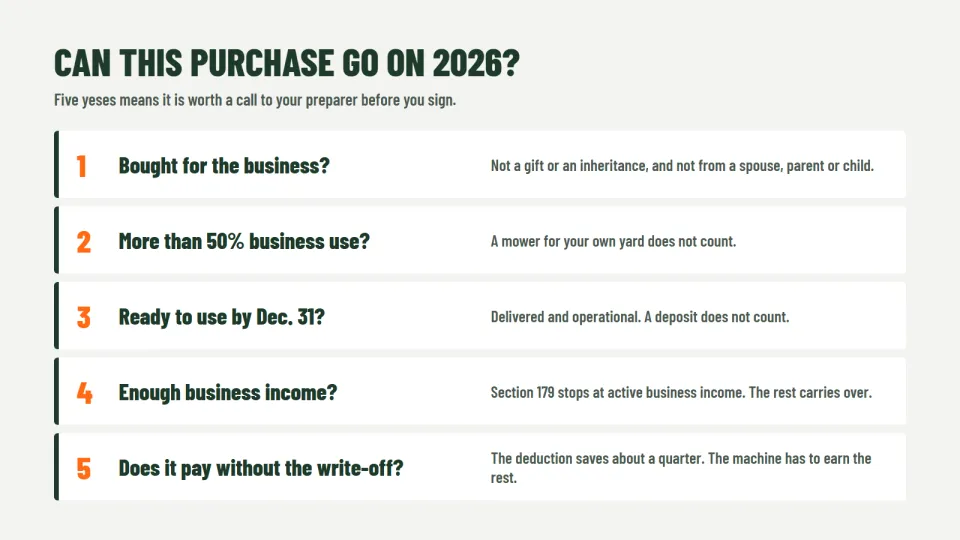
That last one is the number that gets skipped. A sole proprietor filing jointly with $100,000 of profit who buys a $16,000 zero-turn saves about $3,688 in federal tax on our worked example. That is 23 cents on the dollar. The other 77 cents leaves the business. So the write-off is a good reason to buy a machine in December instead of March. It is a bad reason to buy a machine you do not need.
We have 56 days left in 2026 as this goes up. Here is what counts, what it saves at different income levels, and where landscapers get caught.
The 2026 numbers
Several top search results still quote $1,160,000, which was the 2023 limit. These are the current figures from the IRS.
| Item | For tax years beginning in 2026 |
|---|---|
| Maximum Section 179 deduction | $2,560,000 |
| Phase-out starts when Section 179 purchases exceed | $4,090,000 |
| Section 179 cap on a sport utility vehicle | $32,000 |
| Bonus depreciation, property acquired and placed in service after Jan. 19, 2025 | 100% |
| Standard mileage rate | 72.5 cents per business mile |
Those first two lines are irrelevant to a shop buying one mower. The limit that actually binds a small landscaping company is lower down the page: your business income.
What landscaping equipment qualifies
Most of what you would buy for the business can qualify if you bought it, use it more than 50% for business, and put it in service during the year. That covers the usual list: zero-turns and stand-ons, walk-behinds, trailers, aerators, skid steers, dump inserts, salt spreaders, plows, and work trucks. Used equipment can qualify too, so a three-year-old mower from a dealer is not shut out.
Three cases fall outside the simple version:
- Buying from family. Property acquired from a related person does not qualify for Section 179. For this rule, family means your spouse, ancestors, and lineal descendants. Buying your father's mowers when he retires is the classic landscaping version of this problem.
- Trade-ins. When you pay with cash plus a trade-in, IRS Publication 946 says the Section 179 cost includes only the cash you paid. A $16,000 mower with a $4,000 trade-in gives you a $12,000 Section 179 base. On our worked example, that lowers the first-year saving from $3,688 to $2,766.
- Small tools. Trimmers, blowers, and hand tools usually do not need Section 179 at all. They can generally be deducted as supplies or under the de minimis safe harbor. Our tax deductions guide covers those.
The Dec. 31 rule: placed in service, not paid for
The deduction belongs to the year the equipment is placed in service. The IRS definition is short: property is in service when it is "ready and available for a specific use." It does not have to be running yet.
That gives landscapers a useful answer and a dangerous one:
| Situation on Dec. 31, 2026 | Likely 2026 deduction? | Why |
|---|---|---|
| Mower delivered Dec. 29, parked in the shop, ready to run, first cut in March | Yes | Ready and available, even though it is not being used yet |
| Deposit paid, mower still on order | No | Paying is not placing in service |
| Bought in December, dealer delivers Jan. 4 | No | Not available to you until 2027 |
| Plow bought in December, not mounted or usable until January | Likely no | The IRS treats equipment not yet operational as in service later |
| Financed in December, delivered and ready, first payment in January | Yes | The deduction follows service, not payment |
If you are cutting it close, get a dated delivery ticket and keep it with the invoice. A photo of the machine in your shop does not hurt either.
What the write-off is worth: a worked example
The model below is illustrative. It assumes a sole proprietor buying a $16,000 commercial zero-turn, using the 2026 federal brackets, the standard deduction, the 20% qualified business income deduction, and self-employment tax. It leaves out state tax and credits. The price is our assumption; 2026 commercial 60- and 61-inch machines we found ranged from about $11,000 to almost $19,000, depending on brand and engine.
| Business profit before the purchase | SE tax saved | Income tax saved | Total saved | Saved per $1 |
|---|---|---|---|---|
| $30,000, married filing jointly | $2,261 | $0 | $2,261 | 14 cents |
| $50,000, married filing jointly | $2,261 | $1,141 | $3,402 | 21 cents |
| $75,000, married filing jointly | $2,261 | $1,294 | $3,554 | 22 cents |
| $100,000, married filing jointly | $2,261 | $1,427 | $3,688 | 23 cents |
| $150,000, married filing jointly | $2,261 | $1,427 | $3,688 | 23 cents |
| $200,000, married filing jointly | $2,236 | $2,619 | $4,855 | 30 cents |
Two things stand out. First, the marginal bracket quoted in most tax articles overstates the income tax side. A deduction also shrinks your qualified business income deduction, so a 12% bracket works out to less than 12% in practice. Second, self-employment tax does more of the work than people expect. At $100,000 of profit, it is about 61% of the saving.
Filing single changes the answer: the same $16,000 saves $3,688 at $50,000 or $75,000 of profit and $4,795 at $100,000, because the 22% bracket arrives sooner.
Buying to avoid taxes
The landscaper at $100,000 who spends $16,000 to avoid $3,688 in tax is $12,312 poorer in cash than the one who simply pays the tax, before counting anything the mower earns. If the machine replaces a worn-out one or lets you take on more work, that is a good trade and the tax timing is a bonus. If it would sit under a tarp as a backup, it is an expensive way to lower a tax bill. For the math on which machines earn their keep, see our lawn care equipment guide and profit margin guide.
Section 179 is timing, not extra money
Without Section 179 or bonus depreciation, a mower is typically deducted over several years. Using a five-year schedule as an assumption (the IRS tables do not list landscaping gear by name, so have your preparer confirm the class), here is the same $16,000 at a steady $100,000 profit.
| Tax year | Deduct it all in 2026 | Spread on a 5-year schedule |
|---|---|---|
| 2026 | $3,688 | $738 |
| 2027 | $0 | $1,180 |
| 2028 | $0 | $708 |
| 2029 | $0 | $425 |
| 2030 | $0 | $425 |
| 2031 | $0 | $212 |
| Total | $3,688 | $3,688 |
The total is identical. You are getting the same money sooner. That still has real value, especially for a small company where cash is tight, but it changes how you should plan. If you deduct everything in 2026, there is nothing left for that mower in 2027. Your tax bill returns to normal, so your monthly tax set-aside should too.
When spreading wins
Timing matters most when your income is changing. If this year is $60,000 and the next five are $110,000, the model shows spreading saves $3,641 in total against $3,450 for deducting it all now. That is a modest $191, and most owners would still take the money early. But the direction is worth knowing: a big deduction in a low-income year is used at a lower rate. In a year with $30,000 of profit, the deduction saves no income tax at all under these assumptions. It also lowers the earnings reported for Social Security.
Section 179 vs. bonus depreciation
Bonus depreciation is back at 100% for property acquired and placed in service after Jan. 19, 2025, so the two now reach the same place for most purchases. The differences are in the mechanics.
| Section 179 | Bonus depreciation | |
|---|---|---|
| How you get it | You elect it, asset by asset, and can choose the amount | Automatic unless you elect out |
| Income limit | Limited to active business income; the excess carries forward | No taxable-income limit, so it can create a loss |
| Opting out | Simply do not elect it | By whole class of property for the year; revoking needs IRS consent |
| Heavy SUV | $32,000 cap for 2026 | No SUV cap of its own |
| State treatment | Varies | Often not followed |
The trap is the default. Many owners assume that doing nothing means normal depreciation. For qualifying equipment, doing nothing usually means 100% bonus. If you want to deduct $6,000 of a $16,000 mower under Section 179 and spread the rest, you also need to elect out of bonus for that class, and that election covers every asset in the class placed in service that year. This is worth raising with your preparer before the return is filed, not after.
States are the other trap. Federal rules do not settle your state return. Accounting firm summaries list Indiana and Michigan among the states that do not follow federal bonus depreciation, California has long had its own rules, and several legislatures changed course this year. A big federal write-off can leave you with a higher state bill than you planned for and a separate depreciation schedule to track.
Work trucks: the decision that lasts
Truck weight and bed length decide which rules apply. Check the GVWR on the door sticker, not the curb weight.
| Vehicle | Section 179 treatment |
|---|---|
| 6,000 lb GVWR or less | Passenger auto limits apply. The IRS first-year limit was $20,200 with bonus for 2025; confirm the 2026 figure with your preparer. |
| Over 6,000 and up to 14,000 lb, bed under 6 feet | Generally the $32,000 SUV cap for Section 179. Bonus may cover more. |
| Over 6,000 lb, cargo area at least 6 feet long | Excepted from the SUV cap. |
| Over 14,000 lb | Above the range the SUV cap covers. |
The bigger issue is easy to miss. If you claim Section 179 or bonus depreciation on a truck, you cannot use the standard mileage rate on it in any later year. You are on actual expenses for the life of that truck, so you need to keep fuel, repair, and insurance records, plus a mileage log for the business percentage.
Here is the comparison on our $100,000-profit example: a $60,000 truck at 90% business use, driven 15,000 business miles a year.
| Method | Deduction | Tax saved in the model |
|---|---|---|
| Expense it in year one | $54,000 in 2026, plus actual fuel, repairs, and insurance each year | $12,121 in 2026 on the truck cost alone |
| Standard mileage at 72.5 cents | $10,875 a year, with fuel, repairs, and insurance included in the rate | About $2,507 a year, or $12,534 over five years |
The two are not directly comparable, because the first line still gets its operating costs on top. For a truck that hauls a trailer all day and burns fuel, actual expenses often come out ahead. For a lighter truck with high mileage and low running costs, the mileage rate can hold up well. Run both before the sale closes, because you cannot switch to mileage afterward. Our expense tracking guide covers the records either method needs.
Financing: the first year flatters the deal
You can generally deduct financed equipment in the year it goes into service, so a year-end purchase with little money down can still produce a full write-off. The tax saving arrives once, though, and the payments do not stop.
Take the same $16,000 mower on an assumed 48-month loan at 7.99%. The payment is $390.53 a month, and total interest is $2,746.
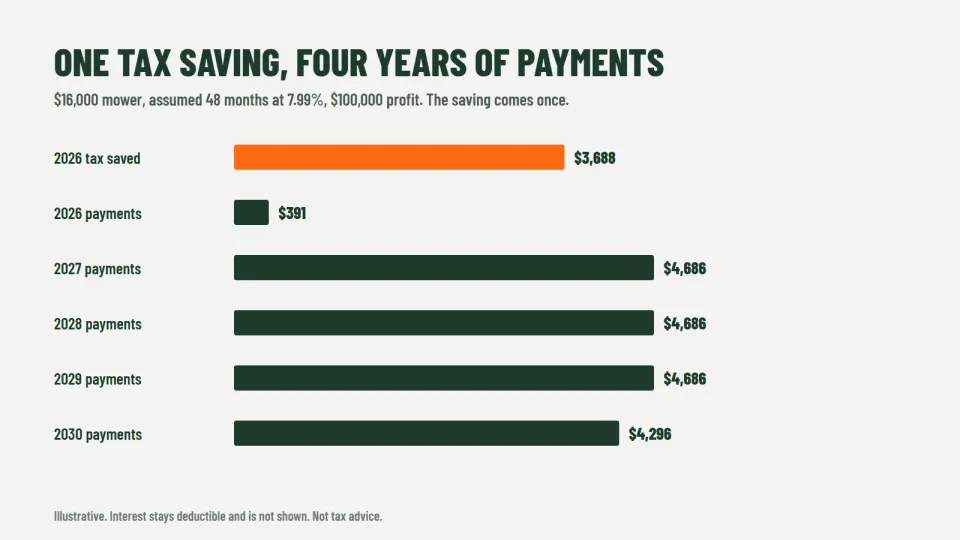
In 2026 the deal looks great: one $391 payment and $3,688 less in tax. From 2027 through 2029, you pay $4,686 a year with no depreciation left to claim on the mower. Only the interest is still deductible. The tax saving covers fewer than 10 monthly payments. So plan the payment against the revenue the machine brings in, not against the write-off. If you need to raise rates to carry new equipment, our price increase letter is a good place to start.
What can bring the deduction back
- Your business income is too low. Section 179 cannot exceed your income from the active conduct of a business. The unused amount carries over, so it is not lost, but it will not lower this year's tax.
- Business use drops. Listed property such as a vehicle must stay above 50% business use. If it falls to 50% or below, you may have to add part of the deduction back into income.
- You sell the machine. A mower you deducted in full has no remaining basis, so sale money is generally taxable gain. Selling that mower for $4,000 in a few years can mean up to $4,000 of ordinary income. Plan for it when you trade up.
A December checklist
- Project your full-year profit now. Pull a year-to-date P&L and add what November and December should bring. You cannot size a deduction without this number.
- Call your preparer before you buy. Ask about the marginal saving at your income, Section 179 versus bonus, and your state's treatment.
- Confirm delivery by a date, in writing. A dealer's "we'll have it by the end of the year" is not a plan. Aim for well before Dec. 31.
- Keep the file: invoice, loan papers, delivery ticket, the date it was ready to use, serial number, and business-use records.
- Adjust your set-aside. Lower it for the saving this year, then return it to normal next year.
- Clean up the rest of year-end tax work. Collect W-9s and review subcontractor totals using our 1099 guide. Forms for 2026 payments are due Feb. 1, 2027.
Where Landscapey fits
Landscapey does not calculate depreciation, make a Section 179 election, or file tax forms. That is your preparer's job. What it does is give your preparer clean numbers. In Expenses, you can log each purchase with its date, payee, amount, payment type, and an Equipment category, then put the serial number and in-service date in the notes. Financials shows your running profit, so the December decision starts from a real number, and it exports a CSV your accountant can open in Excel. If you already keep your books in QuickBooks, the QuickBooks connection can backfill your expenses into Landscapey.
One note on reading your P&L: an Equipment expense logged in the app shows up as a cost when you log it, which is a cash-style view. Your preparer decides the tax treatment. Landscapey is $19.99 a month after a 14-day trial, and you can start without a card. For more on the software side of the books, see our landscaping accounting software guide.
FAQ
Can I write off a lawn mower under Section 179?
Generally yes, if you bought it for your landscaping business, use it more than 50% for business, and it is ready to use by the end of the tax year. A mower for your own lawn does not qualify.
Does the mower have to be used before Dec. 31?
No. It must be ready and available for its specific use. A machine delivered in late December and parked until spring can count. A machine still on order does not.
Can I use Section 179 on used equipment?
Used equipment can qualify if you bought it and it is new to you. Equipment bought from a spouse, parent, grandparent, child, or grandchild does not qualify.
Can I take Section 179 if my business made no profit?
You can elect it, but the deduction is limited by business income and the excess carries forward. Bonus depreciation has no taxable-income limit and can create a loss, which is a separate conversation with your preparer.
Does a pickup qualify for the full deduction?
It depends on GVWR and bed length. A pickup over 6,000 lb with a cargo area of at least 6 feet is excepted from the $32,000 SUV cap. A shorter bed generally falls under the cap, though bonus depreciation may cover more. Check the actual truck before relying on either.
Is it better to buy equipment or pay the taxes?
If you do not need the equipment, paying the tax leaves you with more cash. In our example at $100,000 of profit, a $16,000 purchase saves $3,688 in federal tax and costs $12,312 net. Buy when the machine earns its keep, and use the deduction to help decide when.
Sources and limits
The 2026 Section 179 limits, phase-out, SUV cap, brackets, and standard deduction come from IRS Rev. Proc. 2025-32. Rules on placed-in-service dates, purchase and related persons, trade-ins, and recapture come from IRS Publication 946 (2025). Bonus depreciation and Section 179 line rules come from the 2025 Form 4562 instructions. The standard mileage limits come from Publication 463 (2025), and the 72.5-cent rate from the IRS 2026 mileage release and Notice 2026-10. The 2026 Social Security wage base of $184,500 used in the model comes from published summaries of the SSA announcement, as the SSA page would not open for us.
We could not confirm the 2026 passenger auto limit or read California's current form directly, and state summaries came from accounting firms, so check those with your preparer. Mower prices are dealer and review figures, not manufacturer price lists. The worked examples are illustrative: they use one set of assumptions, ignore state tax, and hold 2026 figures flat for future years. Your real numbers will differ. This is general information, not tax advice, so confirm your situation with a tax professional before you buy.