For payments made in 2026, the federal 1099-NEC threshold is $2,000, up from $600. That is the amount a landscaping company has to pay a non-employee during the year before a form is required. It first affects the forms you file by February 1, 2027, and the time to prepare is now, while your subs are still answering their phones.
The change removes some paperwork, but less than the headlines suggest. The threshold moved. The rules on who counts as a sub, what counts toward the total, and when an LLC gets a form did not. This guide runs a sample shop's real-looking vendor list through the new rule, line by line, then gives you a November-to-February routine.
One note before the numbers: this is general information from the IRS instructions, not tax advice for your company. Your CPA gets the last word, especially on state filing and on who counts as an employee.
What changed, and what did not
The One Big Beautiful Bill Act raised the reporting floor for payments made after December 31, 2025. The IRS instructions for Forms 1099-MISC and 1099-NEC now say to report nonemployee compensation of $2,000 or more, and the amount may be adjusted for inflation starting in 2027. The same $2,000 now applies to the backup withholding trigger on those payments.
| Rule | Payments made in 2025 | Payments made in 2026 |
|---|---|---|
| Form 1099-NEC, services by a non-employee | $600 or more | $2,000 or more |
| Deadline to file and give the sub a copy | February 2, 2026 | February 1, 2027 |
| Payments by credit or debit card | Not on your 1099-NEC | Not on your 1099-NEC |
| Payments to a corporation | Generally no form | Generally no form |
| The sub's duty to report the income | All of it | All of it |
| W-2 wages for an employee | No minimum threshold for this test | No minimum threshold for this test |
January 31, 2027 falls on a Sunday, and the IRS moves a weekend due date to the next business day, which is how you get February 1.
That last row matters more than any other. The $2,000 figure is a reporting threshold for real subcontractors. It does not turn a crew member you paid $1,900 into a contractor. More on that below.
Run a real vendor list through the rule
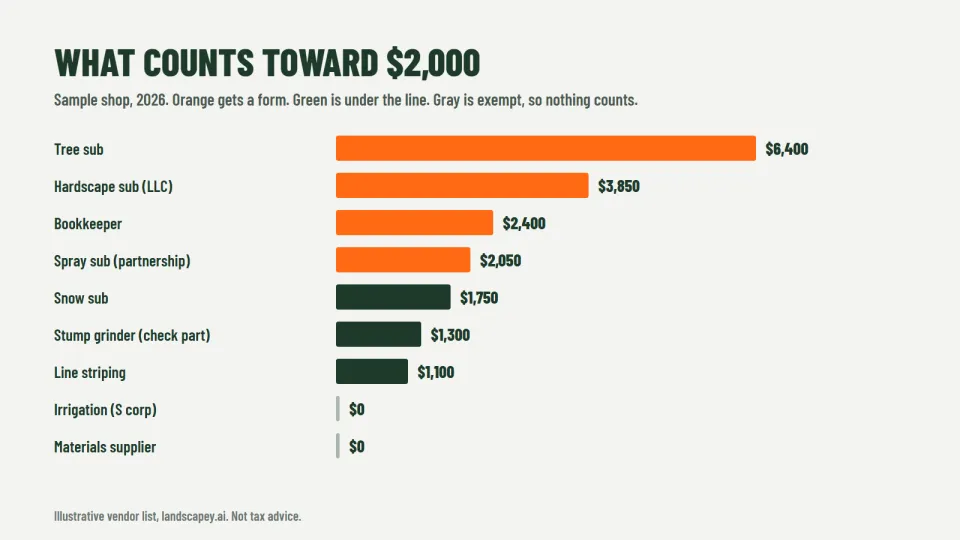
Here is an illustrative year for a three-truck shop. The amounts are made up, but every line is a situation that comes up in this trade. The "counted" column is what actually goes toward the threshold.
| Who you paid in 2026 | Paid | How | Counted | Old $600 rule | 2026 rule |
|---|---|---|---|---|---|
| Tree sub, sole proprietor | $6,400 | Check | $6,400 | Form | Form |
| Hardscape sub, single-member LLC | $3,850 | Check | $3,850 | Form | Form |
| Bookkeeper, sole proprietor | $2,400 | ACH | $2,400 | Form | Form |
| Spray sub, LLC taxed as a partnership | $2,050 | Check | $2,050 | Form | Form |
| Stump grinder, sole proprietor | $2,300 | $1,300 check, $1,000 card | $1,300 | Form | No form |
| Snow sub, sole proprietor | $1,750 | Check | $1,750 | Form | No form |
| Line striping, sole proprietor | $1,100 | ACH | $1,100 | Form | No form |
| Irrigation sub, S corporation | $4,200 | Check | $0 | No form | No form |
| Nursery and materials supplier | $38,000 | Account | $0 | No form | No form |
Result: seven forms under the old rule, four under the new one. Those four cover $14,700 in payments. So the new threshold saved this shop three forms. It did not save it the job of tracking every payee, because you cannot know who crossed $2,000 unless you added up all of them.
Three lines worth a second look
- The stump grinder. You paid $2,300, which is over the line, but $1,000 of it went on a card. Card payments are reported on Form 1099-K by the payment company, not on your 1099-NEC, so only the $1,300 by check counts. If you had paid the whole amount by check, this would be a form.
- The hardscape sub. "LLC" does not mean exempt. A single-member LLC is usually taxed as its owner, so it gets a form. The exemption covers an LLC that is taxed as a C or S corporation. Only the sub's W-9 tells you which, so don't guess from the business name.
- The supplier. Buying plants, stone, or mulch is buying merchandise, and it does not go on a 1099. But a sub who supplies and installs is different: the IRS says to include parts and materials when supplying them was incidental to the service. A $5,000 mulch-and-install bill from a sole proprietor is generally a $5,000 line, not a labor-only line. Ask your CPA where a heavy-materials job falls on that test.
Who gets a form: the five-question test
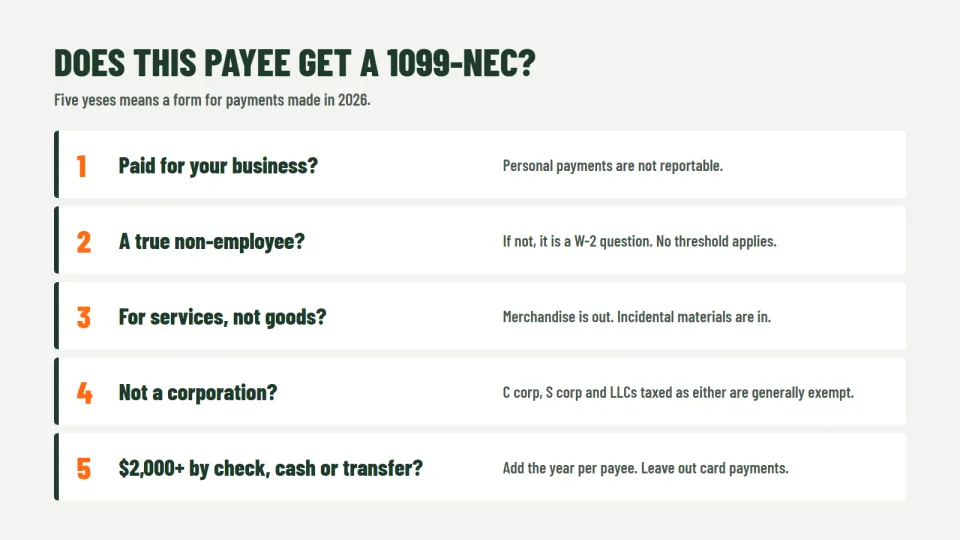
- Did you pay them for your business? The rule covers payments made in the course of your trade or business. Personal payments are not reportable, which is why the homeowners you mow for don't send you a 1099.
- Is this person actually a non-employee? If not, stop here. It's a W-2 question, and no threshold applies to it.
- Were they paid for services, rather than goods? Pure merchandise is out. Services, including incidental materials, are in.
- Are they a corporation? Check the W-9. C corporations, S corporations, and LLCs taxed as either are generally exempt. Attorneys are the standing exception to this exemption.
- Did the total by check, cash, or bank transfer reach $2,000 in the year? Add up every payment to that payee, leave out card payments, and use the date you paid, not the date you got the invoice. Treat a bank-to-bank transfer the way you would treat a check. If you pay through a payment app, ask your CPA how that app reports.
Only a payee who clears all five gets a form. Cash counts, and it is the one that causes the most trouble: a cash-paid sub leaves no bank record, so a missing receipt can make the deduction harder to defend later.
The threshold did not move the employee test
Here's the expensive mistake, and it has nothing to do with $2,000. Plenty of small shops pay helpers by check and call them "1099 guys." The IRS looks at how the work is actually run: who controls how the job is done, who owns the tools and the truck, whether the worker can profit or lose money on the job, and whether the relationship is ongoing.
A helper who rides in your truck, uses your mower, follows your route, and gets paid by the hour looks like an employee, and a form does not change that. A tree service with its own insurance, its own chipper, its own other customers, and a bid price looks like a subcontractor.
Run the numbers on a typical helper: $18 an hour, 30 hours a week, for 30 weeks is $16,200 in pay. The employer share of Social Security and Medicare alone would be about $1,239 at 7.65%. That is the tax that goes unpaid when the person is misclassified, before you count the employee's share you should have withheld, state unemployment, workers' comp, and any penalties. Saving one form is not worth that exposure. If you have a real gray-area worker, the IRS offers Form SS-8 for a determination, but talk to your CPA first.
Our guide to managing subcontractors covers the working side of this, including scopes and paperwork for real subs.
What it costs to get it wrong
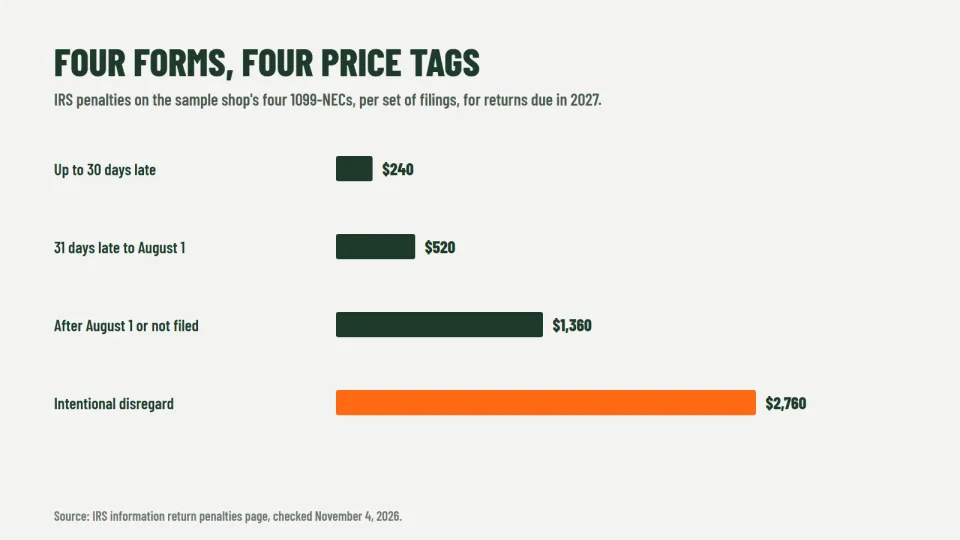
These are the IRS penalties for returns and statements due in 2027. They apply per form, and a late or missing copy to the sub can be penalized separately from the IRS filing.
| When you file | Per return or statement | The sample shop's 4 forms |
|---|---|---|
| Up to 30 days late | $60 | $240 |
| 31 days late through August 1 | $130 | $520 |
| After August 1, or not filed | $340 | $1,360 |
| Intentional disregard | $690, no annual cap | $2,760 |
Those figures are for one set of filings. Because the IRS can also penalize the copy you owe the sub, a shop that blows both could see roughly double. Compare that with the cost of collecting four W-9s in November, which is about four text messages.
There is a second cost. If a sub won't give you a taxpayer ID, you may be required to hold back 24% of reportable payments as backup withholding and send it to the IRS. That is not a conversation to start in late January. Get the W-9 before the first check, as we recommend in the landscaping bookkeeping guide.
A November-to-February routine
This takes about an hour in total if your payments are already logged somewhere. It takes a weekend if they aren't.
| When | Do this |
|---|---|
| This week | List everyone paid for services in 2026, whatever the amount. Pull from checks, bank transfers, and cash receipts. |
| By mid-November | Text a W-9 request to anyone missing one, including subs who are under $2,000 today. A busy snow season can push them over. |
| Early December | Total each payee, with card payments shown separately. Flag anyone between $1,500 and $2,000. |
| December 31 | Lock it. A check dated in 2026 counts for 2026. Don't time or split payments to dodge a form, because the income is taxable either way and split payments look like exactly what they are. |
| Mid-January | Send the list to your CPA or prepare the forms yourself in your accounting software or the IRS's free IRIS portal. |
| By February 1, 2027 | File with the IRS and give each sub their copy. If you have 10 or more information returns in total, you generally have to e-file them. Check your state's rules too. |
On state filing, don't assume the federal number carries over. Some states run their own 1099 rules and thresholds, and they don't all move with Congress. A two-minute check of your state revenue department's page, or a question to your CPA, is the safe move.
Keeping the list without a spreadsheet hunt
You need three facts per payment: who, how much, and how it was paid. If you use Landscapey, each entry on the expenses screen holds a payee, a category (Subcontractors is one of the built-in choices), a date, an amount, and a payment type (cash, check, credit card, debit, other). At year end, the Financials screen exports a sectioned CSV for your accountant, and you can sort its expense lines by payee to see who crossed the line.
To be clear about the limits: Landscapey doesn't file 1099s or store W-9s. Filing happens in your ledger or with your CPA. If that ledger is QuickBooks, see QuickBooks for landscapers and how our QuickBooks connection works. Our accounting software guide explains which tool does which job.
The other direction: forms you'll receive
Everything above is about what you send. You're also on the receiving end, and three things catch owners out.
- Homeowners won't send you anything. Their payments are personal. That money is still income, in full, with no threshold. A $40 cash mow is taxable.
- Commercial accounts probably will. Property managers, general contractors, and businesses that pay you $2,000 or more by check or ACH should send a 1099-NEC unless you're incorporated. Expect fewer of them for small jobs this year. Don't use those forms to build your income figure, because they won't add up to your real revenue. Your own invoices are the record.
- A 1099-K may show gross card receipts. Payment apps and marketplaces use the restored threshold of more than $20,000 and more than 200 transactions. Payment-card processing has no such minimum, so a processor can send a 1099-K at any level. The form shows gross amounts, before fees and refunds, so you need your invoice records to reconcile it to what actually landed in your bank.
That reconciliation is much easier when every invoice and payment sits in one place, and our tax deductions guide for landscapers covers what to do with those records next. If you're currently tracking invoices and sub payments across a notebook, a bank app, and your memory, Landscapey is free to start, with invoicing on one plan at $19.99 a month after the 14-day trial.
Frequently asked questions
Do I need to send a 1099 to a sub I paid $1,500 in 2026?
Not on the federal $2,000 rule, assuming that's the full amount for the year and the person is a true subcontractor. Keep the W-9 and the payment record anyway, and check your state. The sub still has to report that $1,500 as income.
Do the new rules apply to the forms I filed in early 2026?
No. Those covered payments made in 2025, which used the $600 threshold. The $2,000 figure first applies to payments made in 2026, on forms due in early 2027.
Do I send a 1099 to an LLC?
It depends on how the LLC is taxed. A single-member LLC taxed as its owner, or an LLC taxed as a partnership, generally gets a form. An LLC taxed as a C or S corporation generally does not. The tax classification box on the W-9 answers this.
If I paid a sub by card, do I still send a 1099-NEC?
Not for the card portion. Card payments are reported by the payment company on Form 1099-K. Any check, cash, or bank-transfer payments to the same sub still count toward $2,000.
Can I still deduct what I paid a sub if no 1099 is required?
Generally yes. The deduction depends on it being a real, documented business expense, not on the form. Keep the invoice and proof of payment. Our expense tracking guide has a simple way to keep those together.
What if a sub refuses to give me a W-9?
Request it in writing before you pay. If you still have no taxpayer ID and the payments are reportable, you may need to withhold 24% as backup withholding. Many owners simply won't pay a new sub until the W-9 is in hand, which is the cleaner policy. Put it in your sub agreement.
Sources and limits
Threshold, card, corporation, materials, and personal-payment rules come from the IRS Instructions for Forms 1099-MISC and 1099-NEC (12/2026 revision). Penalty amounts come from the IRS information return penalties page for returns due in 2027, as checked on November 4, 2026. The vendor list and helper example are illustrative. Treasury regulations implementing the change were reported as still proposed when we checked, and state rules vary, so confirm your own situation with a tax professional before you file.