Search "landscape lighting installation cost" and the homeowner gets a range: cost guides put a typical job somewhere between about $2,100 and $5,300, with a national average near $3,500, and per-fixture prices anywhere from $100 to $350. Search the installer's version of the question, how much to charge for landscape lighting installation, and there is very little beyond one old trade-magazine rule of thumb ($200 to $300 a fixture, everything in) and a lot of "it depends."
This guide does the installer's version properly. It builds a low-voltage lighting quote from the cost side: the fixtures, the transformer and timer, the wire and the home runs, connectors and stakes, crew hours to lay out, trench and connect, the night visit to aim the lights, trips, overhead and margin. Then it runs that model across fixture counts, fixture grades, hand-dug runs, smart transformers and long home runs, so you can see which part of a per-fixture price is cost and which part is profit.
One rule up front. Every number in the model is an input you should replace. Your supplier pricing, your wage, your overhead and your market set the real figures. The structure of the quote is what carries over.
The short answer
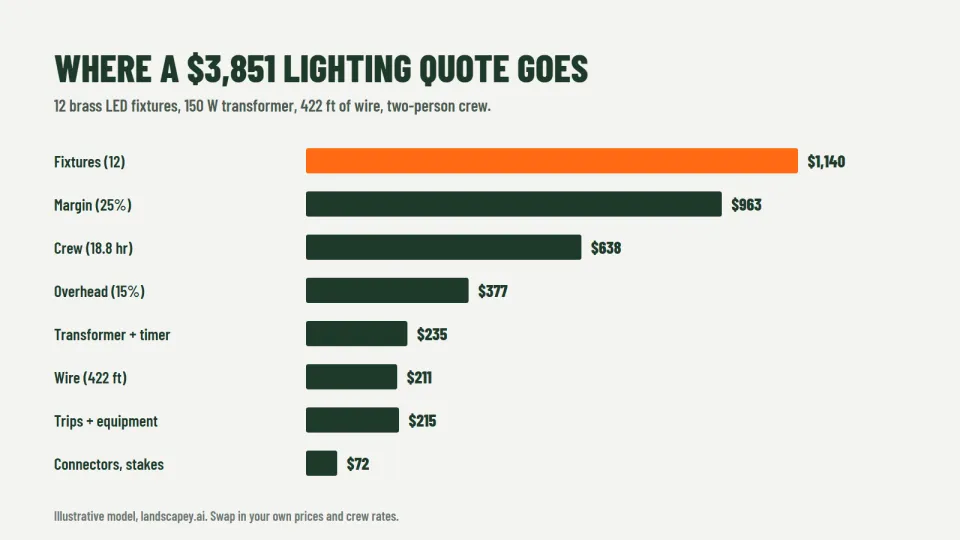
On the inputs below, a two-person crew installing a 12-fixture low-voltage system (six path lights along a front walk, six spotlights on trees and the house front, mid-grade brass integrated-LED fixtures, a 150-watt stainless multi-tap transformer on an existing outdoor GFCI outlet, a photocell and timer, about 420 feet of 12/2 direct-burial wire sliced in at 6 inches, plus a night visit to aim everything) comes to $3,851, or $321 per fixture. That breaks down as:
- $2,511 of direct cost, or $209 a fixture
- $1,140 of fixtures (12 at $95 supplier price)
- $638 of crew time (18.8 hours, including 2.5 hours for one tech on the night visit)
- $235 of transformer and timer, $211 of wire, $72 of connectors and stakes, and $215 of trips and equipment
- $377 of overhead at 15% of direct cost, and $963 of margin, set at 25% of the price
Two things fall out of that straight away. The $321 a fixture sits inside the published $100 to $350 range and close to the $200 to $300 trade rule of thumb, so the model is not out of line with the market. And labor is only about a sixth of the price. Lighting is a materials-and-design job: the fixtures alone are 30% of what the customer pays, nearly double the crew line. That changes how you should price it, which is most of the rest of this guide.
The model, line by line
Here is every input, so you can see exactly what the $3,851 assumes and swap your own numbers in.
| Line | Assumption | Cost on the 12-fixture job |
|---|---|---|
| Fixtures | 12 mid-grade brass integrated-LED fixtures at $95 each (supplier price; the same class retails at roughly $118 to $180) | $1,140 |
| Connectors and stakes | $6 per fixture: gel-filled direct-burial connectors, stake, any mounting hardware | $72 |
| Transformer | 150 W stainless multi-tap, $190 (sized at 125% of the 54 W load) | $190 |
| Photocell and timer | $45 | $45 |
| Wire | 12/2 direct burial at $0.50 a foot; 22 feet per fixture plus a 60-foot home run per 8 fixtures, plus 10% waste = 422 feet | $211 |
| Crew labor | 4 crew-hours fixed (layout walk, mount transformer, timer, test) + 0.6 per fixture + 0.012 per foot of wire sliced in, at $34 an hour loaded | $553 |
| Night visit | One tech, 2.5 hours, to aim, adjust and walk the customer through it | $85 |
| Equipment | Owned line slicer or trencher, meter, hand tools: $40 per crew-day, 2 days | $80 |
| Trips | $45 per trip: 2 install days + the night visit | $135 |
| Direct cost | $2,511 | |
| Overhead | 15% of direct cost | $377 |
| Margin | 25% of the selling price | $963 |
| Price | $3,851 ($321 per fixture) |
The crew-hour rates are the inputs most worth checking against your own jobs. 0.6 crew-hours a fixture covers placing it, making the connection, leveling and staking it; 0.012 crew-hours a foot assumes a line slicer or flat-spade slit through turf and mulch beds. If you have never timed your crew on a lighting install, the next one is the job to do it on. A labor rate you have measured beats any figure in a blog post, including this one. The labor cost calculator walks through building the loaded hourly rate.
Why lighting gets priced per fixture, and where that breaks
Per-fixture pricing is how most customers compare lighting quotes, and it is a reasonable shorthand because fixtures drive almost everything: each one adds its own price, its own wire, its own connection and its own share of transformer capacity. The problem is the costs that do not scale with the fixture count. The transformer, the timer, the layout walk, the night visit and the trips are roughly the same whether you install 4 lights or 14.
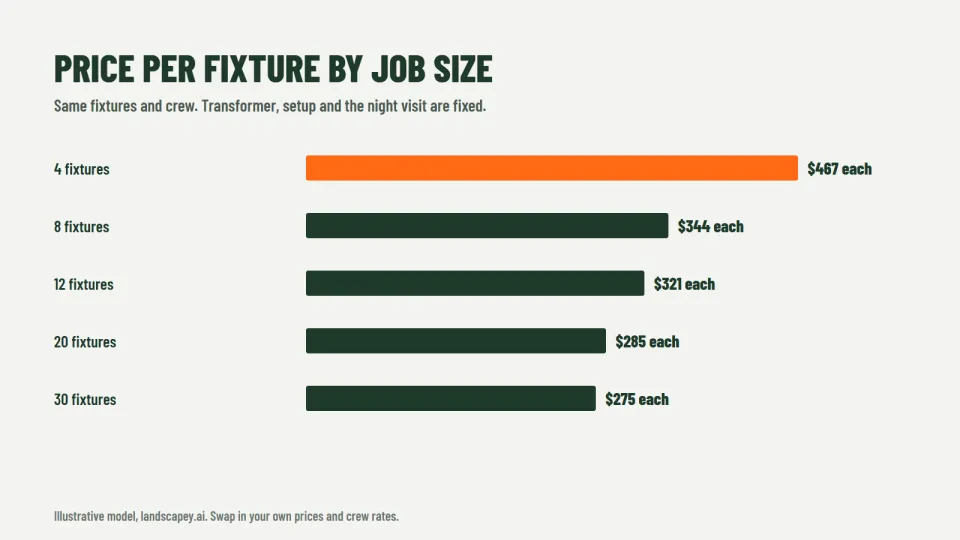
So a single per-fixture number is always wrong at the edges. Run the same model at different sizes and the price per fixture falls steeply on small jobs, then flattens out:
| Fixtures | Price | Per fixture | Direct cost per fixture | Transformer | Install days |
|---|---|---|---|---|---|
| 4 | $1,870 | $467 | $305 | 150 W | 1 |
| 8 | $2,749 | $344 | $224 | 150 W | 1 |
| 12 | $3,851 | $321 | $209 | 150 W | 2 |
| 20 | $5,701 | $285 | $186 | 150 W | 2 |
| 30 | $8,260 | $275 | $180 | 300 W | 3 |
A 4-light job costs more than $300 a fixture before overhead and margin. Quote it at a flat $200 a light and you lose money on every one. The fix most installers land on is a system charge plus a per-fixture price: one line for the transformer, timer, layout and night visit, then a price per fixture for everything that scales. On this model that works out to roughly an $800 system charge plus $250 a fixture, which lands within about 4% of the full calculation anywhere from 4 to 30 fixtures and stops the small jobs from quietly running at a loss.
Fixture grade: the biggest single lever
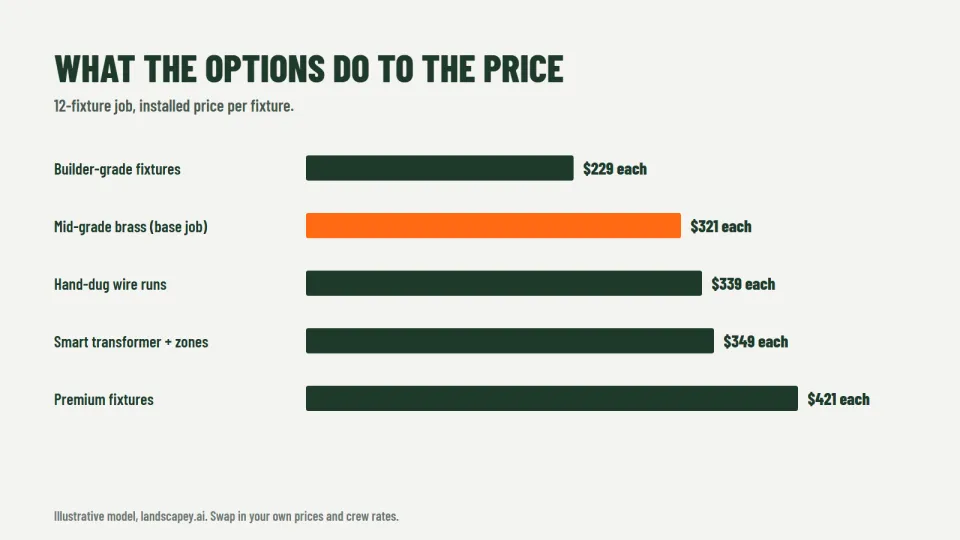
Because fixtures are the largest cost line, the grade you quote moves the price more than anything else. Same 12-fixture job, same crew, three grades:
| Fixture grade | Fixture cost each | Job price | Per fixture |
|---|---|---|---|
| Builder-grade (composite or aluminum, integrated LED) | $35 | $2,747 | $229 |
| Mid-grade brass (the base job) | $95 | $3,851 | $321 |
| Premium brass or copper, adjustable output and beam | $160 | $5,047 | $421 |
The gap between builder-grade and premium is $2,300 on a 12-light job, and almost none of it is labor. That is why two honest quotes for "12 landscape lights" can be $2,700 and $5,000. If you are being shopped against a cheaper installer, the first question is what fixtures they are putting in the ground. Brass and copper do not corrode the way painted aluminum does, and that is the case for the higher grade: fewer callbacks and a system that still looks right in ten years. Put the fixture model on the quote by name so the customer can compare like with like.
A note on markup. Some installers add their margin to fixtures and labor separately (one contractor in a Lawn & Landscape piece described marking fixtures up about 50%). This model applies one overhead rate and one margin to the whole job instead, which gives the same kind of answer with fewer moving parts. Either works. What does not work is passing fixtures through at cost and trying to make the whole margin on labor, because on a lighting job labor is too small a share of the price to carry it.
Wire, voltage drop and the home run
Wire is a modest cost line ($211 here), but it is where a cheap install shows up a year later. Low-voltage lighting runs at about 12 volts, so every foot of wire loses some of it, and the fixtures at the far end of a long run get dimmer or flicker. The drop for a run of 12-gauge copper is roughly 2 x length x current x 0.0016 ohms per foot:
| Run | Load | Voltage drop | Volts at the last fixture (12 V tap) |
|---|---|---|---|
| 50 ft | 30 W | 0.4 V | 11.6 V |
| 100 ft | 54 W | 1.4 V | 10.6 V |
| 150 ft | 54 W | 2.1 V | 9.9 V |
| 150 ft | 100 W | 4.0 V | 8.0 V |
That is what the multi-tap transformer is for: you connect long runs to the 13, 14 or 15 volt taps so the far fixtures still see enough voltage. Many integrated-LED fixtures accept a wide input range, often around 9 to 15 volts, but check the spec sheet for the ones you install. Splitting the load into several shorter home runs (this model uses one per 8 fixtures) and using a hub layout rather than one long daisy chain do the same job.
The home run, the stretch of wire from the transformer to the first fixture, is the line most worth measuring on the site visit, because it changes from house to house while everything else stays put. On the 12-fixture job a 20-foot home run prices at $3,598, the 60-foot base case at $3,851 and a 150-foot run (transformer on the far side of the garage, lights out at the street) at $4,126. Ask where the outdoor GFCI outlet is before you price anything.
Hand-dug runs, smart transformers and other add-ons
The base job assumes a line slicer can get through most of the route. Some properties do not allow it: mature tree roots, rock, dense planted beds, or wire that has to cross under a walk. Here is what the common variations do to the 12-fixture price:
| Variation | Change in the model | Price | Per fixture |
|---|---|---|---|
| Base job | Slicer through turf and beds | $3,851 | $321 |
| Hand-dug runs | Wire trenching takes 1.8x as long | $4,062 | $339 |
| Smart transformer or zone module | +$220 hardware (app control, separate zones) | $4,188 | $349 |
| Short home run | 20 ft instead of 60 ft | $3,598 | $300 |
| Long home run | 150 ft instead of 60 ft | $4,126 | $344 |
Two add-ons are worth quoting as their own lines rather than burying them. Hardscape lights (under-cap lights on a retaining wall, step lights in pavers) are cheapest to install while the wall or patio is being built, so if you are already pricing a retaining wall or a paver patio, offer the wire run at the same time. Boring under a walk or driveway is slow and varies a lot by length and soil; price it per crossing once you know how long yours take.
Why the $150-a-light quotes exist
Some ads and cost guides put landscape lighting at $100 to $150 a fixture installed. Run that against the model: 12 fixtures at $150 is $1,800, about $700 below the $2,511 direct cost of the mid-grade job, before a dollar of overhead or margin. On a 4-light job, $600 against a $1,219 direct cost is a loss of more than half.
There are honest ways to get to $150. Builder-grade fixtures, a shared transformer on an existing system, fixtures added to a system you already installed (no transformer, no layout walk, no new home run), or a high-volume operation with lower fixture and labor costs than this model assumes. That is a different job from a new 12-light brass system, and the quote should say which one it is. If a customer shows you a $150-a-light number, the useful reply is to ask what fixture and transformer it includes.
Electricity, licensing and wire depth
Three questions come up on almost every lighting sales call, and having the answers ready helps close the job.
- "What will it cost to run?" Very little with LED. The 12-fixture system draws about 54 watts; at six hours a night that is under 10 kWh a month, roughly $1.65 at 17 cents a kWh. A lighting supplier's own estimate puts a 100-watt LED system at about $3.60 a month for the same six hours.
- "Do you need an electrician?" A low-voltage system that plugs into an existing outdoor GFCI outlet usually does not, but a new 120-volt outlet does, and some states and cities license low-voltage work separately. Check your local rules before you quote, and put "existing GFCI outlet at transformer location" on the quote as an assumption.
- "How deep is the wire?" The National Electrical Code allows landscape lighting circuits of 30 volts or less to be buried at a minimum of 6 inches, which is what a line slicer does. Local amendments vary.
The service plan that comes after the install
Lighting is one of the few install jobs with a built-in reason to come back. Mulch buries path lights, shrubs grow over spotlights, a mower clips a fixture, and the trees you lit get bigger. An annual tune-up (clean lenses, re-aim, raise buried fixtures, check connections and the timer) is about 1.5 tech-hours on a 12-light system. On the same rates as the install, with a $25 parts allowance, that prices at about $186 a visit.
Offer it on the install quote, not afterwards. A customer who has just spent $3,800 on lighting wants it to keep looking that way, and a once-a-year visit on the schedule is easy recurring revenue that also puts you in front of them for the next job. If you already run maintenance routes, set it up as a recurring yearly job so it lands on the schedule and invoices itself. The guide to billing recurring landscaping clients covers the billing side.
Lighting and holiday lights: the same customer
The customer who pays for landscape lighting in October is often the same customer who pays for holiday lights in November. The trades are related but not the same: holiday lighting is seasonal rental, install and take-down, with its own pricing model, covered in how much to charge for Christmas light installation. If you do both, the fall lighting walk-through is a natural place to quote both.
How to build your own lighting quote
- Walk the property with the customer and agree the fixture count by area: path, trees, house front, hardscape. Mark the transformer location at an existing outdoor GFCI outlet.
- Measure the home run and estimate wire per fixture. Note anything the slicer cannot get through.
- Price the fixtures by model name, at your supplier price, and size the transformer at about 125% of the total wattage (or bigger if the customer plans to add lights).
- Add crew hours: a fixed setup block, hours per fixture and hours per foot of wire, using your own timed jobs. Add the night visit.
- Add trips, equipment, overhead and margin. If you are not sure what your overhead rate is, this guide to landscaping profit margins shows how to work it out.
- Present it as a system charge plus a per-fixture price, with the fixture model named and an optional annual service line.
If you quote off a spreadsheet today, this is a quote that benefits from being saved as a template: the system charge, fixture lines and service plan barely change between jobs. Landscapey's estimate builder lets you send it as a line-item quote the customer approves online, then turns the approved quote into the job and the annual service visit. More on bidding in general is in how to bid landscaping jobs. Plans are on the pricing page, or start free.
FAQ
How much should I charge per light for landscape lighting?
On this model, a mid-grade brass system prices at about $275 to $345 a fixture for 8 to 30 lights, and more on very small jobs. Published consumer ranges run from about $100 to $350 a fixture. The honest answer depends on fixture grade and job size, so price a system charge plus a per-fixture rate rather than one flat number.
What does a typical landscape lighting job cost?
Cost guides put the national average near $3,500, with most jobs between about $2,100 and $5,300. The 12-fixture job in this model comes to $3,851.
What size transformer do I need?
Add up the fixture wattage and size the transformer at about 125% of it, rounded up to the next standard size. Twelve 4.5-watt LED fixtures (54 W) fit a 150 W transformer with room to grow; many installers fit 300 W as standard so the customer can add lights later.
What gauge wire should I use for landscape lighting?
12-gauge two-conductor direct-burial wire (12/2) is the common choice for main runs. Longer runs and heavier loads need either a heavier gauge, a higher transformer tap, or the load split into more home runs. Use the voltage drop table above as a check.
Should I mark up fixtures?
Fixtures are about 45% of direct cost on a lighting job, so they have to carry margin one way or another. Either mark them up directly or apply your margin to the whole job, as this model does. Passing them through at cost leaves too little to carry the rest of the business.
How much should I charge to maintain landscape lighting?
An annual tune-up on a 12-light system is about 1.5 tech-hours plus a trip and a small parts allowance, around $186 on this model. Bigger systems and replacement fixtures cost more.
Sources and limits
The quote model is illustrative: every input (fixture, transformer and wire prices, crew rates, overhead and margin) is an assumption chosen to be plausible for a small residential installer, not a measured market price. The calculation script is the source of every number in the tables. Consumer price ranges are from published landscape lighting cost guides (LawnStarter, Lawn Love and others, 2026); the $200 to $300 per-fixture rule of thumb and the 50% fixture markup are from a Lawn & Landscape design-build article. Retail fixture, transformer and wire prices were checked against current supplier and retail listings in October 2026. The running-cost figure for a 100-watt LED system is from an outdoor lighting supplier's published estimate. The 6-inch burial depth is from NEC Table 300.5 for landscape lighting circuits of 30 volts or less; local codes and licensing rules vary, so check yours before quoting.