Every homeowner who searches for Christmas light installation cost gets a tidy national range. Every landscaper who reads those ranges and quotes off them finds out in January that the range was never built around their crew, their drive time or their lights. This guide goes the other way: it builds a holiday lighting price from the bottom up, on one real roofline, using material prices read off a supplier's site this week, so you can swap in your own numbers and get a quote you will not regret.
The short version, for a 150-foot single-story roofline priced at a 30% margin: about $695 a season if you lease the lights, $913 in year one and $569 after that if you sell them, and $591 if the client supplies their own. That works out to roughly $3.80 to $6.10 per linear foot depending on the model, which is higher than the per-foot labor figures most cost sites publish. The reasons why are the useful part.
What the market says, and why you should not quote off it
Three sources most homeowners will see before you show up:
| Source | Typical job | Labor per linear foot | Materials per linear foot |
|---|---|---|---|
| Thumbtack price guide (updated Apr 13, 2026) | $260–$661 common; $133 low, $1,338 high | $1.25–$3.00 (client owns the lights) | $0.50–$2.00 |
| christmaslights.io (published Jun 26, 2026, read Sep 1) | $432 average; $219–$673 | $2.00–$5.00 | $0.50–$2.00 |
| Jobber's bidding guide, citing Angi (2025 figures) | $442 average; roof lighting $150–$2,000 | not stated | not stated |
Two things jump out. First, the labor-per-foot figures disagree by a wide margin: Thumbtack's midpoint is $2.13 a foot and christmaslights.io's is $3.50. We covered that 65% spread in our piece on what landscapers do in the winter, and it is the single most common reason a lighting quote gets a "that seems high" reply. Second, none of these sources tells you whether the number includes takedown, travel, storage, or the bulb that dies on December 18. Thumbtack says removal runs about half the installation cost, which means a homeowner who anchored on the install-only figure is already short by a third.
Use these ranges for one thing only: knowing what the person across the driveway has probably read. Build your actual price from your own costs, the same way you would price gutter cleaning or any other add-on.
Step 1: Measure the job you are actually pricing
Holiday lighting is sold by the foot but performed by the hour, so the site visit has to capture both.
- Roofline length. Walk it with a measuring wheel along the drip edge, then add the gable rakes separately. Rakes are slower to hang than straight gutter runs, so log them as their own line.
- Height and pitch. Single-story gutter line, second-story gutter line, and anything that requires walking the roof are three different jobs. Thumbtack reports installers commonly charge about twice as much for second-story work and add around 20% for hard-to-reach roofs.
- Power. Count outdoor outlets, check whether they are GFCI-protected, and note which side of the house they are on. A roofline with power at one end needs more lead cord and more of your time.
- Trees, shrubs and walkways. Price these as separate line items. Tree wraps range from about $60 for a small tree to $1,200 for a large one on Thumbtack's guide; that spread is almost entirely height and trunk size.
- Takedown access. Will the crew be able to get on the roof in mid-January? If the answer is "only if it has not snowed," write that into the contract now.
Step 2: Price the materials from a real supplier, not a guess
Most residential pros run commercial C9 sockets on bulk wire, cut to length for each roofline, with LED bulbs screwed in. Here is what that cost on a 150-foot roofline using list prices read from 1000Bulbs.com on October 24, 2026:
| Item | List price | Per foot | 150-foot roofline |
|---|---|---|---|
| C9 socket wire, 1,000 ft spool, 12" spacing, SPT-2, green | $451.44 per spool | $0.45 | $67.72 |
| Warm white faceted LED C9 bulbs, 25-pack | $20.97 per pack ($0.84 each) | $0.84 (one bulb per foot) | $125.82 |
| Waste and breakage allowance, 10% | — | $0.13 | $19.35 |
| Clips, zip ties, plugs (my allowance, price your own) | — | $0.15 | $22.50 |
| Materials total | $1.57 | $235.39 |
The 10% waste figure is the top of the 5–10% range Jobber recommends; on a first-year cut-to-fit job you will use most of it. These are single-unit list prices. If you are buying for twenty houses, call for a bulk quote, because the bulbs are more than half your materials bill.
Note that this lands inside the $0.50–$2.00 materials range both Thumbtack and christmaslights.io publish. The materials figure is the one number the market agrees on. The disagreements are all in labor.
Step 3: Price the labor in hours, then convert to dollars
This is where most lighting quotes go wrong, because people price the hanging and forget everything around it. Here is the time model behind the example. The productivity number is an assumption for illustration; time your own crew on the first three jobs of the season and replace it.
- Crew: two people at a loaded cost of $35 per hour each, so $70 per crew-hour. Loaded means wages plus payroll taxes, workers' comp and the share of insurance the lighting work adds.
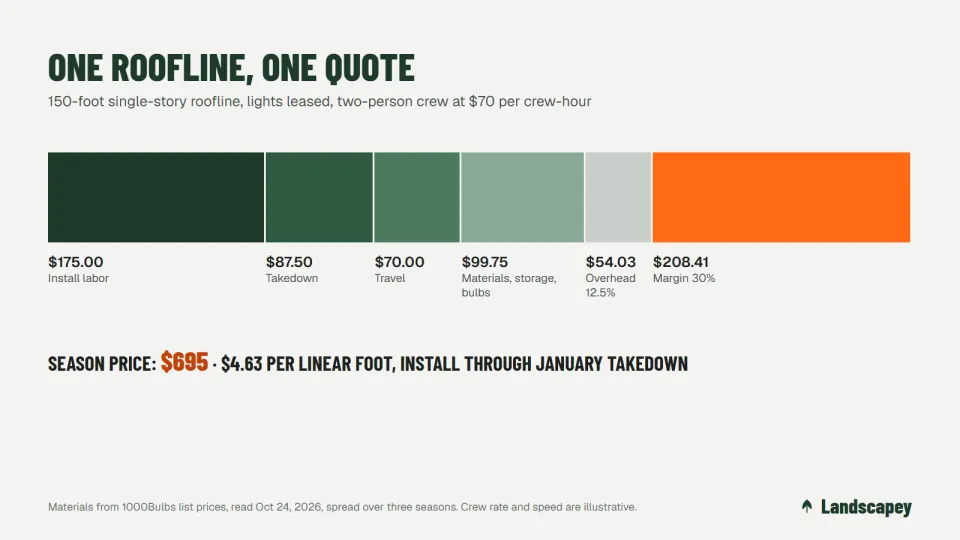
- Install on site: 30 minutes of fixed setup (ladders, layout, testing the run) plus 75 feet of roofline per crew-hour. For 150 feet that is 2.5 crew-hours, or $175.
- Takedown: half the install time, in line with Thumbtack's "about half" removal figure. That is 1.25 crew-hours, or $87.50.
- Travel: allocate 30 minutes of crew time per visit for driving and loading, and there are two visits (install and takedown). That is $70.
Total labor for the season: $332.50. Notice that takedown and travel are $157.50 of it, nearly half. A quote that prices only the hanging leaves that money on the roof.
If you route your installs tightly, the travel line shrinks. Clustering lighting jobs by neighborhood is the same discipline as clustering mowing stops, which is why your scheduling setup matters here as much as it does in July.
Step 4: Pick an ownership model, because it changes the price
There are three ways to handle the lights themselves, and each produces a different quote and a different relationship with the customer.
Model A: You lease the lights
You buy the lights, cut them to that house, label them, store them in your shop between seasons, and hang the same set every year. The client pays one annual price that covers everything. You recover the materials cost over a set number of seasons; this example uses three.
- Labor: $332.50
- Materials spread over three seasons: $235.39 ÷ 3 = $78.46
- Storage allowance (bin and shelf space): $15.00
- Bulb replacement, 5% of bulbs per year: $6.29
- Direct cost: $432.25
Add overhead and margin using the method Jobber lays out. If your overhead runs 12.5% of sales, the job carries $486.28 of cost. To earn a 30% margin, divide by 0.70: $694.69, so quote $695. That is $4.63 per linear foot, all in, every season.
The real benefit of leasing is not the price. It is that the lights were cut for that house and live in your shop, so switching installers means the homeowner starts over. Lease customers renew.
Model B: You sell the lights in year one
The client buys the custom-cut set in year one. You install, take down, and usually still store them for a fee.
- Year one: labor priced at your margin ($534.38) plus materials priced at your margin ($378.30) = $912.68, quote $913, or $6.08 a foot.
- Year two onward: labor, storage and bulb replacement only = $568.59, quote $569, or $3.79 a foot.
The year-one number looks high next to a $432 national average. It is supposed to. One installer on a window-cleaning trade forum described landing on roughly $6 a foot in year one for the same reason: the first season carries the lights. What you have to communicate is the year-two price, in writing, at the same time.
Model C: The client supplies the lights
The cheapest-looking option for the homeowner and the riskiest for you. Their lights are a mix of strand types, half of them have a dead section, and none of them were cut to the roofline. Budget an extra half crew-hour for testing and rerouting. Labor rises to $367.50, and at the same overhead and margin the price is $590.62, quote $591, or $3.94 a foot.
This model needs one contract clause above all the others: any service call caused by the client's own lights is billable. Without it, you are the free warranty on a $12 strand from a big-box store.
The three models side by side
| Model | Year 1 | Year 2 | Year 3 | Three seasons | Who carries the risk |
|---|---|---|---|---|---|
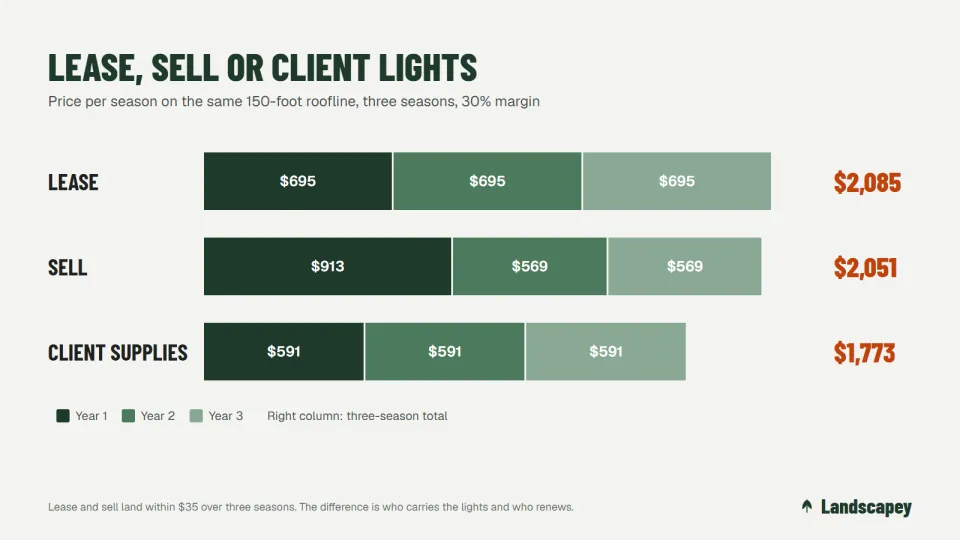
| A. Lease | $695 | $695 | $695 | $2,085 | You own the lights and the failures; client is locked in |
| B. Sell | $913 | $569 | $569 | $2,051 | Client owns the lights; you earn on labor and storage |
| C. Client supplies | $591 | $591 | $591 | $1,773 | You inherit unknown equipment; bill failures |
Over three seasons, leasing and selling come out within about $35 of each other. The choice is not really about price. Lease if you want a renewing customer base and have shop space. Sell if you would rather not store a hundred bins or if your clients prefer owning things. Avoid client-supplied work unless you charge for the troubleshooting.
Step 5: Set a minimum, because per-foot pricing breaks on small jobs
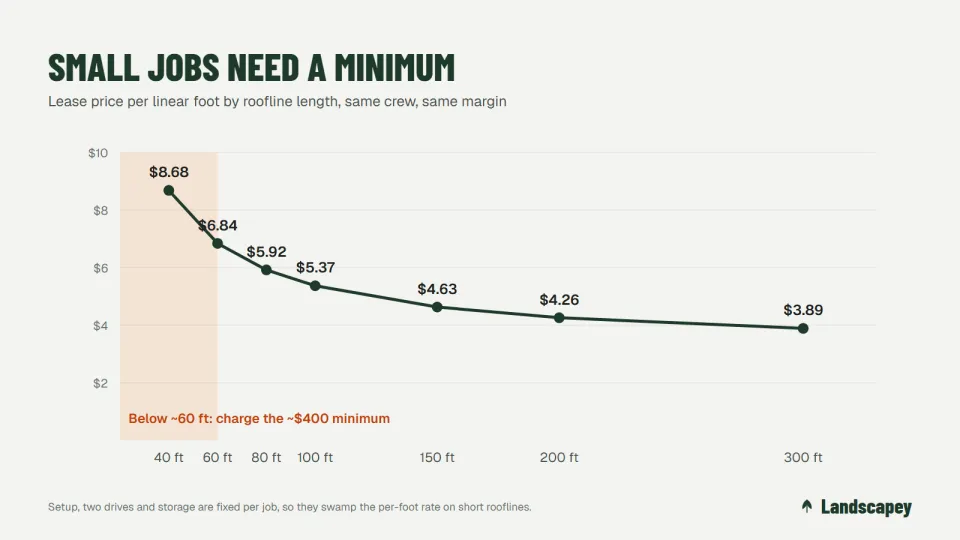
The fixed costs in this model (setup time, two drives, storage) do not shrink when the roofline does. Run the lease model across different roofline lengths and the per-foot price climbs fast as the job gets smaller:
| Roofline | Lease price per season | Per linear foot |
|---|---|---|
| 40 ft | $347 | $8.68 |
| 60 ft | $410 | $6.84 |
| 80 ft | $474 | $5.92 |
| 100 ft | $537 | $5.37 |
| 150 ft | $695 | $4.63 |
| 200 ft | $853 | $4.26 |
| 300 ft | $1,168 | $3.89 |
If you advertise a flat $4.50 a foot, the 40-foot porch job pays you $180 against a cost-plus-margin price of $347. You lose money on it, and the small jobs are usually the ones in the furthest-out cul-de-sacs. In this example, a sensible floor is a job minimum of around $400, which is roughly the 60-foot price. Publish a per-foot rate for long rooflines if you want to, but put the minimum next to it.
Why your price will sit above the cost-site averages
Run the numbers honestly and a two-person crew at $70 an hour will land above Thumbtack's $1.25–$3.00 labor range on most residential work. That does not mean you are overpriced. It means one of these is true about the lower number:
- It excludes takedown, which Thumbtack itself says adds about half again.
- It excludes travel and setup, which are fixed per job.
- It is a solo operator with no workers' comp line, which is a risk you should not price to match.
- The crew is faster than 75 feet per crew-hour. Some dedicated lighting companies are, after years of the same houses. If you get there, your price can come down; until you do, it should not.
The practical move is to show the client what the price includes. A quote that reads "install, mid-season service calls, January takedown, storage" next to a number holds up much better against a $432 national average than a bare per-foot rate does.
Contract terms that protect the margin
Lighting work has more ways to go sideways than mowing, so put these in the agreement:
- Deposit at booking. Many installers take half up front. Install slots between early November and mid-December are scarce, and a no-show customer costs you a slot you cannot resell.
- Takedown window. State it, for example "between January 2 and January 20, weather permitting," and state what happens if the lights are still up in February.
- Service calls. Free within a set time for failures of your materials, billed for client-caused damage (the dog, the inflatable, the neighbor's kid). Price billable calls with a trip-charge minimum.
- Ownership. On a lease, say plainly that the lights remain your property.
- Renewal. Offer next season's booking at takedown, at a stated price. That is when the customer is happiest with you.
Late October: how to still sell a season
If you are reading this in the last week of October and have not sold any lighting yet, you have not missed it, but the order of operations matters:
- Start with your own client list. People who already pay you for lawn care are the cheapest lighting customers you will ever get. A short message to your active clients this week will outperform any ad.
- Quote from the site visit, the same day. Jobber's guide suggests sending the bid within 24 to 48 hours. In November, same-day wins.
- Cap the season. Decide how many installs your crew can do between your last leaf cleanup and December 15, and stop selling when you hit it. Overbooking lighting is how fall cleanups get missed.
- Book takedown dates when you book installs. January is when the work is easiest to forget and hardest to schedule around snow.
For the bigger picture on what lighting can and cannot do for winter cash flow, the arithmetic in our winter revenue piece is sobering: a good lighting season covers roughly three weeks of a twenty-week off-season crew cost. It is real money. It is not a plan by itself, which is why many operators pair it with seasonal snow contracts.
Where Landscapey fits
Landscapey will not design the light layout or count your bulbs. What it does is the paperwork around them. You can build a quote with separate line items for roofline, trees and takedown, send it as a link the client can approve, schedule the install and the January takedown as jobs on your crew's route, and invoice with online card payment so the deposit and the balance actually arrive. Your lighting customers sit in the same client list as your lawn customers, which is exactly where you want them when you send next year's renewal.
Landscapey is free to start, with invoicing on a 14-day trial and then $19.99 a month. See pricing or start free.
Frequently asked questions
How much should I charge per foot for Christmas light installation?
On the example in this guide, $3.80 to $6.10 per linear foot depending on whether you lease, sell, or install client-supplied lights, at a 30% margin. Your own figure depends on your crew cost, your speed, and how far you drive. Published consumer ranges of $1.25 to $5.00 for labor usually exclude takedown and travel.
Should takedown be included in the installation price?
Yes, priced in. Removal runs about half of the installation time, and a separate takedown charge in January is the one most likely to start an argument. One all-in seasonal price is cleaner.
Is it better to lease or sell holiday lights to clients?
Over three seasons the totals are close: $2,085 leasing versus $2,051 selling in this example. Leasing keeps the customer, because the lights are cut to their house and stored in your shop. Selling avoids storage and equipment risk.
What is a reasonable minimum charge?
Set it at the price of a short roofline, around 60 feet in this example, which comes to roughly $400. Below that, setup and travel eat the job.
How much more should I charge for a second story?
Thumbtack reports installers commonly charge about double for second-story work and around 20% more for hard-to-reach roofs. A cleaner method is to price the extra time and any lift or harness gear rather than doubling the whole ticket.
When should landscapers start selling holiday lighting?
September and October, to your existing clients first, with installs from early November. Late-October sales still work if you quote same-day and cap the number of installs to what your crew can finish by mid-December.
Sources and limits
- Thumbtack, "How much will your holiday lighting installation and removal cost?", last updated April 13, 2026, read October 24, 2026.
- christmaslights.io pricing guide, published June 26, 2026, read September 1, 2026 for our winter piece; figures not re-read today.
- Jobber Academy, "How to bid Christmas light installation", last updated October 23, 2025; its benchmark table cites Angi 2025 figures.
- 1000Bulbs.com list prices for SKU CMS-10108 (1,000 ft C9 spool, $451.44) and CMS-C9SWW (25-pack LED C9, $20.97), read October 24, 2026. Single-unit retail; bulk pricing will be lower.
- The crew rate ($70 per crew-hour), productivity (75 feet per crew-hour plus 30 minutes setup), travel allocation, storage ($15) and clip allowance ($0.15 per foot) are illustrative assumptions, not market data. Replace them with your own.
- The 12.5% overhead and 30% margin figures follow the worked examples in Jobber's guide. Your overhead percentage is your monthly overhead divided by your monthly sales.