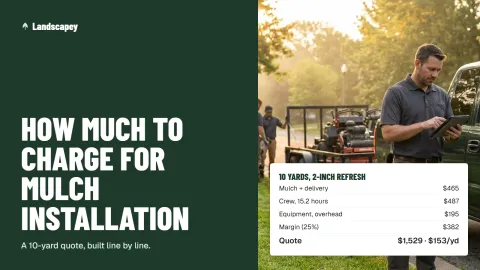
Search "french drain installation cost" and page one is written for the homeowner: a national average, a range wide enough to drive a truck through, and a list of "factors." Search the installer's version, how much to charge for a French drain, and you get a Reddit thread from a homeowner worried about a $7,300 quote, a Facebook group, and a decade-old forum post. Nobody shows the quote from the contractor's side.
This guide does. It builds one complete quote for a typical residential yard drain, line by line: trench, stone, fabric, pipe, outlet, spoil, turf repair, equipment, crew hours, overhead and margin. Then it shows how the price moves with length, depth, crew speed and stone price, and what changes when you can't get a machine in.
One rule up front. Every number in the worked example is an input you should replace. Stone, dump fees, rental rates and wages vary a lot by market. The structure of the quote is what carries over.
The short answer
On the inputs below, a 100-foot French drain along a side yard, 24 inches deep on average, 12 inches wide, fabric-wrapped stone with 4-inch perforated pipe, a 20-foot solid outlet run and a pop-up emitter, comes to $4,615. That is:
- $46.15 per linear foot of trench
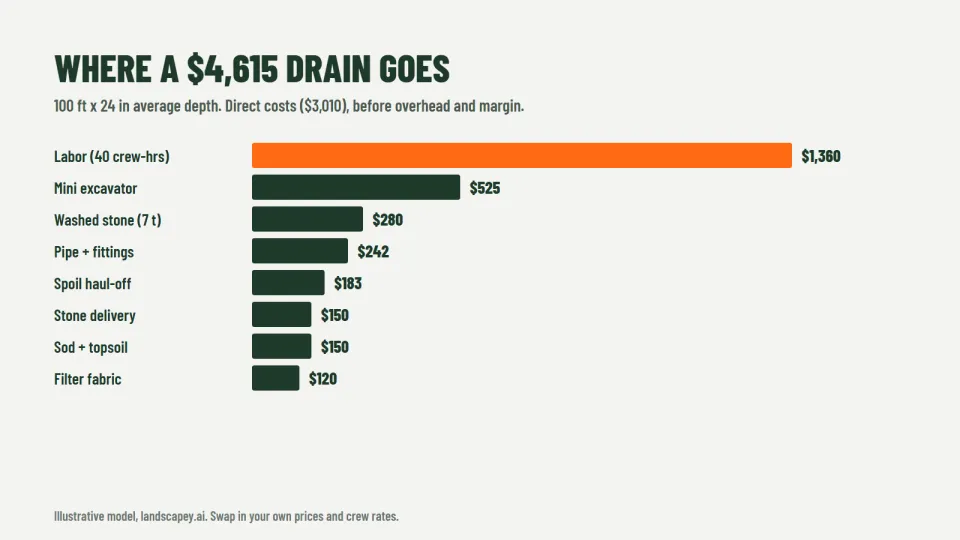
- $3,010 of direct cost, of which labor is $1,360 (40 crew-hours) and the mini excavator is $525
- $452 of overhead at 15% of direct cost, and $1,154 of margin, set at 25% of the price
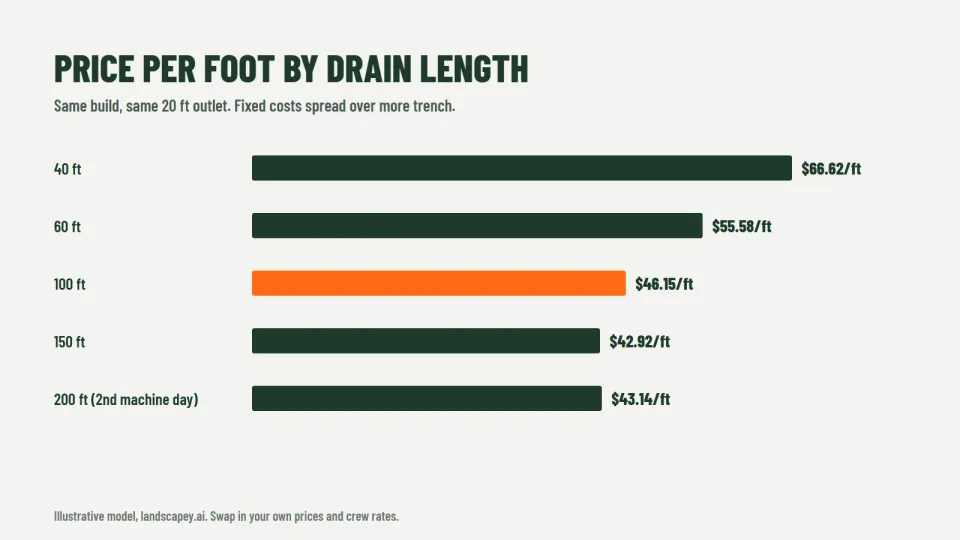
Short drains cost more per foot than long ones, because the machine, the delivery and the setup are the same whether you dig 40 feet or 150. The same build at 40 feet comes to $66.62 per foot; at 150 feet, $42.92.
Published consumer guides put exterior French drains at roughly $10 to $35 per linear foot (HomeGuide) or $10 to $100 (Angi), and one North Carolina drainage contractor says 90% of its residential jobs land between $2,500 and $5,000. The worked job lands inside that contractor's band and above the top of the narrower consumer range. More on why below.
Decide what you are building before you price it
"French drain" covers several different builds, and they are not the same price. Before you measure anything, settle which one the yard needs:
- Curtain or yard drain: a shallow trench (18 to 30 inches) across or along a wet area that intercepts surface and shallow subsurface water and carries it somewhere it can leave. This is the worked example.
- Footing or foundation drain: dug down near footing depth beside a basement wall. Deeper, slower, more spoil, often next to a house you cannot hit with a bucket. Price it as its own job, not as a deep yard drain.
- Gravel-only trench: stone with no pipe. Cheaper to build, carries far less water, and clogs sooner. Fine for a small soggy strip; the wrong answer for a real water problem.
- Downspout extension: solid pipe from a gutter to an emitter. Not a French drain at all, though customers often call it one. If roof water is the whole problem, this may be the right, cheaper fix.
Getting this wrong is where most bad drain quotes start. A homeowner who asks for "a French drain" may need a downspout fix, a regrade, or both. Walk the property in the rain if you can, find where the water comes from, and quote what solves it.
The worked example: a 100-foot side-yard drain
The job: water sheets off a neighbor's higher lot, crosses the side yard and pools against the customer's foundation. The fix is a drain along the side yard that intercepts it and carries it to the back of the lot, where the ground falls away.
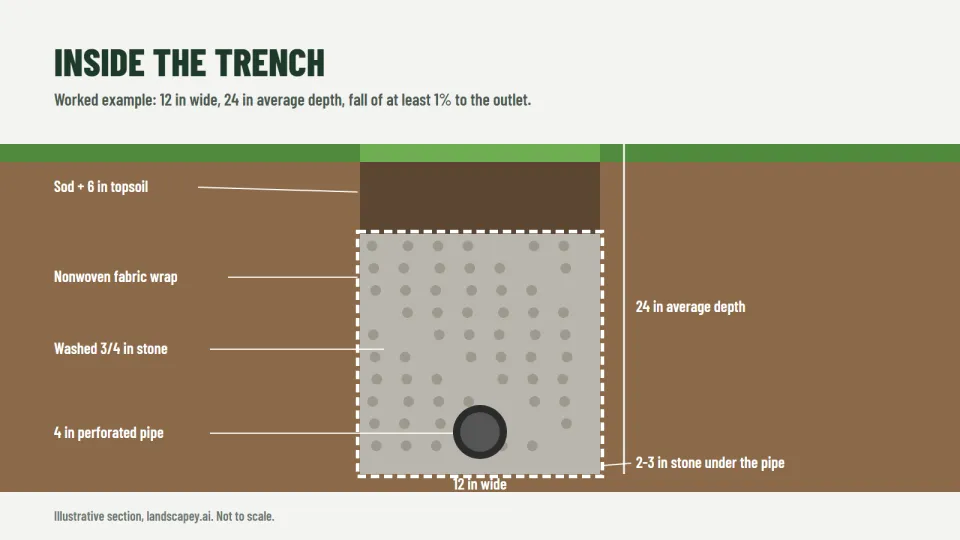
- Trench: 100 linear feet, 12 inches wide. Starts about 18 inches deep at the high end and gets deeper as it holds a steady fall, averaging 24 inches.
- Slope: at least 1% (roughly 1 inch of drop every 8 to 10 feet), checked with a laser or transit, not by eye.
- Perforated section: 80 feet. Nonwoven filter fabric lines the trench, 2 to 3 inches of washed 3/4-inch stone goes under a 4-inch perforated pipe, stone fills to 6 inches below grade, and the fabric folds over the top ("the burrito").
- Outlet: 20 feet of solid 4-inch pipe to a pop-up emitter in the back yard, at least a few feet inside the property line.
- Finish: 6 inches of topsoil over the fabric and new sod on the disturbed 2-foot strip.
Step 1: quantities
| Item | How it is figured | Quantity |
|---|---|---|
| Excavation | 100 ft x 1 ft wide x 2 ft average depth | 200 cu ft (7.4 bank cu yd) |
| Washed 3/4-inch stone | 80 ft x 1 ft x 1.5 ft (top 6 in is soil), minus the pipe, about 1.4 tons per cu yd, +10% | 4.2 cu yd, order 7 tons |
| Filter fabric | wrap = both walls + bottom + 12 in overlap on top = 6 ft wide x 80 ft | 480 sq ft |
| Perforated pipe | 80 ft, bought as one 100-ft roll | 1 roll |
| Solid outlet pipe | 20 ft to the emitter | 20 ft |
| Fittings | pop-up emitter, elbow, couplers, end cap | 1 set |
| Spoil hauled off | the volume the stone displaces, 25% swell; the rest goes back in as backfill and topsoil | 5.2 loose cu yd |
| Sod and topsoil | 100 ft x 2 ft disturbed strip | 200 sq ft |
The stone number is where most quick estimates go wrong. A 12 by 18-inch stone envelope is 1.5 cubic feet per foot of trench. Over 80 feet that is about 4.2 cubic yards, which is roughly 6 tons before waste. Quotes that budget "a couple of yards of gravel" for a drain this size are short by half.
Step 2: direct costs
| Line | Input | Cost |
|---|---|---|
| Labor | 40 crew-hours x $34 loaded | $1,360 |
| Mini excavator | 1 day at $375 + $150 delivery and pickup | $525 |
| Washed stone | 7 tons x $40 | $280 |
| Pipe and fittings | perforated roll $136 + solid pipe $66 + fittings $40 | $242 |
| Spoil haul-off | 5.2 loose cu yd x $35 | $183 |
| Stone delivery | one load | $150 |
| Sod and topsoil | 200 sq ft x $0.75 | $150 |
| Filter fabric | 480 sq ft x $0.25 | $120 |
| Direct cost | $3,010 |
Where the inputs come from: the 4-inch x 100-foot perforated corrugated roll is a Home Depot shelf price ($136, checked October 2026). The stone price is a small-load delivered-yard figure; public bid sheets show washed #57 stone at roughly $16 to $26 a ton at the quarry, and a contractor buying 7 tons from a landscape supply pays well above that. The rental and the rest are illustrative. Replace all of them.
Step 3: the labor hours
Labor is the biggest line and the one most often guessed. Here is where the 40 crew-hours go for a 3-person crew with a mini excavator:
| Task | Crew-hours |
|---|---|
| Mobilize, mark out, confirm locates, set grade stakes | 3 |
| Excavate 100 ft (operator + one laborer) | 10 |
| Hand-trim the trench bottom and check fall | 6 |
| Fabric, bedding stone, pipe, stone fill, fold fabric | 9 |
| Solid outlet run and emitter | 3 |
| Backfill, topsoil, compact | 4 |
| Sod | 2 |
| Load spoil, clean up, demobilize | 3 |
| Total | 40 |
That works out to about 0.37 crew-hours per foot plus 3 hours of fixed setup. It is an assumption, not a published standard; there is no reliable public production rate for residential French drains, and soil makes a huge difference. Clay, roots and rock can double the excavation hours. Time your own crew on the next three drains and use that number instead.
The $34 an hour is a loaded rate: wage plus payroll taxes, workers' comp and the rest. If you have not worked yours out, the labor cost calculator guide walks through it.
Step 4: overhead and margin
Overhead (insurance, the truck, your phone, the office, the time you spent writing the quote) goes on at 15% of direct cost: $451.50, bringing cost to $3,461.50. Then set the price so margin is 25% of the price, not 25% added to cost:
$3,461.50 / 0.75 = $4,615.33, rounded to $4,615.
Margin on the job is $1,154. If you mark up cost by 25% instead ($3,461.50 x 1.25 = $4,327), your real margin is only 20%, and you have given away about $290 on one drain. The profit margin guide covers the difference between markup and margin in more detail.
How the price moves
Length: fixed costs spread out
| Trench length | Crew-hours | Direct cost | Price | Per foot |
|---|---|---|---|---|
| 40 ft | 17.8 | $1,738 | $2,665 | $66.62 |
| 60 ft | 25.2 | $2,175 | $3,335 | $55.58 |
| 100 ft | 40.0 | $3,010 | $4,615 | $46.15 |
| 150 ft | 58.5 | $4,199 | $6,438 | $42.92 |
| 200 ft | 77.0 | $5,627 | $8,628 | $43.14 |
All lengths keep the same 20-foot solid outlet. The per-foot price drops fast up to about 150 feet, then ticks back up at 200 because the job needs a second excavator day. That is worth knowing when a customer asks you to "just add another 50 feet": a short add-on is cheap, but once it pushes you into another rental day, price the extra day.
Depth: more of everything
| Average depth | Stone | Crew-hours | Price | Per foot |
|---|---|---|---|---|
| 18 in | 5 tons | 34.5 | $4,073 | $40.73 |
| 24 in | 7 tons | 40.0 | $4,615 | $46.15 |
| 30 in | 9 tons | 45.5 | $5,158 | $51.58 |
| 36 in | 11 tons | 51.1 | $5,698 | $56.98 |
Every extra 6 inches of depth adds about 2 tons of stone, more fabric, more spoil and more digging, around $540 on a 100-foot drain. Depth is usually set by the fall you need, not by preference: if the outlet is 60 feet away and the yard is flat, the far end gets deep. Shoot grades before you quote so you know the real average depth.
Crew speed
| Production | Crew-hours | Price | Per foot |
|---|---|---|---|
| Fast: 0.28 hr per ft (sandy soil, open access) | 31.0 | $4,146 | $41.46 |
| Worked example: 0.37 hr per ft | 40.0 | $4,615 | $46.15 |
| Slow: 0.50 hr per ft (clay, roots, tight access) | 53.0 | $5,293 | $52.93 |
The spread between a fast and slow crew is about $1,150 on the same drain. That is why you price from your own tracked hours, not from a competitor's per-foot number.
Stone price
Stone matters less than people think. At $30 a ton the job prices at $4,508; at $60 a ton, $4,830. Seven tons is seven tons. If you are trying to sharpen a drain quote, look at labor and equipment first.
When the machine can't get in
Fenced side yards with a 36-inch gate, a slope, or a customer who won't allow equipment on the lawn mean hand digging. On the same 100-foot drain, hand excavation at about 0.95 crew-hours per foot takes the job from 40 to 98 crew-hours. Even after dropping the $525 rental, the price goes from $4,615 to $6,834 ($68.34 per foot).
Check the gate width on the site visit. A mini excavator that fits through 36 inches, or a compact trencher with a narrow chain, usually costs far less than the hand labor it replaces.
Why consumer price ranges look low
On these inputs, direct cost alone is $30.10 per foot on a 100-foot drain and $43.45 per foot on a 40-foot one, before any overhead or profit. The top of HomeGuide's $10 to $35 range is close to break-even on the long job and below cost on the short one.
That does not make the range wrong. It is an average across very different jobs: shallow gravel-only trenches, no fabric, no outlet run, sandy soil, homeowners doing part of the work. What it means for you is simple: when a customer quotes a consumer range back at you, ask what the cheaper quote includes. Depth, fabric wrap, pipe, outlet and turf repair are the line items that separate a drain that works for 20 years from one that silts up in three. Put each one on your quote so the customer can see the difference.
Line items to put on the quote
A drain quote that says "French drain, $4,615" invites a price fight. Spell out what the money buys:
- Length, average depth and width of the trench
- Filter fabric wrap (and the type: nonwoven)
- Washed stone, by size and roughly how many tons
- 4-inch perforated pipe in the collection section, solid pipe to the outlet
- Outlet type: pop-up emitter, daylight, dry well or connection to a storm drain where allowed
- Utility locates called before digging
- Spoil hauled away or spread on site
- Turf or bed repair over the trench
- What is excluded: irrigation repair, rock removal beyond a stated amount, damage to unmarked private lines
A line-item quote also makes add-ons easy to sell: tying two downspouts into the solid run, a catch basin at the low spot, a longer outlet. Each one is a separate line the customer can say yes to.
If you write these quotes in a spreadsheet, a quoting tool saves real time once you have the line items set up. Landscapey's estimate software keeps saved line items and sends the customer a quote they can approve online. For the bidding process around the number, see how to bid landscaping jobs.
Before you dig: locates and where the water goes
Call 811 before every drain job. It is free and every state has a call-before-you-dig law. A 24-inch trench along a side yard is exactly where gas, electric and cable services run. Build the 2 to 3 business days of locate time into your schedule, and note on the quote that private lines (irrigation, landscape lighting, a line to a shed) are not marked by 811.
Know where the water is allowed to go. Local rules vary, but a few examples show the pattern:
- Many cities ban connecting drainage, sump pumps or groundwater to the sanitary sewer. Yankton, South Dakota's code, for one, prohibits subsurface drainage into any sanitary sewer.
- Olathe, Kansas's code declares drainage discharges that end closer than 4 feet to a property line or the public right-of-way a public nuisance.
- Arlington County, Virginia requires new sump pumps to connect to the storm sewer or discharge at least 10 feet from the property edge, and bars discharge onto sidewalks and streets.
Moving water onto a neighbor's lot is the fastest way to turn a drain job into a dispute. Check your local code, keep the outlet well inside the line, and write the outlet location on the quote.
Pricing add-ons and changes
- Downspout tie-ins: price each one as solid pipe plus a fitting plus about 1 to 2 crew-hours, depending on how far it runs. Never tie roof water into the perforated section; it belongs in the solid run.
- Catch basins: a basin plus grate, plus the time to set it level and tie it in. One line item each.
- Dry wells: only where the soil drains. Do a percolation check before you sell one; a dry well in clay is a buried bucket.
- Rock and roots: state an allowance in the quote ("includes up to X hours of rock or root removal; beyond that at $Y per crew-hour"). That protects you without padding every quote.
- Hardscape crossings: cutting and patching a walkway or patio is its own line. If you also build walls and patios, the retaining wall pricing guide and paver patio guide use the same quote structure.
Frequently asked questions
How much should I charge per foot for a French drain?
On the inputs in this guide, about $43 to $67 per linear foot for a 24-inch-deep, fabric-wrapped drain with pipe and an outlet, depending mostly on length. Your number depends on your crew's speed, your soil and your overhead. Build the quote from line items and check the per-foot figure as a sanity check.
How long does it take to install a French drain?
In the example, a 3-person crew with a mini excavator installs a 100-foot drain in about 40 crew-hours, roughly one and a half days. Hand digging the same drain takes about 98 crew-hours. Clay and roots slow both.
How deep should a French drain be?
Installation guides commonly give 18 to 24 inches as a minimum for a yard drain, deeper for a foundation drain. In practice the depth is set by the fall you need to reach the outlet at a steady slope of about 1%.
How many tons of gravel does a French drain need?
A 12-inch-wide trench with 18 inches of stone takes about 1.5 cubic feet per foot. That is roughly 0.06 cubic yards, or about 0.08 tons, per foot. An 80-foot perforated section needs about 7 tons with waste.
Should I use pipe with a filter sock or wrap the trench in fabric?
Many installers wrap the whole stone envelope in nonwoven fabric, as in the example, because it keeps soil out of the stone as well as the pipe. A sock on the pipe alone can clog in fine soils. Either way, put the choice on the quote.
What is the most common mistake in pricing French drains?
Underestimating the stone and the digging, and forgetting the outlet. A drain is only as good as where its water goes, and the solid outlet run plus emitter is real material and labor.
Sources and limits
- Consumer price ranges: HomeGuide, "How Much Does a French Drain Cost? (2026)"; Angi, "How Much Does a French Drain Cost? [2026 Data]"; NC Drainage, "How much does a french drain cost?" (all ranking for "french drain cost," October 2026).
- Depth, width and slope guidance: HouseLogic and Hunker French drain installation guides.
- Pipe price: Home Depot listing for ADS 4 in. x 100 ft. singlewall perforated drain pipe, checked October 2026.
- Quarry stone prices: public 2025 and 2026 aggregate bid tabulations (Defiance County, OH; State of Texas).
- Discharge rules: Yankton, SD Section 26-75; Olathe, KS Code 17.04.041; Arlington County, VA property drainage guidance.
- Every other number (delivered stone price, solid pipe, fittings, fabric, sod, rental rate, disposal, production rates, wage, overhead and margin) is an illustrative input, not a market survey. Replace them with your own.
Ready to turn your drain quotes into line items your customers can approve? Start free with Landscapey or see pricing.