
Net 30 means the customer has 30 calendar days from the invoice date to pay. That is the whole definition, and it is on every page that ranks for the term. What those pages leave out is what it does to a landscaping company, where the crew gets paid on Friday and the work was done three weeks before the invoice went out.
On a company billing monthly, net 30 is closer to 56 days from the work to the money. In the model below, that one choice opens an $80,467 hole in the first spring of the season. The same company billing on the first of the month opens a hole of $5,667. The revenue, margin and crew are identical.
This guide covers what each term means, what it costs, which term fits which kind of job, the wording to put on the invoice, and what to do on the day a customer does not pay. The worked numbers are our own illustrative model, not industry data. Change the inputs to match your books.
Invoice payment terms, in plain English
Payment terms are the line on an invoice that says when the money is due and what happens if it is not. These are the ones you will run into:
| Term | What it means | Where it fits in landscaping |
|---|---|---|
| Due on receipt | Payable when the customer gets the invoice. No date is stated, so it is easy to ignore. | Homeowners and one-off work, if you also print a date |
| Net 15 | Full amount due 15 calendar days after the invoice date | Small commercial accounts that accept it |
| Net 30 | Full amount due 30 calendar days after the invoice date, weekends and holidays included | HOAs, offices, retail sites |
| Net 45 / Net 60 | Due 45 or 60 calendar days after the invoice date | Property managers and large accounts. Price it in. |
| 2/10 net 30 | 2% off if paid within 10 days, otherwise the full amount in 30 | Rarely a good deal for you (see below) |
| EOM | Due at the end of the month | Some commercial accounts. Check whether it means this month or next. |
| Deposit + balance on completion | Part up front, the rest when the job is finished | Install work: patios, walls, sod, lighting |
Two wording problems cause most of the arguments. "Net 30" does not say whether the clock starts on the invoice date or the day they received it, so say which. "Due on receipt" gives no date at all, so a customer can truthfully say they never got to it. Fix both by printing a calendar date: "Due December 5, 2026." Nobody has to count anything.
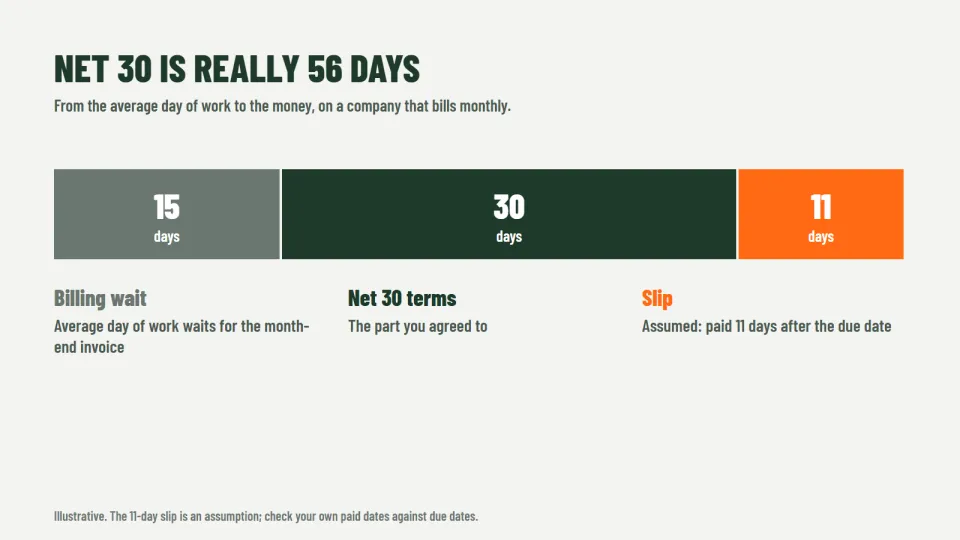
Why net 30 is really 56 days
The term only starts when you send the invoice, and on a monthly billing cycle that happens after the work. So three separate waits stack up:
- The billing wait: 15 days. If you bill on the last day of the month, the average day of work has already been sitting for about 15 days.
- The terms: 30 days. This is the part you agreed to.
- The slip: 11 days. This one is our assumption for how late the payment arrives. Measure your own by comparing paid dates with due dates on your last 50 invoices.
That adds up to 56 days. Most of the discussion about terms is about the middle number, but the first and last are the ones you control without asking the customer for anything.
What it does to your cash, worked through
Take an illustrative company that bills $40,000 a month during the season, with 85% of that going out as the work happens (crew pay, fuel, materials), so a 15% margin before the owner's pay. Costs run at $1,133 a day. It starts the season on April 1 with an empty receivables ledger. The model counts only this season's work, and adds nothing for spring equipment or insurance payments.
| How you bill | First money in | Deepest cash hole | Average wait, work to cash | Average unpaid at any time |
|---|---|---|---|---|
| Monthly in arrears, net 30 (paid day 41) | Day 71 | $80,467 | 56 days | $74,667 |
| Monthly in arrears, net 15 (paid day 22) | Day 52 | $58,933 | 37 days | $49,333 |
| Monthly in arrears, due on receipt (paid day 7) | Day 37 | $41,933 | 22 days | $29,333 |
| Weekly in arrears, net 15 (paid day 22) | Day 29 | $32,867 | 25.5 days | $34,000 |
| Billed weekly with a card link (paid day 2) | Day 9 | $10,200 | 5.5 days | $7,333 |
| First of month in advance (paid day 5) | Day 5 | $5,667 | Paid 10 days before the average day of work | $0 |
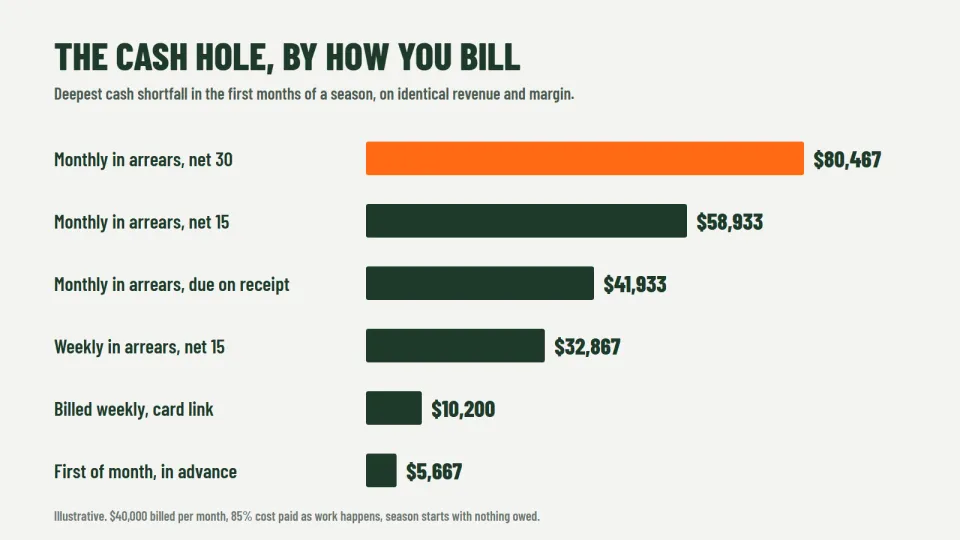
Three things stand out:
- The billing date moves more cash than the term does. Going from net 30 to due on receipt on a monthly cycle shrinks the hole by $38,534. Moving the same customers to first-of-month billing shrinks it by another $36,266, and it needs no change in what the customer pays.
- Weekly billing can beat better terms. Weekly at net 15 has a shallower first hole ($32,867) than monthly at due on receipt ($41,933), because the first money shows up about a week earlier, even though its average wait is a few days longer.
- Terms are a loan, and the loan has a price. Carrying $74,667 at an assumed 12% line-of-credit rate costs $747 a month. Against the $6,000 monthly margin, that is 12.5% of the profit, paid for the privilege of waiting. Your rate may be different. If you are funding it with a credit card, it will be much higher.
The hole is a spring problem, and a cash flow forecast shows it months ahead. Once the first cycle clears, the company in the top row collects about as much as it spends each month, plus its margin, and it looks healthy. The cash is still tied up, and it stays tied up until the season ends. That is why a profitable company can still bounce a payroll in May. Our profit margin guide shows how little room a typical book has for that.
Which terms to use for which work
| Customer or job | Terms to offer | Why |
|---|---|---|
| Weekly mowing, homeowner | Flat monthly, billed on the 1st, due on a stated date within about 5 days. Or per visit with a pay link. | Small invoices, no accounts payable department, and no reason to lend them money |
| One-off cleanup, mulch, aeration | Due the day of completion. Send the link from the truck. | The customer is most willing to pay while looking at the finished work |
| Install: patio, wall, sod, lighting | Deposit to cover materials, progress payment if it runs long, balance due on completion | You buy the materials first. Some states limit home-improvement deposits, so check yours. |
| HOA, office, retail site | Net 30 if required. Ask for net 15 with ACH first. Bill on the 1st. | Their payment run decides this, and you often cannot change it |
| Property manager or large account | Net 45 to 60 if you want the work, with the cost priced into the bid | See the table below |
| Snow, seasonal contract | Fixed monthly, first payment before the first storm | Per-event billing at net 30 lands your storm costs months before the cash. See our snow contract guide. |
How to price long terms into a commercial bid
A commercial contract usually comes with net terms, and refusing them usually means losing the bid. So charge for them. The cost of waiting is the rate you pay for money multiplied by how long you wait, using the full wait and not just the term:
| Term (billed monthly, 11 days late) | Total wait | Cost at 12% a year | On a $4,000/month account |
|---|---|---|---|
| Net 15 | 41 days | 1.35% | $54/mo |
| Net 30 | 56 days | 1.84% | $74/mo |
| Net 45 | 71 days | 2.33% | $93/mo |
| Net 60 | 86 days | 2.83% | $113/mo |
At a 15% margin, a net 60 account gives up nearly a fifth of its profit to the wait unless the bid covers it. Add the percentage to your bid and do not mention it as a separate line. Before you start the work, get the accounts payable contact, the PO requirement and the day of the month they cut checks. Sending a good invoice two days after the payment run costs you a month.
Discounts, card fees and late fees: the real math
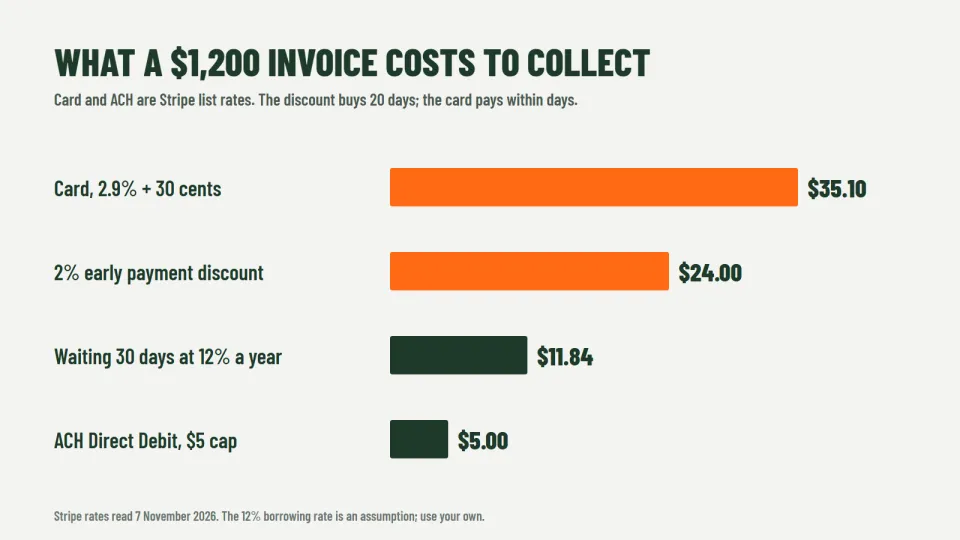
| On this invoice | $400 | $1,200 | $2,500 |
|---|---|---|---|
| Card payment, Stripe standard (2.9% + 30 cents) | $11.90 | $35.10 | $72.80 |
| ACH Direct Debit, Stripe (0.8%, $5 cap) | $3.20 | $5.00 | $5.00 |
| 2% early payment discount | $8.00 | $24.00 | $50.00 |
| Waiting 30 days at 12% a year | $3.95 | $11.84 | $24.66 |
| Late fee collected at 1.5% a month | $6.00 | $18.00 | $37.50 |
Skip 2/10 net 30. Giving 2% to be paid 20 days sooner works out to about 37% a year (2/98 x 365/20). If you can borrow at 12%, you are paying three times the going rate. At a 15% margin, that 2% also takes 13% of the job's profit. It is also awkward to enforce: the customer who pays on day 14 and takes the discount anyway is now a dispute over $24.
A card fee is fairly cheap on small invoices and poor value on large ones. On $400, $11.90 buys you weeks of waiting and the time you would have spent chasing. On $2,500, it costs $72.80 against $5 for ACH, so steer big invoices to bank payment. Whether you can pass card fees on to the customer depends on your state and the card network rules, which we did not check for this guide. Our online payments guide goes further into the options.
Late fees work mostly as a reason to pay on time. A 1.5% monthly fee is a common contract figure, and at our assumed 12% rate it covers the cost of carrying the invoice with a little left over. Treat the fee as a nudge rather than income. You will waive plenty of them, and that is fine: "I took the late fee off this time" is a useful sentence on a call.
The rules on late fees
The fee has to be in your agreement before the work starts. Adding one to an invoice after the fact is an argument, not a term. 1.5% a month is common but it is not a legal safe harbor. States set their own limits, and we did not survey them here. A flat $25 on a $400 invoice is 6.25% for the month, about 75% a year, so have a lawyer look at flat fees on small invoices in particular. Our lawn care contract template has a place for this clause.
At the federal level, Regulation Z says charges for actual, unanticipated late payment are not finance charges, with some conditions. Installment plans are where you can get into trouble. The rule's definition of a creditor reaches someone who regularly extends consumer credit that has a finance charge or is payable by written agreement in more than four installments, and "regularly" means more than 25 times in the prior calendar year. A one-off plan for a homeowner who hit a rough patch is unlikely to meet that. A standing "pay your patio over 12 months" offer might, so talk to a lawyer before advertising one.
Wording you can copy
Adapt these to your business and have your attorney check them for your state, especially the late charge and suspension language.
Homeowner, monthly: Invoices are issued on the 1st of each month for that month's service and are due by the 5th. A late charge of [X]% per month applies to balances unpaid after the 20th. Service may be paused on accounts more than 30 days past due.
Install: A deposit of $[amount] is due to schedule the work and order materials. The balance of $[amount] is due on the day of completion. A late charge of [X]% per month applies to balances unpaid 15 days after completion.
Commercial: Payment terms are net 30 from the invoice date. Invoices are sent on the 1st of the month to [AP email], referencing PO [number]. A late charge of [X]% per month applies to amounts unpaid after the due date. We may suspend service on accounts more than 45 days past due, with 7 days' written notice.
Then put the date on each invoice as well: "Due December 5, 2026. Pay online: [link]." If you are changing terms for existing customers, give notice before the new cycle starts. The approach in our price increase letter works for this too.
When a customer does not pay
Most late invoices are forgotten, not disputed, so start friendly and keep moving. Decide your schedule in advance so that you are not making it up when you are annoyed.
| Day | What you do |
|---|---|
| 3 days before due | Short reminder with the pay link, on big invoices only |
| Day 1 past due | Text: "Looks like this one slipped through. Here's the link." |
| Day 7 | Phone call. Ask if there is a problem with the work. A dispute is different from slow pay, and you want to know now. |
| Day 14 | Resend with the late charge applied if your agreement has one |
| Day 30 | Written notice that service pauses on a stated date. Then pause it. |
| Day 45 | Written demand with a final date and what happens next |
| Day 60 | Decide: small claims, lien if available and still in time, agency, or write it off |
The federal Fair Debt Collection Practices Act defines a debt collector as someone collecting debts owed to another, and it covers consumer debts, so a company collecting its own bill in its own name generally falls outside it. Using a different name can bring you inside it, and a collection agency you hire is covered. Some states have their own rules, which we did not check. Whichever way that goes, stay factual and do not threaten anything you do not intend to do.
Lien rights: count back from the deadline
A mechanics lien is the strongest tool you have on install work, and the deadline can pass while you are still sending polite reminders. Two examples, read from the statutes:
- Florida: the definition of "improvement" names landscaping, and "improve" includes grading, seeding, sodding or planting for landscaping purposes. A claim of lien must generally be recorded within 90 days after final furnishing (section 713.08).
- Washington: the definition of improvement includes planting of trees, vines, shrubs, plants, hedges or lawns. The notice of claim is due within 90 days after you stop furnishing labor or materials (RCW 60.04.091).
Neither passage names mowing or routine maintenance, so do not assume a lien is available for a mowing balance. States may also require earlier notices, especially on homes, and we did not cover those here. If install work goes unpaid, ask a local construction attorney about your deadline as soon as an invoice goes past 30 days. Do not wait for day 60.
Small claims
Limits vary by state and change over time. California's court site, for example, lists up to $12,500 generally and up to $6,250 for a business. It does not say on that page how a sole proprietor is treated, so check with the court. A signed agreement, the invoice and dated before and after photos make for a much simpler case, which is another reason to get terms in writing up front.
The tax angle most guides skip
Many small landscaping companies report on the cash method, and that changes how late payments play out at tax time. Ask your tax preparer how this applies to your return, but these are the points to raise:
- Income counts when you receive it. Under IRS Publication 538, cash-method income is what you actually or constructively received during the year. An invoice sent December 5 on net 30 and paid January 4 is 2027 income, even though the work was done in 2026.
- You cannot sit on a check to move it. The same publication says you cannot hold checks or postpone taking possession of similar property to push income into next year.
- An unpaid invoice generally is not a write-off. IRS Topic 453 says cash-method taxpayers generally cannot take a bad debt deduction for unpaid fees, because the amount was never included in income. Your labor and materials were already deducted when you paid for them, and that is the only deduction you get.
So a lost invoice hurts more than it looks. On a $1,200 job at our 15% margin, you are out $1,020 in costs. Earning that back takes $6,800 of new billed work. On a $400 mowing balance it takes $2,267, and on a $2,500 cleanup or small install, $14,167. That is the case for getting paid fast, in one line. It also matters for your January 15 estimated tax payment, because cash arriving in the new year does not fund a payment based on last year's profit unless you set money aside when it comes in.
How to set this up in Landscapey
Here is what the software does today, and what it does not do.
- Due date on every invoice. It defaults to 14 days out and you can change it per invoice. There is no saved default term per client, so commercial accounts on net 30 need the date set each time. The Notes field is where the payment terms sentence goes.
- Overdue view. Overdue invoices float to the top of the list with an "Overdue" filter, and the dashboard's "Needs you today" card links straight to them. This is your day-1 list.
- Pay link. The public invoice page has a Pay button that runs through your own Stripe account, with no platform fee on top of Stripe's, or through QuickBooks Payments if you use that rail. We did not test ACH on the pay page for this guide, so check what your Stripe settings allow.
- Billing from visits. "Ready to bill" pulls completed visits into draft invoices, per visit or flat monthly. That is billing in arrears. To bill in advance on the 1st, create the invoice by hand.
- What is not there. Landscapey does not add late fees automatically, send automatic overdue reminders, or keep a card on file for autopay. You add a late charge as a line item and send your own reminder.
Clients, jobs and scheduling are free to use, and invoicing is part of the one $19.99 a month plan with a 14-day trial. If your invoices go out late because the paperwork waits for the weekend, start free and try sending the next one from the truck. For the recurring side, see how to bill recurring clients.
FAQ
What does net 30 mean on an invoice?
The customer has 30 calendar days to pay the full amount, normally counted from the invoice date. Weekends and holidays count. To avoid arguments, print the actual due date on the invoice.
What does due on receipt mean?
Payment is expected as soon as the customer gets the invoice. There is no grace period written in, but no firm date either, so many customers treat it loosely. If you use it, add a stated date a few days out.
Is net 15 or net 30 better for a landscaping business?
Shorter is better for your cash. In our model, net 15 needed $21,534 less cash than net 30 on the same monthly billing. Billing earlier matters even more, so fix the billing date first and then negotiate the term.
How much of a late fee can I charge?
It depends on your state and on what your agreement says. 1.5% a month is common in contracts, but it is not a universal legal limit. Put the fee in your agreement before the work begins and have a local attorney confirm it, particularly for flat fees on small invoices.
Should I offer 2/10 net 30?
Usually not. It costs about 37% a year in annualized terms, and it takes 13% of the profit on a 15% margin job. Offering ACH or a card link gets you paid quickly for less on most invoices.
Can I stop service if a customer does not pay?
Generally yes, if your agreement allows it and you have not committed otherwise. Put a pause clause in the contract, give written notice with a date, and then follow through. A commercial contract may set its own notice period, so read it first.
Sources and limits
- The cash model is ours and illustrative: $40,000 billed per 30-day month, 85% cost paid daily, a 12% line-of-credit rate, and assumed payment timing shown in each row. The 11-day slip is an assumption, not a measured industry average. No equipment or insurance payments are included.
- Stripe card and ACH rates were read from Stripe's US pricing page on 7 November 2026. Your account may differ.
- Read on 7 November 2026: IRS Publication 538 (01/2022 revision) and Topic 453, 12 CFR 1026.2 and 1026.4 with commentary, the FTC's text of the FDCPA, Florida Statutes 713.01 and 713.08, Washington RCW 60.04.011 and 60.04.091, and the California Courts small claims page.
- California's lien statutes would not load for us, so California lien deadlines are not given here. State late-fee limits, card surcharge rules and deposit caps were not surveyed.
- Landscapey features were checked in the product's code on 7 November 2026.
- This is general information, not legal or tax advice, and no attorney or tax professional has reviewed it. Check with your own before changing your contracts.