Most landscapers worry about cash in January. The bank balance says otherwise. On a typical seasonal book, the account is fullest around Christmas, after the fall cleanup money lands, and emptiest at the end of April, when the crew is back on payroll, the mulch is paid for, the new mower is in the trailer, and the customers who got their first cuts are still sitting on the invoices.
A cash flow forecast is how you see that hole in November instead of finding it in April. This guide builds one for a landscaping business from scratch: what goes in it, a full 12-month worked example on an illustrative two-truck company, the four levers that change the low point, and a 13-week version for the weeks when payroll is tight. No accounting degree needed; a spreadsheet and your last season's invoices are enough.
What a cash flow forecast is (and what it is not)
A cash flow forecast is a list of the money you expect to land in the bank and the money you expect to leave it, week by week or month by month, with a running balance at the bottom. That running balance is the only number that matters. If it goes below zero, you miss a payroll, bounce a supplier, or put the gap on a credit card.
It is not a profit and loss statement. Your P&L says what you earned; the forecast says when the money moves. The two disagree all the time in this trade:
- You bill in April and get paid in May. The P&L books the revenue in April. The forecast puts the cash in May.
- You buy a $14,000 mower in March. The P&L spreads it over years as depreciation (or writes it off in one go under Section 179). The forecast takes the whole $14,000 out in March.
- You pay quarterly estimated tax. It never shows on the P&L as an expense at all. It still leaves the account four times a year (see estimated tax payments for landscapers).
- You take an owner's draw. Not an expense on a sole-prop or LLC P&L. Very much a cash outflow.
A profitable landscaping company can run out of cash every spring. Profit is the year; cash is the week.
The five lines every landscaping forecast needs
Keep it small. A forecast you update in ten minutes a week beats a perfect one you abandon in February. Five lines carry almost all of it:
| Line | What goes in it | Where the number comes from |
|---|---|---|
| 1. Cash collected | Money you expect to actually receive, by the month it arrives | Last season's billing by month, shifted by how long customers take to pay |
| 2. Crew payroll | Wages, payroll taxes, workers' comp paid per payroll | Crew size and hours per month; paid in the month the work happens |
| 3. Materials and fuel | Mulch, stone, plants, seed, fertilizer, salt, fuel, repairs | Percent of the work it supports, timed to when you buy, not when you install |
| 4. Fixed overhead | Truck and equipment payments, insurance, yard rent, phone, software | Your bank statement; the same every month |
| 5. Lumps | Equipment purchases, estimated tax, insurance renewals, annual licences, owner's draw | A calendar; these are the ones that sink you |
Then one formula: starting cash + collected - everything out = ending cash, and next month's starting cash is this month's ending cash. That is the whole tool.
Line 1 is the hard one: billed is not collected
The most common forecasting mistake is to type in what you will bill and call it cash. Pull last season's invoices and look at the paid dates. On a book that bills monthly with a mix of cards, checks and slow commercial accounts, a split like this is typical:
- 55% of a month's billing is collected in that same month (cards on file, autopay, prompt payers)
- 40% is collected the following month (checks, net 15 and net 30 accounts)
- 5% drifts into the month after that
Use your own split; the point is to have one. If you bill monthly in arrears on net 30 terms, the lag is longer than you think, because the average day of work also waits for the month-end invoice.
A 12-month worked example
Here is a full forecast for an illustrative company, so you can see the shape before building your own. Every figure below is an assumption chosen to look like a normal northern two-truck lawn and landscape outfit; none of it is anyone's real books.
The company: two trucks, mowing plus spring and fall cleanups, mulch and some small installs, a little snow work in winter. $415,000 billed over the year, starting the forecast on November 1 with $38,000 in the bank.
The assumptions:
- Collections: 55% / 40% / 5% over three months, as above
- Crew payroll: 32% of the month's billing, plus $3,000 of pre-season hiring and training in March
- Materials: 12% of the following month's billing, because you buy ahead
- Fuel and repairs: 6% of billing, never below $800 a month
- Fixed overhead: $5,200 a month (truck notes, insurance, yard, phone, software)
- Owner's draw: $5,000 a month, every month
- Lumps: $3,500 of salt in November; $4,000 estimated tax in January, April, June and September; a $14,000 mower plus $3,000 of tune-ups in March
| Month | Billed | Collected | Paid out | Ending cash |
|---|---|---|---|---|
| Nov | $32,000 | $40,800 | $26,800 | $52,000 |
| Dec | $8,000 | $19,800 | $14,300 | $57,500 |
| Jan | $6,000 | $8,100 | $17,500 | $48,100 |
| Feb | $5,000 | $5,600 | $14,000 | $39,700 |
| Mar | $12,000 | $8,900 | $40,200 | $8,400 |
| Apr | $45,000 | $29,800 | $38,300 | -$100 |
| May | $58,000 | $50,500 | $38,900 | $11,500 |
| Jun | $55,000 | $55,700 | $40,900 | $26,300 |
| Jul | $48,000 | $51,300 | $34,000 | $43,600 |
| Aug | $46,000 | $47,200 | $33,500 | $57,300 |
| Sep | $48,000 | $47,200 | $38,700 | $65,800 |
| Oct | $52,000 | $50,100 | $33,700 | $82,200 |
Figures are rounded to the nearest $100. November and December collections include money still owed from the September and October billing.
What the table says
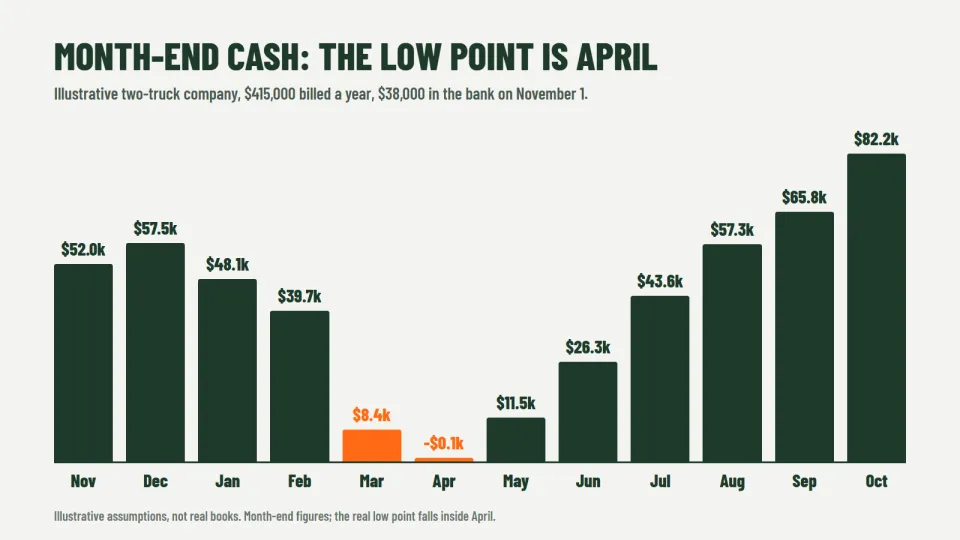
The company makes money. It finishes October $44,200 ahead of where it started, after paying the owner $60,000 in draws. On a P&L, this is a healthy year.
It still runs out of cash. At the end of April the account is at minus $100. And that is the month-end figure. Inside April, payroll goes out every Friday while the first big wave of spring invoices has not been paid yet, so the real low point is lower and earlier than the monthly table shows. That is why the 13-week version further down exists.
Winter is not the problem. December is the fullest the account gets all year, because fall cleanup money is still arriving and the crew is mostly laid off. January and February bleed roughly $9,000 a month, which is uncomfortable but survivable on a $57,000 cushion.
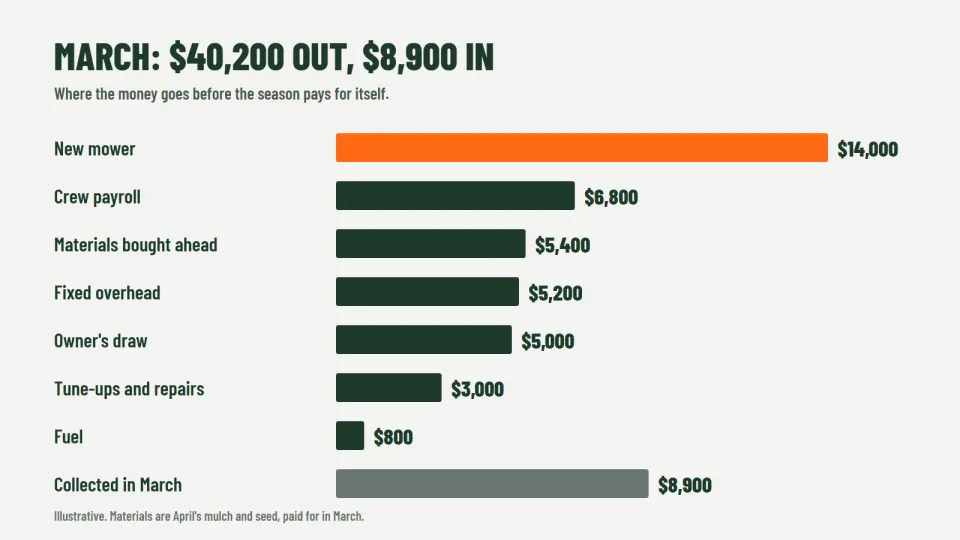
March is the problem. March pays out $40,200 against $8,900 collected. Look at what goes out:
| March outflow | Amount | Why it lands in March |
|---|---|---|
| New mower | $14,000 | Bought before the season so it is ready for the first cut |
| Crew payroll | $6,800 | Spring cleanups plus hiring and training |
| Materials | $5,400 | April's mulch and seed, bought a month ahead |
| Fixed overhead | $5,200 | Same every month |
| Owner's draw | $5,000 | Same every month |
| Tune-ups and repairs | $3,000 | Blades, belts, trailer tires, the winter's deferred fixes |
| Fuel | $800 | Minimum |
| Total | $40,200 | Against $8,900 collected |
Then April piles on: payroll triples, the April estimated tax payment leaves, and most of April's $45,000 of work will not be paid until May. Ending cash recovers from May onward and the company is flush again by August.
Four levers that move the low point
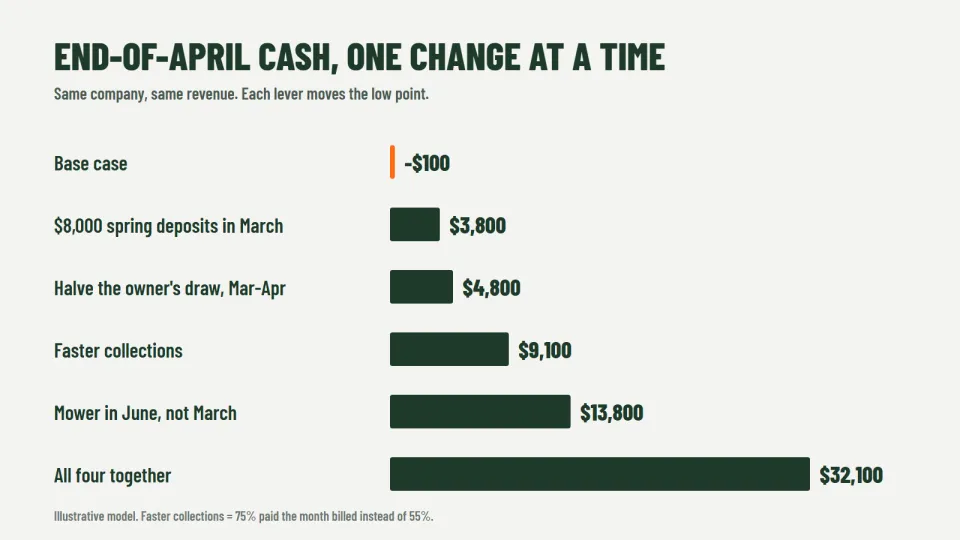
The value of a forecast is not the forecast. It is running the "what if" before it happens. Here is the same company with one change at a time, measured on the April low point:
| Change | End-of-April cash | Difference vs base |
|---|---|---|
| Base case | -$100 | - |
| Faster collections (75% same month, 22% next, 3% after) | $9,100 | +$9,200 |
| Buy the mower in June instead of March | $13,800 | +$13,900 |
| Halve the owner's draw in March and April | $4,800 | +$4,900 |
| Collect $8,000 of spring deposits in March | $3,800 | +$3,900 |
| All four together | $32,100 | +$32,200 |
1. Collect faster
Moving from 55% to 75% same-month collection is worth about $9,200 at the low point, and it compounds every year. The fastest ways to get there:
- Card or bank debit on file for recurring mowing customers. The invoice is paid the day it goes out. See how to accept online payments for the fee trade-off.
- Bill weekly or per visit in spring instead of once at month-end. You shorten the wait before the clock even starts.
- Put a pay link on every invoice. A customer who can tap and pay from their phone pays sooner than one who has to find a checkbook.
- Chase at day 7, not day 45. A short reminder a week after the due date catches most of the drift. More in accounts receivable management.
In the model, faster collections also mean less money is still owed to you on November 1, so the company starts the forecast with more in the bank. That is the honest way to model it: the same business, with the cash arriving sooner.
2. Time the big purchases
The single biggest lever in this example is not buying the mower in March. That does not mean you should run the first month on a worn-out machine. It means the forecast shows you the choice: buy in June when the account is recovering, finance it so it leaves the account in monthly slices, or buy it in December when the account is fullest and park it until spring. Any of the three beats paying cash in the worst month of the year. If tax timing is pushing you to buy before December 31, the Section 179 guide covers what that deduction is actually worth.
3. Smooth the owner's draw
Paying yourself a flat amount every month is good discipline, but it means the draw lands hardest in the months the business can least afford it. Two common fixes: take a smaller base draw all year and a catch-up in August through October, or keep a separate owner's reserve funded in the fall that pays the spring draws. Either way, decide in November, not in April with the account at zero. For a sensible draw level, see how much landscaping business owners pay themselves.
4. Get paid before the work
Install work (patios, beds, plantings) can carry a deposit; many contractors take one to cover materials. In the example, $8,000 of deposits collected in March, applied against April and May invoices, adds about $3,900 to the April low point. Prepaid seasonal mowing contracts work the same way: some customers will pay for the season up front in exchange for a small discount or a locked rate. Price that discount honestly; a few percent off is a cheap loan if it saves you from carrying the gap on a credit card.
The 13-week version, for spring
A monthly forecast is right for planning the year. It is too coarse for March through May, when payroll goes out every week and one slow commercial payer can decide whether Friday clears. From February 1, run a weekly forecast for the next 13 weeks alongside the monthly one. Same five lines, one column per week:
- Starting cash: what is actually in the account on Monday morning.
- Collections: list the specific open invoices you expect paid that week, by customer. Do not use a percentage here; use names. Anything more than 30 days overdue goes in at zero until it lands.
- Payroll: each Friday's payroll, by crew and hours on the schedule.
- Supplier and fixed payments: by due date, from your bills and the bank statement.
- Lumps: the April 15 estimated tax payment, insurance installments, the equipment delivery.
- Ending cash: the running balance. Highlight any week under one payroll's worth.
Every Monday, replace last week's forecast numbers with what actually happened and add a new week at the end. After a month you will know how far off your collection guesses run, which is the most useful thing a forecast teaches you.
Building your own in an afternoon
- Export last season's invoices by month. That is your billing curve. Adjust for any customers gained or lost, and for any price increase you are sending this winter (a price increase letter goes out before the spring billing, not after).
- Work out your collection split. For each month, what share of billing was paid that month, the next, and the one after. Three numbers are enough.
- List your fixed overhead from three months of bank statements.
- Put payroll and materials as a percent of billing, using last season's actuals. Shift materials one month earlier if you buy ahead.
- Walk the calendar for lumps: estimated tax dates, insurance renewal, licence renewals, equipment you plan to buy, the snow salt order, the truck registration.
- Run it and find the low point. If it goes below about one month of fixed costs plus one payroll, pull a lever now.
- Update it monthly in winter, weekly from February.
If your invoices, payments and expenses already live in one system, steps 1 to 4 are a report rather than an afternoon of digging. That is a big part of why we built Landscapey's invoicing and payments with paid dates, expenses and financials in the same place.
Mistakes that make a forecast lie
- Forecasting billing instead of collections. Covered above, and still the most common one.
- Forgetting the money that is already owed. On November 1, the September and October invoices that are still open are real cash coming in. Leaving them out makes November look worse than it is; counting them twice makes it look better.
- Leaving out the owner's draw and estimated tax because they are not on the P&L. Both leave the account.
- Treating snow as reliable. Snow revenue depends on the weather. Forecast a light winter and treat a heavy one as upside, unless your snow contracts are seasonal flat-rate.
- Never comparing forecast to actual. The first year's forecast will be wrong. The second year's will be close, but only if you wrote down what actually happened.
- Using one big spreadsheet nobody opens. Five lines, a running balance, ten minutes a week.
When the forecast shows a hole you cannot close
Sometimes the levers are not enough: a big install contract that needs materials up front, a second truck, a slow commercial customer. Your options, roughly in order of cost:
- Supplier terms. Ask your nursery and stone yard for net 30 on spring orders. Paying for April's mulch in May instead of March moves the cash out of the worst month.
- A seasonal line of credit. Draw it in March, repay it by July. Ask your bank in the fall, when your books show a full season of revenue; it is a harder conversation in April with the account at zero.
- Equipment financing for the machines, so a $14,000 purchase becomes a monthly payment.
- Credit cards only as a bridge you can repay inside the grace period.
The forecast also tells you how much you need and for how long, which is exactly what a lender will ask.
FAQ
How far ahead should a landscaping cash flow forecast go?
Twelve months, monthly, for planning, started in the fall so it covers the whole winter and spring. From February to May, add a 13-week weekly forecast for payroll-level detail.
What is a 13-week cash flow forecast?
A weekly forecast covering one quarter: starting cash, specific collections, payroll, bills and lumps for each of the next 13 weeks, rolled forward every Monday. It is the standard tool for managing a tight stretch because it is short enough to be accurate.
How much cash should a landscaping business keep in reserve?
Run your own forecast and let the low point answer it. As a starting rule, aim to enter March with enough to cover the March and April outflows minus what you expect to collect in those months; in the example above that is about $40,000.
Is a cash flow forecast the same as a budget?
No. A budget sets what you plan to earn and spend. A cash flow forecast shows when the money moves, which is where seasonal businesses get caught.
Do I need special software?
No. A spreadsheet with five lines and a running balance works. Software helps most with the inputs: billing by month, paid dates and expenses, which is the data the forecast is built from.
Why does my account go down in spring when business is picking up?
Because you pay for spring (payroll, materials, equipment, tax) before customers pay for it. Growth uses cash. The faster spring ramps up, the deeper the dip, which is why a company that adds customers can feel poorer in April than one that does not.
Sources and limits
The company, its billing curve, cost percentages, collection split and every dollar figure in the tables are illustrative assumptions built for this guide, not data from any real business or survey. The model is a simple monthly calculation; real cash moves daily and your low point will usually fall inside a month, not at its end. Estimated tax dates follow the IRS quarterly schedule covered in our estimated tax guide. This is general information, not tax or lending advice; talk to your accountant before changing how you pay yourself or financing equipment.
Ready to see your own billing curve instead of a made-up one? Start free with Landscapey and your invoices, paid dates and expenses build the inputs as you work, or compare plans on the pricing page.