
A landscaper who runs a business as a sole proprietor, partnership, or S corporation generally has to make estimated tax payments if they expect to owe $1,000 or more when they file. The last payment for 2026 is due Jan. 15, 2027. Most owner-operators should plan on setting aside about 20% to 25% of profit for federal tax, plus whatever their state takes.
Most guides to estimated taxes are written for someone whose income arrives evenly: a consultant or a freelancer. A mowing company earns almost nothing in February and most of its year between May and October. That changes which payments hurt, which rule you should use, and how worried you should be if you have missed some.
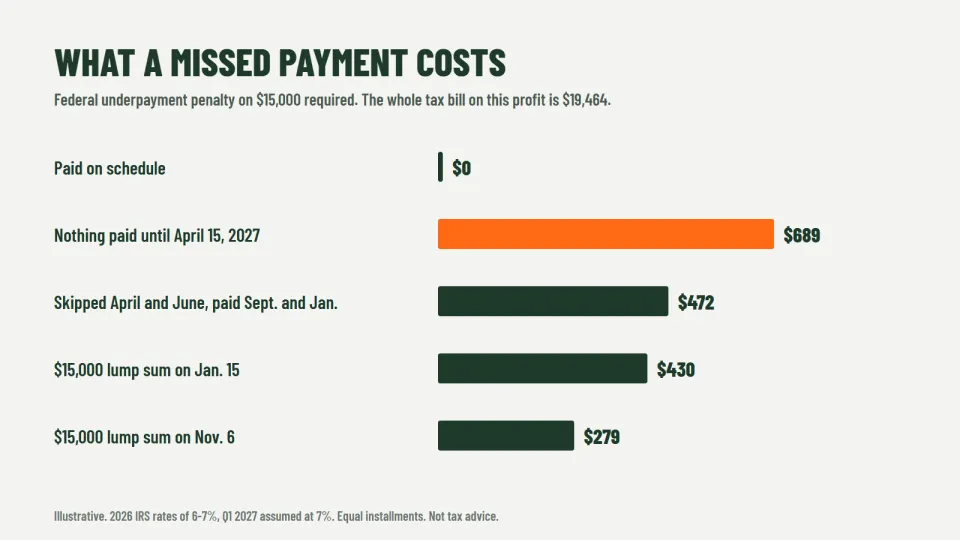
Here is the number that surprised us when we ran the model. A married owner with $100,000 of profit and $15,000 of tax the year before, who paid nothing all year, would owe about $689 in federal penalty. The tax bill that lands with it is $19,464. The penalty is the small problem. There are 70 days until Jan. 15 as this goes up, which is enough time to deal with the big one.
Who has to pay, and when
The IRS rule has two parts. You generally must pay estimated tax for 2026 if you expect to owe at least $1,000 after withholding and refundable credits, and your withholding and credits will come in under the smaller of 90% of your 2026 tax or 100% of your 2025 tax. No employer withholds for you when you own the business, so the job falls to you. Sole proprietors, partners, and S corporation shareholders all fall under this. If you had no tax liability for 2025 and were a U.S. citizen or resident alien for the whole year, you are exempt for 2026.
| Payment | Due date | Income period (IRS) | What that means for a northern mowing company |
|---|---|---|---|
| 1st | April 15, 2026 | Jan. 1 to March 31 | Cash is lowest, and spring supplies are going out |
| 2nd | June 15, 2026 | April 1 to May 31 | Spring cleanups and first mows are being paid |
| 3rd | Sept. 15, 2026 | June 1 to Aug. 31 | The best cash month of the year for many crews |
| 4th | Jan. 15, 2027 | Sept. 1 to Dec. 31 | Fall cleanup money is in, and no mowing money is coming |
Those periods are not equal quarters, which is why "quarterly taxes" is a slightly misleading name. The IRS also says you can pay weekly, every two weeks, or monthly if that is easier, as long as enough is in by the end of each period. For a seasonal business, that is often the most useful sentence on the page.
There is one exception to the January date. You do not have to make the Jan. 15, 2027 payment if you file your 2026 return by Feb. 1, 2027 and pay the full balance with it. Few landscapers can have clean books by then, but those who do can skip it.
How much to set aside
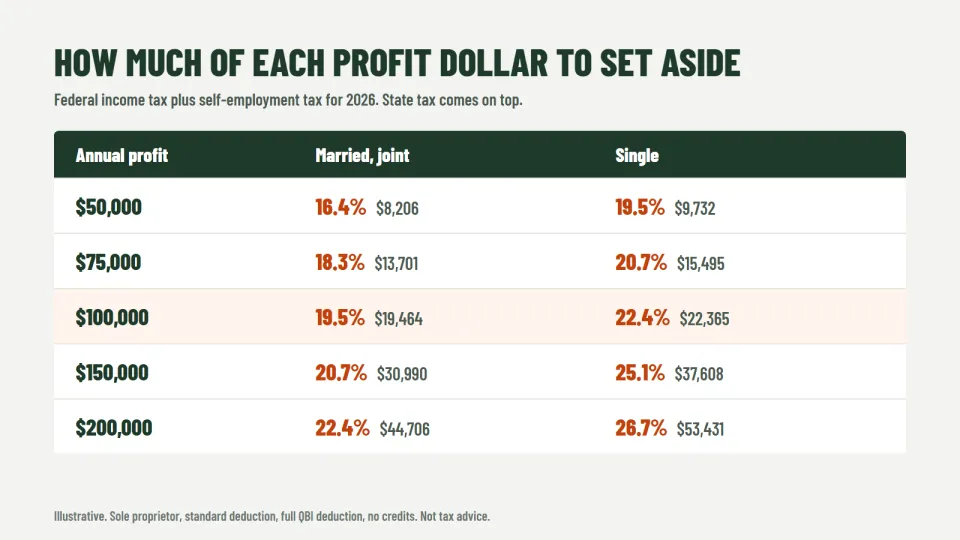
On a sole proprietorship, you pay self-employment tax on profit from the first dollar, then income tax on what is left after the standard deduction and the qualified business income deduction. Here is what that comes to for 2026, with federal tax only.
| Annual profit | Self-employment tax | Income tax (married, joint) | Total | Share of profit | Single filer total |
|---|---|---|---|---|---|
| $50,000 | $7,065 | $1,141 | $8,206 | 16.4% | $9,732 (19.5%) |
| $75,000 | $10,597 | $3,104 | $13,701 | 18.3% | $15,495 (20.7%) |
| $100,000 | $14,130 | $5,335 | $19,464 | 19.5% | $22,365 (22.4%) |
| $150,000 | $21,194 | $9,795 | $30,990 | 20.7% | $37,608 (25.1%) |
| $200,000 | $28,234 | $16,472 | $44,706 | 22.4% | $53,431 (26.7%) |
Two things stand out. Self-employment tax is the larger piece at every level shown, and it is why a married owner with $50,000 of profit still owes over $8,000 while their income tax is about $1,100. Also, the owners who get caught are often the ones who assume a low bracket means a low bill.
"Profit" here means profit before you pay yourself. On a sole proprietorship, your draw is not an expense. That matters when you turn the percentage into a habit, because you see deposits every day and profit only when you run the numbers.
| Profit before owner pay, as a share of revenue | Revenue that makes $100,000 profit | Federal tax as a share of each deposit |
|---|---|---|
| 15% | $666,667 | 2.9% |
| 20% | $500,000 | 3.9% |
| 30% | $333,333 | 5.8% |
| 50% (solo operator, low overhead) | $200,000 | 9.7% |
Pick the row closest to your real margin, add your state, round up, and move that percentage into a separate savings account every time a batch of payments clears. Spread over a 32-week season, the $100,000 example is about $608 a week. That is much easier to live with than $19,464 in April.
The minimum you must pay: the safe harbor
You do not have to predict your year exactly. You avoid the penalty by paying in the smaller of two amounts on time:
- 90% of the tax on your 2026 return, or
- 100% of the tax on your 2025 return. This becomes 110% if your 2025 adjusted gross income was over $150,000 ($75,000 if married filing separately).
The prior-year number is the one to use in a growing company, because you already know it. It is on your 2025 Form 1040.
| Situation | 2025 tax | 2026 tax | Minimum to pay in during 2026 | Left to pay by April 15, 2027 |
|---|---|---|---|---|
| Growing year | $15,000 | $19,464 | $15,000 (100% of last year) | $4,464 |
| Down year | $25,000 | $19,464 | $17,518 (90% of this year) | $1,946 |
In the growing year, four payments of $3,750 keep you penalty-free whatever you earn. But the safe harbor protects you from the penalty, not the tax. The extra $4,464 is still due in April. If you stopped setting money aside once you hit $15,000, that is a bill with no cash behind it, due in the same month your crew restarts.
Why equal payments fit a landscaper badly
Form 1040-ES assumes four equal amounts. Take a mowing company in a northern state that earns $100,000 for the year, with little profit before the season starts. Its first $3,750 payment comes due when it has made $4,000 in profit all year. That payment is 94% of everything the business has earned so far.
The IRS has a fix for this, and most generic guides give it one line. If your income comes in unevenly, the annualized income installment method lets your required payments follow your actual income. You file Schedule AI, part of Form 2210, with your return. The schedule takes your income through March 31, May 31, and Aug. 31, multiplies each by 4, 2.4, and 1.5 to get a yearly rate, figures the tax on it, and requires 22.5%, 45%, and 67.5% of that tax by each date.
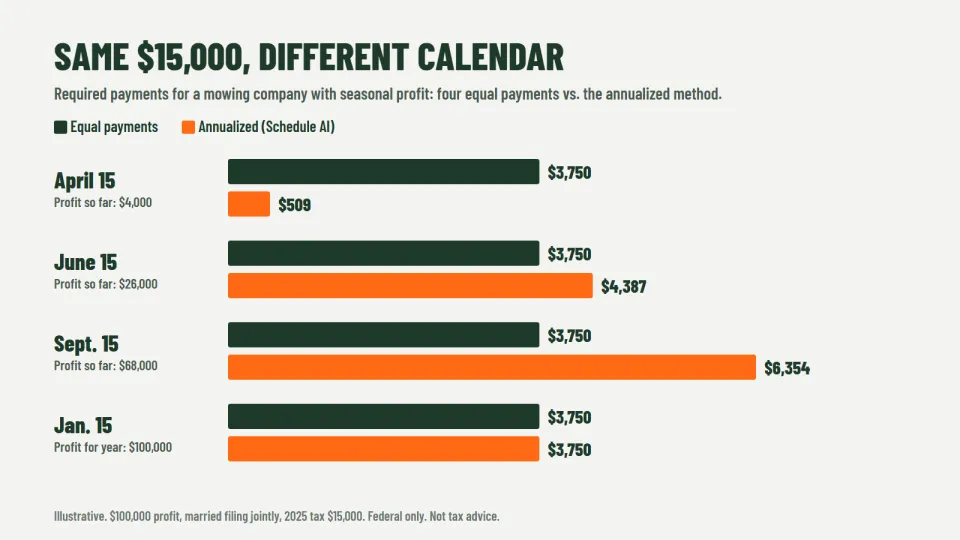
Here is that company, along with a second one that earns the same $100,000 but runs a snow route through winter. Both had $15,000 of tax in 2025.
| Due date | Equal payments | Mowing only: profit to date | Mowing only: required | Mowing + snow: profit to date | Mowing + snow: required |
|---|---|---|---|---|---|
| April 15 | $3,750 | $4,000 | $509 | $16,000 | $2,526 |
| June 15 | $3,750 | $26,000 | $4,387 | $30,000 | $3,329 |
| Sept. 15 | $3,750 | $68,000 | $6,354 | $68,000 | $5,396 |
| Jan. 15 | $3,750 | $100,000 | $3,750 | $100,000 | $3,750 |
| Paid by Sept. 15 | $11,250 | $11,250 | $11,250 |
Look at the last row. By Sept. 15, every version has reached the same $11,250. The annualized method does not reduce what you owe. It moves money out of April and into September, when a mowing company actually has it. The snow company has to pay more in April because its first quarter annualizes to $64,000.
Now the honest part: on these numbers, the method is worth $77. If you pay on the mowing schedule above and do not file Schedule AI, the penalty is $77. File it and the penalty is zero. A preparer may charge about that much to complete the form, so ask first. The real value is knowing you can hold on to spring cash without building up much of a penalty, and that September is the payment to save for. Keep your year-to-date profit as of March 31, May 31, and Aug. 31, because Schedule AI asks for all three.
What a missed payment really costs
The underpayment penalty works like interest. The IRS figures it on the amount you were short, for the days you were short, at its published rate. For individuals in 2026 that rate was 7% in the first quarter, 6% in the second, and 7% in the third and fourth. It runs separately for each payment period. It can apply even if you are due a refund when you file.
| What you did ($15,000 required, equal payments) | Federal penalty |
|---|---|
| Paid all four on time | $0 |
| Paid three on time, skipped January, paid the rest April 15 | $65 |
| Skipped April and June, paid September and January on time, rest April 15 | $472 |
| Paid nothing, then $15,000 on Nov. 6 | $279 |
| Paid nothing, then $15,000 on Jan. 15 | $430 |
| Paid nothing until April 15, 2027 | $689 |
You cannot deduct the penalty, and it is money for nothing, so it is worth avoiding. But keep it in proportion. Waiting from Nov. 6 to Jan. 15 on the whole $15,000 costs about $151. Putting $15,000 on a card at an assumed 24% costs about $900 in three months, plus the card processor's fee. Do not borrow at card rates to avoid a 7% charge. If you truly cannot pay, send what you can now, because each payment stops the clock on the earliest amount you still owe. The IRS also offers payment plans for the balance on your return.
Behind for 2026? What to do before Jan. 15
- Get year-to-date profit. Reconcile through October, then estimate November and December, including any fall cleanup and snow money you expect to collect.
- Find your target. Pull total tax from your 2025 return. Compare it with 90% of your 2026 estimate. The smaller number is your target (or 110% of 2025 if your 2025 AGI was over $150,000).
- Pay what you can today. Use IRS Direct Pay or your IRS online account, and apply the payment to 2026 estimated tax. A January payment is still for tax year 2026, so choosing 2027 by mistake sends it to the wrong year.
- If you or your spouse has a W-2 job, look at withholding. This is the most useful year-end move and the least known. The Form 2210 instructions treat withholding as paid in four equal parts on the four due dates unless you show otherwise, regardless of when it came out. On a joint return, a higher withholding on the last few paychecks of the year counts back to April. In our example, $6,000 of extra withholding plus $9,000 on Jan. 15 means a $258 penalty, compared with $350 if the same $6,000 went in as a direct payment on Nov. 6. A new Form W-4 makes the change.
- Pay state too. Your state runs its own schedule, covered below.
- Save for the balance. Set aside everything above your safe harbor target for April.
Traps specific to this trade
December prepayments count this year. Many small landscaping companies use the cash method, where income counts when you actually or constructively receive it. A client who prepays 2027 mowing or a snow contract on Dec. 20 generally gives you 2026 income, even though the work is next year. Prepay programs are good for cash flow, but set aside the tax on them.
A December equipment purchase changes the math in both directions. In our Section 179 guide, a $16,000 mower in service by Dec. 31 cuts this owner's 2026 tax by $3,688. It also takes $16,000 out of the bank right before the January payment. Check that you can cover both.
Sub payments and estimated tax share a deadline. Forms 1099-NEC for 2026 payments are due Feb. 1, 2027, the same date as the file-early option. Our 1099 guide covers the new $2,000 threshold. Clean vendor records help with both.
S corporation owners still have this problem. Your wages have withholding, but profit that passes through to you usually does not. You can cover it with 1040-ES payments or more withholding on your own payroll. The even-split rule above should work for you too, but ask your payroll provider before you run a large December check.
The farmer rule probably does not apply to you. Farmers and fishers who get at least two-thirds of their gross income from that work have a single payment and a 66-2/3% test. Mowing and installation income is unlikely to count. If you also grow sod or nursery stock, ask your preparer.
Your state may not use equal payments. California requires 30%, 40%, 0%, and 30% across the four dates, so nothing is due in September and 70% is due by June 15. That is a hard schedule for a business that peaks in summer. Check your state tax agency's page for its own dates and threshold.
Keeping the numbers without a spreadsheet
Everything above depends on knowing your profit on a given date. A simple weekly bookkeeping routine and a full list of your deductions get you most of the way there.
Landscapey's Financials page gives you a cash-basis view of your invoices and expenses by month, quarter, year to date, or last year, and it exports a CSV for your accountant. Open year to date on March 31, May 31, and Aug. 31 and write down the number, and you have what Schedule AI asks for. Landscapey does not calculate estimated tax, set anything aside, or file anything, so the percentage and the payments are still yours to handle. If you already keep books in QuickBooks, Landscapey can sync with it. Pricing is one plan, and you can start free.
Frequently asked questions
When is the last 2026 estimated tax payment due?
Jan. 15, 2027. You can skip it if you file your 2026 return by Feb. 1, 2027 and pay the full balance with the return.
How much should a landscaper set aside for taxes?
Plan on 20% to 25% of profit for federal tax on most owner-operator incomes, then add your state. In our model the federal share runs from 16.4% at $50,000 of profit to 22.4% at $200,000 for a married couple filing jointly, and from 19.5% to 26.7% for a single filer.
What happens if I did not make any estimated payments this year?
You will owe the tax plus a penalty that works like interest. In our example, the penalty is $689 on $15,000 required if nothing is paid until April 15. Pay what you can now, because the charge stops on what you have paid.
Do I pay estimated taxes if my business lost money?
Not on the business income, if you expect to owe under $1,000 for the year after withholding and credits. Other income, including a spouse's, can still create a requirement on a joint return.
Can I make smaller payments in spring and larger ones in summer?
Yes, if your income is actually uneven. File Form 2210 with Schedule AI to show the required amounts were lower early in the year. Without the form, the IRS assumes four equal amounts and figures any penalty on that basis.
Is the penalty waived for a bad season?
A slow year alone is not a listed reason. The IRS may waive the penalty for a casualty, disaster, or other unusual circumstance where charging it would be unfair, or if you retired after age 62 or became disabled and had reasonable cause. People in federally declared disaster areas often receive relief automatically.
Sources and limits
- This is general information, not tax advice, and no tax professional has reviewed it. Check your own numbers with a preparer.
- Dates, the $1,000 threshold, the 90/100/110% rules, and the Feb. 1, 2027 exception come from the 2026 Form 1040-ES and the IRS estimated taxes page. Interest rates come from the IRS quarterly interest rates page.
- The Schedule AI factors and the withholding rule come from the 2025 Form 2210 and its instructions, the latest available when we wrote this. Check the 2026 version when it comes out.
- All dollar figures are our illustrative model, not IRS numbers: a sole proprietor with no other income, 2026 federal brackets and standard deduction, and the 20% qualified business income deduction in full. No credits and no state tax. The seasonal profit patterns and the $15,000 and $25,000 prior-year tax figures are assumptions.
- Penalty figures assume the Q1 2027 rate stays at 7%, which the IRS had not published when we wrote this. They are estimates, not what Form 2210 will show for you.
- The 24% card rate is an assumption. Your rate may differ, and the IRS payment processor's fee is not included.
- California's percentages come from the state Franchise Tax Board. We did not check other states.