Search "sprinkler system installation cost" and the homeowner gets a range: cost guides put a typical residential system somewhere between about $3,000 and $10,000, quote $0.50 to $2.50 per square foot, and price a zone anywhere from $350 to $1,800 installed. Search the installer's version of the question, how much to charge for sprinkler system installation, and the answers get thin fast. You find a forum thread where someone says "$10,000 is common," a few contractor pages that list a per-zone number with no working, and a lot of "it depends on the yard."
This guide does the installer's version properly. It builds a residential irrigation quote from the cost side: heads and swing joints, valves and boxes, the controller and sensor, the backflow preventer and the tie-in, mainline and lateral pipe, wire, the drip zone, crew hours, the pulling plow, trips, the permit, overhead and margin. Then it runs that model across zone counts, soil, hand-dug jobs, smart controllers and head grades, so you can see what a per-zone price is really paying for.
One rule up front. Every number in the model is an input you should replace. Your supply-house pricing, your wage, your overhead, your local code and your market set the real figures. The structure of the quote is what carries over.
The short answer
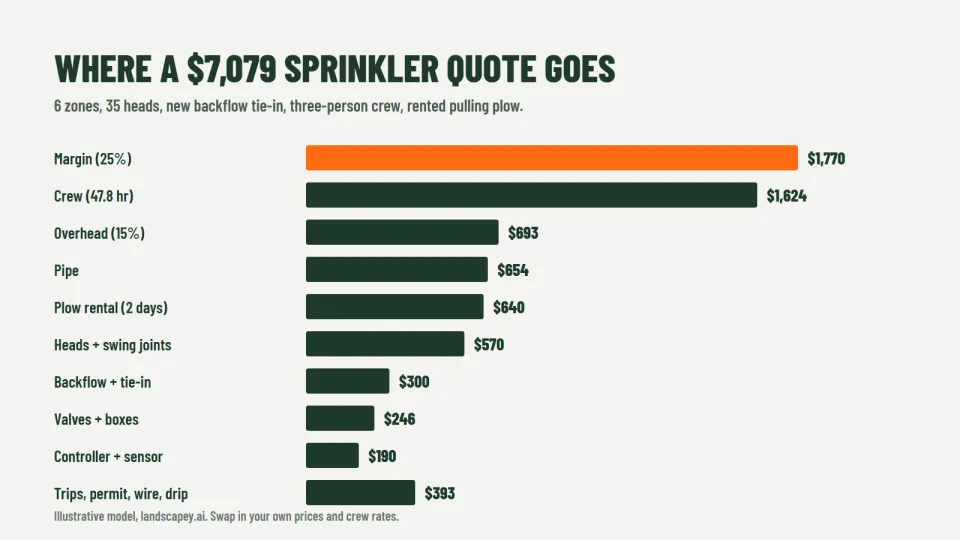
On the inputs below, a three-person crew installing a six-zone system on a quarter-acre lot (three rotor zones of five heads each for the open lawn, two spray zones of ten heads each for the narrow strips and front, one drip zone for the beds, a 1-inch pressure vacuum breaker on a new tie-in, 120 feet of 1-inch PVC mainline, about 910 feet of poly laterals pulled in with a rented plow, a 6-station controller with a rain sensor, two valve boxes, a permit, and a full flush and head adjustment) comes to $7,079, or about $1,180 per zone and $202 per head. That breaks down as:
- $4,617 of direct cost
- $2,118 of materials: $654 of pipe, $570 of heads and swing joints, $300 of backflow and tie-in fittings, $246 of valves and boxes, $190 of controller and sensor, $90 of drip kit and $68 of wire
- $1,624 of crew time (47.8 crew-hours at $34 burdened, two days for three people)
- $640 of plow rental (two days), $135 of trips and $100 for the permit
- $693 of overhead at 15% of direct cost, and $1,770 of margin, set at 25% of the price
Two things fall out straight away. The $1,180 a zone sits inside the $600 to $1,800 installed range the cost guides publish, and the $7,079 total sits inside their $3,000 to $10,000 band, so the model is not out of line with the market. And no single line dominates. Materials are 30% of the price, labor 23%, and the "small" lines (rental, trips, permit, backflow) add up to another 17%. That is why a flat per-zone price that ignores the fixed costs goes wrong on small systems, which is most of the rest of this guide.
The model, line by line
Here is every input, so you can see exactly what the $7,079 assumes and swap your own numbers in.
| Line | Assumption | Cost on the 6-zone job |
|---|---|---|
| Rotors | 15 gear-drive rotors (Hunter PGP Ultra or Rain Bird 5000 class) at $18 each. Retail listings for this class run roughly $16 to $22 a head. | $270 |
| Spray heads | 20 four-inch spray bodies with nozzles at $8 each | $160 |
| Swing joints and fittings | $4 per head, 35 heads | $140 |
| Valves | 6 one-inch residential valves at $26 (Rain Bird's own store lists the 100DV at about $26) | $156 |
| Valve boxes and manifolds | 2 boxes (three valves each) at $25 plus $20 of manifold fittings each | $90 |
| Controller and sensor | 6-station controller at $150 (the Rain Bird ESP-TM2 lists between about $110 and $166) plus a $40 rain sensor | $190 |
| Backflow and tie-in | 1-inch pressure vacuum breaker with ball valves at $200 (retail $180 to $245) plus $100 of brass and copper fittings at the tap | $300 |
| Mainline | 120 ft of 1-inch Schedule 40 PVC at $0.90 a foot | $108 |
| Laterals | 26 ft of poly per head, 910 ft at $0.60 a foot (Home Depot lists 3/4-inch NSF poly at $0.59 to $0.85 a foot by the 100-ft roll) | $546 |
| Valve wire | 150 ft of 7-strand 18-gauge at $0.45 a foot | $68 |
| Drip zone | One bed zone kit: filter, regulator, tubing, emitters | $90 |
| Crew labor | 47.8 crew-hours at $34 burdened (detail below) | $1,624 |
| Pulling plow | Rented, $320 a day for two days | $640 |
| Trips | $45 per trip, three trips (two install days and a return to check coverage) | $135 |
| Permit | $100 placeholder; check your city and water utility | $100 |
| Overhead | 15% of direct cost | $693 |
| Margin | 25% of the final price | $1,770 |
| Price | $7,079 |
Margin is set as a share of the price, not a markup on cost. A 25% margin on $5,309 of direct cost plus overhead means dividing by 0.75, not multiplying by 1.25. The difference on this job is about $443, which is the single most common way installers underprice. If that distinction is new, the landscaping profit margin guide walks through it.
Where the 47.8 crew-hours go
| Task | Crew-hours |
|---|---|
| Layout: flag heads, mark the main and lateral runs, paint valve box spots | 3.0 |
| Tie-in and backflow: shut-off, tap, PVB riser at the right height, test | 4.0 |
| Valve manifolds (2 boxes at 1.5 hours) | 3.0 |
| Controller mount and valve wire | 2.0 |
| Mainline trench, 120 ft at 0.03 hours a foot | 3.6 |
| Pulling laterals, 910 ft at 0.012 hours a foot | 10.9 |
| Heads, 35 at 0.35 hours each (swing joint, set to grade, backfill) | 12.3 |
| Drip zone | 3.0 |
| Flush, set arcs and radius, run every zone, adjust | 3.0 |
| Cleanup, roll the slits, restore the turf | 3.0 |
| Total | 47.8 |
The heads and the laterals are half the hours. That matters later, because those are exactly the lines that move when the soil is rocky or the plow cannot get in. Plug your own rates into the labor cost calculator if $34 burdened does not match your crew.
Price per zone changes with the size of the system
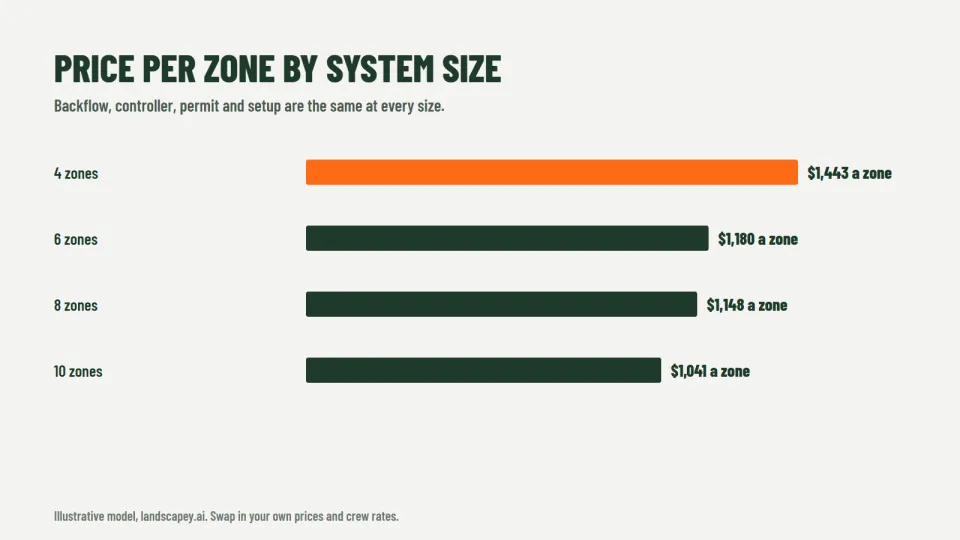
The fixed costs on a sprinkler job are bigger than they look. The backflow preventer and tie-in, the controller, the permit, the layout, the flush and test, and at least one day of plow rental are the same whether the system has four zones or eight. Spread over fewer zones, they push the per-zone price up.
| System | Heads | Crew-hours | Price | Per zone | Per head |
|---|---|---|---|---|---|
| 4 zones (2 rotor, 1 spray, 1 drip) | 20 | 37.8 | $5,770 | $1,443 | $289 |
| 6 zones (3 rotor, 2 spray, 1 drip), the base job | 35 | 47.8 | $7,079 | $1,180 | $202 |
| 8 zones (4 rotor, 3 spray, 1 drip) | 50 | 59.2 | $9,187 | $1,148 | $184 |
| 10 zones (6 rotor, 3 spray, 1 drip) | 60 | 67.3 | $10,412 | $1,041 | $174 |
The four-zone system costs 82% as much as the six-zone system to install, for two-thirds of the zones. A price list that charges the same per zone at every size will either be too cheap on small systems or too expensive on large ones. The structure that fits the model better is a system charge plus a per-zone charge. On these inputs, roughly $2,700 for the system plus $750 a zone lands within about 6% of the full model from four to ten zones: $5,700 at four zones, $7,200 at six, $8,700 at eight and $10,200 at ten. The system charge covers the backflow, controller, permit, rental floor and setup; the per-zone charge covers the heads, pipe, valve and hours that scale.
What a flat $500 a zone actually does
Some of the low-end cost guides quote $200 to $700 a zone, and it is tempting to pick a round number from that range. Run it through the model. At $500 a zone, the six-zone job bills $3,000 against $4,617 of direct cost, before a dollar of overhead or margin. The four-zone job bills $2,000 against $3,763. You would lose money on every system you put in, and lose more on the small ones.
Those low per-zone numbers are not wrong for what they describe. Some count materials only, some assume the homeowner already has a backflow preventer and controller, some come from markets with much lower wages, and some are for a zone added to an existing system, where the tie-in, controller and permit are already paid for. An add-a-zone price is a real product, and it can sit far below a new-system per-zone price. Just do not let it leak into new-install quotes.
What the options do to the price
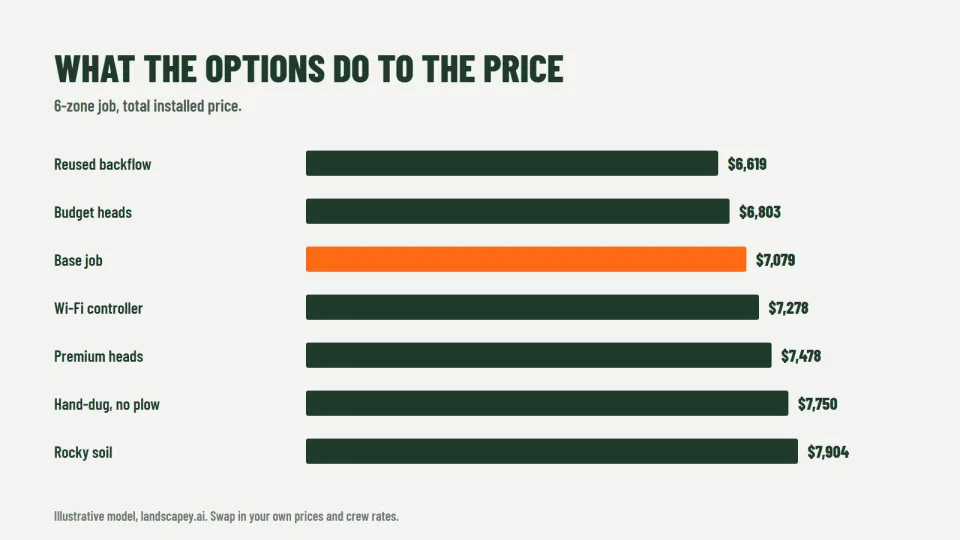
Same six-zone job, one change at a time:
| Change | Price | Difference | Why |
|---|---|---|---|
| Existing backflow preventer is reusable | $6,619 | -$460 | No PVB, no tie-in fittings. Confirm it tests good first. |
| Budget heads ($10 rotors, $5 sprays) | $6,803 | -$276 | Heads are a small share of the price; the savings are smaller than customers expect. |
| Base job | $7,079 | - | |
| Wi-Fi controller upgrade (+$130) | $7,278 | +$199 | Margin and overhead apply to the upgrade too. |
| Premium heads ($30 rotors, $12 sprays) | $7,478 | +$399 | Stainless risers, better nozzles. |
| Hand-dug, no plow access (fenced backyard) | $7,750 | +$671 | Trench hours triple; the plow rental drops out, which takes some of the sting away. |
| Rocky or heavy clay soil | $7,904 | +$825 | Trench and pull hours up 35%. |
The pattern is the same as most install work: the site moves the price more than the parts do. Customers will ask about cheaper heads; the honest answer is that it saves them about $276 on a $7,000 system. Soil and access are what you need to see on the walk-through, and they belong on the estimate as named lines so the customer understands why the yard next door was cheaper.
The other big lever is equipment. If you own a pulling plow, the rental line is replaced by your ownership cost. At about $60 a day of ownership cost instead of $320 a day of rental, the base job drops to about $6,280. That is the case for buying one once you are doing more than a handful of installs a season.
The parts of the job that are not optional
Several lines on a sprinkler quote are there because the law or the water utility says so, not because you chose them. Leave them out and the low quote is not a better quote; it is an incomplete one.
- Backflow prevention. An irrigation system connected to drinking water needs an approved backflow preventer, because fertilizer and lawn water can otherwise siphon back into the supply. A pressure vacuum breaker is common for residential systems; it has to sit at least 12 inches above the highest downstream head or pipe. Some utilities require a different device or an annual test by a certified tester. Check before you quote, because the device and the test change the price.
- Permits and licensing. Many cities require a permit for the tie-in, and some states license irrigation contractors. Texas is the best-known example: irrigation systems there must be installed by a state-licensed irrigator. In some places the tap itself has to be done by a licensed plumber. Find out what applies where you work and price it as a line, not a favor.
- Utility locates. Call 811 before you plow or trench. It is free, it takes a few days, and a pulling plow through a buried cable is the most expensive mistake on this whole list.
How to present the quote
A single number on a sprinkler quote invites the customer to compare it with the cheapest number they found online. A quote broken into the system charge and the zones, with the site conditions named, invites them to compare what is included. A layout that works:
- System: backflow preventer and tie-in, controller and rain sensor, permit, layout and testing. One line, one price.
- Zones: each zone listed with what it waters (front lawn, back lawn, side strip, beds) and its head count. Customers like seeing the yard in the quote.
- Site conditions: rocky soil, hand-digging, long runs to the tap, sidewalk bores. Named and priced.
- Options: Wi-Fi controller, premium heads, extra drip zones. Each with its price, so the customer can add them without a re-quote.
- Service plan: spring start-up and fall winterization (more below).
That is the same good-better-best structure covered in how to bid landscaping jobs. If you build quotes in Landscapey's estimate tool, each of those becomes a line item, and an approved quote converts straight into the job and the invoice, so the numbers you agreed are the numbers you bill.
Do not stop at the install
A new sprinkler system is the start of a recurring relationship. Every system you install needs a spring start-up and, in freezing climates, a fall winterization, every year. On the same cost inputs, a visit of 45 minutes to an hour by one tech with a compressor you already own prices at about $130 to $145 before any route density savings. The sprinkler winterization pricing guide goes deep on that side, including why drive time matters more than zone count.
Two visits a year at around $135 is about $270 a year per system. Ten installs a season becomes $2,700 of recurring work that you can schedule into slow weeks, and each visit is a chance to sell repairs, controller upgrades and the lawn care itself. Put the service plan on the install quote, with the first season's start-up at a discount, and book the dates when the customer signs. Then bill it as a recurring job rather than chasing it every spring.
The install also pairs with work you may already sell. A yard that needs irrigation often needs new turf (see how much to charge for sod installation) or drainage (see French drain pricing). Doing the irrigation before the sod is cheaper for everyone, and worth saying on the walk-through.
Frequently asked questions
How much should I charge per zone for a sprinkler system?
On the inputs in this guide, a new six-zone system comes to about $1,180 a zone, and the per-zone price falls from about $1,440 on a four-zone system to about $1,040 on a ten-zone system. A system charge of around $2,700 plus about $750 a zone tracks the full model within about 6%. Replace the inputs with your own costs before you use the numbers.
Why are some per-zone prices online so low?
Many of them count materials only, assume an existing backflow preventer and controller, or describe adding a zone to an existing system. Adding a zone skips the tie-in, the controller, the permit and most of the setup, so it can be priced far lower. On a new system, $500 a zone does not cover the direct cost in this model.
Should I price by zone, by head or by square foot?
Zones and heads both track cost reasonably well once the fixed costs are covered separately. Square-foot pricing is the weakest of the three, because a long narrow side yard needs far more heads per square foot than an open back lawn. Whatever unit you quote in, build the price from the costs first and convert it afterwards.
Does the brand of sprinkler head matter much to the price?
Less than customers think. Moving from budget heads to premium heads changes this six-zone job by about $675 in total, from $6,803 to $7,478. Soil, access and the tie-in change it more.
Do I need a license to install sprinkler systems?
It depends on where you work. Some states license irrigation contractors (Texas requires a state-licensed irrigator), many cities require a permit, and some water utilities require a licensed plumber for the tap and a certified tester for the backflow preventer. Check your state, city and water utility before you quote.
What should I charge for spring start-ups and winterizations on systems I installed?
On the same cost inputs, a 45 to 60 minute visit prices at about $130 to $145, and less on a dense route. Sell it on the install quote and book it as recurring work.
Sources and limits
Homeowner price ranges come from published 2025 and 2026 cost guides (per-zone ranges of roughly $350 to $1,800 installed and whole-system ranges of roughly $3,000 to $10,000), read on 2 November 2026. Parts prices are retail listings checked the same day: gear-drive rotors at roughly $16 to $22 a head, Rain Bird's 1-inch 100DV valve at about $26 on Rain Bird's store, the 6-station ESP-TM2 controller at about $110 to $166, a 1-inch Febco 765 pressure vacuum breaker at about $180 to $245, and 3/4-inch NSF poly pipe at $0.59 to $0.85 a foot at Home Depot. Contractor supply-house prices are usually lower than retail. The plow rental rate, crew hours, wage, overhead and margin are assumptions, labeled as such; the whole model is illustrative and is meant to be rebuilt with your own numbers. Code and licensing vary by state, city and water utility, and nothing here is legal advice.
Ready to quote it? Start free with Landscapey and build the system, zones and service plan as line items, or see what the plan costs.