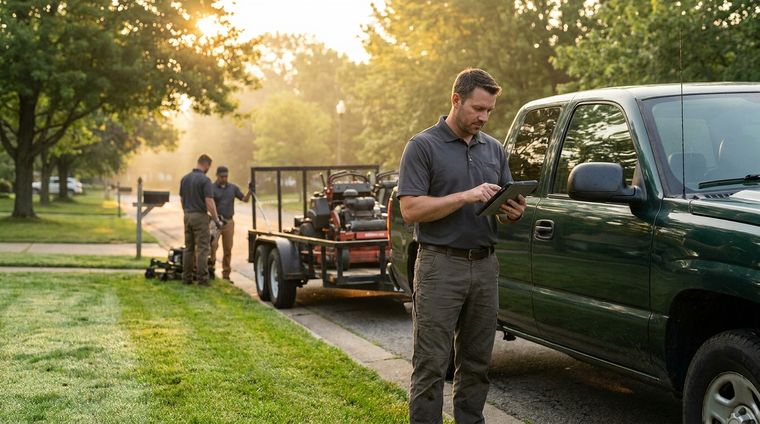
You're standing in a customer's driveway after a solid estimate. The price is fair, the route fits, and the homeowner likes you. Then they glance at the side of your truck, forget the company name by dinner, and hire the crew whose brand sounded more established. That happens more than owners admit.
Your business name is your first marketing tool. It shapes whether a prospect remembers you, whether they can find you in local search, and whether your company sounds like a real operation or a weekend side job. A weak name creates friction before the first quote goes out.
This means your name is not just a creative choice. It affects positioning, search visibility, referral quality, and even the type of work your sales pipeline attracts. A name built for basic mowing routes will not always help you win premium maintenance contracts or higher-end installation work.
That's why a long list of random ideas is not enough. The better approach is to choose a name type that matches the business you want to build, then support that choice with the right systems and follow-up. If you plan to grow, your branding also needs clean estimating, repeatable communication, and organized lead tracking. Tools built for lawn business CRM and sales workflow management help reinforce the identity your name promises.
The sections below break lawn company names into practical categories tied to business goals. Some name types help with local SEO. Some make premium pricing easier to defend. Others are more memorable but require stronger branding to explain what you do. The right choice depends on your market, your service mix, and whether you want to stay owner-led or build a company that can scale beyond you.
Table of Contents
- 1. Descriptive Service-Based Names
- 2. Owner Name-Based Brands
- 3. Benefit-Driven Names
- 4. Nature-Inspired or Metaphorical Names
- 5. Geographic or Location-Specific Names
- 6. Professional Premium Positioning Names
- 7. Action Verb-Based Names
- 8. Compound or Mashup Names
- 8-Point Comparison of Lawn Company Name Types
- Your Naming Checklist Before You Print the T-Shirts
1. Descriptive Service-Based Names
Examples include GreenScape Solutions, Lawn Perfect, LandCare, and BrightView. These names work because they remove guesswork. A homeowner sees the truck, yard sign, or Google profile and immediately knows the company handles lawn care or grounds care.
Why this type works
For most new operators, clarity beats cleverness. Industry guidance consistently recommends using service keywords such as “lawn care” or “landscaping,” often paired with a geographic identifier, because that combination supports discoverability and customer understanding in local search, and exact-match domains are no longer treated like a special shortcut (RealGreen naming guidance for lawn care businesses).
If you're a mowing and maintenance company in one core service area, names like “Cedar Park Lawn Care” or “Northside Landscaping” are often stronger than abstract branding. They're easier to remember, easier to search, and easier to match with customer intent.
Practical rule: If a stranger can't tell what you do in two seconds, the name is making marketing harder.
A service-based name also pairs well with a search-ready online profile. If you're building local visibility, a landscaper public profile that repeats your service category and ZIP-based coverage can reinforce what the name already signals.
Best fit and common mistake
This category fits recurring mowing, fertilization, cleanup, and bread-and-butter residential maintenance. It also works well when referrals matter, because customers can repeat the name without explaining it.
The mistake is sounding interchangeable. “Green Lawn Care” may be clear, but if your county already has Green Valley Lawn Care, Green Lawn Solutions, and Green Grass Lawn Service, you've created confusion. Distinct enough to own, clear enough to search. That's the balance.
A better descriptive name usually adds one extra layer of identity:
- Location signal: “Westfield Lawn Care”
- Quality cue: “Precision Lawn Care”
- Service lane: “Oak Ridge Lawn and Garden”
2. Owner Name-Based Brands
Mike's Lawn Care. Johnson Landscaping. Sarah's Garden Design. These names sell accountability. In many neighborhoods, that still matters more than polish.
Where personal brands win
Owner-name brands work best when the owner is the main salesperson, estimator, and service face. Homeowners often like knowing exactly who's behind the work, especially for weekly mowing, planting, pruning, and small property upgrades. The name feels local, familiar, and answerable.
This approach can be especially strong in a category with heavy local competition. NALP reports that the broader outdoor services industry employs more than 1.4 million people and includes 692,777 landscaping service businesses. In a market that crowded, personal trust becomes a differentiator.
If your reputation is already moving jobs, lean into it. A profile like Maxwell Landscaping shows how an owner-led brand can look professional without feeling corporate.
The resale and hiring issue
Here's the trade-off. Owner-name brands can get sticky when you hire crews or think about an eventual sale. “Mike's Lawn Care” is easy to trust when Mike shows up. It gets harder when three employees handle the route and Mike's in the office or out of the business.
Customers forgive a simple owner-based name. They don't forgive a name that promises personal service after the company stops operating that way.
There are two good ways to handle this:
- Stay personal on purpose: Keep the owner name and build the brand around responsiveness, visible leadership, and review-driven trust.
- Create a transition path: Use “Johnson Landscaping” now, but gradually emphasize a broader company identity in uniforms, proposals, and your website language.
This format also works better with some names than others. Full last names usually age better than first names. “Anderson Grounds Management” carries farther than “Tom's Yard Guys” if you expand into larger properties or commercial work.
3. Benefit-Driven Names
A homeowner gets home at 6:15, sees the lawn looks sharp, the gate is latched, and the invoice is already paid. That customer did not buy mowing. They bought relief.
Examples include EasyLawn, Hassle-Free Landscaping, Premium Turf, and Worry-Free Yards. This category works because it names the result the customer cares about.

Promise the outcome, not the task
Benefit-driven names fit companies selling convenience, consistency, or status more than raw labor. A busy homeowner rarely compares blade height or trimming technique first. They want one less thing to manage.
That changes how the name should work. “Worry-Free Yards” positions the service around peace of mind. “Premium Turf” points to pride and appearance. “Smith Mowing” is clear, but it does less to support premium pricing or emotional recall.
The strongest versions usually fall into three lanes:
- Convenience: EasyLawn, No-Stress Lawn Care
- Quality: Premium Turf, Signature Lawn Care
- Lifestyle: Weekend Back Yard Care
Each lane attracts a different buyer expectation. Convenience names can help conversion with recurring residential customers. Quality-focused names can support higher pricing if the service looks sharper and feels more organized. Lifestyle names are memorable, but they need tighter messaging so they do not sound vague.
Keep the promise operational
This category carries more risk than descriptive names because the name itself makes a service claim. If you call the business Hassle-Free Landscaping, customers will judge every touchpoint against that promise. Missed callbacks, confusing billing, sloppy arrival windows, and crew notes that never reach the field all create a bigger trust gap.
Use the name as an operating standard. If the brand is “EasyLawn,” the estimate request should be short, reminders should go out automatically, job notes should be easy for crews to find, and recurring billing should be simple to understand. A CRM matters here because it helps the company deliver the brand, not just advertise it.
This is also where strategy beats creativity. A benefit-driven name can support local SEO if the website copy and Google Business Profile clearly state the actual services and service area. It can support premium pricing if proposals, uniforms, and communication feel orderly and professional. It can improve memorability if the phrase is easy to say, easy to spell, and easy to repeat in a referral.
Avoid cute spellings and clever twists in this category. A name built around trust and simplicity should read plainly on a truck, in a text message, and in a search result. “Easy Lawn Care” does that better than “EZLawnz.”
4. Nature-Inspired or Metaphorical Names
GreenThumb Grounds, Bloom Grounds, Evergreen Solutions, Thrive Outdoor Services, Eden Grounds. These names create mood and memorability first.

Memorable can work, but clarity still matters
Metaphorical names are often better for companies that want to feel designed, creative, eco-aware, or premium-adjacent. They're common in outdoor design, garden services, and firms that want stronger visual branding than plain service names provide.
They're weaker when the name is so soft or abstract that nobody knows whether you mow lawns, install patios, or sell houseplants. “Bloom” by itself may sound nice, but it needs support. Your trucks, profile headline, service list, and proposal templates must add the missing clarity.
A metaphorical name can open the door. Your service description has to close the sale.
How to make a metaphorical name sell
Use a two-part structure. Put the brandable word first, then anchor it with a plain-language descriptor. “Evergreen Outdoor Services” is easier to place than “Evergreen Collective.” “Thrive Lawn and Outdoor” is clearer than “Thrive Co.”
This category also rewards strong visual identity. If your name is Bloom Grounds, the logo, color palette, uniforms, and truck graphics should feel intentional. A poetic name with cheap-looking branding creates a mismatch.
Another smart move is testing memorability before launch. Recent naming guidance notes that business owners should validate names through availability checks and even basic polls or mockups before committing (Swept guidance on landscaping business name ideas). That's especially important with metaphorical brands, because what sounds elegant to you may sound vague to the customer.
5. Geographic or Location-Specific Names
Examples include Denver Grounds Solutions, Austin Turf Care, Westchester Lawn Services, and The Woodlands Grounds Care. This is one of the most practical naming formats in the trade.
The local search advantage
Location-based names tell customers where you work before they ever call. That's useful in neighborhoods where route density matters and in markets where homeowners prefer local operators over broad service-area claims.
Independent naming guidance for lawn-care businesses recommends combining service terms with geography and checking business registries, trademark databases, domains, and social handles before launch, because availability problems create legal and marketing friction later (VistaPrint lawn care business naming guidance).
If your growth plan is “own three or four ZIP codes and fill them tightly,” a geographic name often supports that strategy well. A profile like Evergreen Lawn & Landscape in Phoenix, AZ shows why. The service category and market signal are both visible at a glance.
When geography becomes a limitation
The downside shows up when you want to expand beyond the area in the name. “North Dallas Lawn Care” is excellent until half your work comes from Plano, Frisco, and McKinney. Then the name starts narrowing you.
There are two ways to solve that:
- Go broad enough: Use a county, region, or metro reference instead of one small neighborhood.
- Use geography in the descriptor, not the core brand: “Evergreen Lawn Care of North Dallas” gives you more room than “North Dallas Lawn Care” as the formal brand.
This format also requires discipline. Don't choose a place name just because it sounds upscale if you don't work there consistently. Customers notice when the branding says one territory and the trucks never appear in it.
6. Professional Premium Positioning Names
A homeowner requests bids for weekly service on a $1.5 million property. One truck says “Joe's Lawn Service.” Another says “Precision Outdoor Care.” Before anyone compares scope, the second company is already framed as the safer choice for a client who cares about reliability, detail, and presentation.

Elite Outdoor Services, Premier Turf Services, Precision Outdoor Care, Excellence Outdoor Management. Names in this category are built to support higher pricing, more formal sales conversations, and a narrower client fit.
That last point matters.
A premium name does not improve a basic operation on its own. It sets an expectation. If you use words like elite, premier, or precision, every touchpoint has to back them up: fast quote response, clean uniforms, polished trucks, clear proposals, reliable crews, and work that holds up after the first visit. If those pieces are missing, the name creates resistance instead of trust.
This category fits companies that want better clients, not just more leads. In practice, that usually means:
- High-end residential maintenance
- Design-build firms
- Estate property service
- Commercial accounts with formal proposal review
The strategic upside is positioning. A descriptive name helps local SEO. A premium name helps perceived value. If your goal is to raise average ticket size, win HOA or property-management work, or stop competing with the lowest bidder, this naming style can support that move.
The trade-off is discoverability. “Premier Turf Services” sounds stronger than “Springfield Lawn Mowing,” but it tells Google and the customer less about where you work and what you do. Solve that in the rest of the brand system. Use service and city terms in your Google Business Profile, page titles, truck graphics, and review requests. Your CRM should reinforce the same identity by sending clean estimates, organized follow-ups, and branded invoices. Premium positioning breaks down fast when the back office feels sloppy.
As noted earlier, the industry has attracted plenty of operators trying to move upmarket. A polished name can help signal that shift. It only works when the business model supports it.
Field note: If your close rate depends on being the cheapest estimate, “Premier” will not give you pricing power. Better routing, better crews, better communication, and better presentation will.
7. Action Verb-Based Names
Grow Green Spaces, Transform Outdoor Services, Cultivate Grounds, Enhance Outdoor Spaces. These names sound active, progressive, and results-oriented.
Why verbs create momentum
Verb-based names work because they imply movement. They suggest that the property won't stay the same after you're hired. That's useful for enhancement work, seasonal upgrades, cleanups, and any service where before-and-after contrast helps you sell.
They can also sharpen your marketing language. “We cultivate healthier grounds” is stronger than “we provide lawn care services.” The name gives you a built-in message.
This category often works well for companies that do more than mow. If you install beds, refresh curb appeal, improve neglected yards, or offer phased property improvements, an action verb can position you as a company that changes conditions, not just maintains them.
Avoid overpromising transformation
The risk is overreach. “Transform Outdoor Services” sounds big. If most of your revenue comes from weekly mowing and basic cleanup, the name may create expectations your day-to-day work doesn't match.
Use a verb that reflects your actual lane:
- Cultivate fits gardening, bed care, and grounds development.
- Upgrade fits higher-end enhancements and design-conscious work.
- Grow fits a broad green-industry brand, but needs a descriptor to stay clear.
This is also a category where your marketing materials should show evidence. Before-and-after photos, seasonal refresh packages, and service descriptions help the name land properly. Without proof, a verb can feel like ad copy instead of identity.
8. Compound or Mashup Names
A company picks a clever name, wraps the trucks, launches Google Business Profile, and then spends the next two years spelling the name for every caller. That is the risk with compound and mashup names. Done well, this category gives you a brand that feels bigger than a one-person operation. Done poorly, it creates friction in search, referrals, and phone intake.
LawnWorks, GreenScape, TurfTech, YardMasters, EcoScape Solutions. These names sit between plain description and pure invention. They usually combine an industry word with a second word that signals expertise, quality, speed, or specialization.
Brandable, if the name still does some selling
This category works best for owners who want room to grow. A mashup name can support mowing today and still fit fertilization, irrigation, lighting, drainage, or commercial work later. It also gives you more freedom if you do not want the brand tied to your surname or a single town.
The trade-off is clarity. A descriptive name helps local SEO and immediate understanding. A mashup gives you more memorability and a cleaner visual brand, but it asks more from your marketing. If you choose this route, your website, Google Business Profile, truck lettering, and review language need to make the service mix obvious fast.
That is the strategy question. Are you trying to rank on pure service clarity, or are you building a name that can carry premium positioning and broader expansion?
Test the name in the real world, not on a brainstorm sheet
This category creates more avoidable mistakes than owners expect. If the name is hard to pronounce, easy to misspell, or awkward to hear once and search later, lead flow gets weaker in small ways that add up.
Run a plain-language test before you buy shirts or decals. Say the name out loud to someone who has never seen it. Ask them to text it back, spell it, and search for it a day later. If they hesitate, guess wrong, or add extra words, the name is costing you more than it is helping.
This matters even more if referrals drive your business. Homeowners often hear a name from a neighbor, then search it later. If your mashup name does not match how real people hear and type words, you lose some of that demand to confusion or to competitors with clearer names, as noted earlier.
Match the name to the operating model
Strong mashup names usually pair well with systems-driven companies. “TurfTech” suggests process, consistency, and a modern service operation. If that is your angle, support it. Use a CRM that sends clean estimates, tracks recurring work, and keeps communication consistent. The name should match the customer experience.
If your company wins on personal relationships and neighborhood familiarity, a mashup can still work, but it needs warmth in the rest of the brand. Otherwise the name can feel manufactured.
Good mashups sound natural and are easy to repeat. Bad ones look clever in a logo file and expensive in every sales conversation.
8-Point Comparison of Lawn Company Name Types
A good name does two jobs at once. It has to make sense to a homeowner in five seconds, and it has to support how the company plans to grow. That second part gets missed. A name that helps a solo operator book mowing routes may work against a firm trying to win higher-ticket design work or expand into multiple towns.
Use the table below as a decision tool, not a recap. The extra columns matter because naming mistakes usually show up later in sales friction, weaker search visibility, brand confusion, or a ceiling on pricing.
| Naming Type | Best business goal | Best fit customer | Difficulty to execute well | Biggest pitfall | Best use in marketing systems |
|---|---|---|---|---|---|
| Descriptive Service-Based Names (e.g., "Lawn Care Solutions") | Get found fast in local search and make the service obvious | Price-aware homeowners comparing several local providers | Low | Sounds interchangeable with competitors, which makes reviews and referrals harder to remember | Build service-page SEO around mowing, treatments, cleanup, and recurring route reminders in your CRM |
| Owner Name-Based Brands (e.g., "Johnson Lawn Care") | Build trust and referrals in a relationship-driven business | Homeowners who want a known local operator | Low to medium | Gets harder to scale when the owner is no longer the face of every estimate and complaint | Use automated follow-up, review requests, and job notes to keep the personal brand consistent across crews |
| Benefit-Driven Names (e.g., "EasyLawn") | Support a clear value proposition such as convenience, reliability, or simplicity | Busy homeowners who care more about outcomes than process | Medium | The promise creates pressure. If service misses, the name works against you | Match the promise with fast quoting, clear scheduling, and tight customer communication |
| Nature-Inspired or Metaphorical Names (e.g., "GreenThumb") | Stand out and build a more memorable brand | Homeowners who respond to personality and visual branding | Medium | The service can feel vague unless the website, truck lettering, and Google Business Profile make the offer obvious | Use consistent visuals, before-and-after photos, and short service copy so the name does not have to explain everything |
| Geographic or Location-Specific Names (e.g., "Denver Yard Services") | Own a city, suburb, or route area in local search | Customers who prefer established local companies | Low | Expansion gets awkward if you later move into nearby markets with different city names | Pair the name with territory tagging, ZIP-based campaigns, and route density tracking in your CRM |
| Professional Premium Positioning Names (e.g., "Elite Turf Management") | Support higher pricing and a polished sales process | Affluent homeowners, HOAs, and commercial buyers expecting professionalism | Medium to high | Creates higher expectations than the operation may be ready to meet | Back it up with polished estimates, good photography, service packages, and disciplined follow-up |
| Action Verb-Based Names (e.g., "Transform Outdoor Services") | Sell results and visible improvement | Customers shopping for upgrades, renovations, or major curb appeal changes | Medium | Can feel overstated for basic mowing and maintenance work | Works best with proposal templates, project galleries, and milestone communication for larger jobs |
| Compound or Mashup Names (e.g., "LawnWorks") | Create a distinct brand with better odds of domain availability | Customers comfortable with modern branding and less generic naming | Medium | Misheard or misspelled names lose referral traffic and direct searches | Use the same spelling everywhere, from invoices to review requests to truck wraps, so the brand sticks |
One practical rule applies here. The farther your name moves away from plain service description, the more your systems have to carry the clarity.
That is why I usually advise owners to choose based on the company they are building, not the one they may build someday. If the next three years are about route density, local SEO, and recurring mowing, descriptive or geographic names often produce faster returns. If the plan is premium design work, stronger margins, and a brand that can stretch beyond one town, a benefit-driven, premium, or well-built mashup name can be the better long-term asset.
Your Naming Checklist Before You Print the T-Shirts
A name isn't finished when you fall in love with it. It's finished when it survives basic reality checks.
Start with confusion risk. Search your local market and look for near-duplicates, not just exact copies. If your town already has GreenScape Lawn Care, Greenscape Landscaping, and Green Scape Property Services, a fourth variation is a bad bet even if the state registry technically allows it. Customers mix up similar names, and local search can get muddy fast.
Then check availability everywhere that matters. Current guidance for lawn-care naming stresses running your top choice through business registries, trademark databases, domain availability, and social handles before launch. That step isn't busywork. It keeps you from building signs, wraps, shirts, estimates, and review profiles around a name you can't fully own.
Your next test is spelling and pronunciation. Say the name out loud to someone who isn't in the industry. Ask them to text it back to you an hour later. If they misspell it, forget the wording, or turn it into something more generic, you've learned something useful before customers do. This matters even more if you were tempted by stylized spellings or a clever mashup.
After that, pressure-test the name against your business model. Does it fit recurring mowing routes, premium residential work, design-build projects, or a future multi-crew operation? A solo operator can get away with a personal local name. A company planning to add crews, office staff, or a future sale usually benefits from a brand that doesn't depend entirely on one person or one neighborhood.
Also check whether the name creates the wrong price signal. “Budget Lawn Care” may attract exactly the customers you'll later want to avoid. “Elite Outdoor Management” may sound impressive, but it can create a gap if your operation still feels informal. The best lawn company names don't just sound good. They pre-qualify the right buyer.
One last practical point. Your name has to show up consistently across every customer touchpoint: Google Business Profile, invoices, yard signs, truck lettering, estimate templates, and your public web presence. If you abbreviate it in one place, stylize it in another, and use a different service label everywhere else, you dilute the brand before it has a chance to stick.
Choose a name that helps you sell the kind of work you want. Then build the operation around that promise. That's when a business name stops being decoration and starts doing its job.
If you're choosing between lawn company names and want the brand to do real work, Landscapey gives you the operating system to support it. You can manage leads, schedule recurring jobs, route crews by density, send invoices, collect online payments, and launch a public profile structured for local search in your ZIP codes. That means your name doesn't just sit on a logo. It shows up where customers search, where estimates happen, and where jobs turn into repeat business.