Most snow shoveling price lists online are written for homeowners: a 2-car driveway is $50 to $100, a sidewalk is $30 to $100, done. That is fine if you are the one paying. If you are the one shoveling, it tells you nothing about whether $45 a visit makes money on your route, what to add when 10 inches falls instead of 3, or whether a seasonal contract is a good bet in your town.
This guide builds a per-visit price the other way round, from minutes on the property, the drive between stops, the blower, the ice melt and the margin you need to sit on call all winter. Every number in the model is illustrative and labelled that way. Swap in your own wage, equipment and route, and the method still holds.
If you plow as well, the plowing side is covered in our guides to snow plowing prices and per-push versus seasonal snow contracts. This one is about the hand and blower work: driveways, walks, steps and the public sidewalk.
What customers are already paying
Start with the market, because it sets the ceiling. Three cost guides updated this fall put residential snow shoveling in roughly the same place:
| Item | Housecall Pro (updated Oct 2026) | Lawn Love (updated Oct 2026) | TaskRabbit (updated Nov 2026) |
|---|---|---|---|
| Driveway, per visit | $30 - $75 | $30 - $70 | $40 - $80 (1-car), $50 - $100 (2-car) |
| Walkway or sidewalk | $40 - $80 per visit | $25 - $75 per hour | $30 - $100 per visit |
| Hourly shoveling or blowing | $25 - $75 | $25 - $75 (minimum $25 - $100) | $25 - $100 |
| Salting / de-icing | $20 - $40 | $20 - $50 | $25 - $75 |
| Seasonal, residential | $300 - $700 | $300 - $1,000 | $300 - $1,000 |
Two things stand out. The ranges are wide, because they blend a teenager with a shovel and a crew with a blower and a truck. And the hourly numbers are misleading for a route business: you are not paid by the hour, you are paid by the stop, and the hour includes driving you cannot bill.
The price model: paid minutes, not snowfall
A visit costs you three kinds of time: work on the property, fixed time at the stop (parking, unloading, walking the property, a final check of the steps), and the drive to the next customer. All three are paid. Only the first one changes much with the size of the driveway.
The illustrative assumptions behind every table in this guide:
- Labor: $30 an hour loaded (wage plus payroll tax and workers' comp). Snow is nights, weekends and overtime, so it should run above your summer rate.
- Production, 2 to 4 inches of normal snow: about 1,000 sq ft per man-hour with a pusher shovel, about 4,000 sq ft per hour with a 24-inch two-stage blower on open pavement, 30% slower on narrow walks.
- Depth: 4 to 8 inches takes 1.6 times as long by hand and 1.3 times with a blower; 8 to 12 inches 2.5 and 1.8 times; over 12 inches 3.5 and 2.5 times.
- Steps: 3 minutes a set, by hand, longer in deep snow.
- Fixed time: 4 minutes a stop. Drive: 6 minutes between stops on a clustered route.
- Equipment: blower $8 an hour of use (a $1,200 machine over three seasons of about 60 hours, plus fuel and shear pins), truck $4 a stop, ice melt $0.35 a pound bought by the pallet.
- Overhead 15% of direct cost, margin 30% of price. Snow carries more margin than mowing because you are paying to be ready on nights when nothing falls.
Worked through for a typical suburban stop: a 2-car driveway (20 x 40 ft, 800 sq ft), a front walk (120 sq ft), a public sidewalk along the frontage (240 sq ft) and one set of steps, 2 to 4 inches, one operator with a blower.
| Line | Minutes or dollars |
|---|---|
| Work on the property | 22.7 min |
| Fixed time at the stop | 4 min |
| Drive to the next stop | 6 min |
| Paid minutes per visit | 32.7 min |
| Labor at $30/hr | $16.36 |
| Blower + truck | $7.03 |
| Overhead (15%) | $3.51 |
| Break-even | $26.89 |
| Floor price at a 30% margin | $38.42 |
So $38 is the floor for this stop, not the price. It earns about $70 per hour of the operator's clock. Market rates of $50 to $75 for a 2-car driveway with the walks leave real room above it, which is exactly the room you need for the storms that go wrong.
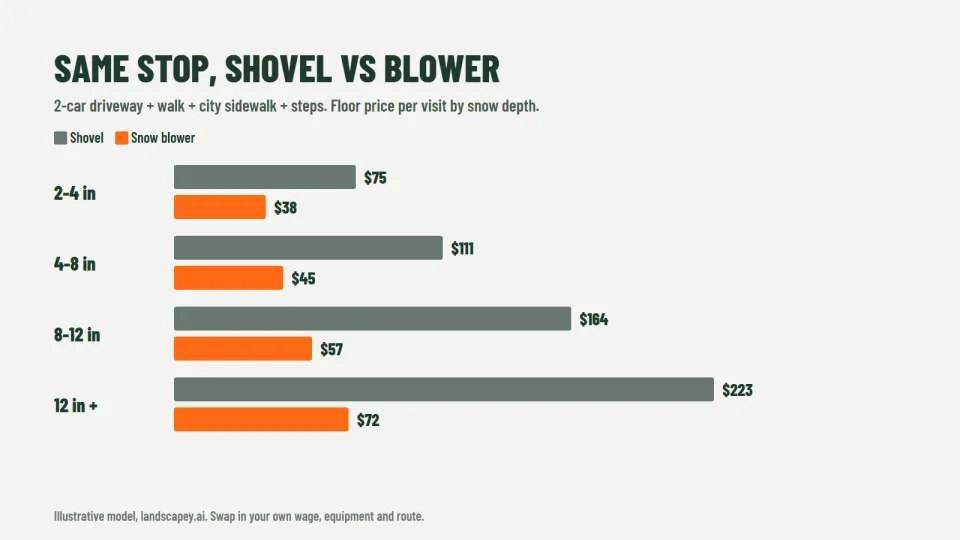
Shovel or blower: the biggest pricing decision you make
The same stop priced by hand and by blower, at each depth:
| Snow depth | Shovel: work min | Shovel: floor price | Blower: work min | Blower: floor price |
|---|---|---|---|---|
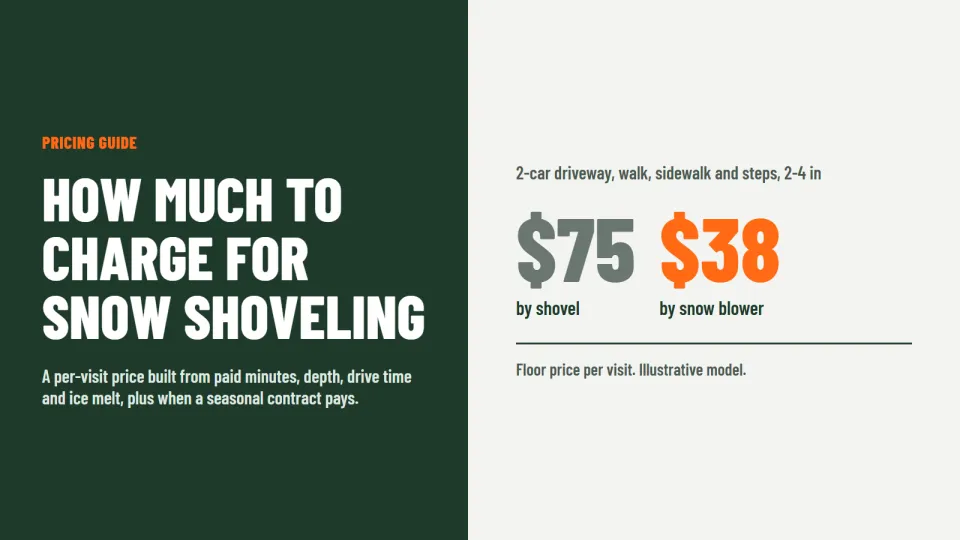
| 2 - 4 in | 73 | $75 | 23 | $38 |
| 4 - 8 in | 115 | $111 | 29 | $45 |
| 8 - 12 in | 179 | $164 | 40 | $57 |
| 12 in + | 249 | $223 | 55 | $72 |
By hand, this stop needs $75 even in light snow, which is the top of the market range, and $164 after a real storm. A blower pays for itself within a handful of storms on a route of any size. Shovels still matter for steps, stoops, tight walks and the last 6 inches against the garage door, but a shoveling business that prices like a blower business and works like a shovel business loses money on every deep storm.
The depth table also shows why "per inch" pricing is common. Housecall Pro lists $12.50 to $25 per inch for the first 6 inches, then $5 to $8.50 per inch beyond. That shape (expensive at first, cheaper per inch after) matches the blower column above: most of the cost is the visit, not the snow.
A simple depth ladder
If you would rather not quote per inch, publish three tiers and stick to them. From the model, with some room above the floor:
- Up to 4 inches: base price (here, around $50 for the 2-car stop).
- 4 to 8 inches: base plus about 25%.
- 8 to 12 inches: base plus about 50%.
- Over 12 inches: base plus about 90%, or two visits billed separately (see below).
Write the tiers into the agreement before the first flake. Arguing about whether it was 7 inches or 9 at the customer's door in January is how you lose both the money and the client.
Price by property, not by driveway
Driveway size is what customers think about. Walks, steps and frontage are what eat your time. The same blower model across common property types, 2 to 4 inches:
| Property | Cleared area | Work min | Floor price |
|---|---|---|---|
| 1-car driveway (10 x 30), short walk | 360 sq ft | 9 | $24 |
| Walks and steps only (driveway plowed by someone else) | 360 sq ft | 11 | $26 |
| 2-car driveway + walk + city sidewalk | 1,160 sq ft | 23 | $38 |
| Long rural driveway (12 x 120) | 1,520 sq ft | 26 | $42 |
| Corner lot: 2-car + 180 ft of sidewalk, 2 sets of steps | 1,640 sq ft | 36 | $52 |
| 3-car driveway (30 x 50) + walks, 2 sets of steps | 1,900 sq ft | 37 | $53 |
The corner lot is the one to watch. Its driveway is no bigger than the 2-car stop, but 180 feet of public sidewalk adds 13 minutes and $14 to the floor. Many cities require that sidewalk cleared within a set number of hours after snowfall ends, so the owner cares about it more than they let on. Measure frontage when you quote, and price it as its own line.
Notice too that the smallest stop still needs $24. Below that, the fixed and drive minutes are most of the cost. That is your minimum charge: no stop goes on the route for less, however small.
Drive time is the hidden price
A snow route has a deadline the lawn route never had. Customers want the driveway clear before they leave for work, so most of the route has to happen in a window of roughly 6 hours between the end of the snowfall and the morning commute. Every minute in the truck is a stop you cannot fit into that window.
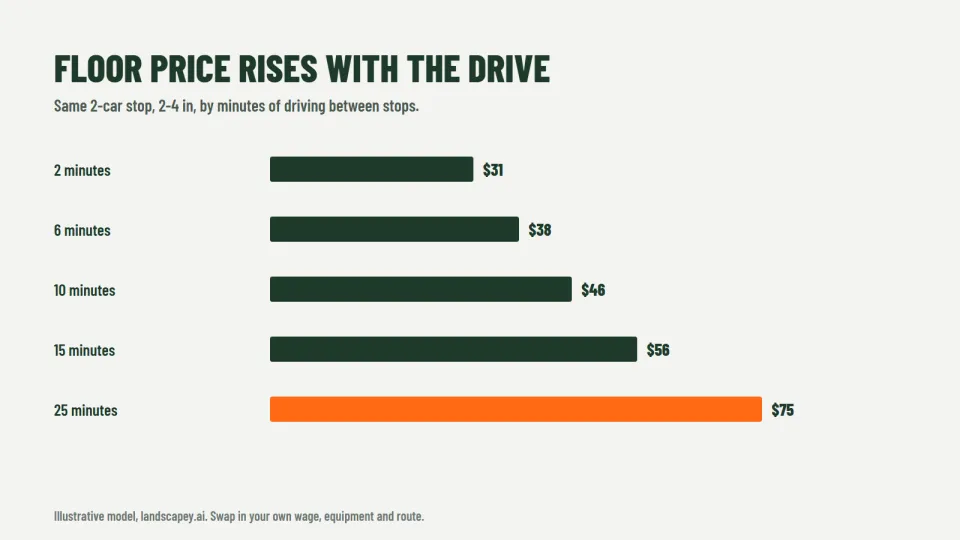
| Drive between stops | Floor price | Stops in a 6-hour window | Profit per stop at a flat $45 |
|---|---|---|---|
| 2 min (same street) | $31 | 12 | $23.47 |
| 6 min (same neighborhood) | $38 | 11 | $18.11 |
| 10 min | $46 | 9 | $12.74 |
| 15 min (scattered route) | $56 | 8 | $6.03 |
| 25 min | $75 | 6 | -$7.39 |
At a flat $45, a tight route makes four times the profit per stop of a scattered one, and fits half again as many customers before 7 a.m. Two practical rules follow:
- Sell by the street. When one house signs, door-hang its neighbors. Offer a small discount for a block of three or more; the drive savings pay for it.
- Charge a distance surcharge, or say no. A customer 15 minutes off the route needs about $17 more than one on it. If they will not pay it, they are not a customer, they are a cost.
This is the same pattern as mowing (we worked it through in how much to charge for lawn mowing), with one difference: in snow, the window caps your capacity. You cannot add stops by working a longer day, because the day ends when people leave for work.
Salting and ice melt
Salting is the highest-margin line on a snow route, and the easiest to underprice. In the model, treating the 1,160 sq ft stop takes about 5 pounds of blended ice melt and 5 minutes. Added to a visit you are already making:
| Item | Value |
|---|---|
| Ice melt (about 1 lb per 250 sq ft) | 4.6 lb, about $1.62 |
| Extra minutes on site | 5.3 min |
| Floor price added to the visit | about $7 |
| Market rate for salting (three cost guides above) | $20 - $75 |
Charge the market rate. Your cost is a few dollars, but the customer is buying something else: nobody slips on the front steps. Two cautions. Use the amount the product label says, not a generous throw, because over-salting kills turf and shrubs along the walk and you will be the one asked to fix it in April. And if you salt commercial walks, read your insurance policy on slip-and-fall before you sell it; that is a different risk from a homeowner's driveway.
A return trip to salt alone, on a stop you are not already visiting, is a full visit: fixed time and drive included. Price it like one.
Per visit, per season or per inch?
There are three common ways to sell residential shoveling. Each puts the weather risk on a different person.
- Per visit (per push): you are paid every time you show up. No weather risk for you. The customer's bill swings with the winter, which some dislike.
- Per inch or depth tier: per visit, scaled by snowfall. The fairest for both sides, and the most to explain.
- Seasonal flat fee: one price for the winter, usually with a trigger (for example, 2 inches or more) and a cap on visits. Steady cash for you, budget certainty for the customer, and a bet on the winter.
The seasonal bet in numbers. Using the 2-car stop with a depth mix of 55% light storms, 30% medium, 12% heavy and 3% very heavy, the average break-even per event is about $31 and the average floor price is about $44. Price a seasonal contract at 12 events and it comes to about $524 for the winter. Then the winter happens:
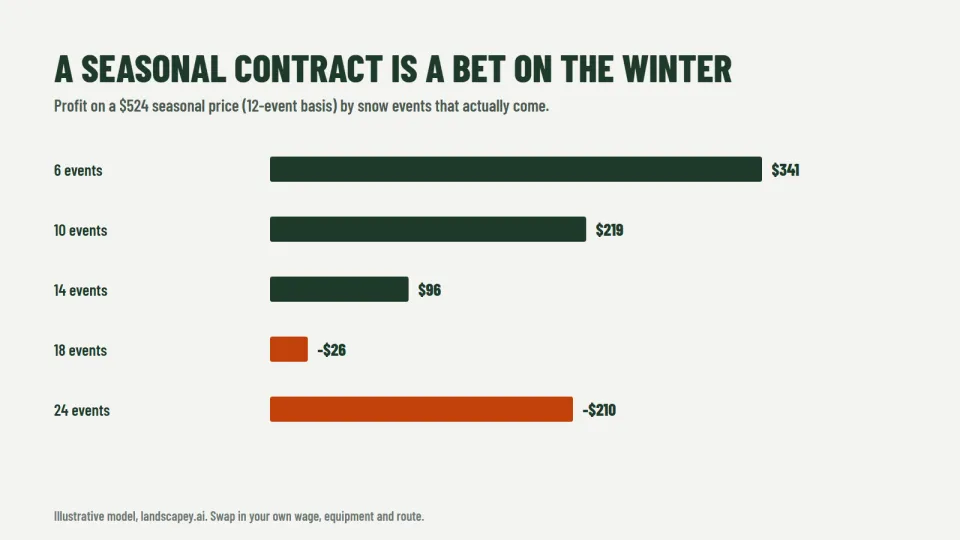
| Events in the winter | Your cost | Seasonal price (12-event basis) | Profit |
|---|---|---|---|
| 6 | $184 | $524 | $341 |
| 10 | $306 | $524 | $219 |
| 14 | $428 | $524 | $96 |
| 18 | $551 | $524 | -$26 |
| 24 | $734 | $524 | -$210 |
A seasonal price only works if you know how many events your town actually gets. Price it on the average number of storms over your trigger, not on last winter, and put a cap in the contract (for example, 15 visits, then per-visit pricing). The number of events in an average season is the figure most guides skip; we went through how to find it for your area in snow removal contracts, per push versus seasonal.
Storms that break the model
Three situations come up every winter. Decide your answer before they do.
Long storms
If snow falls for 14 hours, one clearing at the end means a foot of compacted snow, the most expensive work there is. Many operators clear at about 6 inches and again at the end. That is two visits; bill it as two. Say so in the agreement: "Storms over 8 inches may need more than one visit, each billed at the tier for the snow cleared."
The plow berm
The city plow leaves a ridge of heavy, packed snow across the bottom of the driveway after you have gone. Clearing it is a return trip. Either price one berm return into the visit, or sell it as a separate line. Do not do it for free on every street, or it becomes part of the job.
Ice and freezing rain
Ice is not snow. Chipping ice from steps is slow hand work and the cost guides price ice removal much higher (TaskRabbit lists $100 to $400 a visit). Treat it as hourly with a minimum, and say so in writing.
Shoveling as an add-on to a plow route
If you already plow driveways, walks and steps are the easiest money in the business. A second worker rides with the truck and clears the walks while the plow does the driveway. In the model, walks plus a set of steps on a stop you are already making (no new drive, a 2-minute hop) has a floor of about $16, and the market prices walkway clearing at $30 to $80 on its own. The same logic as selling pressure washing on a visit you already make, which we priced in how much to charge for pressure washing: the stop is already paid for.
Winter cash flow and your mowing clients
Your best snow customers are the people already paying you for mowing and leaf cleanup. They trust you, they live on your route, and their properties are already measured. Offer snow in the fall cleanup visit (see our leaf removal pricing guide), and the winter route builds itself from the summer one.
The other winter problem is billing. Ten storms across 40 customers is 400 visits to invoice, each at a different depth tier, some with salt, some with a berm return. Batch it: bill per-visit and per-inch customers weekly or at the end of each storm, not per visit, and bill seasonal customers in monthly installments from November to March so the cash comes in when the snow does.
That is the kind of record-keeping Landscapey was built to take off your hands. Each client keeps their measured property and their price on file, every visit sits on the schedule, and visits roll up into one invoice per client that they can pay online by card. Plans are $19.99 a month with a 14-day free trial; see pricing, or start free and put this winter's route in before the first storm.
FAQ
How much should I charge to shovel a driveway?
For a typical 2-car driveway with the front walk and city sidewalk, a blower operator on a clustered route needs a floor of about $38 per visit at 2 to 4 inches in this illustrative model. The market charges $50 to $100 for a 2-car driveway. A 1-car driveway needs about $24. By hand, the same 2-car stop needs about $75.
How much should I charge to shovel a sidewalk?
Price public sidewalk by the foot of frontage. In the model, 180 feet of 4-foot sidewalk on a corner lot adds about $14 to the floor price. On its own, walks and steps need about $26 as a separate stop, or about $16 as an add-on to a driveway you are already plowing. Market rates run $30 to $100 a visit.
Should I charge by the hour for snow shoveling?
Not for residential routes. Hourly pricing hides the drive time you cannot bill and punishes you for getting faster with better equipment. Charge per visit or per depth tier, and keep hourly pricing for ice chipping and odd jobs, with a minimum charge.
How much do teenagers charge to shovel snow?
Often $20 to $40 a driveway. That is a fair price for someone with no truck, no insurance, no equipment and no deadline. A business that guarantees the driveway is clear before 7 a.m. after every storm is selling something different, and should price for it.
How much is a seasonal snow shoveling contract?
The cost guides above put residential seasonal contracts at $300 to $1,000. In this model, a 2-car stop priced on 12 events comes to about $524. Whether that makes money depends entirely on how many events your area gets; always include a visit cap.
How much more should I charge for deep snow?
With a blower, roughly 20% more for 4 to 8 inches, 50% more for 8 to 12, and 90% more over 12 inches, or two visits billed separately. By hand, deep snow costs two to three times a light storm.
Sources and limits
- Market price ranges: Housecall Pro snow removal prices (updated October 2026), Lawn Love snow removal cost (updated October 5, 2026), TaskRabbit snow removal cost guide (updated November 1, 2026). These are national averages and mix many kinds of provider.
- Everything in the model is illustrative: the $30 loaded wage, production rates, depth factors, equipment and ice melt costs, drive times, overhead and margin are assumptions chosen to show the method, not measurements. Time your own crew on a few storms and replace them.
- Ice melt amounts and city sidewalk-clearing rules vary by product and by town. Follow the product label and your local ordinance.
- Insurance terms for snow and ice work differ widely; check your own policy before you sell salting or commercial walks.