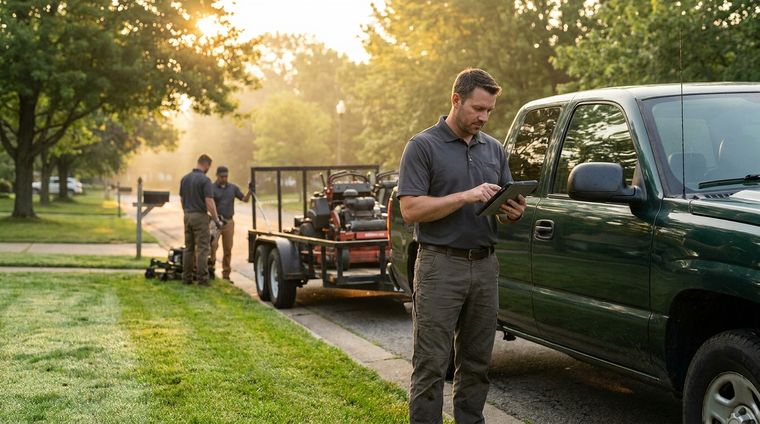
Local search optimization is the work of making your business show up when nearby people search with buying intent, and 46% of all Google searches have local intent, which means roughly 3.9 billion local searches a day if Google's daily volume is about 8.5 billion searches. For a lawn care professional, that matters the moment someone types “landscaper near me” or “lawn care [city]”, because the businesses that appear in the map results are decided by a different system than regular Google search.
It's Saturday morning, the grass is too tall, and a homeowner is standing in the kitchen with coffee in hand, searching on a phone instead of calling around. Local search optimization is what makes your crew visible in that moment, in the ZIP codes where you want work.
Table of Contents
- What Local Search Optimization Means for Landscapers
- How Local Ranking Differs From Regular Google Search
- Where Landscapers Win and Lose Against Bigger Competitors
- Two Landscaper Stories That Show the System in Action
- Why AI Search Changes the Local SEO Game in 2026
- A Prioritized Local SEO Checklist for Landscaping Businesses
- Measuring Local Search Results Without Drowning in Data
What Local Search Optimization Means for Landscapers
A homeowner with an overgrown yard does not want a marketing essay. They want a crew that serves their street, shows up on time, and answers the phone. That is why local search optimization matters so much for landscaping, because it is the work of making a service-area business visible when someone searches with geographic intent, especially on mobile and in map results.

The working definition that matters
For a landscaping business, I would define it this way. Local search optimization is the process of shaping your business profile, website, reviews, and location signals so nearby customers can find you, trust you, and request a quote. That is the version you can repeat to a crew member, a dispatcher, or a spouse without getting buried in jargon.
The key difference from general SEO is intent. A person searching “how to prune hydrangeas” might want information. A person searching “lawn care near me” is usually closer to buying, especially if they are already in a neighborhood you serve. Local search optimization is built for that second person, not for traffic that only wants to read and leave.
Why it is a different game than blogging
General SEO rewards broad topics, backlinks, and content depth across a wide audience. Local search optimization rewards service relevance, proximity, and prominence in a specific area. That means a well-built profile and a tight service-area page often matter more than publishing another general lawn article.
For landscaping, the practical unit is not just “rank.” It is quote requests from the right ZIP codes, calls from people who can afford regular service, and route density that makes the job worth taking. If your visibility brings leads from faraway suburbs you do not want to cover, that is not success. That is noise.
Practical rule: If a searcher cannot tell within a few seconds that you serve their area and do their type of work, you are probably losing the click.
A useful mental model is this. Local search optimization is the digital version of being the crew everyone in a neighborhood recommends by name. The difference is that Google now acts like the first person the homeowner asks.
How Local Ranking Differs From Regular Google Search
Local ranking isn't a separate mystery box. It's a recommendation system built around proximity, relevance, and prominence, and those three signals work differently from the blue-link rankings most users think of as SEO. Google is trying to match a nearby searcher with the best local fit, not the most polished article.

The signals that move the map pack
A 2026 synthesis of local ranking factors reports that Google Business Profile signals account for 32%, followed by on-page signals at 19%, review signals at 16%, and link signals at 15% Search Engines Daily local SEO guide. That weighting explains why a one-truck operator usually gets more benefit from profile work than from a months-long backlink campaign.
The engine is also location-aware in a way regular SEO isn't. It uses geolocation and search modifiers like “near me” to infer intent, then tries to resolve which business best fits the query Local search optimization overview). If your categories are sloppy, your service area is vague, or your NAP data conflicts across the web, the system has weaker signals to trust.
What Google is comparing in practice
A neighbor who's making a referral knows three things: where you are, what you do, and whether other people speak well of your work. Local search works the same way. Proximity tells the system who's close, relevance tells it who matches the job, and prominence tells it who has enough trust to recommend.
Regular SEO still matters, but mostly as supporting evidence. On-page content helps prove you really do mowing, mulch, cleanups, and seasonal maintenance in the places you claim. Reviews help confirm that other homeowners had a good experience. Links help reinforce that you're a real local business, not a thin listing built to chase map visibility.
The mistake I see most often is treating local SEO like a link contest. For field-service businesses, the stronger move is usually making the profile, service pages, and review flow undeniably local.
That's why local search optimization is iterative. You don't set it once and walk away. You tighten the entity signals, watch what surfaces, and keep aligning the website with the way customers search.
Where Landscapers Win and Lose Against Bigger Competitors
Bigger competitors usually have more pages, more links, and more brand recognition. Businesses can still beat them in the places that matter most, especially when the business has tight NAP consistency, strong service-area pages, and recent reviews that reflect real work in the exact neighborhoods being targeted. That combination is often enough to outrank a regional franchise in a few ZIP codes where the franchise is broader, but less specific.
The core opportunity is local fit
Generic SEO advice tends to use one formula for every business. Service-area operators need something tighter. A landscaper does not need to win a national topic. The goal is to own the routes you can serve profitably, then expand outward in a controlled way.
The gap between GBP signals and on-page signals shows up fast here. The business profile can get you into the map pack, but the website still has to confirm the service area, the job types, and the local relevance behind it. If those signals disagree, Google has less confidence in the match. If they line up cleanly, the business looks like a better fit.
Here's the practical difference:
| Asset | Strong for mobile, near-me discovery | Strong for multi-location visibility |
|---|---|---|
| Google Business Profile | Very strong | Strong |
| City-specific service pages | Strong | Very strong |
| Review activity | Very strong | Strong |
| Route density and service-area focus | Very strong | Moderate |
| Broad national content | Weak | Strong |
For a solo operation or a small crew, the profile and local page combo usually wins over trying to look bigger than you are. That trade-off gets missed in a lot of generic advice, but for landscaping businesses it drives the lead quality. Broad visibility can bring the wrong calls, while route-focused visibility brings work that fits the schedule and the truck map.
You can see the practical logic in this local marketing techniques guide for landscapers, especially if the business serves a handful of neighborhoods rather than a storefront on Main Street.
Where small operators usually lose
They lose when the profile is incomplete, the service areas are too wide, and the site says “we do it all” without showing where. They also lose when they chase generic backlinks instead of fixing the basics that prove local relevance. Bigger competitors can absorb sloppy systems. Smaller businesses cannot.
Two Landscaper Stories That Show the System in Action
The first operator was a solo gardener with steady work from referrals but almost no map visibility. The profile was half-finished, categories were too broad, and the review count was thin enough that new homeowners had no trust anchor. The fix wasn't magic. It was profile completion, tighter category alignment, and a real review process.
Solo operator, tighter profile, visible results
The business cleaned up the Google Business Profile, added the right service descriptions, and asked every satisfied customer for a review that mentioned the actual job, not just a star rating. Over 90 days, the owner earned 25 reviews and had enough profile depth for the business to start showing up more consistently in map-based discovery. That shift didn't come from blogging more. It came from making the local entity clearer.
What changed was the kind of lead flow, not just the amount of it. The owner started getting more quote requests from nearby homeowners who were already searching for lawn care or cleanup help in the service area. That matters because a local lead from the right neighborhood is worth far more than a casual browser from outside the route.
Three trucks, better pages, better lead quality
The second business had three trucks, a dispatcher, and a broader territory. The team added city pages and tightened service-area settings so the site matched the places they could realistically serve. Instead of one generic “services” page, they built separate pages for the locations that produced profitable jobs.

The result was better lead quality, not just more form fills. The office stopped sorting through as many mismatched inquiries, and the crew's routes got easier to cluster because the inbound work came from tighter geographic pockets. That's the part most marketing dashboards miss. A local ranking win should make operations smoother, not just prettier.
If the leads aren't clustering by route, the SEO is probably too broad for a field-service business.
Those two patterns repeat everywhere. One operator fixes trust and clarity. The other fixes location alignment. Both improve the odds of getting into the map pack for the searches that turn into booked estimates.
Why AI Search Changes the Local SEO Game in 2026
AI search doesn't replace local SEO, it sits on top of it. More recent coverage now frames local SEO and AIO together, which reflects a real shift in how businesses get discovered in answer-driven interfaces Squarespace local SEO guide. The important part for you is that the same local signals still feed the newer surfaces, including AI-generated answers, conversational search, and map results.
Classic signals still do the heavy lifting
AI systems need structured business data, reviews, and clear service descriptions to summarize local options. They also need confidence that your business is real, current, and relevant to the question asked. That means the basics haven't gone away. They've become more important because they're being reused in more places.
For a landscaping business, the best approach is straightforward. Write service descriptions that sound like how homeowners ask questions. Keep your business name, categories, hours, and service areas clean. Ask for reviews that mention the actual job and the outcome. AI tools are far more likely to surface clear, complete entities than vague, thin listings.
What to change in your content
Service pages should answer real homeowner questions in full sentences, not keyword fragments. A page about spring cleanup should explain who it's for, where you work, what gets included, and when crews usually book out. That kind of structure helps a human reader, and it gives AI systems cleaner material to summarize.
The bigger shift is presentation, not strategy. The same local trust signals that help in the map pack can now support answer boxes and conversational results. So the job is to make your entity easier to understand everywhere it appears.
If you're writing for AI-era search, think in terms of clarity over cleverness. A homeowner doesn't ask a chatbot for “optimization.” They ask who serves their area, who does the job they need, and who sounds trustworthy enough to call.
A Prioritized Local SEO Checklist for Landscaping Businesses
A cleanup crew in a tight service area does not need every local ranking lever at once. It needs the pieces that make a homeowner trust the business fast, call the right number, and ask for the right kind of work. Start with the profile, the phone number, the service area setup, and the review flow. The website still matters, but it does its best work when it supports what the profile already says.
This week, fix the foundation
- Verify and complete the Google Business Profile. Use the precise primary category, keep the service areas realistic, and make sure the description reflects the work you want most.
- Standardize NAP everywhere. Keep the business name, address, and phone format identical on the site, profile, and core directories.
- Ask for reviews from recent customers. Send a short request right after a job goes well, while the result is still fresh in the homeowner's mind.
This month, build local relevance
- Publish city or ZIP-code pages. Write pages that match the neighborhoods you serve and the services people in those areas buy.
- Add service detail to the site. Explain mowing, cleanups, mulch, pruning, and recurring maintenance in plain language that matches search intent.
- Claim the core listings. Start with the directories that matter most, then clean up duplicates and outdated information.
This quarter, reinforce authority
- Grow review volume steadily. Keep the request process moving so the profile does not go stale.
- Add local links where they make sense. Partnerships, sponsorships, and local mentions can strengthen trust when they come from real community ties.
- Review what the map pack is doing. Track the searches that matter most, then adjust pages and categories if the wrong neighborhoods are showing up.
| Action | Tier | Expected Impact | Time to Result |
|---|---|---|---|
| Complete GBP | This week | Stronger visibility in Maps and Local Pack | Fast |
| Standardize NAP | This week | Cleaner trust signals and fewer conflicts | Fast |
| Request new reviews | This week | Better prominence and conversion trust | Fast |
| Publish city pages | This month | Better relevance for service areas | Medium |
| Claim core listings | This month | Stronger entity consistency across the web | Medium |
| Add local links | This quarter | Better authority and local trust | Slower |
A useful companion read is this local SEO guide for landscapers, especially if you want to turn the checklist into a real workflow for an office manager or dispatcher.
Measuring Local Search Results Without Drowning in Data
You don't need a giant dashboard to know whether local search optimization is working. You need a short weekly routine that tells you whether more of the right homeowners are finding you and whether those visits are turning into quote requests. The key metrics are simple.
What to watch each week
Track map pack rankings for your priority searches, then compare them with GBP insights like calls and direction requests. Add branded search volume if you can, because it tells you whether more people are looking you up by name after seeing you in the local results. Then check how many quote requests came from local sources instead of generic traffic.
Ignore vanity metrics at this stage. Raw visits from outside your service area don't help if they don't book jobs. A website can look busy and still fail at the one thing that matters, which is getting local leads that fit your routes.
A 10-minute Friday review is enough if you look at the same few numbers every week.
A simple weekly routine
- Check the top searches. Look at the local terms that matter most for your service area.
- Scan GBP actions. Calls and direction requests tell you whether the profile is doing real work.
- Review new inquiries. Separate nearby, good-fit leads from everything else.
- Note what changed. A new page, a new review, or a service-area adjustment often explains a shift.
That's the whole point of local search optimization. It's not a one-time project, it's a maintenance system. The operator who treats it like a recurring route, checks it regularly, and keeps the local signals aligned is the one who compounds visibility over time.
You can pair that process with customer review management guidance for landscapers if your review flow is the weak link.
If you want a cleaner way to turn local search into booked work, Landscapey helps landscapers organize the jobs, routes, and customer data that support visibility in the first place. Visit Landscapey to see how a purpose-built CRM can help you keep your local presence tight, your route density strong, and your quote requests moving into one place.