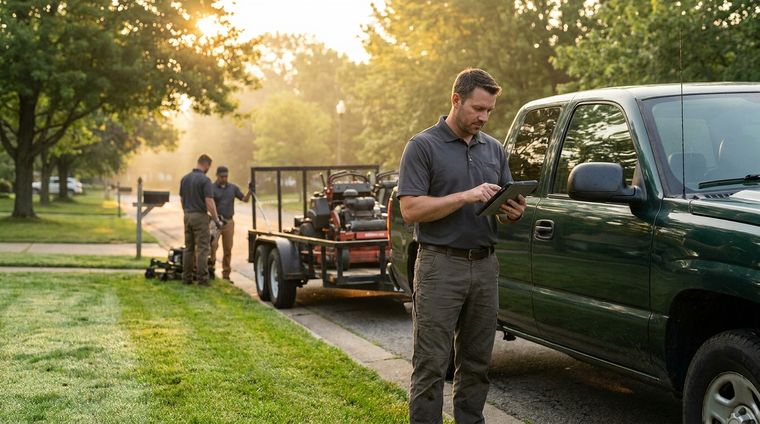
The phone blows up after a storm, the property looks rough, and every caller wants to know the same thing right now, can you get there today? If you're a grounds care specialist, that's where storm damage restoration stops being a side hustle and turns into a real service line, one that rewards crews who can stay calm, document well, and move fast without making expensive mistakes. The work looks messy from the outside, but the operators who win treat it like a system, not a scramble.
Table of Contents
- The First 48 Hours in Storm Response
- Mastering On-Site Assessment and Documentation
- The Cleanup Phase Debris Removal and Tree Care
- Beyond Cleanup Restoration and Remediation
- Pricing for Profit Estimating Storm Restoration Jobs
- Streamlining Chaos with a Landscaping CRM
The First 48 Hours in Storm Response
The first day and a half after a storm decides whether you're doing real mitigation or just moving wet debris around. The most operationally critical window in storm damage restoration is the first 24 to 48 hours, when crews should complete emergency stabilization, water extraction, and documentation before secondary water migration and mold risk accelerate masterstormdamage.com. That means you don't start with the prettiest job, you start with the one that prevents the next layer of damage.

Safety comes before speed
Your crew doesn't step onto a site until someone has checked for obvious electrical and structural hazards. Downed power lines, leaning trunks, soft ground, hidden washouts, and standing water all change the entry plan. If a property has obvious instability, the right move is to slow down, lock the site down, and wait for the hazard to be cleared.
Practical rule: if a tree or roof element is still moving, shifting, or audibly cracking, your team is not in cleanup mode yet.
The field lead should triage every incoming call before the truck rolls. True emergencies are the jobs with exposed interiors, active water intrusion, blocked access, or hazardous debris that could injure someone or worsen the loss. Cosmetic yard cleanup can wait until the property is stable, because a frantic first response on the wrong site burns labor and creates liability.
What gets done first
Once the site is safe enough to enter, the sequence should be tight. The truck doesn't unload every tool at once, and nobody starts with random hauling. Stabilization comes first, then control, then documentation.
A good first-pass checklist looks like this:
- Check team safety and PPE: Helmets, gloves, eye protection, boots, and saw gear need to be right before anyone starts work.
- Contact the client immediately: Confirm access, hazards, and what the homeowner should not touch or remove.
- Walk the site quickly: Find visible roof breach, broken limbs, standing water, and anything that could collapse.
- Stabilize the property: Tarp compromised roof areas, board openings, and secure dangerous limbs when it's safe to do so.
- Assign resources: Put the right crew on the right task instead of sending everyone to one pile.
- Start documentation right away: Capture the damage before anyone moves materials.
That order matters because the site keeps changing. Every hour spent hauling before securing the structure increases the odds that you'll miss evidence, create a bigger claim dispute, or return to a property that's wetter than when you arrived.
Mastering On-Site Assessment and Documentation
The money in storm work is often decided before the first shovel hits the ground. A neat cleanup crew can still get squeezed if the file is weak, because insurers care about sequence, evidence, and whether the loss was documented before repairs started. A major underserved angle is how to document storm damage in a way insurers will accept, because generic advice like “take photos” leaves out the details that matter most, including sequence, GPS and time metadata, and narrated walkthrough video kyro.ai.

Document like the file will be disputed
A homeowner's phone gallery is not a claim package. Save original files, keep the order of events, and narrate what the camera is seeing while you walk the property. The point isn't to create pretty media, it's to make the damage understandable to someone who wasn't there and may not return.
Write notes while the site is still fresh in your head. Include what was visible before anything was moved, what was covered, what was already loose, and what you intentionally left in place for later review. That sequence helps separate storm-caused damage from existing wear, which is where a lot of arguments start.
The biggest mistake is editing too early. If you crop, compress, rename, or scatter files across texts and personal albums, you weaken the record. Keep the original media intact and organized from the start.
Find what the eye misses
Visible damage is only part of the story. The hidden-loss problem shows up when wind-driven rain gets behind walls, under floors, or into attic spaces, and the exterior still looks passable. A full assessment needs more than a quick look, it needs moisture meters, thermal imaging when appropriate, structural judgment, and monitoring of damp materials before anyone closes the wall or starts final repairs.
What insurers reject first is sloppy proof, not just bad damage. If they can't follow the timeline or trust the source files, they'll push back on scope.
This is where work order tracking for landscapers becomes more than office admin. A clean work-order trail ties the field notes, photos, and crew actions together so you can prove who did what and when.
The practical question to ask on every site is simple, is this a surface issue or a concealed-loss case? If you don't know yet, don't guess. Measure, record, and keep the area open until the evidence is strong enough to support the next move.
The Cleanup Phase Debris Removal and Tree Care
Once the structure is stable and the file is started, the physical work begins. Many professionals accustomed to exterior work may consider this familiar territory, but storm cleanup is not routine yard waste removal. Branches are tangled with siding, nails are hidden in trunks, and a fallen tree can hold tension in ways that turn a clean cut into a dangerous shift.
Separate green waste from construction debris
Don't mix every material into one pile and hope the dump site sorts it out. Vegetative waste, roofing material, broken fencing, shingles, insulation, and sheet goods all behave differently in hauling and disposal. If you're not sorting as you go, you'll waste truck space and time, and you'll make the disposal bill harder to defend later.
Grapple trucks, chippers, and saws all have a place, but only if the crew understands the load sequence. A chipper handles clean limbs far better than mixed debris. A grapple truck makes sense when you've got bulky tree material and you need fast clearing, but it's the wrong tool if the pile is loaded with nails or contaminated construction waste.
Know when tree work stops being landscaping
A leaning tree isn't just a cleanup item, it's a hazard assessment. The lead should check root plate movement, trunk splits, hanging limbs, and anything that looks like it could fall without warning. If you're dealing with large structural instability, damaged utilities, or complex removals over a roofline, call in a certified arborist or a specialist with the right rigging experience.
A fast cut is useless if it drops the wrong way.
Widowmakers deserve their own caution. Suspended limbs can shift after the trunk below them is cut, and windy conditions make that risk worse. Crews that stay profitable are the ones that refuse to treat every branch like a simple saw job.
Preserve valuable trees when you can, but don't get sentimental about a tree that has already become a liability. If the root system is compromised, the right call may be removal, not hope. That decision protects the site, the crew, and the long-term grounds.
Beyond Cleanup Restoration and Remediation
After the debris is gone, the site can still be in bad shape. Heavy equipment compacts soil, runoff carves slopes, and saturated root zones can choke plants that looked fine from the street. If you stop at hauling, you've done cleanup, not restoration.

Restore the ground, not just the surface
Compacted soil needs a different response than broken branches. Aeration, careful amendment, and selective regrading matter because roots need air pockets and water movement, not another pass of machinery. On sloped properties, erosion control comes early, because once soil starts moving, replacement planting alone won't fix the problem.
Replacement plantings should match the damage, not the catalog. If a bed was waterlogged for hours, don't rush to replant with the same material and same spacing without checking the root zone first. Good crews test, adjust, and then replant when the site can support new growth.
Use moisture readings before you close anything up
For envelope and siding repairs, hidden moisture should be a decision point, not a visual guess. Technicians use pin-type or pinless meters to check whether water has migrated behind cladding, and wood moisture content above 19% is commonly used as a threshold indicating active moisture damage that needs remediation before new siding or sheathing goes back on prostormdamage.com.
That rule keeps crews from making one of the most expensive mistakes in exterior restoration, closing a wall that still holds water. A surface that looks dry can still trap moisture behind trim, under decking, or in fascia assemblies. Once that gets sealed in, rot and fastener failure show up later, after your truck is gone.
The best practice is to treat dry-out as a process, not a guess. Measure, document, and wait for a defensible condition before reinstalling materials.
Pricing for Profit Estimating Storm Restoration Jobs
Storm work destroys profit when the estimate is too clean and the field reality is too ugly. The market is big enough to matter, but it's also crowded, because the U.S. damage-restoration niche that includes storm work is estimated at about $7.2 billion in annual revenue and growing around 4% per year, with roughly 62,582 firms and fewer than 2 workers per firm on average, which shows how fragmented the field is Proof AI. That fragmentation means you're not just bidding against big outfits, you're competing with a lot of small crews that can underprice themselves into trouble.
Build the estimate from real cost drivers
A storm estimate should break the job into labor, equipment, haul-off, disposal, material replacement, and overhead. If tree work is involved, don't bury complexity inside a single line. The disposal side can swing quickly when you're handling mixed debris, and undercounting it is how a “busy” week turns into a weak margin.
Fixed-price bids work best when the scope is visible, stable, and well documented. Time-and-materials pricing makes more sense when the site is still changing, access is uncertain, or hidden damage is likely. Cost-plus can protect you if the client understands the structure, but only if you're disciplined about backing every charge with field notes and receipts.
Price the uncertainty, not just the shovel time.
Keep the estimate readable and defensible
The estimate should answer three questions, what's being done, what's excluded, and what changes trigger a revision. That protects you when a roof section, fence line, or tree root zone turns out to be worse than the first walk suggested.
Use a landscaping estimate template as a starting point for formatting, then adapt it for storm-specific line items. The value is in making the scope visible enough that the client and insurer can both follow it. If the estimate looks like a lump sum with no logic behind it, someone will challenge it.
The best storm bids don't chase the cheapest number. They build enough margin to cover labor drift, disposal surprises, and the extra admin that comes with a high-stakes job.
Streamlining Chaos with a Landscaping CRM
The biggest problem in storm response isn't the branches or the water, it's the chaos between the first call and the final invoice. Calls pile up, crews get double-booked, notes live in texts, and nobody knows which property is waiting on photos, which one needs a revisit, or which one is ready to bill. A purpose-built CRM turns that mess into a controlled workflow.

From lead to job without the scramble
A solid system starts by capturing leads from the website and dropping them into one queue. From there, the job gets converted with a few clicks, assigned to a crew, and tied to the right property record so the office isn't hunting through messages later. That matters when every storm brings a spike in inbound work and the phone never stops ringing.
The old method is usually a spreadsheet, a whiteboard, and someone's memory. That works until the first day with scattered properties, reroutes, and one customer calling twice because they haven't heard back. A CRM gives you a single record of contact, estimate, job status, and billing, which keeps the work moving even when the weather doesn't cooperate.
Route crews like a dispatcher, not a firefighter
Storm response becomes more profitable when the route plan is deliberate. Group nearby assessments, reduce windshield time, and send crews in a sequence that matches the day's priorities instead of whoever shouted loudest. That's the difference between reacting all day and closing jobs.
The other win is visibility. Once the office can see what's in progress, what's waiting, and what's done, it becomes much easier to keep customer updates accurate and invoices clean.
The broader market makes that discipline worth the effort. The storm damage restoration services market is projected to be $7.96 billion in 2026 and reach $10.97 billion by 2032, which is a projection that points to a growing need for efficient, scalable operations 360iResearch. Growth doesn't help a crew that can't process leads, schedule jobs, and collect payment without losing track of the file.
CRM for landscapers is the cleanest way to think about the shift. You're not buying software for the sake of software, you're buying control over the messy parts that kill response speed and margin.
Billing should be the last messy part
Once the job is finished, invoices need to go out fast and match the field record. Online payments, clear job histories, and real-time profitability tracking keep the back office from becoming the bottleneck. If the team can't tell whether a storm job made money, the business is guessing instead of managing.
The right system makes storm work repeatable. That's the fundamental shift, from emergency chaos to a service line you can dispatch, price, document, and bill without losing your nerve.
If you want storm work to become a serious part of your landscaping business, start by building the systems before the next storm season hits. Use Landscapey to centralize leads, schedule crews, route jobs, and keep every storm file moving from first call to final invoice without the usual scramble.