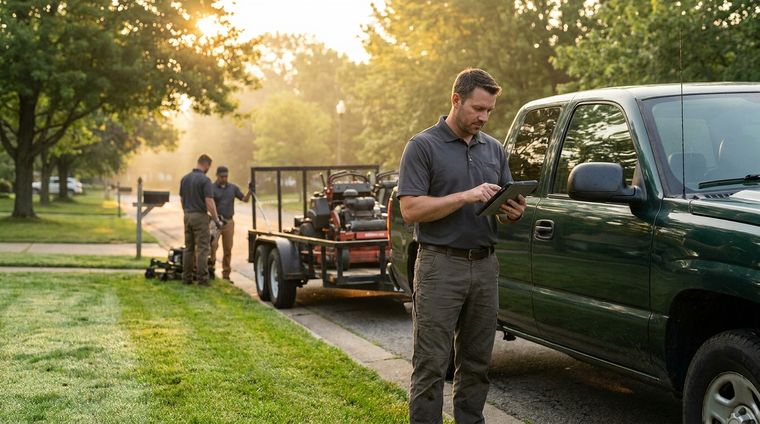
A crew pulls up to the wrong property. The office swears the address was updated. The crew lead says nobody told him the client added hedge trimming. By noon, one truck is missing material, another is waiting on approval, and the customer is already annoyed. Most landscaping owners don't have a labor problem in that moment. They have a communication problem.
That gap usually isn't between two people sitting in the same room. It's between the desk and the field. The office has the schedule, client notes, gate code, and change request. The crew has the truck, the clock, and the customer standing in front of them. If those two sides aren't working from the same playbook, small misses turn into wasted drive time, rework, awkward phone calls, and late invoices.
If you're trying to figure out how to improve team communication in a landscaping business, start there. Not with corporate slogans. Not with another meeting for the sake of meetings. Start with the handoff between the person dispatching work and the people doing it.
Table of Contents
- Why Small Communication Gaps Cause Big Problems
- Establish Your Communication HQ Channels and Norms
- Create a Beat with Daily and Weekly Routines
- Define Who Owns What with Clear Roles
- Navigate On-Site Friction with Simple Scripts
- Unify Your Operations with Landscapey
- Measure What Matters and Protect Your Business
Why Small Communication Gaps Cause Big Problems
A missed note doesn't stay small for long in landscaping. One client says, "Please use the side gate." That note stays in an email thread nobody in the field sees. The crew arrives, can't access the backyard, calls the office, waits, then starts another job late. By the end of the day, you're behind on the route, the customer thinks your team is disorganized, and payroll kept running while trucks sat still.
This is why I don't treat communication as a soft skill issue. In a field service business, it's an operations issue. The office may think they "sent the info." The crew may think they "never got it." Both can be true if the business has no standard way to move job details from desk to truck.
Poor communication carries a real cost. US businesses lose about $37 billion annually because of communication barriers such as misunderstandings, delayed projects, and employee frustration, according to this workplace communication roundup. In a landscaping company, that cost shows up in ways owners know well: wrong addresses, duplicated trips to the yard, missed upsells, jobs that need a second visit, and invoices held up because nobody documented what changed on site.
The damage usually starts in ordinary moments
The expensive failures rarely begin with a dramatic blowup. They start with routine sloppiness.
- Client notes stay buried: A request lives in someone's text thread instead of the job record.
- Dispatch changes happen verbally: A route gets changed by phone, then half the team works from yesterday's plan.
- Crews improvise documentation: One lead takes photos, another doesn't, and the office can't confirm what happened.
Practical rule: If a crew member can't find the latest job details in under a minute, your system is too loose.
A lot of owners respond by telling everyone to "communicate better." That doesn't fix anything. Teams need fewer assumptions, fewer channels, and fewer places where critical details can hide.
Why this hits small landscaping companies harder
Big companies can absorb some waste. Small operators can't. One bad handoff can wipe out the margin on a day of work. When you run a lean crew, every avoidable callback, confused dispatch, and delayed approval pulls the whole week sideways.
That's why learning how to improve team communication isn't about sounding more professional. It's about protecting route density, labor efficiency, customer trust, and cash flow.
Establish Your Communication HQ Channels and Norms
Most landscaping teams don't need more ways to talk. They need clear rules for where specific information belongs. When dispatch changes live in texts, client notes live in email, equipment issues come through voicemail, and photos sit on personal phones, the office and field are guaranteed to drift apart.
That field-to-desk disconnect is common. About 40% of workplace communication failures come from channel mismatches, where critical updates get sent through a method the recipient can't realistically use in the moment, according to this analysis of communication breakdowns. That's exactly what happens when an office sends a detailed instant message to a crew member who's on a mower, in traffic, or away from signal.

Stop mixing personal habits with company communication
If your team relies on whatever feels convenient in the moment, you'll keep losing information. Personal texting habits aren't a business system.
Set a house rule. Every type of message has one home.
| Message type | Best channel | Why it works |
|---|---|---|
| Immediate safety issue or breakdown | Phone call or urgent text | Fastest way to get attention |
| Job status updates | Company app | Creates a record the office can see |
| Client change requests | Job record with note and photo | Keeps field and desk aligned |
| End-of-day exceptions | Email or end-of-day form | Easy for office review and follow-up |
The point isn't complexity. The point is consistency.
Build a simple channel map your crew can remember
A good communication map fits on one page and doesn't require training videos to understand.
Use something like this:
- Call for urgent issues. Equipment failure, injury concern, locked gate, angry customer on site.
- Use the job app for anything tied to the property. Arrival, completion, added work, material need, before-and-after photos.
- Email for admin follow-up. Vendor questions, payroll clarifications, tomorrow's non-urgent notes.
- No job details in personal text threads. If it matters, it belongs in the shared system.
If the office has to ask, "Where did they send that?" your communication channels are already broken.
For many companies, this is the point where software stops being optional and starts being infrastructure. A dedicated system beats a patchwork of personal texts and memory. If you're comparing setups, this guide to crew management software for landscaping teams is a useful place to think through what should live in one system versus what can stay outside it.
What's worked best in the businesses I've seen is simple: one channel for urgency, one system of record for jobs, and one rule that everybody follows. What doesn't work is letting each foreman invent his own method.
Create a Beat with Daily and Weekly Routines
A team can have the right channels and still communicate badly if everything happens on the fly. Good landscaping operations run on rhythm. Crews should know when key information gets shared, when questions get raised, and when yesterday's problems get cleaned up.
Structured communication rhythms can reduce task ambiguity by 40% and increase project delivery speed by 25% compared with ad-hoc communication models, according to this report on team communication practices. In field service, that matters because uncertainty burns time twice. First when people pause to clarify, then again when they redo work.

Use a morning huddle that crews won't hate
Keep it tight. Ten minutes is enough if the right person leads it and everyone knows the format.
A useful morning huddle covers only what affects today's execution:
- Route changes: What moved, what got added, what customer timing matters.
- Site-specific issues: Gate codes, pets, irrigation lines, weather-sensitive tasks, HOA rules.
- Equipment check: Which truck has what, what's low, and what needs backup.
- Decision points: Who approves extras, who handles customer questions, who updates the office.
Don't turn this into a lecture. Crews tune out when huddles become generic motivation sessions. Stick to what helps them avoid surprises before the first stop.
A simple prompt works well: "What's different today that could cause wasted time if we don't address it now?"
Run a weekly wrap-up that fixes the next week
Daily huddles keep the day clean. Weekly wrap-ups keep the same mistakes from repeating.
Pick one consistent time. Review the week with your crew leads and office staff together, not separately. That's where the field-to-desk gap gets closed.
Use three questions:
- What caused confusion this week?
- What got handled well that should become standard?
- Which customer notes or property quirks need to be documented better?
For businesses that rely on scheduled visits and customer confirmations, timely reminders also reduce last-minute confusion before the truck even leaves the yard. A practical system often includes appointment reminder texts for service businesses, especially when access windows or customer presence matters.
Here's a useful training clip to support the habit side of better team communication:
The best routine is the one your team will still be following three months from now.
What doesn't work is random check-ins based on whoever happens to be frustrated that day. Predictable communication beats emotional communication every time.
Define Who Owns What with Clear Roles
A lot of communication problems are really ownership problems. The message may have been sent, but nobody knew who was supposed to act on it. That's how you end up with the office assuming the crew documented a change order, while the crew assumes the office will ask the client later.
Clear roles fix that. Not because people need more rules, but because they need fewer gray areas.
Leadership matters here. About 92% of employees say trust in leadership is fundamental to their motivation, according to this workplace communication data roundup. In plain terms, crews communicate better when they trust that leaders are clear, fair, and consistent. If ownership changes daily or instructions depend on mood, trust drops fast.
Accountability removes guesswork
The best role definitions answer four practical questions:
- Who owns pre-job review?
- Who talks to the client on site?
- Who records changes, issues, and completion notes?
- Who closes the loop back to the office?
This isn't corporate red tape. It's what keeps a landscaping company from running on assumptions.
Crews don't need more supervision. They need cleaner decisions about who handles what when something changes.
When owners resist role clarity, they usually say they don't want to micromanage. Fair enough. But vague responsibility doesn't create freedom. It creates hesitation. People either duplicate each other or avoid acting because they don't want to overstep.
A basic role split for landscaping teams
A simple model works better than a complicated org chart.
- Owner or operations manager: Sets scheduling priorities, approves exceptions, handles escalated client issues.
- Office manager or dispatcher: Owns schedule accuracy, customer notes, route changes, and documenting change orders in the system.
- Crew lead: Confirms site scope on arrival, communicates job status, records on-site issues, gets sign-off when needed.
- Crew member: Flags problems to the lead, completes assigned checklist items, reports equipment or material issues immediately.
A short responsibility sheet for each role can save a lot of tension. One page per role is enough. If you work with outside crews or specialty installers, role clarity matters even more. This breakdown of managing subcontractors in field service businesses is a good reference for keeping outside help aligned with your internal team.
What works is visible ownership. What fails is saying "everyone should know" and then acting surprised when nobody handled the handoff.
Navigate On-Site Friction with Simple Scripts
Even well-run crews hit friction. One person thinks the finish is good enough. Another says the bed edge looks rough. A client adds a request on the spot. Somebody feels ignored. That's normal. The damage comes when people react before they understand what the other person is saying.
A simple listening habit beats a long policy manual. Active listening built around the paraphrase-verify loop improves feedback acceptance by 33% and reduces conflict escalation by 47% in teams with fewer than 20 members, according to this communication training overview.
Use the paraphrase-verify loop in the field
The method is simple.
First, restate what you heard in plain language. Then ask if you got it right.
Example:
"So you're saying the client wants the shrubs shaped lower on the street side, not the whole row. Did I get that right?"
That short pause does two things. It shows respect, and it catches misunderstanding before somebody grabs tools and does the wrong work.
Scripts that work when tempers are rising
You don't need polished corporate language. You need words people will use on a job site.
Try these:
- When a crew member pushes back on feedback: "What I'm hearing is you think the work meets the standard, but you're not clear on what needs changing. Is that right?"
- When a client is upset: "I want to make sure I understand the issue before we fix it. You're concerned about the cleanup along the walkway. Did I capture that correctly?"
- When the office and field disagree: "Let's confirm the exact change. I have the original scope one way, and you're saying the customer approved something different. What's the last confirmed version?"
A few habits make these scripts work better:
- Keep your voice flat: The words matter less if your tone says you're gearing up for a fight.
- Use one issue at a time: Don't stack three complaints into one conversation.
- Confirm the next action: End with who is doing what, not just who was right.
"Repeat it back before you respond" is one of the cheapest training upgrades a landscaping company can make.
What doesn't work is telling people to "be respectful" without giving them language they can use under pressure. Teams need scripts they can remember while standing next to a trailer, not theories about communication styles.
Unify Your Operations with Landscapey
The field-to-desk gap usually isn't caused by bad intentions. It's caused by scattered information. One customer note sits in email. A route change lives in text. Job photos are on a crew lead's phone. The invoice waits because the office isn't sure what was completed. People are communicating, but the business still isn't aligned because the record is fragmented.
That's where a purpose-built system earns its place. If you're serious about how to improve team communication, you need one operating record that follows the job from estimate to completion.

One record beats five scattered conversations
For landscaping teams, one record should hold the details that matter in the field and at the desk:
- Client profile: Property notes, preferences, service history, and access details
- Job record: Scope, schedule, assigned crew, status updates, and photos
- Route context: Which stops belong together and what changed before wheels roll
- Billing handoff: Clear completion notes so invoicing doesn't depend on memory
Landscapey is an excellent fit. It's built around the actual flow of a lawn and outdoor services business, not around generic project management. Crews can work from the same job details the office sees. Dispatch doesn't have to rebuild context across multiple tools. The owner can see what changed, when it changed, and who updated it.
That matters because communication quality improves when the system itself reduces ambiguity. A shared record does part of the managerial work for you. It makes fewer details dependent on somebody remembering to forward a screenshot.
Where software actually helps and where it doesn't
Software won't fix a careless culture. It won't make a weak crew lead suddenly communicate well. It won't replace a daily huddle or solve a trust problem by itself.
It does help in the places where landscaping companies usually break down:
| Problem | What a unified system helps with |
|---|---|
| Office updates don't reach the field | Crews see current job information in one place |
| Client changes get lost | Notes and status updates stay attached to the job |
| Billing lags behind production | Completion records support faster invoicing |
| Dispatch keeps answering the same questions | Shared job context cuts repeat calls |
Landscapey is useful because it combines CRM, scheduling, routing, invoicing, and operational tracking in one app built for outdoor service professionals. That means the communication system isn't separated from the work system. The same platform that stores the client record also supports scheduling, route planning, and the handoff to billing.
A landscaping company gets more consistent when the office and the crew stop working from different versions of reality.
The businesses that benefit most from this kind of setup are usually the ones that have already outgrown informal communication, but haven't yet built a reliable operational backbone. They don't need more apps. They need fewer gaps.
Measure What Matters and Protect Your Business
If you don't measure communication, you'll fall back on mood. One week feels smooth, so everybody assumes things are fine. Then a preventable mistake turns into property damage, an upset client, or a crew member working without the right warning.
Communication has to be treated like a business control. Not just a team culture issue.
Recent industry analysis cited by AHRQ notes that 68% of workplace safety incidents involve a communication failure, such as unclear handoffs or missed warnings, in this teamwork and safety resource. That's the piece too many generic articles miss. In landscaping, poor communication can affect equipment use, site hazards, chemical handling, traffic exposure, and property access. It can also leave you exposed when there's a dispute about what was said, approved, or documented.

Track operational signals, not vague feelings
You don't need a complicated dashboard. Track a few signs that tell the truth.
- Rework jobs: Which callbacks happened because instructions were unclear or incomplete?
- Client complaints tied to confusion: Wrong scope, missed add-ons, arrival misunderstandings, access issues.
- Time spent clarifying work: How often does the office have to call crews to restate details?
- Invoice delays: How many jobs wait for confirmation because records are incomplete?
Review those regularly with both office staff and crew leads. If the same issue keeps showing up, fix the process, not just the person.
Treat communication like a safety system
The strongest teams use communication checks the same way they use equipment checks. Before a job starts, somebody confirms the hazards, access, scope, and special instructions. When conditions change, somebody logs it and alerts the right person. After the job, somebody closes the loop.
This is not optional in a field business. Clear handoffs protect margin, but they also protect people.
If your current setup still depends on memory, scattered texts, and verbal updates, tighten it now. Cleaner communication lowers confusion, cuts avoidable waste, and gives you a stronger record when something goes wrong.
Landscapey gives landscaping businesses one place to manage client records, schedules, routes, job updates, invoices, and the day-to-day handoffs that usually fall through the cracks. If you're ready to close the gap between the office and the field, take a look at Landscapey.